
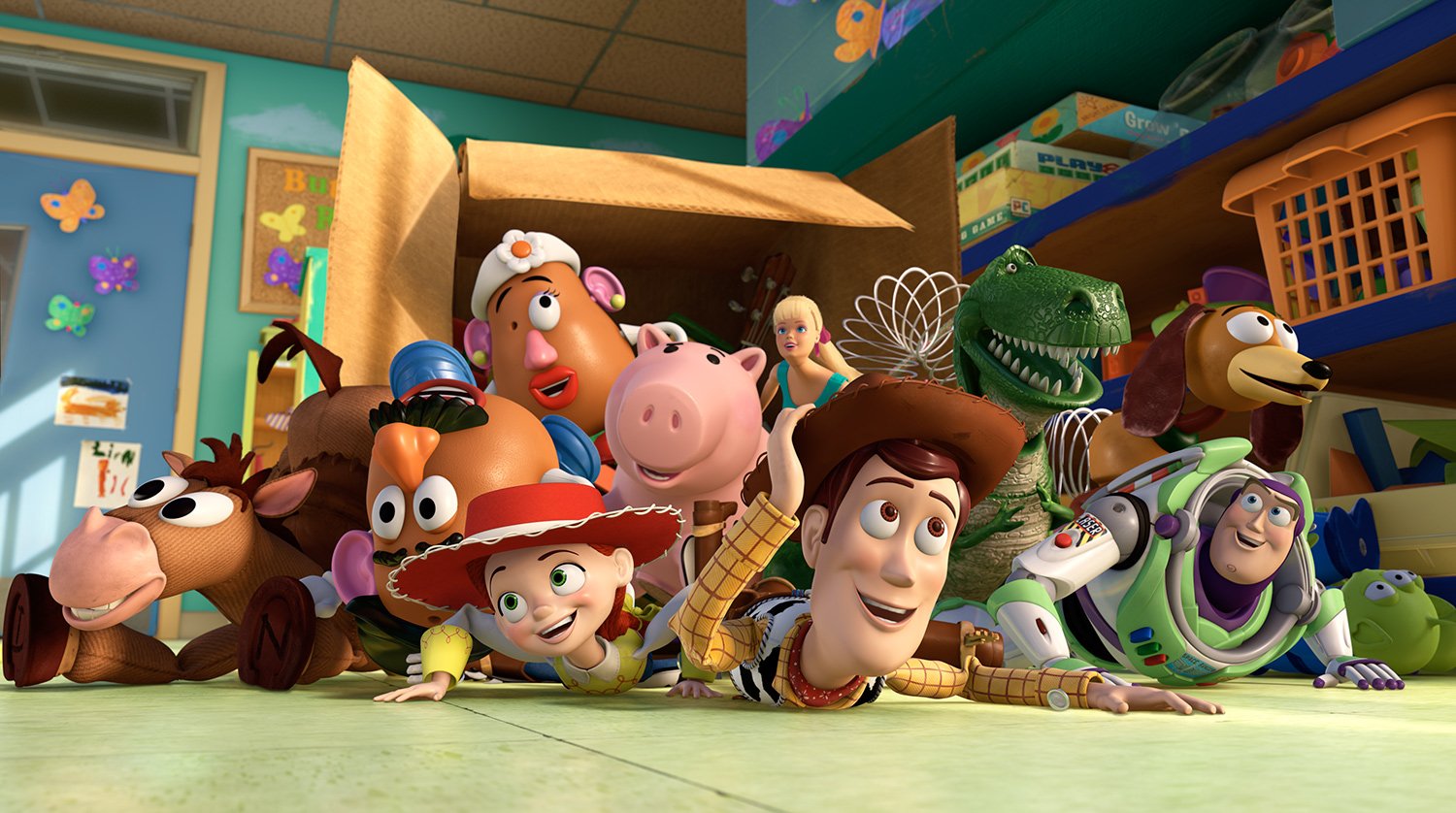
RaeRae Review · Toy Story 3 · 2010
Andy Grew Up, the Toys Built a Prison Break, and Everybody Still Had to Let Go
The attic was not rejection. The garbage bag looked exactly like it. By the time anyone learns the difference, fear has already signed the daycare contract.
Review receipt
Film: Toy Story 3 (2010). Director: Lee Unkrich. Screenplay: Michael Arndt, from a story by John Lasseter, Andrew Stanton, and Lee Unkrich. Music: Randy Newman. Principal voices: Tom Hanks, Tim Allen, Joan Cusack, Ned Beatty, Don Rickles, Michael Keaton, Wallace Shawn, John Ratzenberger, Estelle Harris, John Morris, and Jodi Benson. Verdict: a prison-break movie about retirement, inherited grief, institutional labor, and the terrifying fact that a loving ending is still an ending.
This is a spoiler-complete editorial review. It examines Andy’s departure, the garbage-bag misunderstanding, Sunnyside’s two-tier labor system, Lotso’s authoritarianism, the daycare escape, the landfill, the incinerator, Bonnie, the goodbye scene, performance, design, production history, and the visual details that connect Pixar’s past to its future.
The opening gives the toys the blockbuster Andy once imagined
A speeding train, exploding bridge, force fields, giant pig spaceship, monkeys, orphans, and a final confrontation stage the grand version of play that lived inside a child’s room. The sequence respects imagination by rendering it with the scale memory assigns it.
Then the camera returns to old home video. Adventure survives as documentation while the child who created it has nearly become an adult. The cut establishes the film’s central grief before anyone says college.
Home video turns childhood into evidence instead of present tense
Andy’s recorded voice, smaller body, and complete attention remain available on a screen. The toys can see proof that they were once central, but proof cannot reactivate the relationship.
Archives preserve events and sharpen absence simultaneously. The footage is comforting because the love was real and painful because reality changed anyway.
Only a small core survived the years
Bo Peep, Wheezy, Etch, Lenny, and many familiar toys are gone through yard sales, donation, loss, or disposal. The remaining group carries the invisible history of every departure.
The franchise does not show each exit because attrition is part of the point. A community can shrink through ordinary household decisions until survivors realize stability was a temporary condition.
Woody still confuses loyalty with waiting indefinitely
He insists Andy will find a place for them because his identity remains organized around serving one owner. The others hear the same promise after years in a toy chest and recognize how hope can become refusal to plan.
Woody’s faith is partly accurate and still insufficient. Andy intends the attic, but an attic is preservation without active relationship. Correctly reading one decision does not answer what a meaningful future should be.
The college sorting scene makes ownership look like triage
Andy holds Woody, considers the attic box, and eventually chooses to bring him to college. Every gesture feels intimate and devastating because the toys have no input into categories that determine their future.
The human task is ordinary: pack, discard, store, donate. The toy experience is existential sorting conducted by somebody they love.
The garbage bag is a believable verdict even though it is a mistake
Andy places the attic toys in a black bag before his mother accidentally carries it to the curb. From inside, context disappears. The toys experience enclosure, movement, and the sound of a garbage truck approaching.
Their conclusion is wrong about Andy’s intention and correct about their immediate danger. Trauma does not wait for a complete investigation before mobilizing the body.
Woody’s insistence on intent cannot erase impact
He saw Andy choose the attic and tries to explain the mistake. The group has just torn through plastic to avoid being crushed. Asking them to prioritize Andy’s good intention over that experience sounds like loyalty demanding emotional self-erasure.
Intent matters when assigning blame. Impact matters when deciding whether a system remains safe. The film lets both truths make the argument harder.
Donation feels like agency because the alternative felt like death
The toys climb into the Sunnyside box themselves. The decision is not fully informed, but it is the first action that appears to belong to them.
A coercive choice can still feel liberating when previous options were controlled by somebody else. Sunnyside’s recruitment advantage begins before Lotso speaks.
Sunnyside sells freedom through a permanent supply of children
The daycare promises play without one child aging out. New children arrive every year, creating what looks like a sustainable relationship model rather than a private bond with an expiration date.
The promise targets exactly what Jessie and the others fear. It treats replaceable users as protection against abandonment while hiding how the institution assigns bodily risk.
Lotso welcomes newcomers like a leader who has abolished scarcity
He offers warmth, community language, open arms, and the assurance that no toy goes unloved. His strawberry scent and plush body make authority feel like comfort.
The speech works because it names a structural truth. Daycare can give toys recurring play. The deception lies in who receives safe children and who absorbs toddlers.
The Caterpillar Room is not chaotic by accident
Toddlers throw, mouth, pound, stretch, paint, and disassemble toys because their development involves sensory experimentation rather than careful narrative play. The children are not villains.
Lotso’s system becomes abusive by concentrating that predictable damage on uninformed newcomers while insiders remain protected in the Butterfly Room.
Risk flows downward while privilege calls itself experience
Long-term residents occupy gentler rooms and frame the arrangement as natural seniority. New toys must survive dangerous labor before any possible advancement, though the leadership can always replace them with fresh donations.
The system resembles workplaces that treat injury as initiation and use turnover to prevent workers from accumulating power.
Barbie and Ken begin inside a joke about gendered merchandise
They recognize each other as matching product lines and immediately perform idealized romance. Ken’s Dreamhouse and wardrobe give him status while Barbie’s knowledge of the brand lets her read his vanity accurately.
The comedy later becomes political because attraction gives Barbie access to the privileged class and a reason to betray it.
Woody leaves because truth without solidarity still isolates
He refuses Sunnyside and attempts to return to Andy alone. His information is correct, but he cannot force the others to trust an owner they believe discarded them.
Leadership reaches a limit. Woody must decide whether loyalty means obeying Andy’s intended attic plan or staying connected to friends making a different choice.
Bonnie’s play reveals a community organized without rankings
Dolly, Buttercup, Mr. Pricklepants, Trixie, Chuckles, and the others shift roles fluidly inside Bonnie’s imagination. Performance matters more than favorite status.
The room offers Woody evidence that a child-toy relationship can remain lively without reproducing Andy’s hierarchy. It is not yet his home, but it expands what home might mean.
Chuckles carries the origin story Lotso outlawed
His account of Daisy, the roadside loss, the replacement bear, Big Baby, and the forced exile gives Woody the information needed to understand Sunnyside.
The clown is sad because remembering has not healed him, but testimony keeps pain from becoming propaganda.
Lotso turns one replacement into a theory of all love
He sees another bear in Daisy’s room and concludes attachment is fraudulent. The conclusion protects him from mourning an accident by converting grief into certainty.
He then forces other toys to experience disposability so the institution will keep proving his theory.
Big Baby is both harmed companion and state violence
Lotso lied that Daisy replaced all three toys, keeping Big Baby from returning to a child who still searched for him. The doll’s attachment wound becomes leverage.
Victimization explains dependence without erasing the fear Big Baby inflicts as enforcer. The film allows both truths to remain visible.
The pendant is dangerous because it contains a competing past
Daisy’s image contradicts the story that Big Baby was equally replaced. Woody uses it not as sentimentality alone but as evidence against political memory.
Lotso smashes the object because authoritarian control depends on deciding which history can be felt.
Buzz’s reset converts identity into a policing tool
The Sunnyside group returns Buzz to factory Space Ranger mode and redirects his programmed obedience against friends. The body remains, while accumulated relationships become inaccessible.
The scene revisits the first film as violation. What was once comic delusion becomes deliberate erasure used to manufacture an officer.
Spanish Buzz is funny and ethically complicated
A second reset changes language, movement, flirtation, and confidence while Jessie becomes the focus of exaggerated romance. The performance is vibrant, but it treats cultural coding as an alternate personality switch.
The comedy depends on stereotype and affection at once. A serious review can enjoy the dance while noticing how quickly “Spanish” becomes shorthand for passionate spectacle.
The monkey makes surveillance feel like a toy-store nightmare
Security monitors give one small object sight across the daycare. Cymbal alarms transform observation into immediate enforcement.
Lotso’s power is distributed through technology, guards, room assignments, manuals, and locked containers. Removing him physically will not be enough unless the infrastructure changes.
The prison-break structure respects every body’s capability
Mr. Potato Head can move between bodies, Slinky extends reach, Barbie manipulates Ken’s access, Rex uses size, Hamm reasons through systems, and Woody coordinates information.
Escape succeeds through differences rather than a single hero’s strength. Accessibility becomes strategy.
Mr. Tortilla Head makes embodiment flexible and disgusting
When the potato body is unavailable, facial parts animate a tortilla and later a cucumber. The gag explores whether identity travels with parts, memory, or arrangement.
The tortilla dries and tears, reminding viewers that alternative bodies create new vulnerabilities even when they restore agency.
Barbie interrogates Ken through the wardrobe he values most
She tears and threatens clothing while he reveals the instruction manual location. The scene reverses expectations that fashion makes her politically unserious.
Her expertise in the value system gives her leverage. Femininity is not discarded to make resistance credible.
Ken benefits from Lotso before choosing reform
He has housing, wardrobe, status, and insulation from toddler play. His attraction to Barbie exposes the system’s cruelty, but personal discomfort begins only when privilege costs a relationship he wants.
His later cooperation matters, yet accountability should include how comfortably he recruited newcomers into harm.
The sandbox is punishment designed around material vulnerability
Mr. Potato Head spends the night outside where cold, dirt, moisture, and lost components threaten a plastic modular body.
The regime studies bodies well enough to hurt them efficiently. That knowledge is the inverse of care.
The chute escape turns waste infrastructure into a border
The toys must cross from daycare property into a garbage system that treats every object as identical refuse. The route promises freedom and carries them toward greater danger.
Institutions connect in ways individuals cannot see. Escaping one violent system can place vulnerable people inside another.
Big Baby’s revolt breaks emotional legitimacy before physical rule
When Woody reveals the pendant and Lotso destroys it, Big Baby recognizes that obedience was built on a lie. He lifts the leader and throws him into the dumpster.
The act is personal liberation and regime collapse. The most powerful enforcer no longer accepts the story authorizing force.
The garbage truck makes status physically meaningless
Lotso, Woody, Buzz, Jessie, Rex, and the others enter the same compaction machinery. The system does not recognize leader, favorite, rarity, or moral worth.
Material equality at the dump does not create moral equality. Everyone is vulnerable, but responsibility for arriving there remains uneven.
The claw returns as faith, joke, and practical rescue
The Aliens’ religious devotion to the arcade claw once marked them as comic followers. At the landfill, they understand and operate industrial equipment better than anyone else.
The characters most easily dismissed as repetitive save the whole community. Expertise can hide inside language others treat as nonsense.
Woody saves Lotso because ethics is not a reward system
The group frees him from the shredder despite Sunnyside. Rescue expresses the kind of community they choose to be, not a verdict that Lotso deserves restored trust.
Mercy can preserve a life without cancelling boundaries or accountability.
Lotso’s emergency-stop betrayal removes the final excuse
He reaches the button because the others saved him, looks back, and leaves them moving toward the incinerator. No misunderstanding about Daisy or Sunnyside requires this choice.
He actively abandons people at the moment cooperation costs least, proving grievance has become an ethic of disposability.
The incinerator scene works because nobody gives a speech
Metal walls close, fire approaches, and escape attempts fail. Jessie reaches for Buzz, the others join hands, and Woody finally accepts that leadership cannot invent another plan.
The gesture is not surrender to meaninglessness. It is refusal to let anyone face the end alone.
The scene makes death legible without pretending children cannot understand
The characters do not name death, yet posture, silence, light, and joined hands communicate complete awareness. The film trusts viewers of different ages to recognize the stakes at their own level.
Family storytelling becomes powerful when it protects children from graphic harm without protecting them from emotional truth.
The Aliens rescue them after the movie permits acceptance
The claw interrupts death only after the group has reached relational closure. The escape therefore feels miraculous without making the hand-holding emotionally false.
They were ready to remain together even when survival appeared impossible. Rescue gives them more time, not a reason the bond mattered.
Lotso’s truck-grille ending is consequence without repair
A garbage driver straps him beside other found toys, exposing him to insects, weather, road debris, and the smell of refuse. The punishment is poetic because a comfort product becomes a warning ornament.
It removes institutional power but does not require confession, restitution, or listening to victims. Suffering is not the same as accountability.
Woody writes Bonnie’s address because loyalty finally changes shape
He can no longer pretend the attic fulfills the group’s need for relationship. Adding the note redirects Andy’s intended donation and risks being included himself.
The act is technically disobedient and ethically attentive. Woody chooses the living needs of the community over a narrow interpretation of ownership.
Andy’s hesitation over Woody is the film’s emotional verdict
He planned to bring the cowboy to college, then discovers Woody in Bonnie’s box. His hand pulls back when Bonnie reaches, revealing that giving is not clean detachment.
The moment respects Andy’s bond without making Bonnie earn it through persuasion. Letting go is difficult because the relationship was meaningful.
The final play session lets Andy introduce people, not inventory
He explains each toy’s personality, history, and abilities to Bonnie. The transfer includes relational knowledge rather than simply handing over objects.
For one afternoon, Andy enters play again as both child and adult, teaching a new caretaker how to see the community he knew.
So long, partner completes Woody’s shift from possession to gratitude
Woody watches the car leave and names the relationship without demanding return. The line is devastating because it does not deny the ending or convert love into grievance.
He can remain himself after Andy because the years together became part of him rather than the only condition of existence.
Bonnie is a new beginning, not a replacement Andy
Her imagination, toys, family setting, and way of playing differ. The film avoids claiming one child can be swapped for another without loss.
Continuity comes through community and capacity for relationship, not identical ownership.
The reformed Sunnyside proves the building was not the villain
Postcards show rotating access, shared risk, and a daycare where Ken and Barbie help create fairer conditions. The same children and rooms support a different institution.
Lotso called exploitation necessary. Reform reveals it was a political choice.
Final verdict
Toy Story 3 earns its tears because it spends the whole film refusing easy comfort. Andy did not mean to throw the toys away, Sunnyside can be good without Lotso, and love can end without becoming a lie.
The prison break, incinerator, and goodbye all serve one argument: survival is not keeping every relationship unchanged. It is carrying what was real into a future nobody can fully control. Review verdict: emotionally ruthless, structurally ambitious, and iconic because it lets a child grow without treating growth as betrayal.
The film begins after the retirement conversation should have happened
Andy’s toys have spent years with declining play and no reliable information about college. Woody keeps the group oriented toward loyalty, but nobody can ask Andy what the attic means, whether visits will happen, or how long storage may last.
The crisis is therefore not caused only by growing up. It is caused by a system where the people most affected by transition cannot participate in planning. Love exists without communication rights.
Retirement anxiety becomes accurate even when the employer, owner, or family member has benevolent intentions. Uncertainty can injure a community before any final decision is made.
The cell-phone plan is a last attempt to prove relevance
The toys place Andy’s phone among themselves so he will search the chest and encounter them. They do not ask for permanent childhood. They ask to be seen long enough for the relationship’s status to become legible.
Andy retrieves the phone and leaves without meaningful play. The failed plan demonstrates that attention cannot be engineered back into its former form.
Woody treats the result as neutral because Andy still knows they exist. The others recognize existence without engagement has become the problem.
Molly’s donation of Barbie previews the toys’ possible future
Molly places Barbie in the donation box with little ceremony, not because the doll was never loved but because the relationship no longer organizes her room. Barbie experiences the decision as personal devastation.
The scene refuses to reserve grief for Andy’s favorites. Every toy faces the same ownership structure, and girls’ toys are not protected by being coded as social or fashionable.
Barbie’s later political awakening begins with being discarded from one hierarchy and discovering another. Her heartbreak becomes sensitivity to systems that define people through usefulness.
The attic is both shelter and suspended sentence
Woody describes storage as safety, continuity, and proximity to Andy’s family. The attic protects the group from disposal and keeps open the fantasy that future children may rediscover them.
It also offers darkness, dust, seasonal temperature changes, and no guarantee of play. Jessie’s history makes indefinite enclosure especially difficult, yet Woody rarely centers that body memory in his defense.
The argument reveals how one person’s acceptable compromise can be another person’s trauma environment. A community decision requires more than loyalty to the leader’s preferred risk.
Sunnyside’s brochure image exists before its political reality
The building looks bright, clean, colorful, and child-centered. Donation language suggests generosity, reuse, and a second life for objects no longer needed in private homes.
Nothing about the public mission requires Lotso’s labor hierarchy. The daycare can deliver exactly what the toys want under different governance, which the ending later confirms.
This matters because abusive institutions often retain genuinely valuable missions. Criticism should distinguish the social function from the people and practices that capture it.
Toddlers are framed as natural disaster because the toys cannot negotiate
The Caterpillar children do not understand fragile joints, detachable parts, paint limits, or the difference between narrative play and sensory exploration. Adults supervise children, not the invisible welfare of toys.
The result is harm without malicious intent, paralleling Andy’s mother and the garbage bag. Human innocence does not make toy bodies less damaged.
Lotso exploits this gap rather than advocating for safer rotation, repair access, or matching toys to developmentally appropriate rooms. He converts predictable need into a class system.
Sunnyside hides labor behind the language of endless love
The phrase “no owners means no heartbreak” sounds emancipatory. In practice, no individual owner also means no human relationship capable of recognizing a particular toy’s history or limits.
Collective use can be wonderful when toys share decisions and risk. Under Lotso, collective use means newcomers are always available to absorb damage for elites.
The film separates communal ownership from authoritarian allocation. Bonnie’s room and reformed Sunnyside show shared life does not require disposability.
Lotso’s strawberry scent is branding that survives moral collapse
Smell is designed to trigger comfort before argument. The scent promises softness, nursery familiarity, and safe physical closeness.
When Lotso becomes threatening, the product feature does not disappear. Comfort and coercion occupy the same body, which makes the character more unsettling than a visual monster.
Institutions also use reassuring aesthetics, friendly language, and sensory cues to reduce scrutiny. The movie turns that dynamic into a teddy bear viewers can almost smell.
Ned Beatty gives authority the sound of exhausted wisdom
Lotso rarely needs to shout at first. Beatty uses a warm regional cadence, patient pacing, and the confidence of somebody who presents policy as old common sense.
The voice makes newcomers feel immature for questioning arrangements he claims to understand. Anger later sharpens the same hospitality rather than replacing it with a different villain voice.
That continuity matters. Cruel leaders do not always reveal themselves by dropping a disguise. Sometimes welcome was one operational setting of the same authority.
Ken’s Dreamhouse is a private economy inside the prison
Closets, architecture, leisure, and personal space distinguish Ken’s life from the crowded baskets assigned to newcomers. His abundance is not separate from their deprivation. It is the visible reward for helping preserve the system.
The fashion show lets him enjoy self-expression with Barbie, and that genuine pleasure complicates his position. Privilege can support real beauty while still depending on unfair labor.
Ken changes when relationship makes the cost harder to ignore. Reform becomes credible only when he uses access against the regime rather than asking Barbie to join him inside comfort.
Barbie’s politics grow through betrayal without erasing romance
She initially believes Ken’s warmth, discovers his allegiance to Lotso, and performs reconciliation to gain entry. The plan weaponizes assumptions that heartbreak made her easy to control.
Her knowledge of clothing becomes interrogation technique, and her brand identity becomes leverage rather than a joke that disqualifies seriousness.
She later chooses Ken after he participates in resistance. The relationship does not substitute for political change. It becomes possible because his political choice changes.
Buzz’s body contains passwords other people can use
The instruction manual exposes factory modes that override the identity built through years of experience. Lotso’s group treats the switch as legitimate access because it exists in the product design.
This is a privacy and bodily autonomy problem disguised as toy mechanics. Technical possibility becomes permission without consent.
The later Spanish mode extends the joke, but the first reset establishes a terrifying vulnerability shared by any person whose cognition can be altered by someone controlling a device.
Spanish Buzz and Jessie reverse their earlier romantic rhythm
Buzz becomes openly theatrical and physically expressive while Jessie responds with surprise, attraction, and amusement. The shift allows her to receive attention without chasing or explaining herself.
The sequence is entertaining because Tim Allen commits to the altered rhythm and the animators rebuild familiar movement vocabulary. It is also culturally broad, reducing Spanish identity to romance, dance, and flamboyant confidence.
Enjoyment and critique can coexist. Calling the stereotype affectionate does not make it neutral, while noticing it does not require pretending the comedy lacks craft.
Woody’s return to Sunnyside is a choice of people over being right
He reaches the safety of Bonnie’s house and learns the truth about Lotso. Returning means entering a controlled institution that the others chose against his advice.
He does not demand an apology before helping. The friends’ mistaken judgment does not cancel their need or his relationship to them.
Leadership matures when correct information becomes responsibility rather than ammunition. Woody returns because truth creates obligation to act.
The escape plan is an accessibility map
Every barrier is matched to a body or skill: detachable parts, stretch, small size, climbing, acting, technical reading, memory, and social access.
The plan does not make every toy interchangeable. It succeeds because vulnerability in one setting becomes capability in another.
This is the opposite of Lotso’s allocation system. He assigns bodies according to expendability, while the group coordinates bodies according to consent and strength.
Mrs. Potato Head’s missing eye creates remote vision
An eye left in Andy’s room transmits what it sees, letting the group finally confirm the attic intention. The same detachable body treated as comedy becomes a communications advantage.
Her perspective settles the factual dispute but arrives after institutional consequences have grown. Correct information cannot instantly undo captivity.
The scene is a franchise-long argument that disability and modularity are contextual. A body feature can create inconvenience, danger, humor, and unique power without any one meaning defining the person.
The garbage route is the system nobody planned to enter
Lotso’s overthrow appears to complete the prison story, but the dumpster moves everyone into municipal waste processing. Victory over one leader does not stop infrastructure already in motion.
The truck compacts without knowing who is inside. Machines follow design goals that do not include conscious toy life because humans deny that category exists.
The sequence expands institutional critique beyond villains. Some danger comes from perfectly functioning systems built around incomplete moral knowledge.
The landfill is consumer culture after the bright packaging ends
Mountains of objects lose brand display, room assignment, and sentimental framing. They become material streams separated by machinery, magnets, shredders, and fire.
Every toy franchise depends on production and eventual disposal, a reality family merchandising rarely places at the climax. Toy Story 3 makes the waste system its underworld.
The film does not solve environmental consumption, but it forces beloved products to encounter the destination their market usually hides.
The magnet sequence turns material composition into survival
Metal components rise while plastic and plush bodies continue toward shredding. Characters exploit what they are made of, yet material differences also separate friends.
The scene visualizes how emergency systems sort bodies by properties rather than relationships. Survival depends on understanding physical composition quickly.
Lotso receives rescue from people who could have left him, making the later betrayal a refusal of solidarity he directly experienced.
The incinerator is frightening because the characters stop performing heroism
Woody searches, Buzz strains, and the group tries every available option. When none works, movement slows and eye contact replaces strategy.
The hand-holding includes characters who have argued, failed, led, followed, and misunderstood one another. No rank remains at the edge of death.
The film allows acceptance to look communal rather than victorious. Courage becomes presence when action cannot guarantee rescue.
Randy Newman’s score knows when not to rescue the audience
Music builds mechanical dread and emotional recognition without giving the incinerator a triumphant theme. The score supports the hands joining while leaving space for silence and industrial sound.
At the goodbye, familiar musical language returns with restraint. Memory is present, but the scene is not forced into celebration or pure tragedy.
Newman’s franchise vocabulary makes continuity audible. A few harmonic gestures can carry years of viewer attachment before dialogue finishes the thought.
The 11-year production gap lives in surfaces and light
Toy bodies retain recognizable designs while gaining wear, more complex materials, improved articulation, and lighting that integrates them into rooms with greater physical confidence.
Andy’s older face and hair required new rigging and simulation. Human characters no longer need to remain distant caricatures in the way the first film’s technology encouraged.
Technical advancement serves time. The world looks more detailed because the characters have accumulated years, not because the studio wants to erase its earlier visual identity.
Andy’s room loses the cloud-wallpaper innocence in stages
The first film’s bright clouds gave way to a star field in the second, and the third surrounds a teenager with subdued light, posters, boxes, and the visual evidence of departure.
Production design lets walls age alongside relationships. The room remains recognizable while no longer functioning as the center of childhood play.
Place becomes an archive that can outlast the activity giving it meaning. The toys are not the only residents facing a changed identity.
Bonnie’s room is designed to earn trust quickly
Warm light, handmade details, active imagination, and a varied toy ensemble establish safety without copying Andy’s space. Bonnie engages toys through roles rather than feature demonstrations.
The film needs viewers to accept donation as possibility rather than disguised abandonment. Design carries much of that ethical burden before the final handoff.
Safety is not visual perfection. It is evidence that relationships happen, different personalities matter, and play makes room for surprise.
Mr. Pricklepants treats play as theater and still belongs
He commits to roles, corrects framing, and values performance craft in ways that could appear pretentious. Bonnie’s group accommodates the seriousness rather than demanding every toy play identically.
His theatricality expands what child play can contain. Imagination includes direction, rehearsal, genre, and the pleasure of taking fiction seriously.
The character also mirrors actors voicing animated toys: a performer inside a role who knows performance itself can create real feeling.
Totoro’s presence is a friendship between studios hidden in plain sight
Bonnie owns a Totoro plush, placing Hayao Miyazaki’s character inside Pixar’s world without turning him into a speaking franchise crossover.
The image acknowledges the relationship between Pixar leadership and Studio Ghibli while functioning naturally as a child’s toy.
It is an Easter egg with emotional fit. Totoro already symbolizes childhood imagination, comfort, and encounters adults cannot fully verify.
The opening returns visual details from the first film’s play
One-Eyed Bart, force fields, monkeys, a train, and familiar villain roles revive Andy’s earlier stories at expanded scale. The references work as memory before they work as spectacle.
Viewers recognize that childhood play repeats and elaborates motifs, turning whatever objects are available into a continuing mythology.
The sequence honors the first film without trapping the third in its locations. Memory becomes launch material for a story about leaving those locations.
Lotso appeared before Toy Story 3 as Pixar’s own planted memory
A Lotso bear can be spotted in Up, released before this film. The early appearance makes the product feel as if it already circulated in children’s rooms.
The Easter egg reverses the usual direction. Instead of only referencing the past, Pixar seeds a future character into the existing visual world.
That choice suits Lotso, whose power depends on arriving with the familiarity of a toy viewers might believe they once owned.
The Pizza Planet truck remains a route through the Pixar map
Its recurrence has become a studio signature, connecting films through an ordinary service vehicle rather than a grand continuity explanation.
In a franchise about movement between homes, stores, airports, daycare, and landfill, the truck also represents the mundane logistics carrying childhood objects around the human world.
A recurring prop becomes meaningful because it keeps doing work. Recognition rests on function, not only placement.
A113 continues as an artist signature inside the human system
The CalArts classroom reference appears again, linking the film to the training history behind Pixar’s visual culture.
For most viewers, it remains invisible. For attentive audiences, repetition turns a number into shared studio folklore.
Easter eggs like A113 invite close looking without requiring the narrative to pause and congratulate discovery.
Andy’s final play is not regression
He does not abandon college, deny adulthood, or reclaim every toy. He spends one afternoon translating a community to Bonnie through the language that created it.
Returning briefly to play allows him to give with knowledge rather than dropping a box at the curb. The act is transition work.
Adulthood becomes capable of honoring childhood without remaining inside it. That is a healthier nostalgia than freezing the past as an identity requirement.
Bonnie’s hand reaching for Woody creates a consent problem the film handles through Andy
Bonnie wants the cowboy because play has already made him interesting. Andy initially resists, showing attachment remains active even after he placed the toy in a donation box by accident.
He then introduces Woody and releases him deliberately. The pause transforms an unintended transfer into a conscious gift.
Woody cannot speak to Andy directly, but his earlier placement in the box functions as a choice of community. The scene layers imperfect forms of consent rather than pretending ownership law answers everything.
The goodbye works because Andy names each relationship
He does not list market features. He explains courage, loyalty, humor, and personality. The toys leave as people in his memory even though he never learns they are literally conscious.
Bonnie receives social context that can guide how she welcomes them. The handoff includes stories, not only bodies.
Relational provenance becomes the ethical alternative to Al’s collectible provenance. Both preserve history, but one history is organized around care.
Woody watches the car leave from inside a new community
The composition keeps him with Buzz, Jessie, and the others as Andy becomes smaller. Loss and belonging occupy the same frame.
He does not chase the car or pretend the choice feels easy. He names Andy as partner, allowing the relationship to end in gratitude rather than accusation.
The moment answers Lotso. Replacement and separation do not prove love was false. They prove love cannot control time.
Andy’s silence is loving, ordinary, and structurally devastating
Andy does not know the toys require a transition conversation, and the film never turns him into a neglectful monster for failing to provide one. He is packing a human life under time pressure. From his perspective, choosing the attic is a gesture of preservation. From their perspective, years of diminished contact and one unexplained bag create an abandonment crisis.
The moral pressure comes from incompatible knowledge. Andy loves conscious beings he believes are objects. The toys depend on a person they cannot safely reveal themselves to. Nobody can establish informed expectations, so every household action carries consequences far beyond its human meaning.
That structure complicates the popular reading that the movie simply teaches children to donate responsibly. Responsible transfer helps, but the franchise’s secret makes fully ethical ownership impossible. The toys survive through reading gestures, improvising agency, and building community beneath a human system that cannot recognize their personhood.
The garbage-bag misunderstanding is the plot’s most important accident
The bag is not a cheap contrivance that could disappear if characters listened for thirty seconds. It concentrates years of uncertainty into physical evidence that appears conclusive. Andy places the toys inside, the attic ladder retracts, his mother carries the bag, and the curb places them beside refuse. Every sensory fact supports the wrong conclusion about intent.
Woody possesses privileged information because he was outside the bag and watched Andy’s decision. His friends possess embodied information because they felt the truck approach while trapped in plastic. The argument fails when either side treats its evidence as the only reality worth acknowledging.
The film understands how trust breaks during procedural error. A benevolent policy can produce the same immediate conditions as rejection. Repair requires both correcting the record and changing the future so the same vulnerability is not repeated.
Jessie’s vote for Sunnyside comes from experience, not disloyalty
Jessie has already lived through loving a child, being forgotten, rediscovery, donation, long storage, and a museum plan built around permanent display. The attic sounds less like patient loyalty than another box whose reopening she cannot control.
When Woody says Andy meant to keep them, Jessie hears a promise of indefinite suspended life from somebody whose favorite status has repeatedly protected him. Her refusal is emotionally and politically coherent even though Sunnyside is dangerous.
The film could have centered her reasoning more explicitly. Instead, group panic sometimes compresses the other toys into a single mistaken crowd. Reading Jessie carefully restores the history that makes donation a rational gamble rather than a tantrum.
Lotso’s regime is built on turnover, not only fear
Constant donations supply inexperienced toys faster than the Caterpillar Room can destroy or exhaust them. High turnover prevents durable solidarity because new arrivals do not know the rules, the building, or one another.
Insiders tell themselves rough play is a temporary initiation, but the system offers no transparent path to safer assignment. If every newcomer eventually advanced, somebody would still need to absorb toddler labor. The regime requires a permanent lower tier.
Lotso’s power therefore depends on logistics as much as intimidation. A leader can be removed, yet the exploitation may persist unless room assignment, repair access, information, and decision-making are redesigned. The reformed Sunnyside’s rotation matters because it changes distribution rather than merely tone.
The Butterfly Room’s happiness is part of the indictment
Children there play imaginatively and carefully. Toys receive the exact recurring attention Sunnyside promised. The room proves the institution’s public mission can work beautifully.
That success makes the Caterpillar arrangement worse. Privileged residents cannot claim nobody knows a safer model. They experience it daily while defending a system that withholds it from newcomers.
Political criticism becomes sharper when benefit is real. Ken’s wardrobe, gentle play, and communal life are not illusions. They are goods protected through unequal exposure to harm.
Lotso recruits through the wound he caused himself to repeat
His speech tells abandoned toys that owners create heartbreak and daycare offers freedom. By assigning newcomers to destructive play and punishing exit, he produces more evidence that individuals are disposable.
Every exhausted toy can then be told survival requires accepting the hierarchy. The regime manufactures the trauma used to justify the regime.
This self-validating cycle is why private reassurance cannot defeat him. Woody needs evidence, collective resistance, insider defection, and a practical escape route. Ideology is embedded in daily conditions.
Big Baby’s face contains a child’s attachment and an adult-sized threat
The design combines a worn baby doll, drooping eyelid, enormous scale, and limited speech. Viewers read vulnerability and danger at the same time.
Lotso treats the doll as muscle while preserving emotional dependence through the lie about Daisy. Big Baby’s inability or unwillingness to explain himself lets other characters narrate his history for him until the pendant reopens memory.
His revolt should not be reduced to sudden goodness. It is the moment suppressed knowledge makes continued obedience impossible. Liberation begins when he recognizes that the person claiming to protect him destroyed access to the relationship he mourned.
Barbie’s constitutional speech is funny because the politics are sincere
She invokes government by consent while confronting Lotso’s rule. The language sounds grand inside a daycare, but the institution genuinely lacks representation, due process, labor fairness, and freedom of movement.
Jodi Benson delivers conviction without winking the argument away. Barbie’s pink visual coding and emotional expressiveness do not make her analysis less accurate.
The scene corrects a franchise habit that often kept feminine-coded toys outside leadership. She becomes one of the clearest voices naming the regime rather than merely supporting Woody’s escape.
Ken’s reform arc remains incomplete without the postcards
During the escape, he helps because Lotso betrayed Barbie and because his loyalty is no longer emotionally sustainable. That personal motivation does not automatically prove he can govern fairly.
The postcards show policy changes, shared access, and a community no longer organized around permanent Caterpillar sacrifice. Reform becomes visible in practice rather than resting on one romantic defection.
Even then, Ken’s continued prominence deserves caution. A former beneficiary can contribute knowledge and resources, but rebuilding should center those who absorbed the system’s harm. The movie gestures toward collective celebration more than detailed accountability.
The escape sequence is a workplace-organizing fantasy
Members share information, identify chokepoints, recruit an insider, exploit shift patterns, and coordinate specialized labor. The plan succeeds because private grievances become a collective project.
Nobody waits for Lotso to recognize their humanity. The toys build power through cooperation and leave without permission.
The heist pleasure comes from watching a supposedly disposable workforce understand the institution better than leadership does. Every humiliating body feature becomes operational knowledge.
The landfill does not care whether the daycare dispute was resolved
Once the dumpster closes, political victory becomes irrelevant to machinery designed for waste. Big Baby’s revolt cannot stop the truck. Lotso’s loss of authority cannot open the compactor.
This shift prevents the story from pretending one villain explains every danger. Consumer objects exist inside supply, ownership, donation, and disposal systems larger than any character.
Survival requires solidarity across enemy lines, which is why Woody’s rescue of Lotso is ethically coherent. Immediate bodily danger creates obligations that do not depend on who won the earlier argument.
The incinerator image enters cultural memory because it earns stillness
Many animated climaxes increase motion until rescue. This one exhausts motion. Characters stop, turn toward one another, and hold hands as the fire fills more of the frame.
The decision gives viewers time to understand that every plan has failed. Silence refuses the comforting language that somebody will certainly think of something.
Its emotional force comes from thirteen years of relationship across the trilogy, but the scene is also legible alone. At the edge of annihilation, community becomes the last action still available.
The claw rescue pays off a joke without insulting faith
The Aliens have always described the claw with reverence. Other toys tolerate or dismiss the belief because it sounds like programming inherited from an arcade machine.
At the landfill, the Aliens learn to operate an industrial claw and become rescuers. Their language was never a complete technical explanation, yet it organized attention toward the tool that saves everyone.
The callback respects comic characters by giving them competence. It does not reveal they were secretly foolish or secretly omniscient. It lets a repeated worldview produce practical expertise.
Tom Hanks lets Woody age through emotional tempo
Woody remains fast under pressure, but his certainty carries fatigue. Hanks makes attic arguments sound rehearsed, as if the leader has repeated them to himself through years of dwindling play.
With Bonnie, the voice becomes curious and unexpectedly light. At the goodbye, restraint replaces command. Woody does not manage Andy’s feelings. He witnesses them.
The performance traces growth without changing the recognizable vocal identity. Aging appears in what Woody no longer needs to prove.
Tim Allen plays three Buzz identities without losing the body underneath
Our Buzz begins as experienced friend, factory-reset Buzz returns to rigid mission certainty, and Spanish Buzz changes rhythm, posture, and romantic display.
The animation and voice coordinate so mode changes feel physically comprehensive. Yet small continuities remind viewers that the same material body is being accessed through different settings.
The technical comedy deepens the ethical problem: if personality can be externally switched, community must treat access controls as part of bodily safety.
Joan Cusack keeps Jessie active inside a Woody-centered ending
Jessie argues against the attic, survives toddler play, resists confinement, navigates escape, protects friends, and reaches for Buzz at the incinerator. Cusack’s performance retains speed even when fear enters.
The script still gives Woody the decisive note, return mission, and final transfer choice. Jessie’s perspective informs the stakes more than it controls the resolution.
That imbalance is worth naming because her history makes her one of the franchise’s strongest analysts of abandonment. A deeper ensemble version would let her shape the new-home plan explicitly.
Ned Beatty refuses to make Lotso theatrically monstrous
His welcome, rationalization, contempt, and rage belong to one coherent voice. Beatty makes cruelty sound like a person tired of explaining reality to naive newcomers.
That performance is more frightening than a constant snarl because it captures how abusive policy becomes common sense to the person benefiting from it.
The emergency-stop betrayal is nearly quiet. Lotso does not need a final speech because the choice completes the argument his voice has been making all along.
Michael Keaton turns Ken’s vanity into both comedy and vulnerability
Ken treats clothing as art, the Dreamhouse as identity, and admiration as oxygen. Keaton gives him delighted specificity rather than a generic shallow voice.
The same need for validation makes him recruit for Lotso and makes Barbie’s rejection politically destabilizing. Vanity is not harmless, but it creates an opening through which conscience can enter.
His fashion performance remains funny because the film lets him enjoy it fully. Masculinity is not restored by making him abandon clothes. It is challenged by asking what he will do with the privilege surrounding them.
The daycare color story moves from promise to surveillance
Bright murals, saturated toys, sunlight, and cheerful classroom design initially make Sunnyside look like abundance. After hours, blue-green darkness, security monitors, cages, and long corridors reveal a different operational identity.
The building does not physically transform. Lighting changes which relationships and controls become visible.
That design mirrors Lotso. Comfort aesthetics remain present while power changes how viewers read them.
The landfill palette removes brand distinction
Rust, ash, dirty metal, smoke, orange fire, and industrial gray overwhelm individual product colors. Toys remain recognizable, but the environment tries to reduce them to material categories.
The visual compression makes the joined hands stand out as relational form inside a system that sees only waste.
When the claw lifts them into cooler light, rescue feels like reclassification from refuse back into community.
The film uses improved simulation to show accumulated wear
Fabric, plastic, fur, seams, scratches, dust, hair, and skin respond with greater subtlety than earlier entries. The toys look like objects that survived years rather than freshly rebuilt models.
Wear becomes narrative data. Condition tells us which bodies were played with, stored, handled roughly, or maintained.
The technology supports the franchise thesis that damage can record relationship. More realism is not only spectacle. It makes history visible on surfaces.
Toy Story 3 is a sequel about inherited audience aging
Children who met Woody and Buzz in 1995 could approach college or adulthood by 2010. The gap lets the film address viewers whose own toys had moved to attics, donations, or memory.
That alignment intensifies nostalgia, but the movie avoids simply rewarding fans with return. It asks them to participate in separation.
The final handoff becomes a generational ritual: an audience gives the franchise’s original childhood to Bonnie while recognizing it cannot occupy the same life stage forever.
The movie’s tears are engineered and still honest
Home video, familiar music, the incinerator, Andy’s introductions, the pause over Woody, and the departing car are arranged with exact knowledge of audience attachment. Emotional construction is obvious.
Calling the sequence manipulative as if craft invalidates feeling misunderstands storytelling. The question is whether the film earns the response through character and theme.
It does. Every tear has been prepared by concrete choices about ownership, time, fear, and community. Technique delivers the argument rather than replacing it.
The ending’s weakness appears when Toy Story 4 reopens it
Toy Story 3 frames Bonnie’s home as a sustainable answer and Woody’s choice as mature transition. The next film will show Bonnie’s attention changing and Woody struggling again.
That continuation does not make this ending false, but it exposes how easily viewers treat a new child as permanent solution rather than another finite relationship.
The third film’s strongest reading already contains that truth. Bonnie is not forever. The victory is finding a community capable of facing change, though the fourth film will test whether Woody actually learned that lesson.
Easter egg field notes with actual purpose
Totoro joins Bonnie’s room, a Lotso seed appeared in Up, A113 returns, the Pizza Planet truck persists, the Luxo ball and familiar brands appear, and the opening reconstructs Andy’s earlier play mythology.
These references do different work. Totoro signals studio friendship, A113 carries artist history, the truck creates visual continuity, and the opening turns memory into spectacle.
A list becomes criticism only when it explains why recognition belongs in the scene. Toy Story 3 is about carrying a shared past forward, so recurring objects function as the studio’s version of Andy’s home videos.
What the film understands about humanity
People often want love to guarantee permanence because endings feel like retroactive judgment. Lotso chooses that belief and turns pain into policy. Woody slowly chooses a harder one: a relationship can finish without becoming a mistake.
Andy’s adulthood is not betrayal, Jessie’s fear is not ingratitude, Bonnie’s arrival is not replacement, and donation is not automatically rescue. Every transition requires context, consent, and care.
The film examines humanity through objects because objects let viewers see ownership habits that usually remain invisible. Who gets stored, used, transferred, repaired, or discarded becomes a language for how communities assign value to people.
The film’s prison references work because the daycare scale stays intact
Night guards, surveillance, isolation, interrogation, escape routes, and authoritarian leadership borrow prison-film grammar. Yet every mechanism remains built from baskets, toy manuals, playground sand, classroom doors, and a cymbal monkey. The movie never needs to turn Sunnyside into an adult concrete fortress.
That scale discipline preserves the double audience. Children can follow a dangerous toy escape, while adults recognize carceral systems and labor control. The daycare objects are funny because they are familiar and frightening because their ordinary purpose can be redirected.
The result is not merely parody. It argues that institutional violence does not require traditionally sinister architecture. A cheerful building can become a prison when movement, information, risk, and exit are controlled.
The attic debate is also a debate about care work
Woody expects the group to remain available in case Andy or a future child needs them. That position treats waiting as loyal service and assumes emotional readiness can be stored with the bodies.
Jessie, Barbie, and the others are asked to absorb uncertainty while Woody protects an owner-centered definition of duty. Their desire for active community is not selfish refusal to care. It is a claim that caregivers also require a life outside endless availability.
The movie moves toward reciprocity when Woody stops defining worth through service to Andy alone. At Bonnie’s house, toys care for one another as well as a child, and the group’s continuity becomes ethically significant in its own right.
The toys’ secrecy makes every rescue depend on invisible labor
Humans see rooms cleaned, toys moved, and household transitions completed without knowing the objects coordinated survival. The toys cannot request repair budgets, safer storage, or recognition for protecting one another.
Their society performs constant care work beneath the human narrative: finding missing members, managing panic, repairing damage, sharing information, and preserving community through moves. None of it appears in ownership decisions.
Toy Story’s secret-life premise is charming, but it also creates an underclass whose labor is structurally invisible. The third film makes that condition harder to ignore because the work expands from bedroom coordination to institutional resistance.
Bonnie’s imagination differs from Andy’s in ways the transfer respects
Andy’s play often organizes around action adventure, rescue, authority, and a central sheriff. Bonnie’s play moves quickly through tea, performance, fantasy identities, domestic scenarios, and collaborative role changes.
Woody initially tries to direct the room and learns that this ensemble already has rhythms. Entering a new community requires listening rather than arriving as the most experienced leader.
The final donation changes more than the child’s name. It places the toys inside a different creative culture. Continuity does not mean recreating Andy’s room with a younger owner.
The cardboard box changes meaning across the entire film
At first, boxes are sorting tools controlled by Andy. The Sunnyside box becomes chosen escape from apparent disposal. Classroom baskets become cages. Donation boxes become routes between owners. At the end, Bonnie’s box holds a community in transition.
The same container can protect, imprison, conceal, transport, or erase depending on who controls destination and opening. Material form does not settle ethical meaning.
Jessie’s fear keeps this symbolism grounded in a body. A box is never abstract to someone who spent years unable to determine when light would return.
The toys survive because one leader is not the whole community
Woody coordinates much of the rescue, but information comes from Chuckles and Mrs. Potato Head, access comes through Barbie and Ken, technical action comes from the ensemble, revolt comes through Big Baby, and final rescue comes through the Aliens.
The distributed structure challenges both Lotso’s authoritarian model and Woody’s earlier favorite-based leadership. No single perspective can see every room or solve every barrier.
The final handoff keeps Woody important without making the others extensions of him. Andy introduces each personality because the community contains multiple centers of value.
The garbage truck driver repeats the human ignorance problem
He sees Lotso as a found object and straps the bear to the grille beside other discarded toys. The act appears playful or practical from a human viewpoint. Lotso experiences continuing exposure without consent.
The driver does not know he is punishing a dictator, so the poetic justice belongs to the audience rather than the human action. Cosmic satisfaction should not be mistaken for accountable process.
Toy Story repeatedly asks viewers to notice how ordinary object treatment would change meaning if consciousness became visible. Lotso’s guilt does not make the underlying ignorance ethical.
The incinerator and goodbye are paired endings
The landfill offers an ending imposed by a system that sees the toys as waste. Bonnie’s yard offers an ending chosen through relationship, testimony, and deliberate transfer. Both require the group to face separation from the life they knew.
At the incinerator, hands join because no future seems available. At Bonnie’s, Andy places each toy down because another future has become imaginable. Physical arrangement carries the contrast.
The rescue from fire matters because it creates time for a better ending, not because survival allows everyone to avoid ending. The film distinguishes postponement from resolution.
Oscar recognition reflects craft beyond sentiment
Toy Story 3 received a Best Picture nomination in addition to animation recognition, an unusual acknowledgment for the medium. The achievement reflects structure, performance, production design, editing, music, and thematic control rather than tears alone.
Awards do not determine artistic worth, and institutional praise can reproduce its own hierarchies. Still, the nomination marked a moment when an animated sequel centered on commercial toys was treated as serious feature filmmaking.
That recognition fits the movie’s argument about categories. A work can be family entertainment, franchise continuation, technical showcase, prison film, mortality drama, and major cinema at the same time.
Why the film remains more than an ending machine
Its reputation often collapses into the incinerator and Andy’s goodbye, as if the rest were delivery apparatus for two famous emotional scenes. That summary misses the institutional precision making those scenes possible.
Sunnyside teaches the characters what a future without Andy could become under coercion. Bonnie teaches Woody what it could become under reciprocity. The landfill strips every social promise down to bodily survival. Each environment tests a different answer.
The ending moves people because the movie has already examined bad preservation, exploitative reuse, accidental disposal, and communal renewal. Tears arrive after an argument, not instead of one.
The film gives accidental harm more attention than most family stories
Andy’s mother carries the wrong bag, toddlers damage toys without knowing, a driver straps Lotso to a truck as decoration, and municipal machinery processes conscious beings as waste. None of these humans understands the category of harm.
The absence of malicious intent prevents a simple punishment story. Safety depends on systems, communication, and design, not merely identifying bad people.
Lotso is culpable precisely because he does know toys are conscious and still organizes predictable harm. The comparison clarifies accountability instead of flattening every painful outcome into equal evil.
Bonnie’s yard becomes a ceremony without formal rules
No adult announces a rite of passage. A cardboard box, introductions, shared play, and a departing car create the transfer through ordinary actions.
The lack of formal ritual makes Andy’s care more important. He slows down, names each toy, observes Bonnie’s responses, and allows himself one last participation.
The scene models transition as attention. People cannot guarantee the next home, relationship, or era, but they can refuse to make departure careless.
The trilogy arc changes the meaning of favorite
In the first film, favorite status creates Woody’s authority and jealousy. In the second, cultural fame tempts him with value beyond Andy. In the third, being selected for college separates him from the group and gives him the power to redirect everyone’s future.
Woody finally uses special access to preserve community rather than rank. He places himself in Bonnie’s box after arranging the others’ transfer, even though Andy intended a private exception for him.
Favorite stops being proof that Woody deserves more. It becomes a resource he can surrender when keeping it would isolate him from the people who made his identity livable.
Why the goodbye does not erase the toys who disappeared earlier
Bo Peep, Wheezy, Etch, and others are absent from Andy’s final introductions. The scene celebrates one surviving group while carrying the quiet fact that not every relationship received a careful handoff.
That absence prevents the ending from functioning as a universal promise. Some toys were sold, donated, lost, or discarded offscreen. The household learned no magical ethical system before college.
The surviving community’s good ending matters without rewriting attrition. Later stories can return to those missing lives, but this film already lets absence remain visible around the box.
The movie understands that preservation is not one moral category
The attic preserves bodies but suspends participation. Sunnyside preserves access to children while exploiting newcomers. The landfill destroys material entirely. Bonnie’s room preserves community through renewed relationship.
Each destination can be described as “keeping the toys” or “giving them another life,” but conditions determine whether those phrases mean care.
The distinction protects the review from easy slogans. Donation is not automatically virtuous, storage is not automatically cruel, and play is not automatically safe. Ethics lives in consent, information, risk distribution, and the ability to leave.
What remains after Andy is not a consolation prize
Woody, Buzz, Jessie, and the others do not become lesser versions of themselves because their original child departs. Their history with Andy remains constitutive without owning every future chapter.
Bonnie offers new relationships, but the deeper continuity is the group’s commitment to one another. They survived jealousy, collecting, attrition, prison, waste, and the edge of death as a community capable of revision.
That is the trilogy’s mature definition of home. It is not one room, one owner, or one unchanged role. It is a network of people who carry memory while making enough space for life to continue.
The title still belongs to the toys after the child leaves
Calling the film Toy Story 3 rather than Andy’s final chapter keeps narrative ownership with the community. Andy’s transition is crucial, but the toys experience a complete institutional adventure beyond his knowledge.
They make decisions, misread evidence, enter danger, organize resistance, rescue an enemy, survive industrial disposal, and choose a new home. Their lives do not pause when the human camera leaves the bedroom.
The ending matters because it closes one relationship while keeping the actual protagonists in motion. Andy drives away from the story world, not the other way around. Bonnie’s yard is not an epilogue to his life. It is the next present tense for theirs.
That shift is why the movie can grieve childhood without claiming adulthood owns the final meaning. Andy remembers. The toys continue. Bonnie imagines. Three relationships to time coexist, and none has to invalidate the others for the goodbye to be complete.
One last receipt
The story ends one partnership while refusing to end personhood with it. That distinction turns nostalgia into an ethic instead of a demand that anybody remain unchanged.
Final editorial verdict
Toy Story 3 is not perfect. Its ensemble agency remains uneven, Spanish Buzz leans on cultural shorthand, and the reformed Sunnyside arrives more neatly than institutional repair usually does.
Its achievement is still enormous. It combines prison mechanics, labor politics, mortality, comedy, technical craft, and an intimate goodbye without losing the emotional logic of a child’s bedroom.
The film does not say keep everything. It says pay attention to what transition costs, let the affected community have a future, and do not call love meaningless because time moved. Final verdict: a devastating sequel whose tears come with receipts.
Return to Toy Story
Read More across the Toy Story franchise
The incinerator scene earns its terror because nobody suddenly becomes the chosen hero. The toys reach for one another when escape appears impossible. That joined-hands image turns years of friendship into action without requiring a speech, and the rescue that follows does not erase the fact that they had already chosen how to face the end together.