
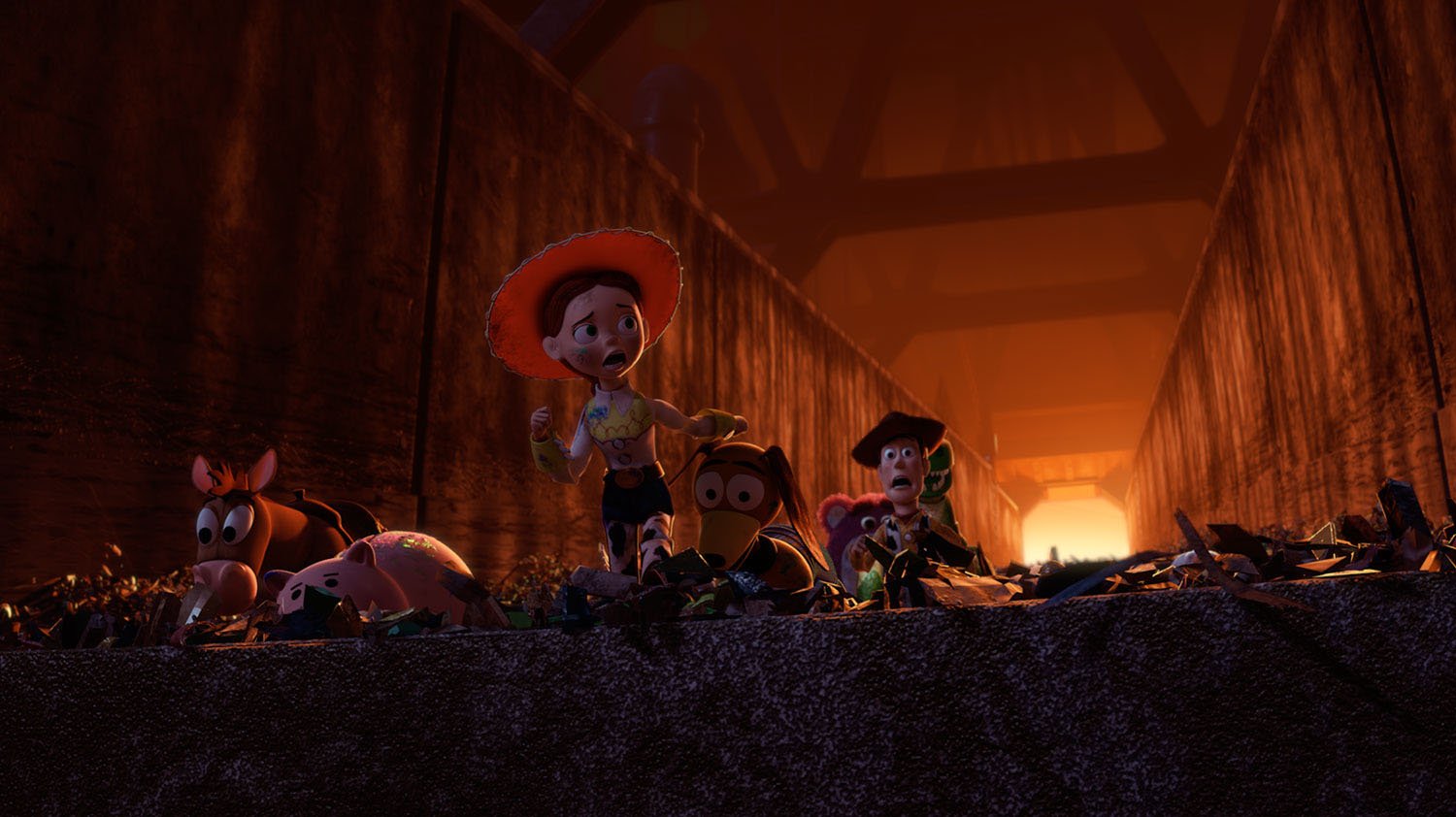
The Landfill Incinerator
Everybody knows the claw is coming. The hands still hurt.
The scene does not begin at the fire
The incinerator sequence works because the movie spends an entire act teaching the toys to solve systems. They escape Sunnyside through planning, timing, and shared competence. By the time the landfill machinery catches them, the audience has been trained to expect one more clever mechanism and one more narrow opening.
That expectation is part of the trap. The landfill is not a villain with a weakness or a prison with a map. It is an industrial process built to keep moving. The toys enter a machine that does not hate them, recognize them, or care whether they have completed their emotional business.
A conveyor belt turns people into material
Toy Story has always asked what happens when conscious beings are legally and socially treated as objects. The landfill makes the metaphor physical. Every beloved body on the belt is sorted beside metal, plastic, and garbage according to material value rather than personhood.
The scene becomes frightening before anybody reaches the furnace because the machinery performs a classification the human world has always accepted. To us, Woody and Jessie are people. To the system, they are components in a waste stream. The horror is not that the machine makes a mistake. The horror is that it functions exactly as designed.
Jessie sees the danger first
Jessie has already survived abandonment, storage, and the fear of being sealed away forever. Her panic carries memory. When she looks toward the orange light, the reaction is not simply a character noticing a hazard. It is somebody recognizing another version of disposal.
The film does not make her history into a speech here. Her face and movement do the work. That restraint matters because trauma is not always a tidy explanation delivered after the danger passes. Sometimes it is the body understanding the room a second before everybody else.
Woody cannot lead machinery into caring
Woody usually survives through leadership. He gives instructions, finds routes, assigns jobs, and believes coordinated action can return everyone to the child who needs them. The landfill attacks that faith without turning it into foolishness.
He keeps directing because direction has saved them before, but command cannot negotiate with gears. The scene forces him to confront the boundary of leadership. Being the person with a plan does not mean the world owes the plan enough time to work.
The claw rescue is deliberately withheld
Toy Story trained an entire generation to hear the word claw and think of three little aliens waiting for transcendence. The landfill includes that image in its machinery, then delays the joke until hope has almost been extinguished.
If the claw appeared too early, the sequence would become a callback. By withholding it, the film lets the aliens earn a reversal. Their old belief in an all-powerful claw stops being only a gag and becomes the knowledge that saves their family.
Lotso makes the moral choice unmistakable
The toys rescue Lotso because their ethics cannot depend on whether he deserves kindness. Then he reaches safety, understands exactly what will happen to them, and abandons them anyway. His betrayal removes the possibility that the furnace is merely bad luck.
Lotso has built his identity around the belief that toys are replaceable and affection is a lie. Saving the others would threaten that worldview. He would have to admit that solidarity exists, that somebody chose mercy, and that his suffering did not authorize everything he did afterward.
I still yell at the button
There is a special kind of movie anger reserved for a rescue control sitting close enough to touch. Lotso reaches it. We see the solution. The scene gives the audience one clean breath of certainty and then makes him step away.
I do not need him to become good forever. I need him to press one button after a group he terrorized risked themselves to save him. His refusal is so small in physical effort and so enormous in consequence that it feels personal every time.
The furnace strips away the franchise hierarchy
Woody is not more flammable because he is the leader. Buzz is not protected by his technology. Jessie is not spared because the audience knows her grief. Hamm, Rex, Slinky, Bullseye, and the Potato Heads move toward the same fire.
That equality is terrifying, but it also clears away status. The toys cannot bargain with importance. For one suspended moment, the franchise stops organizing them by favorite, comic relief, hero, or side character. They are a community facing one ending together.
Buzz reaches for Jessie first
The hand-holding begins as a specific relationship before it becomes a circle. Buzz and Jessie look at each other and choose contact. Their gesture carries the romance the films have built, but it is not staged as a dramatic declaration.
That is why it hurts. Love arrives as the simplest available action when rescue appears impossible. Buzz cannot promise safety. Jessie cannot outrun the machine. They can refuse to let the other person meet the end without being held.
Woody stops performing certainty
Woody looks for another route until there is no honest route left. When he takes the offered hands, he does something leadership rarely permits him to do. He admits through action that he cannot fix this.
The admission does not make him weaker. It makes the circle possible. If he kept pretending a plan existed, everyone would remain isolated inside his performance. His surrender to truth creates the last form of care still available.
The silence is the point
The sequence becomes quieter as the toys approach the fire. There is no final round of jokes and no speech explaining friendship. The movie trusts faces, hands, heat, and the mechanical roar to carry the argument.
Silence prevents the scene from becoming sentimental decoration. Nobody tells us what the moment means because the characters are not composing a lesson. They are scared. Their attention is on one another, not on producing a beautiful ending for the audience.
Why children understand it immediately
A child may not name industrial dehumanization, mortality, or existential acceptance, but children understand being moved by systems too large to negotiate with. Schools, adults, schedules, custody decisions, and family changes can all feel like conveyor belts.
The scene gives that helplessness a shape without talking down to its audience. It also offers a response that is emotionally possible even when control is not. You reach for somebody. You tell the truth with your body. You stay.
The image of joined hands changes the whole trilogy
The first Toy Story begins with Woody treating Buzz as a threat to his place in Andy’s room. The landfill ends that competition at the level of survival. Woody and Buzz are not measuring who is more loved while the furnace approaches.
Across three films, ownership anxiety becomes chosen family. The toys still care about Andy, but the circle proves their relationships with one another are not secondary products of belonging to the same child. They have built obligations that survive the bedroom.
Then the aliens become gods on schedule
The rescue is funny because the aliens finally occupy the role they always assigned to the claw. They operate it with serene focus while everybody below stares upward in disbelief. The ancient joke returns with perfect mechanical timing.
But the laugh does not erase the terror. It releases pressure after the scene has already made its claim. Their faith mattered because it taught them to recognize and control the very machine everyone else experienced only as fate.
Mr. Potato Head hugging the aliens matters
Mr. Potato Head spent the earlier films snapping at the aliens and treating their presence as an inconvenience attached to his wife. After the rescue, gratitude collapses that distance. They are not background weirdos anymore. They are the reason the family is alive.
The hug is one of the scene’s best corrections. Heroism does not belong only to the franchise leads. The characters with the strangest speech pattern and longest-running joke receive the decisive action, and the community has to update how it sees them.
The scene earns Andy’s goodbye later
The incinerator is not the ending, but it changes the emotional temperature of everything that follows. When the toys reach Andy again, the audience has already watched them accept losing every future together.
That makes the handoff to Bonnie feel less like a routine relocation. Life after the furnace is excess time. The final play scene becomes precious because it was almost impossible, not because the toys suddenly stopped fearing change.
What the landfill says about disposal
Lotso believes replacement proves love was never real. The landfill offers a harsher possibility: a thing can be loved deeply and still enter a system designed to discard it. Meaning does not automatically create protection.
The movie refuses to solve that contradiction through innocence. Andy’s love cannot stop the conveyor belt because he does not know where the toys are. Care matters, but care without knowledge, access, or action cannot interrupt machinery.
The camera makes the furnace feel inevitable
The framing keeps lowering the toys into an environment that dwarfs them. Walls, belts, claws, and mountains of waste fill more of the image than any individual face. Even when Woody occupies the center, the composition refuses to pretend he controls the space. The characters are visually swallowed before the fire can reach them.
Orange light gradually replaces the landfill’s dirty industrial color. That shift turns destination into atmosphere. The furnace is no longer a location somewhere ahead. It stains every face and surface, making the ending feel present while the toys are still moving toward it.
Nobody gets a private heroic exit
A different movie might separate Woody from the group and give him one last spectacular rescue attempt. Toy Story 3 keeps everybody crowded together. Their bodies bump, tumble, and climb as a collective, which makes survival depend on shared movement rather than one hero’s superior courage.
The choice also protects the emotional argument from becoming a sacrifice fantasy. Nobody volunteers another person. Nobody decides whose life counts more. When options disappear, the toys form a circle that includes the anxious, sarcastic, brave, frightened, central, and supposedly minor members without ranking grief.
Why Lotso cannot accept the mercy he received
Lotso’s cruelty is rooted in a story he tells about Daisy replacing him. If love can be lost, he concludes it must have been false. The Sunnyside dictatorship lets him force every toy to live inside that conclusion. He can call domination realism and treat hope as childish denial.
Being rescued by Woody’s group creates evidence against him. They know what he did and still refuse to let him be shredded. Pressing the button would require Lotso to participate in a moral world larger than his wound. He chooses the wound because it has become the only authority he trusts.
The scene refuses cheap forgiveness
Mercy does not transform Lotso. That matters. Stories sometimes reward a good act by making the recipient immediately grateful, as if compassion is a vending machine for redemption. Here, the toys act rightly and still suffer betrayal. Their ethics do not purchase control over his response.
The film therefore separates kindness from naivety. Saving Lotso was not wrong because he later abandoned them. His decision belongs to him. Their decision belongs to them. The painful space between those choices is where moral action becomes real instead of transactional.
The claw rescue does not cancel what happened
After the aliens lift everyone away, relief arrives so quickly that it is tempting to treat the furnace as a trick. It was not. The toys believed they were dying, made choices under that belief, and learned something about one another that survival cannot reverse.
A rescue can change the outcome without erasing the experience. The circle remains part of their history. That is why the following jokes feel warm instead of dismissive. Laughter returns to people who have just seen the edge together, and the movie lets joy coexist with the fact that the edge was real.
RaeRae’s final reaction
I know the claw is coming. I know all of them survive. My chest still tightens when the hands connect because the scene is not asking whether I remember the plot. It is asking what I think love is worth when it cannot guarantee rescue.
Toy Story 3 gives an answer I actually believe. Love is not pretending the fire is harmless. It is not forcing optimism on the frightened person beside you. It is seeing the same terrible truth, reaching across the gap, and refusing to let anybody become anonymous material alone.
That is also why the scene survives repeat viewing. Suspense is not its only fuel. Once the outcome is familiar, attention moves toward the glances, the decisions, and the speed with which a frightened group becomes emotionally honest. I am no longer waiting to learn whether the toys live. I am watching how they choose to be people together when living appears to be unavailable. The claw saves their bodies. The circle is what proves the family was already real. That truth lands before rescue and remains after it.