
RaeRae Review · Toy Story 2 · 1999
Woody Found Out He Was Valuable and Nearly Forgot Who Loved Him
A museum offers forever. Andy offers a few more years. Jessie knows exactly what happens after that, and suddenly loyalty is not a simple answer.
Review receipt
Film: Toy Story 2 (1999). Directors: John Lasseter, Ash Brannon, and Lee Unkrich. Screenplay: Andrew Stanton, Rita Hsiao, Doug Chamberlin, and Chris Webb. Music and songs: Randy Newman. Principal voices: Tom Hanks, Tim Allen, Joan Cusack, Kelsey Grammer, Wayne Knight, Don Rickles, Jim Varney, Wallace Shawn, John Ratzenberger, Annie Potts, Estelle Harris, Jodi Benson, and Jonathan Harris. Verdict: the rare sequel that grows the original question instead of repeating the original answer.
This is a spoiler-complete editorial review. It follows the film through disability panic, collecting culture, abandonment, restoration, commodity value, the gendered burden inside Jessie’s story, the seduction of permanence, and the brutal difference between being preserved and being known. It also stops for the technical leap, the production history, the jokes that became franchise architecture, and the Easter eggs hiding inside Al’s overstocked capitalism temple.
The broken arm turns a small accident into an identity emergency
Woody begins the film ready for Cowboy Camp because the trip confirms his place in Andy’s life. One ripped seam changes everything. Andy does not punish him or declare him unwanted. He makes a quick child decision and leaves the damaged toy behind. Woody experiences the cancellation as evidence that physical failure can interrupt love without warning.
The scene understands how people who are valued for usefulness can turn one accommodation into a prophecy of permanent exclusion. Woody is not only disappointed about missing camp. He fears the arm has revealed a future in which every limitation makes him less eligible for intimacy. The injury is temporary, but the panic reaches all the way to obsolescence.
Wheezy is the future Woody keeps pretending is not in the room
The squeakerless penguin sits dusty on the upper shelf, loved in memory but absent from active play. Andy’s mother plans to sell him because repair has been delayed long enough for the household to reinterpret him as clutter. Woody sees a friend in immediate danger and an image of what damage might do to his own status.
His rescue attempt is generous and self-protective at once. Saving Wheezy argues that broken toys remain members of the community, yet Woody needs that principle because his own arm is torn. The film refuses the clean separation between altruism and fear. Sometimes people defend another person’s dignity because they have finally noticed the same system moving toward them.
The yard sale is a domestic deportation system
From a human perspective, the sale clears unused objects and transfers them to new homes. From the toys’ perspective, it removes residents without notice, hearing, or any knowledge of the destination. A price sticker converts a shared history into a negotiable household asset. The sunny driveway hides the violence because every adult assumes the property cannot object.
Toy Story keeps finding moral pressure inside ordinary ownership. Andy’s mother is not written as cruel. She lacks the information that would make consent possible. That ignorance does not make the toy experience less frightening. The franchise can hold both realities together, which is why its emotional world remains richer than a simple good-owner and bad-owner chart.
Al recognizes value and still cannot see a person
Al McWhiggin knows Woody is rare, historically significant, and worth enough to complete a museum sale. His expertise exceeds Andy’s by every collectible measure. He can identify the manufacturer, television franchise, missing accessories, and international market. None of that knowledge produces respect for Woody’s autonomy.
The collector’s attention flatters the object while erasing the subject. Al treats condition, provenance, scarcity, and completeness as the only meaningful truths. The irony is sharp: the adult who knows the most facts about Woody knows him less intimately than the child who has never heard of Woody’s Roundup.
Kidnapping arrives disguised as connoisseurship
Al does not grab a random toy. He feels entitled because he recognizes what the family does not know it owns. When Andy’s mother refuses to sell Woody, Al steals him. Expertise becomes a private license to override the person whose history he claims to honor and the household that said no.
The scene punctures the romance of rescue collecting. A collector can preserve an artifact from destruction, but preservation without consent can still be captivity. Al’s language of rarity never requires him to imagine Woody has relationships, plans, fear, or a definition of home that differs from the market’s.
The Roundup room offers Woody a biography bigger than memory
At Al’s apartment, Woody discovers that he was once the center of a black-and-white television program, a merchandise line, a cast, and a national audience. The knowledge is intoxicating because the first film left him looking technologically old beside Buzz. Here, oldness becomes heritage and design simplicity becomes cultural history.
The discovery answers a wound Woody has carried since Buzz arrived. He is not merely the outdated toy Andy happened to favor. He was famous. Yet fame introduces a dangerous shortcut: if millions once loved the character image, perhaps that abstract audience can substitute for the particular child whose love will eventually end.
Woody’s Roundup is nostalgia manufactured before Woody can remember it
The show gives him a scripted past that feels emotionally true even though he did not live it as personal memory. He recognizes his own face, voice style, accessories, supporting cast, and moral role. A commercial archive becomes ancestry. For a mass-produced toy, media history can function like a family story handed down after the fact.
The film does not mock the attachment. Cultural history genuinely expands identity. The danger appears when the archive starts making demands about where Woody belongs now. Learning where a design came from should add context to a life, not overrule the relationships that life actually formed.
Jessie enters at full volume because silence has already cost her years
Jessie is fast, funny, physically fearless, and desperate for the museum plan to remain intact. Her energy is not a simple cheerful-cowgirl trait. It is the speed of somebody trying to outrun the possibility that Woody may send her back into indefinite storage. Every objection threatens to reopen the box.
The film lets her be abrasive without making the fear ridiculous. She pushes Woody because his private choice changes the fate of a group that cannot travel without him. He arrives with options and calls the museum captivity. Jessie hears a person with somewhere to return dismissing the only exit she has been offered.
When She Loved Me is not sad because childhood ends
The sequence hurts because Emily’s love was real. Jessie remembers outdoor play, car rides, shade under a tree, and the complete bodily relaxation of belonging. The later distance does not expose those memories as false. It shows that genuine love can be temporary without being fraudulent.
That is a more frightening idea than betrayal. If Emily had always been cruel, Jessie could protect herself with judgment. Instead, ordinary development changes the relationship. Makeup, friends, and adolescence enter the frame while Jessie remains built for the same form of play. Nobody has to become a villain for the bond to stop fitting the life around it.
The donation box converts reunion into a second abandonment
Emily rediscovers Jessie as an adult, briefly holds her, and drives toward what looks like home. The staging allows hope to return before the box is placed beside a charity donation. Emily may believe another child will love the toy. Jessie experiences the trip as a reunion used to deliver her elsewhere.
The scene explains why museum glass can resemble safety. A display case cannot grow up, forget, move houses, or decide a toy belongs to somebody else. Permanence offers relief from the unpredictability of attachment, even if the price is never being held again.
The museum is immortality with the verbs removed
Woody, Jessie, Bullseye, and the Prospector will be seen, maintained, documented, and protected from ordinary wear. They will not be played with, surprised, revised, or allowed to form relationships outside the exhibit’s script. The future guarantees existence while narrowing life to presentation.
The film’s central choice is therefore not life versus death in a literal sense. It is vulnerable participation versus controlled preservation. The museum promises that nothing bad will happen because almost nothing will happen at all.
Stinky Pete mistakes unopened condition for moral superiority
The Prospector has never been chosen by a child. His box protected him from scratches and denied him the relationships that could have complicated resentment. He speaks with patience and frontier wisdom because the performance helps him govern the group without appearing coercive.
Mint condition becomes both material state and ideology. He treats lack of wear as evidence that he deserves elevation, while played-with toys appear foolish for accepting damage. The film quietly reverses collectible logic: scuffs can be evidence of a life, and pristine packaging can be a record of exclusion.
His grievance is understandable until he makes everybody else pay it
Watching every other Prospector doll sell while he remained on a dime-store shelf would create humiliation, loneliness, and rage. His bitterness has a source. The museum plan finally turns the trait the market used against him into the condition of extraordinary value.
The moral break occurs when he traps Jessie, Bullseye, and Woody inside that solution. He does not only choose preservation for himself. He sabotages escape and uses the others as required components in a collection. Personal injury becomes entitlement to determine a group’s future.
Woody’s repaired body makes captivity look luxurious
Geri cleans dust, repaints worn details, repairs the arm, and restores Woody with extraordinary craft. The sequence is sensuous because care is visible in every tool movement. It also prepares an object for sale without asking the person inside the object whether restoration serves his chosen life.
Care and control occupy the same table. Woody benefits physically, while Al benefits financially and the museum benefits institutionally. The repair is not fake because the motive is compromised. It is excellent work embedded inside a transaction that still treats Woody as inventory.
Geri’s chess pieces turn an Easter egg into a signature
The cleaner resembles the elderly player from Pixar’s short Geri’s Game, and his case includes chess pieces. The reference rewards viewers without interrupting the story. More importantly, it connects two forms of close observation: the short studies an old man performing both sides of a contest, while the film studies hands reading an object’s tiny physical needs.
Pixar Easter eggs work best when they add texture before trivia. The audience does not need to recognize Geri for the scene to function, but recognition makes the studio feel like a growing neighborhood of visual memories.
Woody’s missing hand-painted name settles the ownership argument
The restoration leaves Andy’s name on Woody’s boot. That mark lowers collectible condition and raises relational value. It records that this particular cowboy did not remain an abstract product. A child claimed him, played with him, and placed identity on the body.
The museum wants the character as a representative specimen. Andy’s handwriting makes him stubbornly specific. The mark is not damage to be corrected. It is provenance the market cannot price correctly because its value depends on a private history.
Buzz becomes the loyal friend Woody had to learn to be
In the first film, Woody crossed town because rivalry and accident placed both toys in danger. Here, Buzz organizes a rescue because Woody matters. He does not calculate remaining play years, market price, or whether the damaged cowboy can still maintain room leadership. Friendship has become the mission.
The role reversal is the sequel’s strongest evidence that the first film changed them. Buzz now understands he is a toy and uses Space Ranger discipline voluntarily. Identity has moved from delusion to chosen ethic.
The street crossing makes a city feel designed to kill small bodies
Cones become disguises and moving shelter while tires, horns, painted lanes, and human speed turn ordinary traffic into an enormous hazard. The sequence expands the visual scale of the first film without forgetting that toys experience infrastructure from inches above the pavement.
Comedy does not remove the accessibility argument. A system built for one body size becomes lethal to another, and successful navigation requires collective timing rather than individual bravery alone.
Al’s Toy Barn is abundance without relationship
The shelves contain countless toys, variations, accessories, aisles, and manufactured worlds. For Andy’s group, the store is visually magnificent and existentially disturbing. A retail environment treats bodies like theirs as replaceable units arranged by product line.
The scale allows the sequel to ask whether uniqueness can survive mass production. Buzz confronts hundreds of identical unopened versions and discovers that visual sameness does not create shared memory. The answer is relational: individuality accumulates through experience.
Utility Belt Buzz lets the first film happen again from the outside
The new Buzz believes he is a real Space Ranger, interprets Andy’s Buzz as a rogue cadet, and heads toward Zurg. This time our Buzz occupies Woody’s former position, trying to explain toy reality to somebody protected by factory certainty. The callback is funny because growth has changed which side of the argument he inhabits.
He responds with impatience but also responsibility. Seeing his earlier self gives Buzz a living measure of how far he has traveled. The sequel uses repetition as character evidence rather than nostalgia alone.
The Barbie tour guide understands retail theater perfectly
Tour Guide Barbie performs corporate hospitality with dazzling fluency, moving through product departments as if abundance itself were freedom. Her script turns store design into entertainment and leaves no space for questions about what happens to unsold inventory.
The performance is affectionate satire. Barbie has expertise and personality, yet the language available to her was built to move consumers through a branded environment. She can guide the toys while still reproducing the store’s version of reality.
Zurg turns franchise mythology into a family joke
The elevator confrontation borrows the father reveal from The Empire Strikes Back and lets Utility Belt Buzz accept it almost immediately. The parody works because Buzz’s fictional world has enough detail to support melodrama even while the movie knows it is merchandise mythology.
Rex accidentally defeats Zurg, fulfilling the video-game mission that frustrated him at the opening. A supposedly weak player resolves the epic conflict through embodied action. The joke gives Rex a victory without pretending skill anxiety vanished.
The repair argument becomes a consent argument at the apartment
Once Woody’s arm is fixed, the physical reason for remaining with the collection disappears. Jessie and the Prospector shift to emotional and coercive reasons. Jessie offers testimony. The Prospector controls access. Those are not morally equivalent forms of persuasion.
Woody owes Jessie honesty about the consequences of his choice, but he does not owe the museum his body. Group dependence makes individual autonomy harder, not irrelevant. The film earns complexity by refusing to turn every plea into manipulation.
The television episode reminds Woody what his character was for
In the Roundup footage, puppet Woody chooses community and refuses to abandon friends. Watching the fictional cowboy clarifies the values Andy activated through play. The manufactured story does not dictate a museum destination. It gives Woody language for a commitment he has already practiced.
Brand mythology can become ethical material when a person interprets it rather than obeys it literally. Buzz learned this in the first film. Woody learns the parallel lesson here.
Woody chooses finite love with his eyes open
Returning to Andy is no longer based on the fantasy that childhood will last forever. Jessie has shown him the ending, and the museum has offered an alternative. He chooses the child while knowing the relationship has a horizon.
That knowledge makes the choice mature rather than sentimental. Love does not become worthless because time will change it. The film refuses both denial and cynicism.
Jessie needs a future, not another argument about gratitude
Woody cannot ask her to repeat his decision without recognizing their histories differ. Andy represents safety to him and a complete stranger to her. The promise that Andy has a younger sister matters because it offers Jessie a relationship not organized around replacing Woody.
Her decision to leave the museum is courageous precisely because play is the source of her deepest wound. Hope is not innocence returning. It is risk accepted after knowledge.
The Prospector’s defeat is tailored to his prejudice
He is placed in a child’s backpack beside a customized Barbie whose face has been drawn on. For a toy obsessed with pristine condition and elite display, the destination threatens wear, alteration, and ordinary play. The punishment attacks his value system more than his body.
The scene is satisfying and ethically uncomfortable. The girl is framed as a horror because she decorates toys creatively, yet Toy Story has already defended mutant bodies and non-factory identities. The joke exposes the Prospector’s fear, but viewers should not inherit his contempt for the child.
Bullseye chooses relationship without needing dialogue
The horse communicates through movement, expression, and immediate attachment. He wants Woody to stay, fears separation, and becomes an active participant in the airport rescue. Silence never makes him less legible to the group.
His presence expands the franchise’s idea of voice. Personhood does not depend on speech, and care requires learning forms of communication beyond spoken explanation.
The airport converts logistics into a mechanical underworld
Baggage belts, scanners, tunnels, carts, and luggage containers form an enormous hidden system beneath ordinary travel. The toys move through infrastructure humans trust without ever seeing. Every conveyor promises efficient delivery and threatens to separate the group permanently.
The sequence makes modern systems feel both miraculous and indifferent. The airport can route thousands of objects correctly while remaining incapable of recognizing that one item is a person trying to choose a destination.
Jessie’s plane rescue gives her fear physical form
The cargo hold is another sealed container taking her somewhere chosen by others. Woody and Bullseye pursue across open pavement while the aircraft begins to move. The climax converts years of boxed helplessness into a moment where friends visibly refuse to let the door close.
Woody’s leap is not a promise that nobody will ever leave her again. It is evidence that this community responds to her fear with action instead of demanding she become less affected by it.
The Roundup trick turns old fiction into present survival
Woody and Bullseye recreate a rescue from the television show against a modern jetliner. Nostalgia becomes useful when adapted to new conditions. The old episode does not trap them in repetition. It offers a pattern they can revise.
The sequence answers the museum question visually. Heritage belongs in motion, not only behind glass. Woody honors the character’s past most fully by using it to save somebody in the present.
Andy repairs Woody without restoring him to factory condition
At home, Andy sews the arm with rough child stitches. The repair lacks Geri’s precision but carries consent, recognition, and shared history. Woody prefers the imperfect seam because it belongs to the relationship he chose.
Craft quality and care quality are not identical. Geri performs better technical work. Andy performs the repair inside a bond where Woody is more than the condition of an asset.
Jessie and Buzz begin with attraction that preserves her personality
Buzz is visibly overwhelmed by Jessie’s confidence and athleticism. The film does not require her to become quieter so the romance can register. His admiration begins with the force that other characters sometimes find difficult.
Later films will develop the pairing unevenly, but this introduction at least treats intensity as charisma rather than a defect waiting for a boyfriend to soften.
Wheezy’s final song turns repair into reclaimed participation
A new squeaker lets Wheezy perform a Randy Newman number with theatrical confidence. The shelf-bound toy returns not merely to functional status but to communal presence. The scene gives him pleasure and visibility after the yard sale reduced him to disposal risk.
Repair matters because it restores options, not because every body owes the group productivity. Wheezy sings because he wants to, and the room celebrates the person who had almost disappeared upstairs.
The sequel understands that children are not villains for growing
Emily and Andy change because human development changes interests, schedules, bodies, and households. The toys experience that process as existential loss. The film takes their grief seriously without asking children to remain frozen so objects can feel secure.
This balance is why the franchise escapes pure nostalgia. Childhood matters, and ending is part of what makes it matter. The ethical question becomes how people handle transition, not how to prevent time.
The visual leap is doing emotional work
Subdivision surfaces allowed more complex facial articulation, while improved human skin, hair, lighting, and environmental scale expanded what the animators could stage. The progress is visible without turning the first film’s designs unrecognizable.
Technical refinement serves quieter feelings as much as spectacle. Jessie’s memory depends on subtle transitions in posture and light. Woody’s hesitation has to live in a face capable of holding competing futures.
The colorscript moves between warmth, enclosure, and transit
Andy’s room carries familiar warmth. Al’s apartment uses dim artificial light and imposing vertical space. The Roundup imagery creates vintage warmth that can become suffocating. The airport cools the world into machinery and urgency.
Production design does not simply label safe and dangerous places. It makes the museum temptation beautiful enough to deserve consideration, then lets the same beauty reveal its stillness.
The film was the first feature created, mastered, and exhibited digitally
That production milestone matters beyond trivia because the story is also about copies, formats, preservation, and transitions between old and new media. A digitally exhibited sequel spends its emotional center inside a fake 1950s television archive.
The technology does not erase history. It reconstructs television grain, marionette limitations, record players, packaging, and analog nostalgia through computational craft. New tools preserve old visual languages by translating them.
The Pixar shorts on Hamm’s television make channel surfing an archive
While Hamm searches for the Al’s Toy Barn commercial, clips reference Tin Toy, Red’s Dream, and Luxo Jr. The montage turns early studio experiments into television debris inside the new feature.
It is a perfect Easter egg for this film. Work that could have remained historical storage becomes active material, seen briefly by characters who do not know they are living in the studio those shorts helped create.
A Bug’s Life toys make the store a shared commercial universe
Merchandise from Pixar’s previous feature appears inside Al’s Toy Barn. The reference operates logically because successful animated characters would become products in a large toy store. It also lets one fictional property become media inside another.
The boundary is playful rather than a demand for continuity charts. Pixar is learning how recurring objects can create audience memory without making every story serve one master plot.
The Pizza Planet truck graduates from callback to infrastructure
The rescue team uses the truck as transportation, extending an object from the first film into a recurring piece of Pixar language. It is not parked as a hidden logo. It solves a story problem while rewarding recognition.
Good Easter eggs survive even when the viewer misses them. The truck has a reason to exist inside the action, and the reference sits on top of that function rather than replacing it.
A113 remains on Andy’s family vehicle
The license-plate reference to a CalArts classroom continues from the original film. By 1999, A113 was becoming a studio ritual that connects individual artists, training history, and audience treasure hunting.
The number does not deepen Woody’s decision, and it does not need to. A movie this emotionally disciplined can afford small signatures that exist for the pleasure of looking closely.
The Star Wars references are about inherited franchise language
Zurg’s breathing, weapon sounds, fortress staging, and father revelation borrow one of cinema’s most recognizable sequel mythologies. Toy Story 2 uses the references openly because Buzz himself was designed from commercial science-fiction memory.
The parody also asks what happens when a franchise sequel becomes the source of somebody else’s childhood play. Stories reproduce through imitation, toys, jokes, and misremembered scenes long after their original context changes.
The movie expands the world without making home irrelevant
Downtown traffic, a high-rise apartment, a giant retail store, and an international airport make the first film’s neighborhood feel small. The expansion could have made Andy’s room look childish. Instead, distance clarifies what home means to each character.
Scale is not importance. A bedroom matters because relationships happened there. A museum can be globally prestigious and emotionally wrong for the person being displayed.
The sequel’s deepest argument is that value has incompatible measurements
Al sees auction value. The museum sees historical value. Andy sees relational value. Jessie sees security value. The Prospector sees vindication. Woody has to decide which system gets authority over his body and future.
No single measurement is imaginary. The collection really is rare. The television history really is culturally significant. Andy really will grow up. The film becomes adult by allowing the facts to remain true while rejecting the conclusion that market or institutional value automatically outranks consent.
Final verdict
Toy Story 2 succeeds because it does not ask whether Woody loves Andy. We already know he does. It asks whether that love remains worth choosing after Woody learns exactly how temporary it is and exactly how valuable he could be elsewhere.
Jessie prevents the answer from becoming easy nostalgia. Stinky Pete prevents pain from becoming automatic virtue. Buzz proves friendship can outgrow rivalry. The museum remains beautiful, the future remains frightening, and Woody returns anyway. Review verdict: iconic on purpose, emotionally dangerous by precision, and one of the strongest sequels because forever is allowed to make a convincing case before the film says no.
Cowboy Camp is a tiny ritual carrying enormous emotional weight
Woody has attended enough of Andy’s imaginative life that one weekend trip reads as confirmation of continuity. The hat, the camp theme, and the expectation of being chosen tell him that the cowboy identity still has a place beyond ordinary bedroom play. Missing the trip feels like missing evidence that the bond remains current. That is why the torn arm produces more than disappointment. A ritual that was supposed to reassure him becomes the first occasion where damage changes access.
The film is precise about how insecure attachment reads scheduling. A cancelled plan does not stay one cancelled plan. It gathers every earlier fear and presents itself as a pattern. Andy makes a practical decision because he does not want to damage Woody further, while Woody hears the beginning of retirement. Both interpretations arise from care, but only one character knows the other is conscious enough to be hurt by silence.
The nightmare names the landfill long before the third film
Woody dreams that Andy throws him into a trash can and the container opens into a pit of discarded toy bodies. The image turns obsolescence into an underworld where broken objects disappear together. It is not a prediction of Andy’s actual intent. It is Woody’s anxiety choosing the most absolute image available: not storage, donation, or repair, but removal from the category of things worth keeping.
The landfill will become literal franchise geography in the third film, which makes the nightmare feel like an early psychic map. Toy Story understands that disposal haunts consumer objects even while they are loved. Every toy is produced within an economy that expects replacement, and affection can delay that cycle without abolishing it. Woody wakes before the franchise has an answer, carrying a fear the sequels will keep revisiting.
Bo Peep’s absence from the rescue exposes the franchise’s gender limits
Bo comforts Woody, understands his insecurity, and clearly matters to him, yet the expedition remains largely organized around the male bedroom ensemble. Jessie enters the franchise with extraordinary energy, but adding one major woman does not erase how the existing group distributes adventure. Mrs. Potato Head stays home after packing her husband’s supplies, and Tour Guide Barbie assists within the store rather than joining the final rescue.
The film gives women memorable personalities while still arranging action through a boys’ toy-room inheritance. Jessie’s history receives the most emotionally sophisticated sequence in the movie, then her escape requires Woody’s persuasion and rescue. That does not make her passive. It does mean the movie’s empathy is more progressive than the structure of agency surrounding it.
Jessie’s panic in confined spaces is memory happening in the body
When a box closes or an exit narrows, Jessie does not calmly retrieve an old story and decide to be afraid. Her body moves first. Breath, speed, anger, and desperate insistence arrive before explanation. The response makes sense after years spent in storage, where enclosure was not a brief inconvenience but an indefinite condition with no reliable witness.
The film avoids treating her reaction as a cute quirk cured by one speech. Woody can help her move toward the airport rescue, but the history remains. Trauma is not ignorance corrected by better facts. Jessie already knows the museum may be physically safe. Her nervous system also knows that sealed protection can become disappearance.
When She Loved Me changes time by removing dialogue
Sarah McLachlan’s vocal carries the memory while Jessie does not narrate over every image. The decision protects the sequence from becoming a case file. Light, season, Emily’s changing body, neglected space under the bed, and the movement from active play to stillness communicate what neither character can say to the other. Randy Newman’s song gives Jessie an interior voice without pretending she performed the memory as a concert.
The lyrics are simple enough to sound universal, but the animation keeps the grief specific. Emily does not merely age in a montage. Her interests occupy more physical space until Jessie becomes visually peripheral. The composition makes emotional distance measurable before the donation box makes it final.
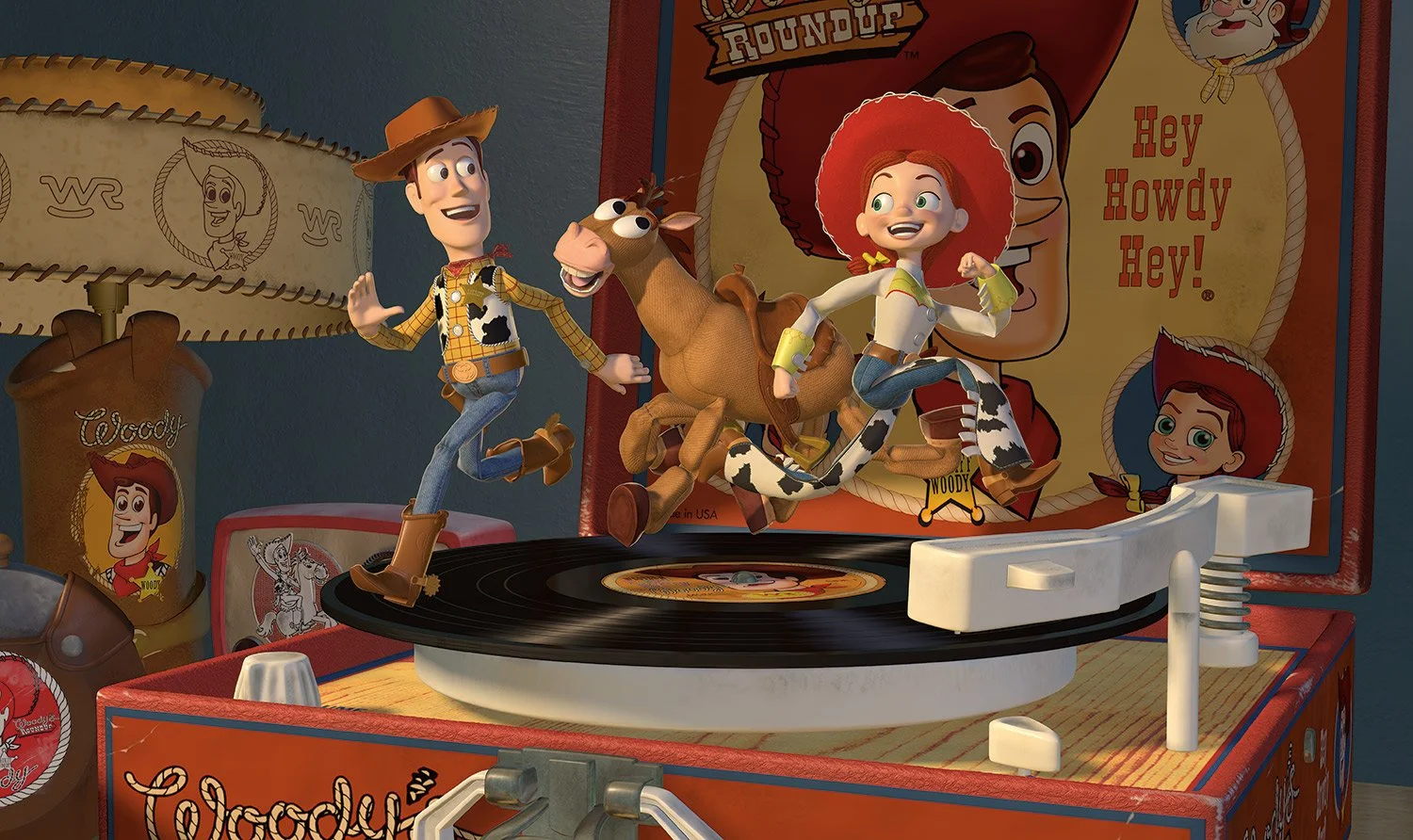
The record player stages nostalgia as a machine
Woody, Jessie, and Bullseye perform on a spinning record surrounded by Roundup merchandise. The image literalizes how nostalgia works: a commercial archive turns, repeats, and invites the present-day toy to step into a role already pressed into grooves. The scene is joyous because Woody discovers community, yet the machinery also suggests repetition without development.
The museum plan depends on that loop. Visitors will encounter the same story, costumes, poses, and historical explanation while the toys remain fixed as representatives. Woody enjoys the record because he can still jump off it. The conflict begins when Stinky Pete decides the performance should become permanent residence.
Al’s apartment is designed as the opposite of Andy’s room
Andy’s space is cluttered by play, crossed by natural light, and scaled through familiar furniture. Al’s apartment sits high above the city with dimmer artificial light, muted adult colors, and large empty areas that make a toy visible and isolated. The air vent becomes an escape route because the room was not organized for relationships among small bodies.
Production design turns ownership philosophy into architecture. Andy’s room changes because a child uses it. Al’s space holds commodities temporarily while waiting for profit. Even the careful Roundup display is staging for a transaction. The apartment knows how to show toys and has no idea how to live with them.
The museum in Japan is distant enough to become myth
None of the Roundup toys has seen the museum, met its staff, or experienced its display conditions. Al provides the promise, and Stinky Pete repeats it as certainty. Japan functions less as a developed place in the film than as the farthest imaginable destination, a prestigious elsewhere that makes return nearly impossible.
That abstraction deserves scrutiny. The movie uses an international museum to represent cultural validation while giving the institution no voice of its own. The choice reflects a late-1990s American fascination with Japanese markets and collecting culture, but the emotional argument would be stronger if the destination were treated as a real institution rather than a beautifully lit concept of forever.
Al’s chicken suit makes greed ridiculous without making it harmless
The television costume is bulky, loud, and humiliating, which lets the film mock a man who wants to control objects associated with childhood. Wayne Knight’s performance gives Al impatience, self-pity, and the sweaty urgency of somebody convinced one deal will justify every shortcut. His ridiculous presentation lowers the audience’s guard before the theft and sale reveal genuine harm.
Comedy works because Al is not a strategic mastermind. He is a retailer with access, information, and a willingness to ignore boundaries. Harm does not require elegance. An ordinary opportunist can exploit a knowledge imbalance and move a person across the world while everyone around him sees only merchandise.
The Prospector studies the room before revealing authority
He allows Jessie to appear volatile while he occupies the role of patient mediator. He validates Woody’s fears, supplies historical context, and frames the museum as the reasonable compromise. The arrangement makes coercion harder to detect because the person setting the boundaries sounds calmer than the person resisting abandonment.
His box increases the performance of harmlessness. He appears physically contained, older, and less mobile than Jessie or Woody. When he finally leaves the package and blocks the vent, the reveal is not that disability or age was fake. It is that he used assumptions about passivity to conceal how much control he had always exercised over information and exit.
Jessie and Stinky Pete do not make the same museum choice
Both want Woody to complete the collection, and both know that remaining incomplete may send everyone back to storage. The similarity can tempt viewers to flatten their pressure into one antagonistic position. Jessie tells Woody what happened to her and pleads for a future where it cannot happen again. Stinky Pete sabotages the television, seals the vent, and threatens physical force.
Trauma can make Jessie’s persuasion intense without making consent irrelevant to her. The difference is how each responds when Woody decides otherwise. Jessie is hurt and frightened, but she can reconsider. Stinky Pete treats another person’s refusal as an obstacle he has the right to remove.
Buzz’s rescue speech returns Woody’s own values to him
When Buzz reaches the apartment, he does not simply say Andy misses Woody. He confronts the museum choice as a retreat from the meaning Woody once taught him. In the first film, Woody insisted that being Andy’s toy was a worthy identity. Now Buzz has internalized the relational ethic strongly enough to defend it when its original advocate is exhausted.
The scene could have become hypocrisy prosecution. Instead, it shows that values become communal after we teach them. Woody no longer owns the principle, and Buzz is allowed to hold him accountable to it without pretending fear is irrational. Friendship sometimes means returning a person’s better language after they can no longer hear themselves use it.
Woody’s change of mind is not a victory over Jessie
He initially decides to return alone, which would preserve his chosen relationship while leaving the Roundup group with no museum future. The morally complete answer requires imagining more than his own escape. Inviting Jessie and Bullseye to Andy’s room creates a third option between display and abandonment.
That invitation still carries uncertainty. Andy may not love them equally, and Molly will grow too. Woody cannot guarantee permanence. What he can offer is a community that recognizes them as people and will face transition together. The film chooses solidarity over security without pretending solidarity removes risk.
The elevator shaft gives Buzz a parody father and a real identity test
Utility Belt Buzz accepts Zurg’s paternal claim because both characters inhabit the same manufactured mythology. Our Buzz watches the encounter with the distance of somebody who once needed that mythology to be literal. The joke is not that imagination was stupid. It is that factory programming supplies emotional revelations on schedule.
By refusing to reenter the script, Andy’s Buzz demonstrates freedom. He can enjoy the Space Ranger language, fight courageously, and recognize Zurg without letting a product narrative dictate his family. Chosen relationships have replaced packaging lore as the source of obligation.
Rex earns the victory his hands could not achieve on a controller
At the opening, Rex cannot defeat Zurg in the video game and blames the limitations of his tiny arms. At the elevator, his physical body accidentally knocks the villain down the shaft. The callback gives him a completed arc inside the larger rescue without redesigning him into a conventional action hero.
His limitation remains, but context changes what the body can do. The film repeatedly makes this point through toys navigating human environments. Capacity is relational. A body that struggles with one interface may become exactly the body that changes an outcome somewhere else.
Andy’s name is an anti-museum label
Museums rely on labels to establish maker, date, material, context, and significance. The handwritten name on Woody’s boot performs a competing catalog. It says this object belongs to a relationship that cannot be summarized by the television program or manufacturing line.
The writing also complicates ownership. Andy’s mark is affectionate and possessive at once. Woody chooses to honor it, which gives the name meaning beyond property law. Consent transforms the same inscription from a claim imposed on an object into a reminder the person carries willingly.
Repair raises the uncomfortable question of alteration without consent
Geri works while Woody remains required to stay still and cannot disclose consciousness. The cleaner removes paint, tightens seams, recolors surfaces, and corrects signs of play. The result delights Woody physically, but he had no meaningful opportunity to approve each intervention. The scene is gentle enough that this tension can disappear beneath satisfaction.
Restoration ethics often ask whether treatment preserves history or replaces it with an ideal condition. Woody’s wear records Andy’s touch. Cleaning protects the object while repainting may erase evidence. The film lands on a relational answer when Andy’s rough stitch becomes more valuable to Woody than invisible perfection.
The airport rescue works because everyone carries a different piece
Buzz provides leadership, Utility Belt Buzz adds force, the Potato Heads improvise with parts, Hamm reads systems, Rex acts despite anxiety, Slinky extends reach, Bullseye supplies speed, and Woody understands the Roundup scenario. No single hero could cross every layer of the airport alone.
The ensemble structure answers Stinky Pete’s hierarchy. He believes a collection becomes valuable when every required piece serves one display. The rescue team becomes powerful when different bodies coordinate without surrendering autonomy to one owner.
The film lets a sequel argue against completionism
Al needs every member of the Roundup set because the museum will not buy an incomplete collection. Stinky Pete treats completion as the condition that gives any individual future meaning. The plot therefore turns franchise completeness into a threat. A set can become so important that its members lose the right to leave.
That argument is unusually self-aware for a sequel surrounded by merchandise. Toy Story 2 expands the product world while warning that the desire to own every piece can stop us from relating to any piece as singular. Completion satisfies the collector’s system, not necessarily the lives contained inside it.
The outtakes create an affectionate lie about animated labor
The closing bloopers present digital characters as actors who miss cues, break props, laugh, and encounter crew accidents. The device had appeared with A Bug’s Life, and here it reinforces the fiction that a finished animated image came from a physical set inhabited by performers.
The joke also humanizes a production made through thousands of controlled decisions. Instead of exposing animators, render systems, and editorial revisions, it translates labor into the familiar language of movie-set mistakes. The fiction is charming, though the real production story is at least as dramatic and deserves its own attention.
The near deletion of the film belongs in any honest production reading
A command reportedly removed a large portion of production files from Pixar’s systems before backups and a home-working copy helped recovery. The incident has become studio legend because it mirrors the franchise’s own fear that a life can disappear through one ordinary action. Digital objects are not immune to loss simply because they can be copied.
The story should not eclipse the sustained labor required to rebuild and revise the movie, but it changes how the preservation theme resonates. A film about museum permanence and fragile personal memory survived because multiple forms of storage existed and people recognized what was missing.
The direct-to-video origin explains some of the sequel’s strange confidence
The project began on a smaller release path before Pixar and Disney expanded it into a theatrical feature. That history helps explain why the movie can feel both like a rapid continuation and an ambitious reinvention. It retains the pleasure of revisiting a familiar ensemble while building environments and emotional stakes large enough to challenge the first film.
Expansion created intense production pressure, and success should not romanticize overwork. The finished film’s fluency can hide the human cost of schedules and revision. Editorial admiration should include the labor conditions that make polished spontaneity possible.
Randy Newman writes two different kinds of franchise memory
The Woody’s Roundup song manufactures cheerful television nostalgia for a program the audience never actually watched. It arrives already catchy, familiar, and slightly distant, as if recovered from childhood syndication. When She Loved Me moves the other direction, turning one toy’s specific memory into a universal grief song.
Together, the songs distinguish public nostalgia from private remembrance. One builds a cultural past through style. The other enters a relationship through emotional detail. Woody is tempted by the first and ultimately guided by what the second teaches him about the cost of loving a child.
Tom Hanks lets Woody want the museum before the script admits it
Woody’s voice brightens around the Roundup archive, softens around Bullseye, and acquires defensive certainty as he explains why returning to Andy may be foolish. The performance keeps the temptation alive beneath every practical argument. He is not merely trapped by Jessie’s need or Stinky Pete’s plan. Part of him wants the recognition.
That desire matters because a coerced hero has no moral decision to make. Woody must genuinely see the museum’s appeal for choosing Andy to mean anything. Hanks gives the character enough vanity, exhaustion, tenderness, and fear that both futures remain audible in the same sentence.
Joan Cusack makes Jessie funny without using humor to cancel pain
Jessie can dominate a room, improvise physical comedy, tease Woody, and explode with frustration. Cusack’s speed creates comic momentum, then the performance can collapse into guarded stillness when Emily enters the conversation. The range prevents trauma from becoming the character’s only trait.
The voice also resists a neat recovery arc. Jessie does not finish the film as a quieter person who has learned to be easy. She carries fear into a new home while retaining the volume, courage, and impatience that make her herself.
The film treats storage as suspended life rather than neutral safekeeping
A box protects a toy from sunlight, dirt, impact, and accidental loss. It also removes the toy from relationships, information, and any ability to influence when the lid opens again. Jessie’s years in storage make this contradiction impossible to ignore. Material preservation can coexist with social disappearance. A body may remain intact while a life is placed outside time.
The museum offers a more prestigious version of the same bargain. Glass replaces cardboard, visitors replace darkness, and professional conservation replaces household neglect. Yet both futures ask Jessie to accept that being safely visible is enough. Her desire to be played with is not childish ingratitude. It is a claim that participation matters more than immaculate survival.
This is where the movie reaches beyond toys. Institutions often define care through what can be measured: stable temperature, controlled access, documented condition, reduced risk. Those protections matter, especially for fragile bodies and historical objects. They become dehumanizing when the protected person loses voice, touch, spontaneity, and the right to decide which risks make life meaningful.
Woody’s privilege is having a home from which to debate impermanence
Woody can romanticize finite love because Andy’s room is still available. Even after the torn arm and kidnapping, he expects people to notice his absence and attempt rescue. Jessie and the Prospector have lived without that safety. Their disagreement is therefore not a philosophy seminar among people with equal options.
Jessie’s anger at Woody carries class-like resentment. He arrives from a functioning community, learns he has cultural value, and initially plans to leave the others with the consequences of an incomplete set. His freedom to choose exposes their dependence. The movie becomes more honest when Woody stops arguing that his answer should automatically fit everyone and starts creating an exit that includes them.
Privilege does not make Woody’s choice wrong. It gives him responsibilities inside the choice. He must use access to expand somebody else’s future rather than simply return to comfort. Inviting Jessie and Bullseye home is the moment loyalty grows beyond protecting what was already his.
Jessie is not Woody with a sadder owner
Both are cowboy toys who loved children and fear obsolescence, but the film builds different relationships to control. Woody responds to insecurity by trying to manage rivals and later by considering an institution that promises status. Jessie responds through urgency, physical motion, and resistance to enclosure. Their bodies remember different forms of danger.
Woody’s identity is anchored by leadership and being chosen. Jessie’s identity is anchored by play that once offered freedom and then vanished without explanation. He fears falling in rank. She fears being sealed away. The museum flatters his need to matter while soothing her fear of another private abandonment. One destination recruits them through different wounds.
Treating Jessie as a parallel rather than an accessory clarifies why her presence changes the franchise. She proves that the same child-toy system distributes pain unevenly. A toy can know love and still reasonably refuse to trust its timetable again.
Stinky Pete represents the person institutions reward for never having lived
His unopened box makes him ideal to collectors because nothing unpredictable has happened to the product. No child wrote a name, no game scuffed paint, no repair changed stitching, and no relationship left evidence. The market translates absence of experience into superior condition.
That valuation gives the Prospector a bitter form of revenge. The quality that once marked him as unwanted now makes him the most institutionally legible member of the set. He has learned that systems may ignore pain until it can be converted into scarcity. The museum does not heal his rejection. It promises to display the result as value.
His tragedy is that he accepts the market’s measurement completely. Instead of questioning why being untouched outranks being loved, he uses mint condition to claim authority over played-with toys. The system that wounded him becomes the system through which he seeks domination.
Al and Andy offer two imperfect models of knowing
Andy knows Woody through use. He understands the voice he gives the sheriff, the adventures they invented, the comfort of carrying him, and the place he occupies among other toys. He does not know the television series, collectible market, production year, or museum interest. Al knows nearly all of that external history and none of the interior life.
The film does not require viewers to reject scholarship, archives, or collecting in favor of innocent childhood. Woody is moved by the history Al’s expertise uncovers. The problem is separation. Knowledge about an object becomes dangerous when it refuses knowledge from the person, community, or use history attached to it.
An ethical museum version of this story would have to combine both forms. It would preserve the Roundup archive while respecting Woody’s chosen relationships and living history. The plot creates urgency by presenting institutions that cannot imagine such consent, but the conflict also points toward better curatorial practice.
The fake vintage footage understands that media age is an aesthetic construction
Woody’s Roundup never existed in the 1950s, yet scratches, contrast, puppet movement, framing, music, and storage damage make the footage feel recovered. Pixar uses new digital tools to simulate old mechanical limitations, then simulates the physical deterioration of the imaginary recording. The archive arrives with a complete material biography.
That layered fabrication is thematically perfect. Woody accepts an invented media past as genuine context because authenticity does not require the show to have existed outside the movie. It requires consistent evidence inside his world. Viewers perform the same act, feeling nostalgia for a program they first encounter during the sequel.
The sequence reveals how quickly style can manufacture memory. A jingle, monochrome image, and puppet string can make an audience supply childhood familiarity. The film enjoys that power while warning how easily nostalgia can tell a person where they supposedly belong.
The restoration scene is also a demonstration of digital confidence
Close views of dust, thread, paint, cloth, metal tools, reflected light, and flexible facial surfaces invite comparison with the first film’s technical limits. Pixar does not announce the upgrade through a speech. It places Woody under magnification and makes the audience stare at materials computer animation once struggled to render convincingly.
Every action has weight and resistance. Cotton stuffing compresses, the fabric arm responds to stitching, paint covers wear, and the cleaner’s hands move with practiced economy. The scene becomes satisfying because physical cause and effect are legible. Craft is represented through craft.
The technical flex serves the story rather than pausing it. Restoration seduces Woody and the viewer at the same time. We enjoy seeing damage disappear, which makes it easier to understand why perfect condition can feel like rescue before the movie asks what else perfection erases.
The traffic cones are a joke about visibility and institutional assumptions
The toys hide beneath bright orange cones, objects designed to be noticed and obeyed. Drivers avoid them because the symbol communicates road authority even while moving in ways a cone never should. The rescue team survives by borrowing legitimacy from infrastructure humans respond to automatically.
The gag depends on selective attention. Nobody sees toys carrying cones because everyone sees the category “traffic control” first. Toy Story repeatedly turns human certainty into camouflage. Adults overlook conscious beings because object categories tell them perception is unnecessary.
There is also collective choreography in the crossing. A single cone would be vulnerable. Several moving together create enough pattern to interrupt traffic. The sequence makes solidarity visible as a practical technology, not only an emotional slogan.
The baggage system makes destination look like destiny
Once luggage enters the airport machinery, tags and routing systems decide where it goes. Objects move through gates they cannot choose, watched only for errors in delivery. Jessie, Woody, and Stinky Pete become cargo within a system whose success is measured by sending them to the destination Al purchased.
The toys’ resistance therefore appears to the institution as malfunction. The belt does not know a rescue from a routing error. This is the franchise’s ownership problem at industrial scale: a system can perform exactly as designed and still violate the conscious object traveling through it.
Woody’s group wins by reading the machinery, interrupting expected paths, and using service routes for purposes they were not designed to support. Freedom is not outside infrastructure. It is improvised through knowledge of how infrastructure can be redirected.
The plane rescue refuses to make Jessie prove fearlessness
Jessie participates in escape, but the cargo hold triggers a history that cannot be solved through embarrassment. Woody does not call her irrational or ask her to demonstrate growth by rescuing herself alone. He and Bullseye cross the runway because community responds when trauma limits what one person can do in a specific moment.
Her courage is already visible in choosing the uncertain future, confronting Stinky Pete, and moving toward the airport exit. Needing help at the final enclosure does not cancel that courage. The film’s best instinct is understanding that independence is not the only evidence of healing.
The rescue also gives Bullseye emotional agency. He is not transportation rented by Woody. His attachment to Jessie and the Roundup group helps drive the pursuit. The silent character becomes part of the promise that nobody will be boxed and shipped away without resistance.
The mutant toy lesson quietly returns in the Prospector’s ending
The first film taught viewers not to equate altered bodies with ruined people. Toy Story 2 then sends Stinky Pete to a child who customizes toys, adding paint and mixing identities. His horror depends on the collectible belief that modification destroys value. The franchise’s earlier ethics suggest the opposite: alteration may become another chapter of life.
The joke is still uneasy because the girl’s creative play is used as punishment, and she has no idea the recipient is conscious and unwilling. A stronger reading does not celebrate nonconsensual modification. It recognizes that Stinky Pete’s terror is intensified by prejudice against bodies that display use.
His future may expose him to exactly the relational unpredictability he rejected. That is not guaranteed redemption. It is a removal from the controlled environment where resentment could masquerade as superior wisdom.
The final bedroom scene is hopeful because nothing is guaranteed
Jessie and Bullseye enter a community with space for them, but Andy’s affection cannot be assigned by Woody. The newcomers must form their own relationships, and the existing toys must adjust status and routines. The film does not linger on every negotiation, yet the welcome feels different from Buzz’s arrival because Woody is no longer treating attention as a fixed amount he must guard.
He can watch Jessie receive excitement without reading it as his disappearance. That change is more meaningful than remaining favorite. Security no longer depends on being the only irreplaceable person in the room.
The group also knows more about the future than it did at the beginning. Wheezy’s repair, Jessie’s history, and Woody’s museum choice make eventual transition impossible to deny. Hope comes from facing impermanence together rather than returning to ignorance.
What the sequel improves and what it leaves unresolved
The film deepens Woody and Buzz, introduces Jessie with extraordinary emotional force, expands the physical world, and turns collecting into a serious ethical problem. Its pace carries jokes, action, and analysis without making the themes feel like homework. The antagonist emerges from the same wound as the heroes, which makes the conflict moral rather than merely mechanical.
It leaves Bo Peep and Mrs. Potato Head outside too much of the adventure, uses Japan as a prestige abstraction, and occasionally makes customization or femininity the surface of jokes it has not fully examined. Jessie’s story is richer than the amount of decision-making the climax gives her. These limitations do not erase the achievement. They show where the franchise’s empathy exceeds its inherited ensemble habits.
A serious review can love the movie without turning affection into immunity. Toy Story 2 lasts because it can withstand those questions and because many of the questions are already alive inside its own argument about who gets to define value.
Easter egg field notes without pretending trivia is analysis
Hamm’s television carries Pixar shorts, the store contains A Bug’s Life merchandise, the Pixar ball appears among inventory, Geri repairs Woody with chess pieces in his kit, A113 returns on a license plate, and the Pizza Planet truck becomes rescue transportation. Zurg’s language and reveal openly parody Star Wars. These details reward attentive viewing and map a young studio developing a visual memory.
The important distinction is function. Some references are background signatures. Some advance the plot. Some connect production history to the movie’s preservation theme. Listing them is useful, but interpreting why they fit is what turns a scavenger hunt into criticism.
Toy Story 2 is uniquely suited to Easter eggs because its world is already crowded with commodities, media fragments, brand histories, and copies. Hidden objects do not feel pasted onto an empty frame. They belong to a story about how culture accumulates inside the things people keep.
Why the title “Toy Story 2” understates the reinvention
The plain numbered title promises continuation, and the film delivers familiarity quickly: Andy’s room, birthday anxiety’s aftermath, Pizza Planet language, Buzz’s mission vocabulary, and the ensemble rhythms return. Yet the sequel changes the scale of the moral world. The first movie asks whether two rivals can recognize each other as people. The second asks which institutions, markets, archives, and relationships get to decide what a person is worth.
That expansion is why the movie does not feel like leftover adventure. Woody’s problem cannot be solved by repeating that he belongs to Andy. Jessie has evidence that belonging ends. The Prospector has evidence that never belonging can deform hope. Al has evidence that market recognition may arrive after personal neglect. Every new character complicates the original answer instead of merely threatening it.
The sequel also revises the meaning of “toy.” In the first film, accepting toyhood frees Buzz from an impossible manufactured identity. Here, being a toy contains competing futures: plaything, collectible, museum artifact, television character, historical object, commodity, friend, and abandoned possession. None of those labels alone captures the conscious life moving among them.
A strong sequel should make returning to the first film feel different. After Jessie, Woody’s confidence about Andy carries the shadow of Emily. After Stinky Pete, untouched packaging looks less like perfection and more like loneliness. After the museum, the handwriting on a boot becomes an argument. Toy Story 2 earns its number by changing what the number follows.
It also trusts children with an answer that is not emotionally convenient. Woody returns, but Jessie’s history is not disproved. The museum is rejected, but preservation is not mocked. Stinky Pete is defeated, but his original loneliness remains legible. Andy’s love is celebrated, but its expiration date stays visible. The movie gives the audience relief without pretending relief settled the underlying problem. That combination is rare in family filmmaking because it respects both the desire for a happy ending and the knowledge that another ending waits beyond it.
Most importantly, the film never confuses emotional accessibility with shallowness. Children can understand the fear of a closed box, the pride of being chosen, the thrill of a rescue, and the sadness of somebody growing away. Adults can recognize collecting economies, institutional authority, labor, disability panic, and grief converted into control. The same images carry both readings because the movie builds complexity from experience rather than jargon.
Why the review lands on humanity instead of nostalgia
The easiest version of this conversation would say children should treasure old toys and adults should never discard sentimental objects. The movie is more humane than that. Emily is allowed to grow. Andy is allowed to change. Jessie is allowed to grieve. Woody is allowed to choose finite attachment. No person has to freeze so another person can avoid loss.
Humanity appears in the willingness to treat endings as morally significant without treating them as proof the beginning was fake. That principle reaches beyond childhood possessions. Friendships change, bodies change, work changes, families change, and people often protect themselves by declaring temporary love worthless. Toy Story 2 refuses that defense.
The film’s emotional courage is not believing Andy will love Woody forever. It is letting Woody know he will not and return anyway. Permanence stops being the test for meaning. Presence, consent, memory, and care become the measures instead.
Return to Toy Story
Read More across the Toy Story franchise
Jessie’s history changes the franchise because abandonment stops being a future fear and becomes remembered experience. Her song is not a decorative sad pause. It explains why the promise of museum preservation can feel safer than another relationship whose ending she cannot control. The film asks her to risk attachment again without pretending the earlier loss was childish.