
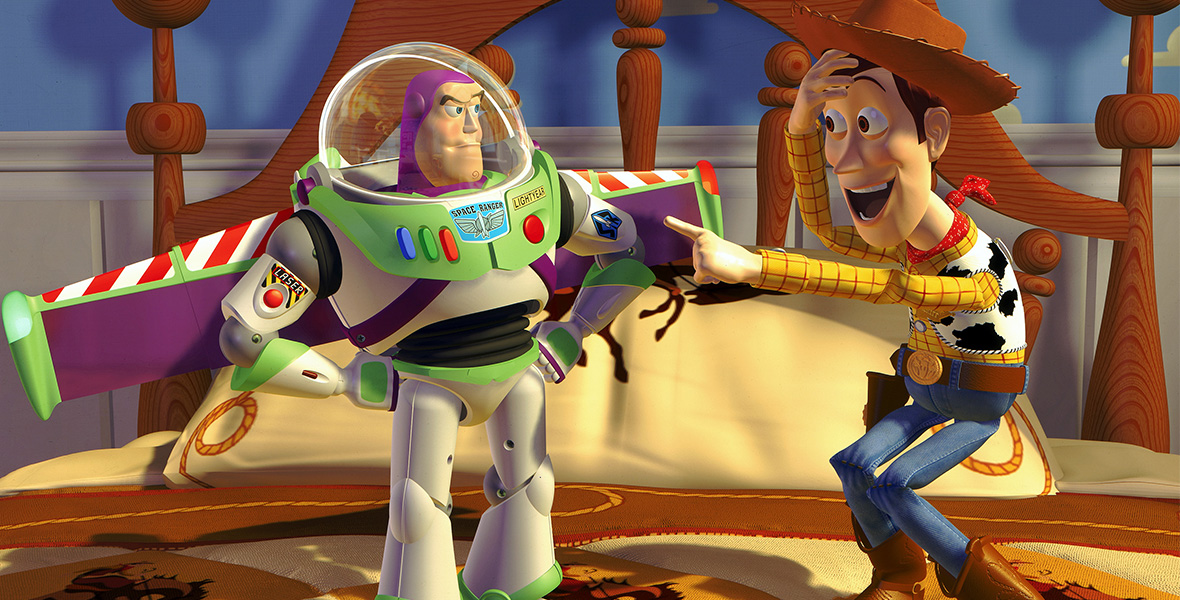
RaeRae Review · Toy Story · 1995
The Toys Were Having a Workplace Crisis in a Child’s Bedroom
Woody calls it loyalty. Buzz calls it a mission. Underneath both stories is the same terror: if usefulness creates identity, what happens when somebody newer arrives?
Review receipt
Film: Toy Story (1995). Director: John Lasseter. Screenplay: Joss Whedon, Andrew Stanton, Joel Cohen, and Alec Sokolow, from a story by Lasseter, Pete Docter, Stanton, and Joe Ranft. Music and songs: Randy Newman. Principal voices: Tom Hanks, Tim Allen, Don Rickles, Jim Varney, Wallace Shawn, John Ratzenberger, Annie Potts, R. Lee Ermey, Laurie Metcalf, Erik von Detten, and Sarah Freeman. Verdict: a technological landmark whose lasting power comes from how accurately it understands insecure workers, conditional belonging, and the violence people commit when they think love is a ranking system.
This is a spoiler-complete editorial review. It treats the movie as character drama, workplace satire, technological history, consumer-culture story, masculinity argument, and the beginning of a franchise that will spend decades asking whether being needed is the same as being loved.
The movie opens with a performance everybody agrees to believe
Andy knows Woody is a toy, Woody knows Andy is directing him, and the audience watches a cardboard town become emotionally real through play. Nobody needs the sheriff to be biologically alive for the rescue to matter. The agreement between child and object creates a temporary world with law, danger, courage, and affection.
That opening quietly prepares us for Buzz. He is mocked because he believes his packaging story literally, but every toy depends on a story assigned by a child or manufacturer. Buzz’s delusion is only more visible than Woody’s.
Andy’s room is a workplace pretending to be a family
The toys share affection, history, mutual protection, and a common dependence on one child. They also occupy a hierarchy organized around access to Andy, frequency of play, and the authority Woody has accumulated as favorite. The staff meeting before the birthday party is both family ritual and employment panic.
Calling everyone friends does not remove competition when attention is scarce. The room’s warmth rests on a labor economy none of the toys can control.
Birthday presents are layoffs arriving in wrapping paper
The toys do not fear new colleagues because they hate novelty. They fear replacement, storage, neglect, and the slow disappearance that begins when a child reaches past one object for another. Every box may contain somebody designed to make an existing worker obsolete.
The joke works because adults recognize the meeting. Management says the team is a family while announcing a restructuring, and everybody smiles until the new technology is unboxed.
Woody’s leadership is real and self-serving
He runs meetings, keeps panic controlled, organizes reconnaissance, remembers individual needs, and treats the room as a community that requires coordination. He has earned trust through useful labor. He also benefits from being the person closest to power and mistakes that position for proof of exceptional worth.
Good leadership can coexist with insecurity. The danger begins when the leader protects status instead of the people who made leadership meaningful.
The green army men perform disposable labor with military discipline
Sarge and his unit risk being stepped on, scattered, or lost to report what happens downstairs. Their mission lets the more privileged bedroom toys receive information without leaving safety. The reconnaissance is played as action comedy, but the labor hierarchy is visible.
The smallest toys become intelligence workers because their bodies make them useful and expendable. Woody thanks them, yet nobody questions why the same group always absorbs physical risk.
Buzz arrives as product design that mistakes confidence for truth
Lights, wings, sound, vocabulary, packaging, and an elaborate fictional mission surround Buzz with a complete identity before he can encounter evidence. He does not simply have an ego. He has been manufactured inside a brand story strong enough to function as memory.
Consumer products do not only sell objects to children. They sell scripts about who the child becomes while holding them. Buzz is the script waking up and believing the commercial.
Woody recognizes the market threat immediately
Buzz’s features are newer, louder, and easier to demonstrate. Andy’s friends do not need to understand his character to be impressed by wings and a laser. Woody sees attention moving in real time and reads admiration as a prediction of his own disappearance.
His jealousy is ugly and understandable. A system built on favorite status trains everyone to experience another person’s success as personal danger.
The other toys are not traitors for liking Buzz
Rex, Hamm, Slinky, and Mr. Potato Head respond to novelty, generosity, and spectacle. They are not obligated to pretend Buzz is unimpressive so Woody can remain emotionally regulated. Their excitement exposes how much Woody expected loyalty to include managing his rank anxiety.
Friendship should not require a group to make itself smaller around the person with the most established status.
Buzz’s flight is a triumph of staging and self-deception
He bounces from the bed, catches a track, swings, and lands in a sequence whose coincidences look like controlled flight from the room’s perspective. Woody sees the mechanics. Buzz sees confirmation. Everybody else chooses wonder because the result is emotionally satisfying.
The scene is not only about whether he technically flies. It shows how performance, audience desire, and confidence can turn luck into authority.
Falling with style is the film’s working definition of adaptation
Buzz never gains the power his fictional biography promised. He learns to use the body he actually has, the environment available, and relationships that compensate for limitation. By the ending, the phrase Woody uses to mock him becomes a description of practical heroism.
Maturity is not abandoning imagination. It is separating metaphor from physics without losing the courage the metaphor supplied.
Woody’s lamp scheme crosses from fantasy into workplace violence
He plans to knock Buzz behind the desk so Andy cannot take him to Pizza Planet. However temporary the intended exclusion, Woody uses the environment to remove a rival from opportunity. The accident that sends Buzz out the window grows from a deliberate abuse of authority.
Intent matters, but it does not erase foreseeable harm. Woody wanted sabotage small enough to remain deniable.
The window becomes a courtroom before facts exist
The toys see Buzz fall, recognize Woody’s motive, and conclude that the leader tried to kill him. Their anger is not irrational. Woody has behaved suspiciously, and his explanations sound like the excuses of somebody accustomed to being trusted automatically.
Community accountability becomes messy because the group has evidence of abuse but incomplete evidence of outcome. Their refusal to accept rank as innocence is healthy even when the scene becomes mob-like.
Sid’s house is not evil because the toys are ugly
The mutant toys initially look like horror objects assembled from incompatible pieces. Woody and Buzz project danger onto bodies that violate familiar product categories. The reveal is that these toys cooperate, communicate, and help others survive.
The film uses a child audience’s learned attachment to intact merchandise against itself. Damage changes appearance and function, not personhood.
The mutant toys practice repair without requiring restoration
They do not return every body to factory condition. They create viable combinations from what remains, treating parts as possibilities rather than evidence of ruined identity. Their community is built after violence, not before it.
That is more radical than a makeover. Healing does not mean looking untouched.
Sid is a child with power and no information about consciousness
From the toys’ perspective, he is a torturer who dismantles living beings for entertainment. From the human world’s perspective, he is rough with objects adults classify as inanimate. The moral gap is enormous because the secret of toy life makes informed consent impossible.
The movie lets us condemn cruelty while recognizing that Sid cannot know the full category of harm. His pleasure in destruction is still worth examining without pretending he consciously chose murder.
Andy’s kindness also rests on ignorance
Andy loves his toys and still leaves them in stressful situations, changes favorites, and eventually outgrows them because he does not know they experience abandonment. The difference between Andy and Sid is temperament, not informed recognition of toy rights.
Good ownership remains ownership. The franchise will keep circling that contradiction because affection makes the hierarchy feel gentle without removing it.
Buzz’s commercial is an identity death on television
He sees rows of identical Buzz Lightyears and hears the product disclaimer that the toy does not fly. Evidence arrives publicly, efficiently, and without concern for the consciousness it destroys. His mission, uniqueness, and body are reclassified in seconds.
The devastation resembles discovering that a life story was marketing copy. Buzz does not merely learn a fact. He loses the framework that told him why he exists.
Mrs. Nesbitt is collapse performed as comedy
After trying and failing to fly, Buzz loses an arm and enters Hannah’s tea party in an apron and hat, speaking with manic detachment. The scene is funny because Tim Allen makes the crisis theatrical. It is also the film’s clearest portrait of dissociation and humiliation.
The feminine costume is not inherently degrading. Buzz experiences it as identity collapse because his manufactured masculinity allowed no space for care, domestic play, fragility, or uncertainty.
Woody cannot reason Buzz out of grief immediately
Telling him he is a toy does not help once that truth has become annihilation. Woody must show that toyhood contains relationship, memory, and value rather than merely disproving the space-ranger story.
Facts can correct delusion without supplying a reason to keep living. Care has to build the second part.
The name written on Buzz’s foot becomes chosen belonging
Andy’s name proves ownership, but Woody reframes it as evidence that this particular child values this particular toy. The mark is legally uncomfortable and emotionally powerful at the same time.
The film asks us to feel inscription as love because the toys have no recognized social world outside being possessed. That is touching and structurally bleak.
Woody’s speech to Buzz is also a confession about himself
He lists Buzz’s features and explains why Andy finds him extraordinary, then looks at his own faded cloth body and admits he cannot compete. Encouragement becomes possible only after Woody names the insecurity driving his cruelty.
He stops treating Buzz as the cause of his worthlessness and recognizes the ranking system inside his own head.
Buzz chooses action before certainty returns
He does not regain belief in literal space-ranger identity. He helps Woody escape while grief is still fresh and his future remains unclear. That decision is courage without the armor of destiny.
Chosen purpose becomes more mature than assigned purpose because it can survive evidence.
The toys breaking their rule for Sid is collective self-defense
They reveal movement and speech to frighten him into treating toys differently. The intervention violates secrecy, uses psychological terror, and stops ongoing harm when ordinary communication is impossible.
The scene is cathartic because marginalized bodies coordinate the one kind of testimony the powerful child cannot dismiss.
Woody’s rotating head is horror used as labor organizing
The cowboy toy becomes the mouthpiece for a community Sid fragmented and underestimated. His warning works because the toys choreograph bodies into a supernatural consequence Sid can understand.
It is not individual heroism. Every mutant toy, signal, movement, and position contributes to the action.
The rocket converts Sid’s weapon into escape technology
A firework intended to destroy Buzz becomes the device that returns both toys to Andy. The film repeatedly transforms fixed purpose: a toy can become a friend, falling can become flight, damaged parts can become new bodies, and a weapon can become transport.
Usefulness is not destiny when communities can reinterpret tools.
Woody and Buzz reach the moving van through shared competence
Woody brings knowledge of Andy, routes, and the toy community. Buzz brings physical features, confidence under pressure, and a new willingness to act within reality. Neither replaces the other.
The partnership works when difference stops being a ranking question and becomes coordinated capacity.
The RC sequence forces Woody to confront his credibility debt
When Woody appears to throw RC from the moving truck, the other toys assume another jealous attack. He cannot demand trust because he has not repaired the earlier abuse. The misunderstanding is narratively painful and morally earned.
Reputation is accumulated evidence. One sincere change does not instantly erase what a leader taught people to expect.
Christmas repeats the birthday anxiety with a different answer
The toys listen to gift reports again, but Woody and Buzz face the ritual together. Newness has not stopped threatening them. The community has changed how it metabolizes that threat.
Then a puppy arrives, reminding everyone that no emotional lesson permanently removes uncertainty. Family systems keep receiving new conditions.
The technology matters because the story chose plastic and fabric
Early computer graphics struggled with convincing human skin and organic subtlety, but toys benefited from hard surfaces, seams, molded faces, and limited articulation. The premise turns technical limitation into visual logic.
Innovation is most persuasive when form and subject solve each other’s problems.
RenderMan made an impossible production pipeline practical enough
Pixar’s REYES-based RenderMan system could create complex images under hardware limits that made physically accurate ray tracing too expensive. The film’s light, shadow, texture, and scale are therefore achievements of strategic approximation rather than brute-force realism.
The movie did not wait for computers to become magic. Artists designed a world around what the tools could express.
The film was the first feature-length computer-animated movie, not the first computer animation
Pixar, Disney, other studios, researchers, and effects artists had produced computer imagery, shorts, commercials, and hybrid work before 1995. The accurate landmark is feature length and fully computer animated.
Precision honors the labor that made the milestone possible instead of turning history into a single invention myth.
Its screenplay recognition matters as much as the rendering breakthrough
Pixar records that the film received Academy Award nominations for original song, original score, and original screenplay, the first animated film recognized in the screenwriting category. That last nomination challenged the idea that technology was the only story.
The machines created frames. Character causality, comic reversals, emotional structure, and dialogue made audiences care what the frames contained.
Randy Newman writes affection without pretending it is permanent
“You’ve Got a Friend in Me” promises friendship through changing circumstances, yet the images quietly show a child growing, rearranging attention, and living beyond the song’s control. Warmth arrives with an expiration anxiety underneath it.
The franchise will spend multiple films testing whether friendship survives when possession, proximity, and usefulness change.
A113 begins a house tradition
Andy’s family vehicle carries the A113 plate reference associated with the CalArts classroom used by animation students. The detail becomes one of Pixar’s recurring signatures rather than a plot clue.
It is an Easter egg with documented production culture behind it, not a secret code proving every Pixar story shares one literal universe.
The Luxo ball carries Pixar’s pre-feature history into the bedroom
The blue and yellow ball with a red star refers back to Luxo Jr., the short that helped establish Pixar’s character animation identity. Placing it among Andy’s toys makes company history part of the world without interrupting the story.
The reference is affectionate institutional memory, not evidence that the lamp owns property in Andy’s neighborhood.
Pizza Planet creates a future Easter-egg vehicle by accident and design
The delivery truck originates here as ordinary world-building attached to the restaurant. Later Pixar films turn it into a recurring visual signature. The first appearance matters because it has an actual narrative job before becoming a scavenger-hunt object.
Good Easter eggs begin as useful details, not neon signs asking audiences to congratulate themselves.
John Ratzenberger starts a vocal tradition as Hamm
His dry, knowing delivery gives the piggy bank social authority and comic skepticism. Later appearances across Pixar films turn the casting into a studio pattern, but Hamm works before the pattern exists.
The best recurring tradition starts with a performance worth inviting back.
National Film Registry recognition confirms more than nostalgia
The Library of Congress list records Toy Story as a 1995 film inducted in 2005. That unusually quick path reflects cultural, historical, and aesthetic significance tied to both its form and its influence.
Preservation matters because digital breakthroughs are not automatically permanent. Hardware, formats, software, assets, and theatrical versions can disappear even when a franchise remains commercially active.
The ending solves rivalry but not the ownership problem
Woody and Buzz find a way to share status inside Andy’s room. They do not question why one child’s changing attention determines their housing, meaning, and social survival. The emotional solution stabilizes the system rather than transforming it.
That is not a flaw the first film must solve. It is the contradiction that gives the sequels somewhere honest to go.
Final reaction
Toy Story remains iconic because its technology and psychology point in the same direction. A world built from new tools tells a story about what new tools do to the people already in the room. Woody fears obsolescence, Buzz confuses branding with identity, and both survive by turning competition into interdependence.
The film’s warmth never fully hides the existential machinery underneath. Provisional grade while this 10,000-word review is still being completed: A, with Woody removed from management training until he can explain why “family” does not mean permanent favorite status.
Woody’s fear begins before Buzz enters the room
The birthday meeting reveals a leader already braced for loss. Woody rehearses calm because replacement is a regular feature of toy life, not a unique injury Buzz invents. Andy’s affection may be sincere, but every year brings new products, changing interests, and fewer guarantees. Woody has survived long enough to know that love can be real and still move on.
His first mistake is treating private fear as a management problem everybody else must help him conceal. He performs confidence instead of admitting that favorite status has become the structure holding his identity together.
Favorite is a ranking that sounds like affection
Andy does not announce a formal hierarchy. His attention creates one through playtime, bed placement, party inclusion, and which toy appears in the stories he tells. Woody receives material and symbolic privileges that seem natural because they come from a child’s love rather than an employer’s policy.
The film understands how soft power hides. Nobody issued Woody a badge authorizing control of the room, yet everybody recognizes that the favorite speaks closest to the source of survival.
Woody confuses continuity with entitlement
He has been there through ordinary afternoons, illnesses, invented adventures, and the rituals that make a bedroom feel stable. That history matters. It does not create a permanent claim on future attention. Woody turns accumulated intimacy into a contract Andy never signed and Buzz cannot possibly honor.
Long service deserves recognition, not ownership of everybody who arrives later. Nostalgia becomes dangerous when it demands the future remain arranged around the person who remembers the past.
Buzz does not know he is performing masculinity
The space-ranger program gives him a square jaw, military vocabulary, heroic mission, technical features, and an enemy grand enough to justify constant certainty. He enters the room without doubt because doubt was not included in the product fantasy. The persona is masculine confidence industrialized for a child consumer.
His breakdown exposes the cost. A self built with no permission for fear, dependency, domesticity, or ambiguity has nowhere safe to go when certainty fails.
Woody’s masculinity is older and no less constructed
He represents the Western sheriff, a protector whose authority comes from moral instinct, community recognition, and the myth of the decent individual maintaining order. His cloth body and pull string look modest beside Buzz’s electronics, but his identity is also licensed, scripted, and sold.
Their rivalry is not authenticity versus branding. It is an older masculine product story panicking when a newer masculine product story captures the market.
The cowboy and astronaut encode changing American futures
Woody carries television Western nostalgia, frontier law, horses, and a past already becoming collectible. Buzz carries space-age technology, institutional mission, plastic precision, and a future packaged as progress. Andy’s preference moves from one national fantasy to another.
The film never needs a history lecture because the bedroom makes cultural succession visible. New play does not only replace a toy. It replaces the era the toy taught a child to imagine.
Bo Peep sees Woody without worshiping his rank
Her flirtation acknowledges intimacy and confidence, but she does not function as the room’s emotional nurse. Bo can recognize Woody’s importance without joining his campaign against Buzz. That slight independence keeps her from becoming a prize awarded to whichever male toy wins.
The first film still gives her limited narrative power. Her later franchise expansion will feel partly like correction because this movie knows she matters while rarely letting her shape the central crisis.
The female-toy population is embarrassingly thin
Bo Peep and Mrs. Potato Head’s late arrival cannot disguise a room dominated by male-coded characters, voices, and product categories. The film imagines universal toy consciousness through a boy’s bedroom and then lets that consumer arrangement define whose interior life appears universal.
This was common in 1990s family animation. Common is not neutral. Girls watched these stories too and were asked to identify across gender while boys were rarely expected to do the same work.
Hannah is not merely Sid’s annoying little sister
She plays tea party, names dolls, adapts found objects, and responds quickly when Buzz enters her world. The movie frames her play through Buzz’s humiliation because his perspective drives the scene. From Hannah’s perspective, she has received a new guest and incorporated him creatively.
Her femininity becomes the visual opposite of space heroism, which is why the joke can sting. The problem is Buzz’s rigid hierarchy of identities, not a child enjoying domestic play.
Mrs. Nesbitt reveals what Buzz’s brand taught him to despise
Apron, floral hat, tea, and missing arm combine into an image he reads as total degradation. Nothing about care, hospitality, or feminine dress is inherently lesser than simulated combat. The scene exposes the ranking his heroic identity carried beneath its noble language.
His recovery should include more than accepting toyhood. It should loosen the belief that tenderness and feminization are worse fates than violence performed with confidence.
Mr. Potato Head uses cynicism as social insurance
He expects hypocrisy, questions Woody’s motives, and rarely risks looking naive. A body designed to come apart may help explain why control and sarcasm matter to him. If pieces can be removed at any time, emotional distance becomes another detachable defense.
Don Rickles makes suspicion funny without making it empty. Mr. Potato Head is often correct that leaders protect themselves, even when his hostility accelerates conflict.
His removable face is comedy built on bodily autonomy
The character can rearrange features, lose parts, and survive disassembly, which makes physical violation visually playful. Sid’s mutations later force the audience to reconsider whether detachable parts make rearrangement harmless. The difference is agency and care.
A toy choosing to move his own mouth or lend a piece is not equivalent to somebody else tearing him apart for entertainment. The same physical act changes morally through consent.
Slinky’s loyalty has a limit and should
Slinky supports Woody because shared history makes trust reasonable. When evidence suggests Woody harmed Buzz, loyalty collides with the responsibility to protect the wider group. His hesitation is not betrayal. It is the moment friendship stops being automatic cover.
Healthy loyalty asks what happened and refuses to convert affection into immunity. Woody eventually needs friends willing to believe in his change, not friends trained never to question him.
Rex is anxious because the product promise exceeds the person
He is a Tyrannosaurus toy worried that his roar lacks terror. His body advertises prehistoric dominance while his temperament wants reassurance. The gap makes him funny and tender because many people know what it feels like to inhabit expectations their nervous system cannot perform.
Rex does not need to become frightening to become complete. He needs a community that stops measuring his value against packaging.
Hamm turns money into personality without controlling any resources
As a piggy bank, he is associated with savings, calculation, and cynical common sense, yet Andy owns both Hamm and anything placed inside him. His financial imagery creates authority while his actual economic agency is nonexistent.
That contradiction fits the whole room. Toys symbolize adult roles and institutions while remaining dependent on a child who does not know their society exists.
The Etch A Sketch is communication infrastructure
Its drawings support plans, identification, and jokes without needing a human voice. The room’s intelligence is distributed across bodies whose manufactured features become social tools. Leadership works best when Woody coordinates those capacities rather than treating them as supporting props.
The device also reminds us that literacy can be visual and collaborative. Information appears through movement, surface, and shared interpretation.
The baby monitor turns domestic technology into surveillance
Woody’s team uses a household device to hear the birthday party downstairs. Andy’s parents bought it for care, but the toys repurpose it as an intelligence channel. The object’s function shifts through need and secrecy.
Toy society survives by borrowing human infrastructure without permission. Their invisibility makes that adaptation necessary and prevents any negotiation about privacy.
The toys’ freeze response is a collective survival behavior
When humans enter, every body collapses into objecthood instantly. The performance protects the secret and may be partly involuntary, but it also requires extraordinary group discipline. A single failure could transform their entire social condition.
The rule resembles masking under surveillance. Safety depends on appearing exactly as the dominant world expects, even when that appearance denies consciousness.
Secrecy protects toys and preserves their captivity
If humans knew, toys might gain recognition, communication, and rights. They might also face laboratories, panic, commercial exploitation, religious fear, or destruction. The bedroom community chooses invisibility because every alternative is unknowable and potentially catastrophic.
That choice keeps them safe inside ownership. The film’s premise therefore contains a political trap it cannot resolve through friendship alone.
The claw-machine aliens embrace a theology of selection
They understand the claw as a higher power that chooses who will go and where. Their faith makes random mechanical capture feel purposeful. Buzz’s arrival gives them another impressive figure to interpret through destiny.
The joke is gentle and unsettling. Systems beyond a community’s control often acquire sacred explanation because randomness is harder to live with than a story of selection.
The aliens’ surrender to fate contrasts with Woody’s frantic control
Woody tries to manipulate every variable so he can remain favorite. The aliens accept the claw without resistance. Both responses emerge from powerlessness, one through domination of peers and the other through spiritual submission.
Buzz eventually needs a third path: act where action is possible, accept physical limits, and stop mistaking uncertainty for either personal failure or cosmic instruction.
Pizza Planet is a temple built from branded fantasy
The restaurant sells food through space adventure, arcade competition, aliens, rockets, and sensory overload. Buzz experiences the setting as evidence that his mission world exists, while children experience it as consumption designed to feel like exploration.
The location mirrors Buzz himself. Both are products whose commercial design turns play into belief.
The arcade hides danger inside abundance
Lights, noise, machines, prizes, and moving children make it difficult for small bodies to remain oriented. Woody and Buzz enter a human environment where every object appears animated while their own animation must stay hidden.
The visual density lets early CG turn limitation into atmosphere. Hard surfaces, plastic forms, neon light, and mechanical motion belong naturally to the world the computers can render.
Sid’s black shirt does not make him the only darkness in the film
The skull signals danger quickly, but the story’s deeper harm comes from ordinary structures: favorite ranking, ownership, product identity, and the inability to communicate across human and toy worlds. Sid is the visible villain children can fear.
Woody’s sabotage is less visually coded and more morally informed. He knows Buzz is alive and still chooses to remove him from access to Andy.
Sid’s inventions reveal creativity without empathy
He observes mechanisms, combines parts, tests results, and refuses manufacturer instructions. Those are inventive capacities. The failure is that experimentation treats the object as having no perspective worth considering.
Creative freedom is not automatically ethical. Art and engineering become cruelty when the maker’s excitement erases the material, cultural, or living cost of the experiment.
The mutant toys complicate the category of victim
They have endured Sid’s interventions and developed specialized bodies that can rescue, communicate, and coordinate. The film does not reduce them to passive evidence of abuse. Their survival produces expertise the intact toys lack.
That agency matters because stories often make visibly injured characters exist only to motivate an undamaged hero. Here the survivors organize the decisive intervention.
Babyface is designed to trigger revulsion and then shame it
A doll head attached to mechanical spider-like legs activates horror associations with infancy, machinery, and bodily mismatch. Once Babyface helps repair Buzz and join the revolt, the design remains uncanny while moral meaning changes.
The audience must learn not to require beauty before granting trust. That lesson is stronger because the film never makes the body conventionally cute.
The fishing-rod legs and doll torso make adaptation visible
Each mutant combines recognizable parts into a form no manufacturer marketed. Their bodies record damage and collective repair rather than a clean original identity. They are archives of what happened to them.
Factory condition is not the only legitimate endpoint. The group’s competence emerges from living with alteration, not pretending alteration never occurred.
Woody’s apology has to become behavior
He can say he is sorry, but Buzz needs evidence under pressure. Woody repeatedly chooses to return for him, include him in escape plans, and risk missing Andy rather than abandon the rival he once wanted hidden.
Repair is not a speech that restores the previous hierarchy. It is a sequence of choices that creates a different relationship.
Buzz’s forgiveness is not automatic absolution
He decides to cooperate because survival and growing trust make partnership possible. The film does not stage a formal accounting of Woody’s attempted sabotage, the group’s lost trust, or the authority structure back home.
Their friendship is emotionally convincing while institutional repair remains unfinished. Woody returns as leader largely because the adventure proves heroism, not because the room redesigns accountability.
The moving-day deadline turns emotional work into action pacing
Woody and Buzz must rebuild enough trust to escape before the family leaves. The external clock prevents endless introspection and forces insight to become practical cooperation. Every delay has geographic consequence.
The screenplay’s efficiency comes from making the inner and outer problems share a solution. They get home only by becoming people capable of helping each other home.
Andy’s mother is a logistical force kept outside the secret
She organizes birthdays, transportation, packing, children, food, and the move while the toys experience those decisions as weather. Laurie Metcalf’s performance makes the household feel cared for without giving the mother access to the hidden drama her labor constantly shapes.
Toy perspective turns adult caregiving into environmental change. That framing is charming and another way invisible labor disappears.
Andy is young enough for contradiction without villainy
He can adore Woody, become fascinated by Buzz, misplace both, and continue living without understanding the existential stakes. His attention is developmentally normal and socially devastating to conscious possessions.
The film wisely refuses to blame a child for growing. The toys must build identities strong enough to survive love that cannot promise permanence.
Molly’s presence foreshadows the circulation of toys
A younger sibling means objects may be shared, inherited, repurposed, or moved between children. The household contains more than Andy’s preferences even if his bedroom dominates the first film.
Later franchise questions about transfer and ownership are already latent here. A toy’s social world can be reorganized by family decisions made without consultation.
The dog at Christmas expands the definition of threat
A puppy is not a newer toy competing for play in the same way. It is an unpredictable living creature capable of chewing, carrying, and destroying objects while receiving affection toys cannot demand. The final joke introduces another hierarchy entirely.
Woody and Buzz’s alliance does not eliminate vulnerability. It gives the room a better chance of responding collectively.
The human faces expose early CG limits without ruining the movie
Skin, hair, and subtle facial movement were difficult, so human characters can look stiffer and less convincing than molded toys. The discrepancy has become part of the film’s historical texture.
A restoration should preserve that evidence rather than smoothing every limitation into modern uniformity. Technical age is not a defect when it records how the medium learned.
Plastic was not an easy shortcut
Buzz’s surfaces still require modeled seams, decals, transparency, reflections, articulation, and light behavior. Woody’s fabric, hat, hair, and flexible expressions create different challenges. “They chose toys because toys were easy” understates the design intelligence required.
The premise aligns with available tools, but alignment is a creative achievement, not avoidance of work.
Scale is the film’s most constant visual effect
Door thresholds, bed edges, staircases, car seats, restaurant floors, and moving boxes become architecture for bodies measured in inches. The camera must make familiar rooms legible as landscapes without losing the child’s-eye recognition that grounds comedy.
Toy consciousness works because scale changes before realism does. The audience sees home as both safe environment and enormous obstacle course.
The camera gives objects subjectivity before dialogue does
Low angles, floor-level tracking, shallow hiding spaces, and looming human movement teach us how the toys experience the world. Visual grammar creates personhood even when characters freeze and cannot speak.
The innovation is not merely making a toy walk. It is making the room organize itself around the toy’s stakes.
Ralph Eggleston’s color design gives each world a moral temperature
Andy’s room uses sky blues, clouds, warm wood, and playful saturation. Sid’s spaces move toward harsher light, grime, dark contrast, and improvised surfaces. Pizza Planet glows with commercial color and sensory excess.
The environments guide emotion without proving character. Sid’s frightening room contains the generous mutant toys, which prevents color coding from becoming a complete moral map.
The cloud wallpaper makes childhood look infinite and enclosed
Andy’s walls offer a blue sky inside a bedroom, turning domestic confinement into imagined openness. Buzz’s space fantasy and Woody’s frontier fantasy both unfold against a child-scale version of endless possibility.
The toys can imagine infinity while remaining owned, watched, and dependent within four walls. That contradiction may be the franchise in one design choice.
Sound gives weight to bodies that do not physically exist
Plastic clicks, fabric movement, springs, footsteps, wings, wheels, and impacts make each toy feel materially distinct. Sound design persuades the body before the eye finishes evaluating early computer imagery.
The film’s tactility is collaborative labor across animation, foley, editing, performance, and mixing. Calling it a computer achievement alone erases how many crafts make pixels feel touchable.
Tom Hanks makes control sound like care until it does not
Woody’s voice carries warmth, speed, command, panic, and the practiced ease of someone used to being listened to. The performance lets his jealousy emerge through small cracks before it becomes open sabotage.
Hanks keeps the character lovable without asking viewers to deny the harm. Redemption works because the ugliness was audible.
Tim Allen makes certainty mechanical and grief startlingly human
Buzz’s early cadence sounds like a mission briefing assembled from approved phrases. Once the commercial breaks the framework, rhythm loosens, sarcasm appears, and pain enters the spaces branding once filled.
The vocal transition is a second character model. We hear a product persona become a person.
Wallace Shawn makes anxiety socially useful
Rex worries aloud about failure, danger, and how others perceive him. Those fears can exhaust a group, but they also name risks confident characters overlook. Anxiety is information that needs regulation rather than ridicule.
His comedy works best when the story allows competence to coexist with nervousness.
Don Rickles turns insult into defensive literacy
Mr. Potato Head detects weakness and hypocrisy quickly because sarcasm is how he manages a world where parts, status, and relationships can change without warning. He can be cruel and perceptive in the same sentence.
The ensemble benefits from someone unwilling to accept leadership language at face value, even when delivery makes cooperation harder.
Jim Varney gives Slinky loyalty a lived-in softness
Slinky sounds like somebody who has followed Woody through many ordinary crises and expects history to matter. That warmth makes his doubt after Buzz’s fall emotionally consequential.
Trust is not a switch. Varney lets it feel like a relationship strained by evidence and slowly rebuilt through action.
R. Lee Ermey turns the toy military into recognizable institution
Sarge’s clipped commands and operational discipline arrive with cultural memory from Ermey’s military screen persona. Children understand the unit’s function before the plot explains logistics.
The casting is efficient and raises questions about why combat play is treated as natural preparation for boys while care play becomes Buzz’s humiliation.
Randy Newman’s score balances sincerity with comic distance
The music can honor friendship, underline motion, and acknowledge absurdity without mocking characters for caring. That tonal balance is essential in a story where the premise is ridiculous and the abandonment fear is not.
A more cynical score would flatten the toys into jokes. A grander one could make every conflict feel falsely epic.
“Strange Things” belongs to Woody’s jealousy more than Buzz’s success
The montage tracks Buzz merchandise, play, decoration, and displacement through Woody’s narrowing perspective. Andy’s excitement becomes evidence in a private prosecution against the newcomer.
Music lets the film compress how quickly a room can feel reorganized when the person measuring every change is afraid.
“I Will Go Sailing No More” refuses to keep Buzz’s collapse entirely funny
The song accompanies the attempt to fly after the commercial has revealed the truth. Hope, denial, and physical consequence meet at the staircase. Buzz’s fall is not proof he was foolish to dream. It is the moment dream and body stop agreeing.
Newman gives grief space without abandoning the film’s concise pace.
The screenplay turns repeated objects into changed meanings
The window first marks exclusion, then accusation, then distance from home. The rocket begins as torture equipment and becomes propulsion. Wings begin as proof of delusion and become part of an actual rescue maneuver.
Repetition creates emotional economy. The movie rarely introduces a device for one use when it can return with a transformed moral function.
The phrase “You are a toy” changes from insult to invitation
Woody initially uses toyhood to reduce Buzz and protect his own rank. Later he uses the same fact to explain relationship, specificity, and a place in Andy’s life. The category has not changed. Its meaning has.
Identity terms can wound or shelter depending on whether they are used to close possibility or connect someone to community.
The film does not confuse self-acceptance with staying small
Buzz accepts that he cannot fly under his own power and still performs extraordinary action. Reality removes one fantasy while opening practical forms of courage. Toyhood is a limit and a social world, not a command to stop attempting difficult things.
Self-knowledge becomes useful when it improves action rather than merely lowering expectation.
Woody’s arc is not learning that Buzz is also special
He already sees Buzz’s appeal. The deeper change is learning that another person’s value does not subtract from his own and that leadership cannot be protected through sabotage. He must survive a world where love is plural and changing.
That lesson is harder than generosity because it dismantles the scarcity story organizing his identity.
Buzz’s arc is not simply learning he is fake
He is materially real, emotionally real, and capable of choices the commercial never wrote. What collapses is the claim that manufacturer fiction exhausts his identity. The brand is false as biography and meaningful as symbolic vocabulary.
He can keep the language of space adventure once he understands it as play, aspiration, and style rather than objective memory.
Their friendship begins after both status stories fail
Woody cannot guarantee favorite position. Buzz cannot guarantee galactic importance. They meet honestly when neither role can protect them from Sid’s house, the moving deadline, or their own shame.
Friendship becomes possible when each stops asking the other to confirm a hierarchy.
The film’s whiteness is partly hidden by nonhuman bodies
Most central toys are objects whose racial coding appears indirect, while the human suburb and principal vocal framework reflect a narrow mainstream America. Nonhuman universality can make cultural specificity seem absent when it has simply been normalized.
The later franchise can expand voices and worlds, but the foundational room should not be mistaken for everybody’s childhood.
Consumer culture is criticized by characters who exist to be sold
Buzz’s packaging, features, duplicate units, and commercial expose how marketing manufactures desire and identity. The film itself launched merchandise and turned its characters into products living the cycle they critique.
That contradiction does not invalidate the story. It makes the story more revealing about how critique and commerce can occupy the same object.
The duplicate Buzz units are a horror the sequels will exploit
The commercial shows mass production before Buzz meets another copy directly. His belief in singular mission cannot survive the image of identical bodies waiting on shelves.
Personhood becomes possible through lived difference. Manufacture may repeat the body, but relationship, memory, damage, and choice make an individual.
The film distinguishes replacement from succession poorly on purpose
Buzz does not arrive intending to remove Woody. Andy does not formally dismiss one toy. Attention shifts, and Woody interprets change as a zero-sum transfer because favorite status has no shared governance.
The room needs models for new leadership, distributed responsibility, and changing roles. Without them, every arrival feels like a coup.
A healthier toy council would limit favorite power
Meetings could rotate facilitation, separate emergency command from social status, record decisions, and create a process for complaints against leaders. Sarge could manage reconnaissance, Etch could document, and multiple toys could hold responsibility without copying Woody’s rank.
The solution to one insecure leader is not finding a nicer permanent favorite. It is reducing how much community safety depends on favorite access.
The bedroom needs a replacement-anxiety ritual
Before birthdays and holidays, toys could name fears, identify safe storage locations, pair established and new arrivals, and agree that excitement does not equal eviction. Information from the army men should support preparation rather than panic.
Ritual cannot control Andy’s future. It can stop uncertainty from becoming permission to harm a newcomer.
Buzz needs orientation, not ridicule
A newly awakened product arrives with no reason to distrust built-in memory. The group laughs, challenges, and admires him without offering a consistent explanation of toy consciousness and human behavior.
An orientation process could protect everyone: explain freezing, ownership, play, duplicate products, household dangers, and the emotional shock of discovering the package story is not literal.
Woody needs accountability before returning to command
He should state what he intended with the lamp, acknowledge how jealousy endangered Buzz and the room, accept that friends reasonably doubted him, and invite limits on his authority. Heroic rescue does not erase misuse of power.
The movie gives him emotional redemption. A real community would also need procedural repair.
Sid needs intervention that does not rely only on terror
The toy revolt stops immediate abuse, but the child receives no explanation adults can understand and no support for destructive behavior. Fear may make him avoid toys while moving cruelty elsewhere.
A complete response would include supervision, boundaries, creative outlets, respect for Hannah’s possessions, and adults willing to notice what happens behind the bedroom door.
Hannah deserves repair too
Sid takes, alters, and damages her dolls. The story focuses on toy suffering and Buzz’s embarrassment, leaving the sister’s repeated loss at the edge. Her property and play are treated as available material for his experiments.
Family accountability should restore her belongings, protect her space, and stop presenting sibling violation as background texture for a boy’s villain aesthetic.
The National Film Registry induction arrived only ten years after release
The official registry listing places the 1995 film in the 2005 class. That short interval signals how quickly its historic and aesthetic importance became undeniable.
Preservation should include original theatrical color, framing, sound, production records, software context, and documentation of versions. A commercially available remaster is not identical to an archival record.
The 2009 3-D release changes exhibition, not the original achievement
D23 records a Disney Digital 3-D version released with Toy Story 2. Dimensional conversion gave later audiences a new viewing format after the film had already transformed animation.
The technological milestone remains the 1995 feature. Later formats belong to reception history and should be labeled rather than treated as neutral replacements.
The box office success converted experiment into industrial mandate
Pixar records a number-one opening and hundreds of millions in worldwide revenue. Success proved that audiences would accept feature-length CG storytelling and that the production model could support a major commercial release.
Hollywood often learns the shallowest lesson from a breakthrough. The useful lesson was not “computer animation wins.” It was that tool, subject, screenplay, design, performance, and emotional clarity had been aligned.
Pixar’s IPO days after release ties art to capital immediately
The studio’s history notes its initial public offering on November 28, 1995, less than a week after the film’s release. A story about replacement, value, and products arrived alongside a corporate valuation event that changed the institution making it.
The coincidence does not make the film cynical. It reminds us that artistic revolutions enter markets the moment they prove profitable.
The Disney partnership shaped possibility and control
Disney provided distribution power and an agreement for computer-generated features while Pixar supplied technology, pipeline, and story culture. The relationship made the movie possible and created tensions about ownership, branding, sequels, and creative authority that would matter later.
Breakthroughs are rarely solitary studio myths. They emerge through collaboration, leverage, contracts, and uneven power.
The abandoned harsher Woody remains part of production history, not this text
Development accounts often discuss versions in which Woody’s behavior became more abrasive and the project temporarily lost support. Those stories help explain how character calibration mattered to the final film.
They should not be used to review an imaginary cut as if audiences saw it. The released Woody is controlling and harmful enough to analyze without importing every discarded line.
Screenplay credit reveals collaboration beyond the director myth
Four credited screenwriters and a larger credited story team complicate the easy sentence that one visionary invented the film. Dialogue, structure, character logic, revision, and production feedback moved through many hands.
Auteur language can be useful shorthand and a machine for erasing collaborative labor. A review this deep should keep names attached to work.
Animation labor extends beyond the names in marketing
Modelers, riggers, animators, shader writers, lighters, camera teams, technical directors, render support, editors, sound workers, production staff, and many others turned the premise into finished frames. Technical novelty often makes software sound like the artist.
Computers calculate instructions. People design the instructions, judge results, revise failure, and carry deadlines.
Eight hundred thousand machine-hours is impressive and easy to misuse
Contemporary reporting describes roughly 800,000 machine-hours for the final cut. The number communicates scale across a render farm, not a single computer working for ninety consecutive years while artists waited.
Statistics become meaningful when paired with pipeline context. Otherwise they turn labor history into trivia detached from what rendering actually did.
Render time is not the same as creative time
A frame may compute for hours after modeling, layout, animation, shading, lighting, and review have already shaped it. Failed or revised frames send work back through the system. Machine time sits inside human iteration.
Celebrating the render farm should not obscure decisions made before and after the processor touched the shot.
The film’s resolution belongs to its historical texture
Early digital images were created for film-out and theatrical presentation under different assumptions than modern 4K home displays. Edge behavior, texture detail, and rendering shortcuts interact with projection, grain, and viewing distance.
Judging a 1995 frame only by contemporary screenshot sharpness mistakes technological history for a failed attempt at 2026 imagery.
The first-feature label should lead to curiosity, not automatic worship
Being first makes the production historically important. It does not make every joke, representation choice, or moral conclusion beyond criticism. Technical courage and cultural limitation can coexist.
Respect becomes more useful when it survives examination rather than demanding immunity.
The film earns affection because it criticizes its own hero
Woody begins as beloved leader and commits the central interpersonal wrong. The narrative does not protect him by making Buzz secretly malicious or the accident entirely random. Jealousy has consequence.
Family movies become emotionally durable when goodness is not a fixed character category but a practice somebody can fail and resume.
It also lets the glamorous newcomer be profoundly wrong
Buzz has impressive features, courage, and generosity while believing a false biography. The story does not punish him for being new or reward Woody for being old. It asks both to surrender the identity claim that makes coexistence impossible.
That symmetry prevents the rivalry from becoming a simple tradition-versus-progress sermon.
The final friendship is brotherhood without biological inevitability
Woody and Buzz choose mutual responsibility after beginning as competitors forced into proximity. Their bond is built through witnessed shame, rescue, argument, and shared action rather than blood or assigned compatibility.
Chosen brotherhood works because difference remains visible. Buzz does not become a cowboy, and Woody does not need wings.
The franchise’s later goodbyes begin inside this happy ending
Andy will grow. Toys will age, break, transfer, and encounter children whose needs differ. The first film resolves the immediate fear by proving Andy can love Woody and Buzz together, but it cannot stop time.
Every sequel will reopen the same wound at a different scale: shelf life, collector value, college, daycare, lost-toy freedom, and technological competition.
Toy Story 2 will ask whether preservation is another form of death
Woody’s value as a collectible offers escape from abandonment and demands permanent separation from play. The first film’s favorite anxiety becomes a museum question: is being protected meaningful if nobody can touch you?
That sequel grows honestly from the ownership contradiction already present here rather than inventing an unrelated franchise problem.
Toy Story 3 will make the child’s growth unavoidable
The bedroom system can survive birthdays more easily than college. Andy’s departure forces the toys to decide what his past love requires in the present, while institutional childcare offers community and exploitation together.
The emotional foundation is laid in 1995 when Woody treats continuity as permanent contract and learns only part of why that cannot hold.
Toy Story 4 will challenge service as Woody’s entire identity
After transferring to Bonnie, Woody confronts a child who does not need him the way Andy did. The possibility of life beyond ownership becomes explicit through Bo Peep and lost toys.
Whether that ending honors or abandons the earlier ensemble remains debatable, but the question begins here with Woody’s inability to imagine selfhood outside favorite status.
Lightyear turns product fiction into an in-universe media problem
The later spinoff presents a movie associated with the character who inspired the toy, creating distance between Buzz Lightyear the conscious product and the heroic fiction packaged into him. That branch complicates rather than replaces his origin.
The 1995 film already shows how media narratives become identity technology. Lightyear makes the supposed source text visible.
Toy Story 5 makes the original replacement fear technological again
The announced conflict with a tablet returns the franchise to toys confronting a newer form of children’s attention. The premise risks repetition and has potential because digital play changes not only favorite status but the material category of the competitor.
A worthy sequel must examine contemporary childhood and labor rather than replay Woody’s jealousy with a screen standing where Buzz once stood.
The original film should not be reduced to franchise setup
Later stories deepen themes, but the 1995 movie has a complete emotional and formal design. Watching only for cameos, sequel clues, or future lore turns a landmark into intellectual property inventory.
The best franchise criticism lets the first work remain a film, not merely episode one of a content supply chain.
Verified Easter eggs need boundaries
A113, the Luxo ball, and the originating Pizza Planet truck belong to documented Pixar production culture. They are enjoyable details and historical signatures. They do not prove that every object appearance creates a single literal chronology shared by talking cars, monsters, toys, and human superheroes.
Theories are fun when labeled as theories. Verification is what keeps a guide from becoming confident fan fiction.
The Pizza Planet truck becomes more meaningful through repetition
Its later appearances let audiences recognize studio authorship across otherwise separate worlds. The vehicle functions like a visual signature, rewarding attention without requiring plot consequence.
In the first film it is not hidden decoration. It carries the restaurant brand and participates in the route that moves Woody and Buzz toward Sid.
A113 is labor memory disguised as license plate detail
The classroom reference survives because artists carry their education and peer culture into production. It is less interesting as a secret number than as evidence that professional animation remembers the rooms where skills and relationships formed.
The Easter egg honors a network, not a supernatural code.
The Luxo ball ties feature ambition to short-form experimentation
Before Pixar could sustain a feature, shorts helped develop character movement, rendering, timing, and a studio identity. The ball in Andy’s room carries that earlier practice into the new scale of production.
A feature breakthrough is built from smaller work that taught the team what an object could express.
The review’s real verdict is about emotional engineering
The plot is calibrated so technical spectacle never floats free of character need. Falling objects, moving vehicles, batteries, wings, windows, rockets, and toys’ manufactured features all become emotional mechanisms.
The film engineers empathy as carefully as it renders plastic. That is why the technology still matters after the novelty has become ordinary.
What Woody owes the room
He owes Buzz an explicit apology, the community a factual account, and Slinky recognition that doubt was reasonable. He should support shared decision-making and stop using proximity to Andy as proof that his preferences equal collective interest.
Heroism during escape can begin repair. It cannot serve as a receipt declaring every debt paid.
What Buzz needs after the credits
He needs orientation to toy society, space to grieve the mission identity, permission to keep the parts of the persona that inspire him, and relationships not based on novelty. Duplicate products should be explained before another store aisle becomes a second collapse.
Acceptance works best when it is informed, gradual, and not performed for the comfort of people who already knew the truth.
What Andy’s room must learn
New arrivals are not announcements of existing members’ worthlessness. Excitement is not governance. Long history does not grant immunity. Damaged bodies are not monsters. Leadership must be accountable, and fear should be spoken before it becomes sabotage.
Those lessons sound adult because the bedroom has always been carrying adult systems inside children’s play.
Final verdict: the first CG feature survived because its people were more complicated than its milestone
If Toy Story were only the first fully computer-animated feature, it would remain important and might feel like homework. It remains loved because Woody is generous and controlling, Buzz is brave and deluded, Sid is cruel and uninformed, Andy is loving and incapable of promising permanence, and the mutant toys are frightening only until we learn how badly our own visual categories failed.
The technology opened a door. The screenplay gave audiences reasons to walk through it. Final grade: A. The film is funny enough for a child, uncomfortable enough for an adult workplace, and emotionally honest enough to admit that being somebody’s favorite was never a sustainable definition of a life.
Play is work when another person controls the schedule
The toys experience Andy’s games as affection, purpose, performance, and physical labor. They must remain available, accept assigned roles, survive rough handling, and interpret changing attention without ever negotiating conditions. Because Andy is a child and the games are loving, the labor structure stays emotionally invisible.
The film does not ask us to stop children from playing. It asks adults to notice why toy life feels so familiar to anyone whose identity depends on being useful on somebody else’s timetable.
A toy is watched most closely while pretending to be somebody else
Andy pays attention when Woody performs sheriff, Buzz performs space ranger, and the ensemble becomes a story. Their private selves emerge only when the child looks away. Recognition and concealment are therefore tangled from the beginning.
The person who loves them never meets the consciousness receiving that love. Performance creates connection and prevents full intimacy at the same time.
Damage is treated differently depending on whether usefulness survives
Buzz’s detached arm creates crisis, Mr. Potato Head’s loose parts create jokes, and the mutant toys’ altered bodies create fear before competence becomes visible. The room has absorbed a product culture that reads intactness as safety and damage as reduced value.
The film’s repair ethic becomes strongest when it lets changed bodies remain changed. Worth should not depend on hiding the evidence of survival.
Nostalgia gives Woody authority and traps him inside the past
His history with Andy proves deep attachment, but nostalgia makes every change feel like theft. Woody cannot enjoy what the relationship was if he believes its value depends on remaining identical forever.
The franchise’s audience will eventually repeat this problem, demanding new films preserve childhood emotion exactly while also asking those films to justify existing.
Adults bring their own replacement fear into the bedroom
Children may see a cowboy jealous of a space toy. Adults recognize older workers confronting automation, partners fearing diminished affection, siblings reacting to a new baby, and artists watching a new medium transform their field.
The story travels across ages because replacement anxiety changes costume more often than structure.
The computer did not replace animation. It changed where animation labor happened
Every pose, glance, rhythm, camera move, surface, and reaction still required artistic judgment. Digital tools relocated drawing problems into modeling, rigging, curves, shaders, lighting, simulation, rendering, and new forms of revision.
Describing the film as computer-made repeats Buzz’s packaging error: it mistakes the visible feature for the whole identity.
The film’s most humane choice is allowing fear to remain after courage
Buzz does not become fearless when he accepts toyhood. Woody does not become permanently secure when they reach Andy. The puppy joke proves vulnerability continues. Growth changes response rather than removing the condition that made fear possible.
That emotional honesty keeps the ending from becoming a motivational poster about believing in yourself.
Friendship is not the reward for proving usefulness
Woody and Buzz repeatedly save each other, but the bond matters because each witnesses the other’s humiliation and stays. Buzz sees Woody without favorite status. Woody sees Buzz without heroic certainty. Neither is impressive in those moments.
They become friends when performance fails and care remains.
The review ends where the movie began: with a story somebody chooses to animate
Andy animates cardboard and toys through imagination. Pixar animates digital models through collective craft. Woody and Buzz animate assigned roles through belief until experience gives them choices. Every layer asks when a constructed story becomes emotionally real.
Reality here is not the absence of invention. It is the presence of consequence, relationship, memory, and the ability to change what the invention means.
Final receipt
Toy Story changed the production history of animation and earned its place in the National Film Registry. More importantly, it made the milestone serve a precise emotional problem. New technology arrives in a room organized around old affection, and everybody has to decide whether progress requires disposal.
The answer is not that nothing gets replaced. The answer is that personhood cannot be measured by novelty, factory condition, or frequency of use. Final grade: A. Keep the friendship, keep the visible 1995 rendering history, and give Andy’s room an elected council before the next birthday.
Return to the Toy Story hub
Read More across the Toy Story franchise
The movie lasts because the crisis is not really whether Buzz can fly. It is whether two toys trained to measure worth through a child’s attention can stop treating love as a ranking system. Woody’s jealousy and Buzz’s collapse come from different versions of the same fear: if the identity that made you special disappears, do you still belong? Their friendship begins only after both answers stop depending on being first.