
Memory, Sorrow, and Thorn · Canonical Character Profile
Thane Tonnrud
Tonnrud is Gutrun’s uncle and the thane whose household at Skoggey becomes a shelter inside Rimmersgard’s collapse. Gutrun retreats to him before leading refugees to Naglimund; later, Isgrimnur’s other son and two daughters remain in Tonnrud’s care. He never needs a battlefield entrance to matter. People survive because his door holds.
At a Glance
The off-page northern lord whose household becomes a survival route
- Name
- Tonnrud
- Title
- Thane
- Seat or place
- Associated with Skoggey
- Family connection
- Gutrun’s uncle
- Book 1 role
- Shelters Gutrun’s displaced group before she travels to Naglimund
- Book 2 role
- Cares for Isgrimnur and Gutrun’s other son and two daughters
- Appearance
- Not described
- Status
- Alive or at least functioning as guardian in the latest confirmed reference; later fate unconfirmed
Skoggey
Tonnrud’s place enters the story as somewhere vulnerable people can still be left safely
Tonnrud is associated with Skoggey.
The reading record does not describe the settlement’s size, terrain, walls, hall, distance from Elvritshalla, economic base, population, or exact route.
What it establishes is function. Skoggey becomes a place of refuge and family custody during the political destruction spreading through Rimmersgard.
A map pin alone would miss the point. Locations in this part of the series are defined by what power does to them: garrisons disappear, lands are reassigned, households flee, roads become dangerous, and winter turns movement into bodily risk.
Skoggey matters because Tonnrud’s authority there still offers enough stability for Gutrun to seek shelter and later for three ducal children to remain behind.
The text does not call it impregnable. Shelter is not immunity.
Future 101 coverage should preserve that distinction. Tonnrud’s household is trusted under crisis conditions; the record does not promise no enemy can reach it.
Gutrun’s Retreat
The Duchess turns toward her uncle when Skali’s pressure breaks the northern household apart
Gutrun is Duchess of Elvritshalla, Isgrimnur’s wife, and mother of their children.
As Skali’s rise and Elias’s northern policy destabilize the family’s position, she retreats to her uncle Tonnrud.
The word “uncle” gives the only confirmed shape of their kinship. It does not specify whether he is her mother’s brother, father’s brother, or an uncle by marriage.
Her choice nevertheless indicates trust.
Gutrun does not simply hide alone. She later reaches Naglimund with six of Isgrimnur’s men and twenty women and children, her own fingers frostbitten from the journey.
Tonnrud’s shelter belongs to the survival chain before that arrival. His household gives the displaced group somewhere to regroup, endure, or choose its next movement.
The record does not say whether he organizes the later escort, supplies the travelers, argues against departure, or remains behind by necessity.
We should not turn family hospitality into a military operation without receipts. The confirmed act is shelter.
That act is political whether or not Tonnrud makes a speech. Receiving the family of a lord branded traitor exposes a household to the conflict surrounding Elias, Skali, and Josua.
A Refugee Group, Not Royal Luggage
Tonnrud’s connection includes the unnamed women and children moving with Gutrun
Gutrun eventually brings twenty women and children to Naglimund alongside six of Isgrimnur’s men.
The text does not name every person or confirm that each one stayed personally under Tonnrud’s roof. It does establish that Gutrun sheltered with her uncle before leading the group onward.
A profile focused only on ducal kin would erase the broader household crisis.
Political defeat displaces servants, dependents, children, guards, and women whose titles may never enter the surviving record. Tonnrud’s value as refuge extends through Gutrun to that larger group.
At the same time, the page should not credit him with rescuing every refugee in northern Rimmersgard. His documented scope is Gutrun’s retreat and the related family network.
The frostbite on Gutrun’s hands shows how little protection status provides once travel begins. Shelter can postpone exposure; it cannot cancel winter.
The Children Left in His Care
Book 2 confirms Tonnrud as guardian to three of Isgrimnur and Gutrun’s children
In Book 2, Isgrimnur thinks about his scattered family.
Gutrun and their grown son Isorn remain his central hope, while his other son and two daughters are in Thane Tonnrud’s care at Skoggey.
The children are not named in this receipt. Their ages, order, health, personalities, and reasons for staying behind are not supplied.
Tonnrud’s guardianship is clear enough to establish cross-volume relevance. He is not merely a place Gutrun once passed through; he continues holding family responsibility after she and Isgrimnur move elsewhere.
The arrangement also clarifies the decisions adults make during war. Taking every child along a dangerous political mission is not automatically courage. Sometimes protection means separation.
For Isgrimnur, knowing they are with Tonnrud allows duty to continue without eliminating fear. Trusted care is not emotional certainty.
The profile must not claim the children are safe through the trilogy, that Tonnrud adopts them, or that they remain at Skoggey permanently. It records the latest confirmed placement and leaves later fate open.
Sanctuary Is an Action
Tonnrud’s hospitality belongs to the conflict even though he never appears swinging a weapon
Epic fantasy often treats sanctuary as empty space between events. Tonnrud shows why it is not.
A household that receives displaced kin must allocate food, beds, guards, secrecy, routes, and risk. The book does not itemize those resources, so the profile cannot claim exact provisions.
But shelter itself changes what becomes possible. Gutrun can move toward Naglimund. Children can remain outside a journey their father considers dangerous. Isgrimnur can continue searching for Miriamele while imagining his family held by somebody he trusts.
Tonnrud’s role is therefore logistical, emotional, and political.
It is also bounded. We do not know whether he supports Josua ideologically, opposes Elias, hates Skali, acts only from kinship, or understands the supernatural threat.
Helping family targeted by a regime has political consequences without proving a complete platform.
A strong profile can celebrate sanctuary without writing a resistance manifesto Tonnrud never delivers.
The Rimmersgard Family Network
When formal authority fractures, kinship becomes infrastructure
Isgrimnur’s ducal authority is attacked through land grants, garrison failures, slander, and the detention of his son.
Formal titles do not guarantee control. Family connections become the routes through which people survive the collapse.
Gutrun turns to her uncle. Tonnrud accepts responsibility. The children remain with him while their parents and brother are dispersed across different missions and dangers.
This network should not be romanticized as effortless. Gutrun’s frostbite and the wider refugee crisis show the cost of reaching even friendly ground.
Nor should it be treated as proof that every northern noble stands together. Skali is Isgrimnur’s cousin and enemy. Kinship can produce refuge or betrayal depending on the people involved.
Tonnrud’s confirmed choice places him on the refuge side of that contrast.
Connections
The niece, her husband, their children, and the northern threat around Tonnrud
Duchess Gutrun
Tonnrud’s niece, who retreats to his household before leading displaced people toward Naglimund.
Duke Isgrimnur
Gutrun’s husband, who trusts three of his children to Tonnrud’s care while pursuing his duties.
Isorn
Isgrimnur and Gutrun’s grown son; he is not one of the three children identified as staying with Tonnrud.
Two daughters and another son
Unnamed children of Isgrimnur and Gutrun who remain in Tonnrud’s care at Skoggey.
Skali Sharp-nose
The occupying rival whose pressure drives Gutrun’s retreat; no direct meeting with Tonnrud is confirmed.
The displaced household group
Six men and twenty women and children later travel with Gutrun after her refuge with Tonnrud.
Why Thane Tonnrud Matters
He represents the protective work that lets quests and wars continue
Tonnrud matters because somebody has to hold what the heroes cannot carry into danger.
Isgrimnur’s mission depends emotionally on believing his family has not simply vanished. Gutrun’s movement depends on having somewhere to retreat before taking the road again. Three children’s latest confirmed safety depends on remaining with a trusted adult.
Tonnrud does not need a duel, prophecy, or direct speech to shape those possibilities.
His page also helps the franchise hub treat off-page care as canonical action. “Sheltered” and “in his care” are verbs with consequences, not empty genealogical notes.
The evidence remains small, so the profile keeps a hard boundary around everything else. We do not know his personality, politics, household composition, fighting ability, wealth, or fate.
What we know is enough: when a northern family fractures under war and usurpation, Tonnrud becomes one of the places it does not completely break.
Character Image Continuity
A trusted mature thane, visually distinct from the northern warriors already established
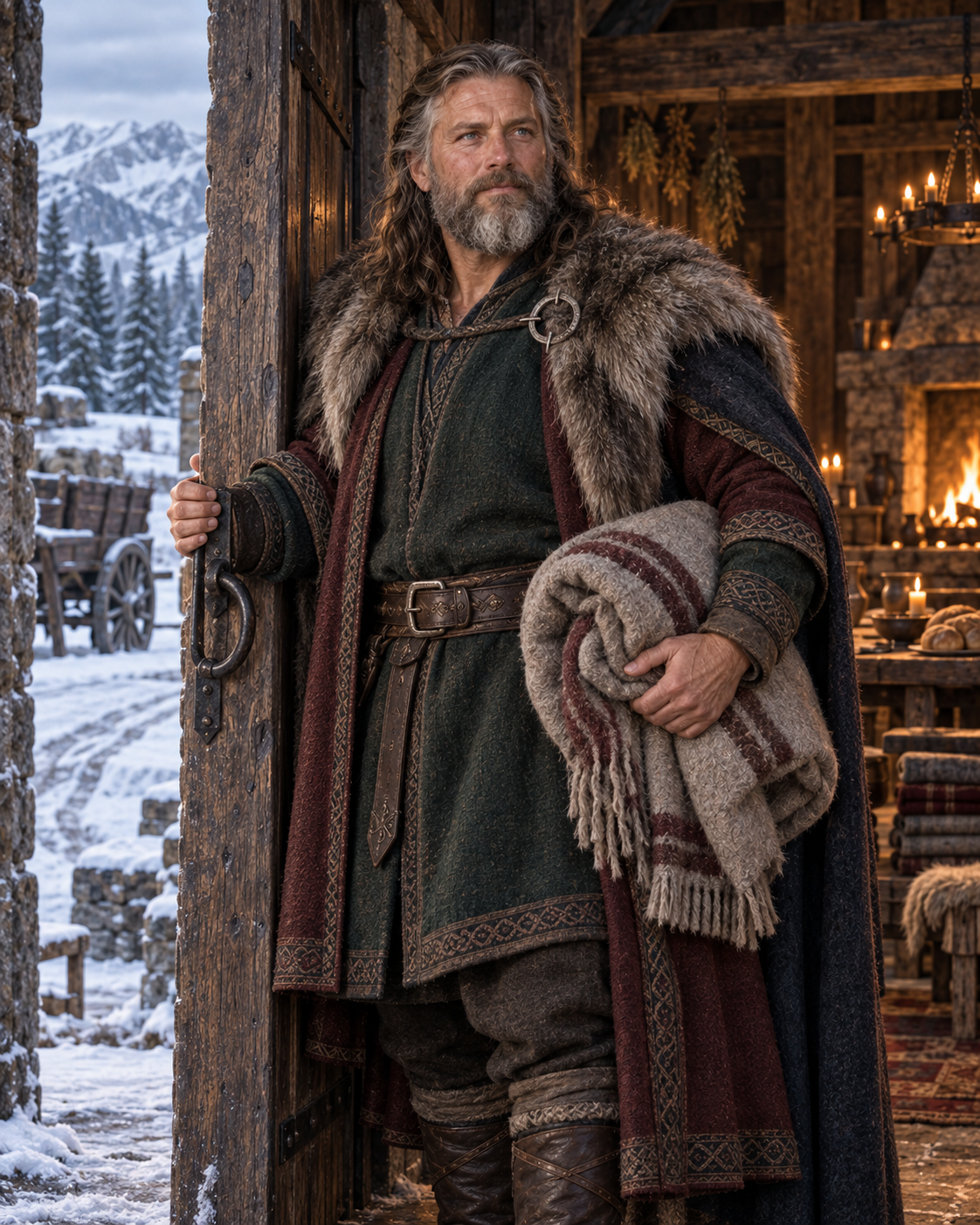
The approved identity presents one strikingly handsome mature Rimmersgard thane with a long square face, weathered fair skin, blue-green eyes, ash-brown hair silvered at the temples, a full brown-and-silver beard, spruce-and-burgundy wool, restrained fur, and an open-door household posture.
Canon supplies no exact age, face, hair, eyes, height, build, beard, clothing, armor, weapon, badge, hall, blanket, stores, wagon, mountain, pose, weather, or light. Every one of those visible choices is CVM editorial reconstruction.
This exact face, mature age baseline, broad sturdy body, complexion, eyes, hair, temple silver, beard, palette, brooch, and refuge-keeper presence now govern the franchise directory, Books 1 and 2 cards, profile hero, Gutrun retreat imagery, children-in-care context, and every later scene.
Do not clone Isgrimnur, Isbeorn, Frekke, or another Rimmersman. His canonical hero remains the open door and blanket—not a forced warrior pose for a battle record the books never give him.
On the Record
Books 1 and 2, one canonical thane, no invented battle record
This is Tonnrud’s one canonical, full-spoiler character profile. His confirmed relevance spans The Dragonbone Chair and Stone of Farewell.
Book 1 establishes Thane Tonnrud as Gutrun’s uncle and the person with whom she shelters while retreating from Skali’s pressure before reaching Naglimund with six men and twenty women and children.
Book 2 confirms that Isgrimnur and Gutrun’s other son and two daughters remain in Tonnrud’s care at Skoggey.
The record does not confirm Tonnrud’s exact age, appearance, parentage, whether the uncle relationship is maternal, paternal, or by marriage, spouse, children, military service, politics, direct opposition to Skali, resources, hall, dialogue, later actions, or final fate.
Status: alive or functioning as guardian in the latest confirmed reference; later fate unconfirmed. The approved canonical attachment now powers the featured image, hero, franchise card, both volume cards, and social metadata while remaining explicitly reconstructed beyond the verified relationship and refuge record.