
Memory, Sorrow, and Thorn · Canonical Devotional Profile
Tohuq
Tohuq is the Qanuc sky-lord and father of Sedda in the star-song Binabik shares beneath Sedda’s Blanket. He appears only inside sacred story, but that story carries a family bargain, nine children, two kinds of death, and the ancestral fork between Sithi and Qanuc. Small mention. Entire cosmology attached.
At a Glance
The sky-lord at the beginning of a story about mortality and descent
- Name
- Tohuq
- Culture
- Qanuc
- Devotional role
- Sky-lord
- Child
- Sedda
- Story relationship
- Bird-lord Kikkasut bargains for Sedda
- Grandchildren
- Nine children born to Sedda, including hidden twins Lingit and Yana
- Source
- Binabik’s sung cycle beneath the stars
- Status
- Devotional and legendary figure; literal manifestation unverified
Beneath Sedda’s Blanket
Tohuq enters the novel through music, sky-reading, and trust
Binabik names the constellation humans call Mezumiiru’s Net as Sedda’s Blanket among the Qanuc.
He then sings part of a much longer traditional cycle to Simon.
The setting matters. This is not a detached encyclopedia lecture. Simon and Binabik are traveling together, sharing food, questions, and the growing possibility that Simon might one day live among the Qanuc if Naglimund offers no safety.
The same sky carries different names and inherited stories. Binabik’s song makes cultural knowledge relational: he offers Simon a way of seeing stars that existed before Simon learned to call them by another pattern.
Tohuq appears inside that song as the sky-lord and Sedda’s father.
The text does not show Tohuq descending into the campsite, answering Binabik, or causing an observable phenomenon. His canonical presence is devotional and narrative.
Father of Sedda
The relationship is confirmed; the family dynamic is not
Sedda is described as Tohuq’s daughter.
She is pale and black-haired in the song. Those are Sedda’s details, not automatically Tohuq’s.
The text does not tell us how Tohuq raises her, whether they are close, whether she obeys him, whether he protects her, or how either understands kinship among divine figures.
It also does not name Sedda’s mother, Tohuq’s partner, other children, siblings, parents, court, dwelling, or worshippers.
Calling him “sky-lord” establishes status within the story’s cosmological language. It does not define a complete divine portfolio.
The father-daughter relationship becomes important because Kikkasut’s desire for Sedda is handled through a bargain involving Tohuq. That locates marriage within family authority and exchange rather than presenting Sedda’s union as an isolated romance.
The song’s later pain—the removal of her children and her protection of Lingit and Yana—makes that opening bargain feel consequential. The profile can recognize the structure without inventing Tohuq’s intentions or assigning him knowledge of every later event.
Kikkasut’s Bargain
A marriage begins through negotiation and becomes a story of neglect
Kikkasut, the bird-lord or bird-king, bargains for Sedda as his bride.
The surviving summary makes Tohuq the relevant sky-lord and father at the beginning of that arrangement.
It does not preserve the bargain’s exact terms, price, speaker order, consent language, ritual, location, witnesses, or outcome from Tohuq’s point of view.
We should not claim Tohuq sells Sedda, blesses the marriage, opposes it, or deceives Kikkasut unless the fuller cycle supplies evidence.
What the recorded song does establish is that the marriage leads to neglect and the birth of nine children. Kikkasut removes the children, while Sedda hides the youngest twins.
Tohuq does not re-enter the preserved portion as rescuer, judge, combatant, or adviser.
His absence from the later summary is not proof of indifference. Traditional songs compress action, and Simon falls asleep before demanding more. The novel explicitly tells us the cycle is longer than the portion received.
A responsible fandom profile marks the surviving edge rather than filling it with an imagined grandfather intervention.
Lingit, Yana, and the Two Deaths
Tohuq’s family tree reaches the Qanuc and Sithi through a choice about mortality
Sedda hides her youngest twins, Lingit and Yana.
The children must choose between two mortal patterns: Moon-death and Bird-death.
Moon-death returns cyclically. Bird-death continues through descendants.
Yana chooses Moon-death and becomes a Sithi foremother in Qanuc tradition. The Qanuc trace mortal descent through Lingit.
That makes Tohuq the divine ancestor positioned above the story’s branching lineages: Sedda’s father, and therefore ancestor within the song’s genealogy of both twins.
The profile does not treat this as externally verified biological history. It is a canonical Qanuc tradition narrated by Binabik.
The distinction does not make it unimportant. Mythic genealogy tells us how the Qanuc understand mortality, survival, kinship with the Sithi, and their place beneath a shared sky.
Tohuq’s role is foundational rather than active. The sky-lord belongs at the opening of a story whose deepest consequence is the kind of death inherited by later peoples.
Sky-Lord, Not Weather Button
The title does not assign every storm in the trilogy to Tohuq
Tohuq is called the sky-lord.
The series also contains drought, unnatural winter, lightning, blizzards, and altered seasons. None of those phenomena is attributed to Tohuq in this evidence.
It would be especially misleading to make him responsible for the Storm King’s winter merely because both figures have sky-adjacent language.
The title does not confirm control over rain, wind, thunder, stars, sunlight, birds, seasons, navigation, or prophecy.
Future Story 101 coverage may compare cultural cosmologies, but it must keep names, traditions, observed mechanisms, and reader interpretation separate.
Tohuq’s strongest confirmed celestial connection is the context of the song: Sedda’s Blanket is mapped across the stars, and he is the sky-lord named as her father.
Connections
The daughter, bird-lord, twins, and storyteller attached to Tohuq
Sedda
Tohuq’s daughter, bride of Kikkasut, mother of nine, and maker of the jeweled night-net.
Kikkasut
The bird-lord who bargains for Sedda and later removes their children.
Lingit
Sedda’s hidden son and the ancestral line through whom the Qanuc understand their mortality.
Yana
Sedda’s hidden daughter, chooser of Moon-death, and Sithi foremother in Qanuc tradition.
Binabik
The Singing Man who shares the star-cycle with Simon and preserves Tohuq’s name in the narrative.
Simon
The outsider invited into Qanuc cosmology beneath the same sky he knows by different names.
Why Tohuq Matters
He anchors a creation-sized family story inside one night of companionship
Tohuq matters because his family relationship opens one of the trilogy’s richest compact myths.
The song links sky, birds, marriage, parental loss, protection, mortality, ancestry, constellations, Sithi, and Qanuc identity.
His limited action does not make him disposable. Traditional genealogies often place a named figure at the top because authority and descent require an origin point.
He also demonstrates why the character directory includes devotional figures. Readers searching for Tohuq should not receive one sterile sentence or a fabricated god-sheet. They should find the whole story in which the name carries meaning, with every uncertainty visibly labeled.
The result is richer than false certainty: Tohuq is confirmed as sky-lord and father, culturally immense, physically unseen, and still surrounded by parts of the song Simon never hears.
Image Continuity
Devotional interpretation, never a fake canonical portrait
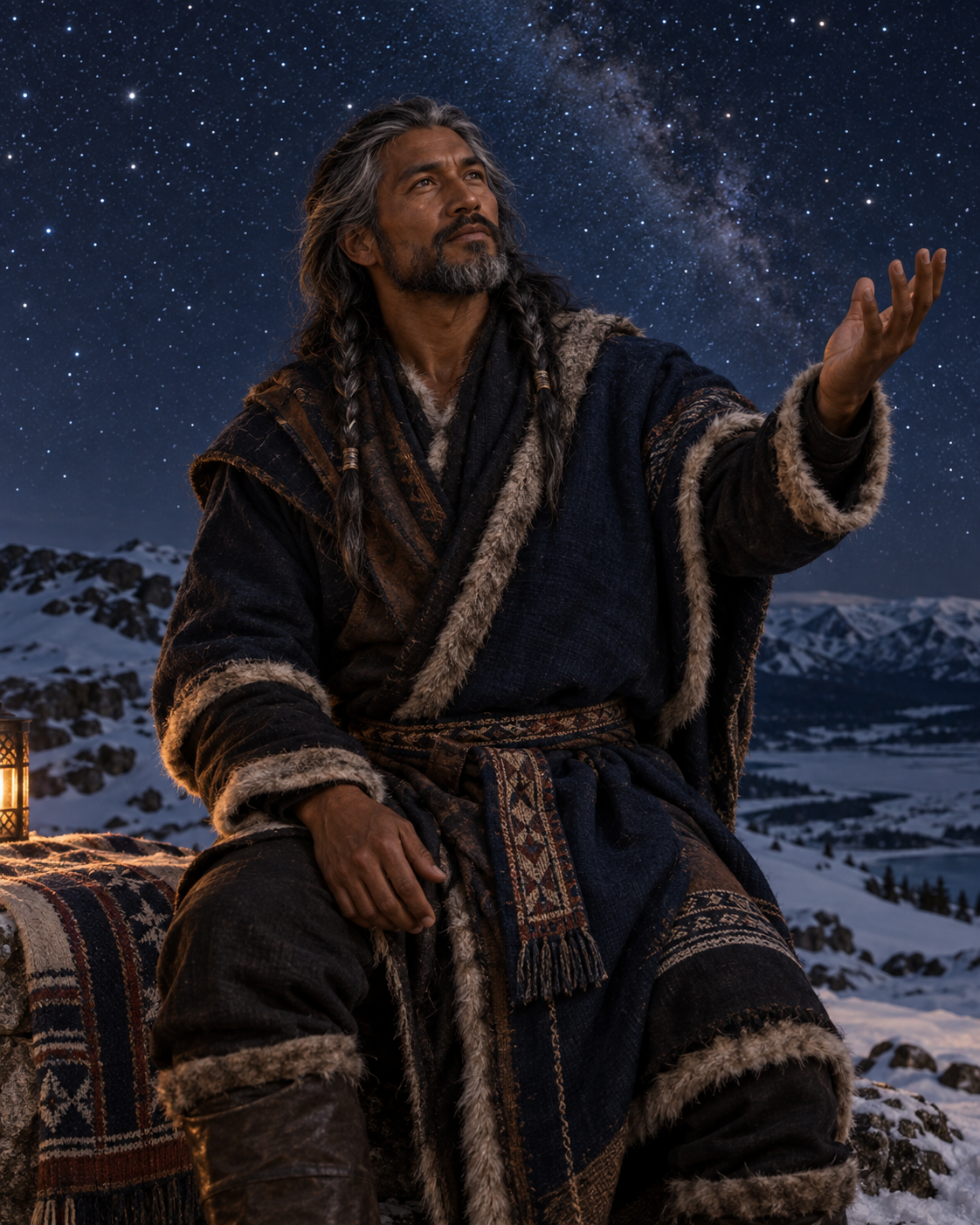
Visual state: approved Qanuc devotional interpretation. Tohuq now has one permanent symbolic identity and this profile is published.
CVM depicts Tohuq as a breathtakingly attractive adult male-presenting Qanuc figure around forty-two: compact powerful endurance build, warm-brown eyes, rich copper-brown skin, shoulder-length iron-gray hair with black underlayers in two restrained braids, a close dark-and-gray beard, and serene attention. This remains Qanuc devotional interpretation, not a witnessed body.
Canon supplies no face, skin, hair, eyes, age, build, height, clothing, crown, weapon, animal form, wings, dwelling, or weather effect.
The design uses midnight-blue, muted-copper, charcoal, bone-white, dark hide/wool, narrow fur edging, a woven sash, a nearby blanket, and one open-palm storytelling gesture beneath natural stars. It does not clone Sedda’s pale black-haired description or turn “sky-lord” into a thunder god, winged king, weather controller, or white-bearded patriarch.
Preserve this exact symbolic face, adult baseline, body, complexion, eyes, iron-gray/black hair and two-braid map, beard, midnight/copper/charcoal/bone wardrobe, sash, and star-song gesture across the canonical post, Sedda cycle art, Qanuc Story 101 pages, and every directory card while retaining the interpretive disclosure. The same attachment powers featured image, hero, card, and social metadata.
On the Record
One Book 1 song, a complete cultural relationship, and firm ontology boundaries
This is Tohuq’s one canonical, full-spoiler devotional profile. His confirmed evidence appears in The Dragonbone Chair when Binabik sings the Qanuc cycle associated with Sedda’s Blanket.
The record confirms Tohuq is a Qanuc sky-lord and Sedda’s father. It places him at the beginning of the bargain through which bird-lord Kikkasut takes Sedda as bride. The surviving song continues through nine children, the hidden twins Lingit and Yana, and the mortality choices associated with Sithi and Qanuc ancestry.
The record does not confirm Tohuq’s physical appearance, powers, worship, intervention, motive, bargain terms, relationship quality with Sedda, response to Kikkasut’s neglect, later actions, literal manifestation, or responsibility for any weather in the main narrative.
Status: devotional and legendary figure; literal manifestation unverified.
Visual state: approved Qanuc devotional interpretation. One canonical attachment powers featured image, hero, directory card, and social metadata while remaining labeled as interpretation rather than literal manifestation.