
To Green Angel Tower, Part I: The Clock Is Running and Nobody Owns the Answer
Prophecy gives the resistance a deadline, not instructions. Legends return with agency. Love creates obligations that are not ownership. And an army remains a city even after somebody hands it a banner.
The thematic engine
The final volume begins by refusing every convenient “final answer”
To Green Angel Tower, Part I collects the objects and people an epic fantasy usually treats as solutions: a newly knighted hero, a restored legendary warrior, a magical sword, a prophecy, ancient allies, a princess, and an army. Then it asks whether anyone knows what those things mean, whether they consent to the role assigned to them, and whether the enemy designed the quest in the first place.
The result is not cynical. It is demanding. Hope remains possible because people interpret, argue, care, and correct course—not because a cosmic checklist has guaranteed victory. The Conqueror Star can name an hour without explaining what to do in it. Camaris can rally Nabban without becoming public property. Simon can become Miriamele’s champion without purchasing her decisions. Josua can command an army only by admitting the civilians are the purpose of the army.
Theme one
Identity is practice, not ceremony
Simon’s knighting is real. It also fails to produce the internal transformation he expected. The public sees banner, sword, squire, beard, scar, and title. Simon sees the same mooncalf wearing upgraded equipment. Binabik’s answer cuts through the pageantry: Simon changed on Urmsheim and keeps changing through choices. The accolade names a responsibility already forming; it does not install adulthood.
Camaris makes the same argument from the opposite direction. He has the famous name and recovered technique, but memory, selfhood, and willingness remain incomplete. He begins Simon’s education with horse care, stance, equipment, and the Canon because “knight” means disciplined service rather than a useful arm holding a prestigious weapon. The restored hero trope becomes a consent problem the coalition would rather call destiny.
Sisqi describes her rescue of Binabik as their marriage even without formal words. The act becomes identity because both understand the chosen obligation. The death-sung Talons reveal the darker version: ritual makes living Norns socially dead before their mission ends. In every case, status changes how communities treat bodies. The book keeps asking whether the person inside the title helped choose it.
Romance and obligation
Rescue creates responsibility, not ownership
Simon and Miriamele’s relationship advances because the story finally separates devotion from entitlement. The White Arrow embodies Jiriki’s pledge to Simon. Miriamele refuses it because his love cannot transfer someone else’s promise. Simon then offers what is genuinely his: service. She accepts him as champion with an ordinary sword, turning longing into a vow without turning herself into his reward.
Aditu’s shent lesson names the ethical mechanism. Effective action requires imagining the other person’s mind. Saving Miriamele may frighten her because an unpayable debt can feel like another chain. Simon’s good intentions do not override that experience. When he later follows her, the act remains debatable, but he grounds it in offered service rather than a claim over her destination.
The contrast with Aspitis is brutal and deliberate. He uses beauty, rank, hospitality, and marriage language to make captivity sound generous. He treats protection as proof of permission. Gan Itai’s resistance and Miriamele’s eventual escape expose the missing test: can the protected person refuse, leave, and remain fully human afterward?
Prophecy and time
The Conqueror Star is a deadline, not a divine instruction manual
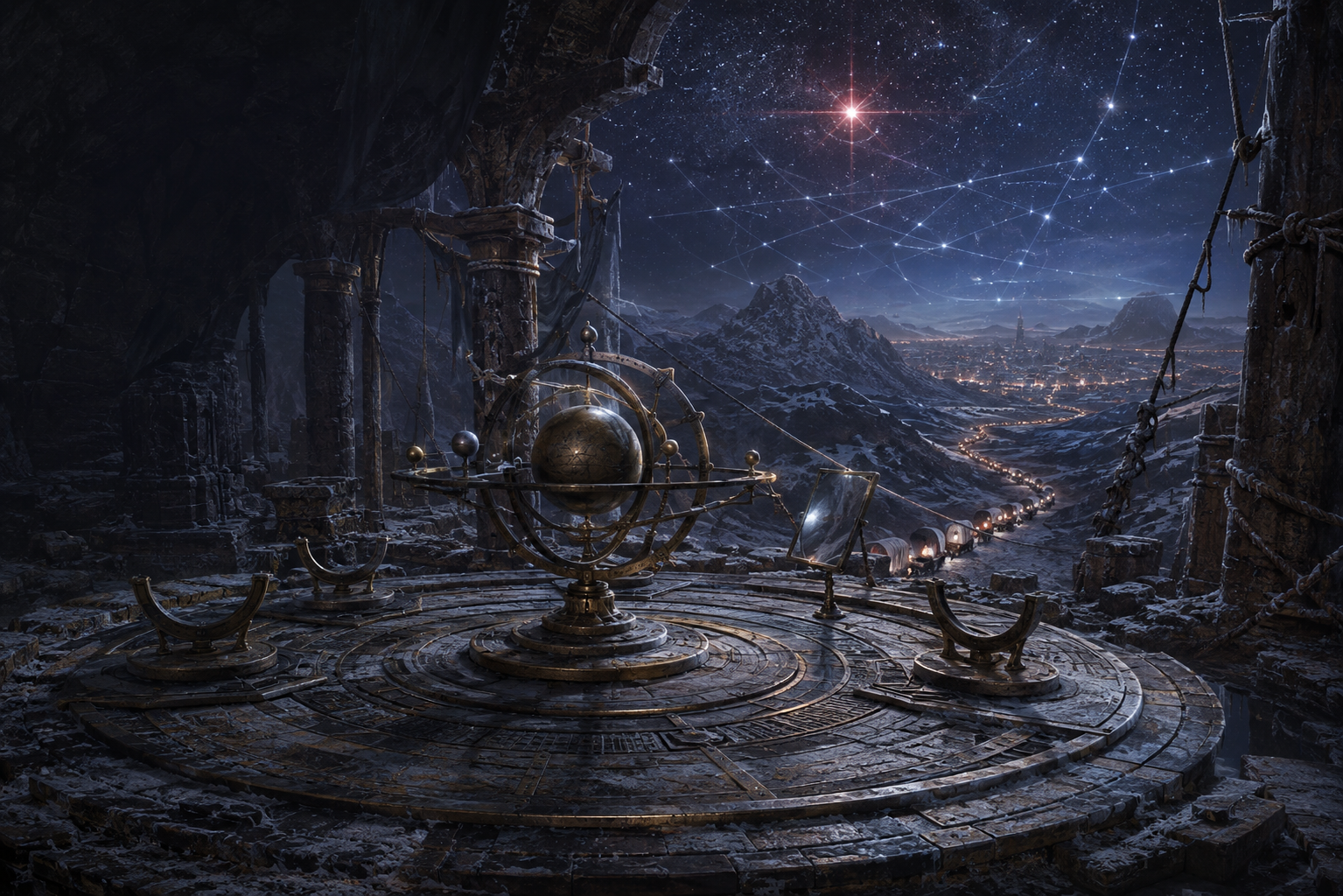
Morgenes’s research ties the star’s five-hundred-year cycle to fallen empires, Asu’a, and Ineluki’s working. Its three appearances—bright, almost hidden, then brightest—create a measurable window. The third approach pressures Josua’s campaign and corresponds to Ineluki’s withdrawal into a deeper source of power. The sky supplies urgency without supplying trustworthy interpretation.
That matters because the Three Swords prophecy may describe a trap as easily as a cure. Thorn, Bright-Nail/Minneyar, and Sorrow do not become morally aligned because a verse places them in one sentence. Every sword has a history, bearer, location, and capacity to act through people. “Gather the objects” is therefore not strategy. It is the moment strategy becomes necessary.
The book pairs the cosmic clock with mortal bodies. Vorzheva’s bleeding pregnancy, refugees’ hunger, wounds, exhaustion, and travel speed keep the campaign from living at prophecy’s abstract scale. War councils can discuss winter’s end; Geloë and Gutrun must decide whether a pregnant woman can survive tomorrow’s road. Time is political because not every body can move at the pace heroic urgency demands.
Magic as infrastructure
Witnesses make communication powerful by making it dangerous
The Observatory is Rhao iye-Sama’an, built over the Earth-Drake’s Eye. It can amplify a smaller Witness such as Jiriki’s mirror toward the reach of a place-bound Master Witness. Pools, scales, columns, shards, lamps, and other devices form a damaged network across Osten Ard. This is not decorative lost technology. It determines who can see, speak, mislead, and intercept across distance.
Simon’s vigil vision arrives without a Witness he knowingly activates. Aditu is alarmed because the event sits outside Amerasu’s understanding of him. Jiriki’s attempt to use the network becomes visible to Utuk’ku, who blocks him through Speakfire and the Shard of Mezutu’a. Tiamak’s ghant captors force a mirror fragment into his wounded hands and open him to a hostile mind.
Connection therefore behaves like a door with no guaranteed one-way lock. The resistance needs its scattered knowledge to converge; every convergence point can expose a route back to the speaker. The same theme applies without magic when Pryrates controls public stories, messengers, and access to institutions. Communication is never merely content. It is architecture.
Power from below
The refugee army trope works only when the refugees remain people
A settlement does not become baggage when soldiers appear
Josua’s procession includes carts, livestock, children, sick people, fighters, and civilians who did not volunteer to become epic scenery. The moving-town appearance is not an embarrassment to be edited out. It is the political truth of his cause. If military speed requires abandoning the people he claims to defend, the resistance has already copied Elias.
Collective knowledge defeats a larger force
The victory uses riverboat shields, Qanuc ice work, Thrithings horsemanship, secrecy, local terrain, and adaptation after the enemy counters the first plan. No lone genius owns it. The deaths of Deornoth, Snennq, Helfgrim, his daughters, and others prevent clever tactics from becoming consequence-free competence porn.
Symbolic power can rally people and consume the symbol
Josua chooses Nabban partly because Camaris’s return can fracture Benigaris’s claim. The plan is rational. It also asks a damaged old man to become a public instrument before he has explained himself. The book holds strategic necessity and personal violation in the same frame.
An old bargain becomes present alliance
The Fox’s Bargain brings the Sithi west to repay Prince Sinnach’s five-century faithfulness. Their intervention breaks Skali’s occupation, but history does not eliminate cultural distance. Eolair recoils at a severed head that Likimeya understands through older custom. Alliance requires more than shared enemies.
Memory and forgetting
Perfect recall can become a prison; forgetting can become mercy or evasion
The Sithi carry living memory across centuries, ride ancient roads their horses know, and preserve songs capable of waking buried recognition in Camaris. That continuity allows the Fox’s Bargain to be honored and old crimes to remain legible. It also sustains grief so long that extinction can begin to resemble fidelity.
Simon’s moral-injury conversation with Strangyeard makes the theme human-sized. If divine knowledge includes every horror, perhaps even God chooses to forget some pain. Simon connects that possibility to Sithi exhaustion. The book does not declare forgetting good. Elias forgets or rewrites responsibility. Political institutions suppress inconvenient evidence. Camaris’s lost memory leaves him vulnerable. The ethical question is what forgetting protects and whom it abandons.
Maegwin demonstrates memory reorganized into another reality. Her grief, visions, and leadership fuse until Sithi country becomes heaven and living companions become the dead. Eolair’s kindness cannot simply argue her back. Her love confession is emotionally real; the cosmology containing it is not safely shared. Williams refuses the cheap comfort that sincerity guarantees truth.
Institutions and access
The apocalypse still needs doors, servants, rumors, and supply lines
The Hayholt’s reality fracture is supernatural, but Elias and Pryrates built the human permissions that let it advance. Nabban’s collapse likewise requires Benigaris, Stréawe, frightened officials, manipulated Church authority, levies, money, and controlled narratives. Utuk’ku’s plan uses Talons, Red Hand singers, Witnesses, occupied territory, and the social condition of being death-sung.
This keeps evil from becoming weather. The winter may be unnatural, but people still decide who receives food, which testimony counts, whose body becomes expendable, and whether cruelty can be renamed order. Fengbald’s child-hunt is the miniature version: he defines murder narrowly enough to preserve his self-image while treating terror as sport.
The split ending
Departure becomes the honest answer to false convergence
The volume gathers Camaris, Miriamele, Tiamak, the Sithi alliance, Qanuc riders, Hernystiri volunteers, and Josua’s campaign—then splits them again. The Talons enter the abandoned Observatory. The camp burns. Simon and Miriamele ride away. Josua’s caravan moves toward Nabban while the Sithi and Hernystiri turn toward Naglimund.
The story is not losing focus. It is proving that “together” was never a strategy.
Every group carries a different clock, obligation, blind spot, and piece of knowledge. The next movement must test whether those differences can coordinate without one authority flattening them. That is the series’ political argument hiding inside a page-turner ending.
On the record
Read front-to-back, then traced through mechanism
Return to the To Green Angel Tower, Part I hub → · Read the complete Plot → · Follow the Character Arcs → · Open the series hub →