
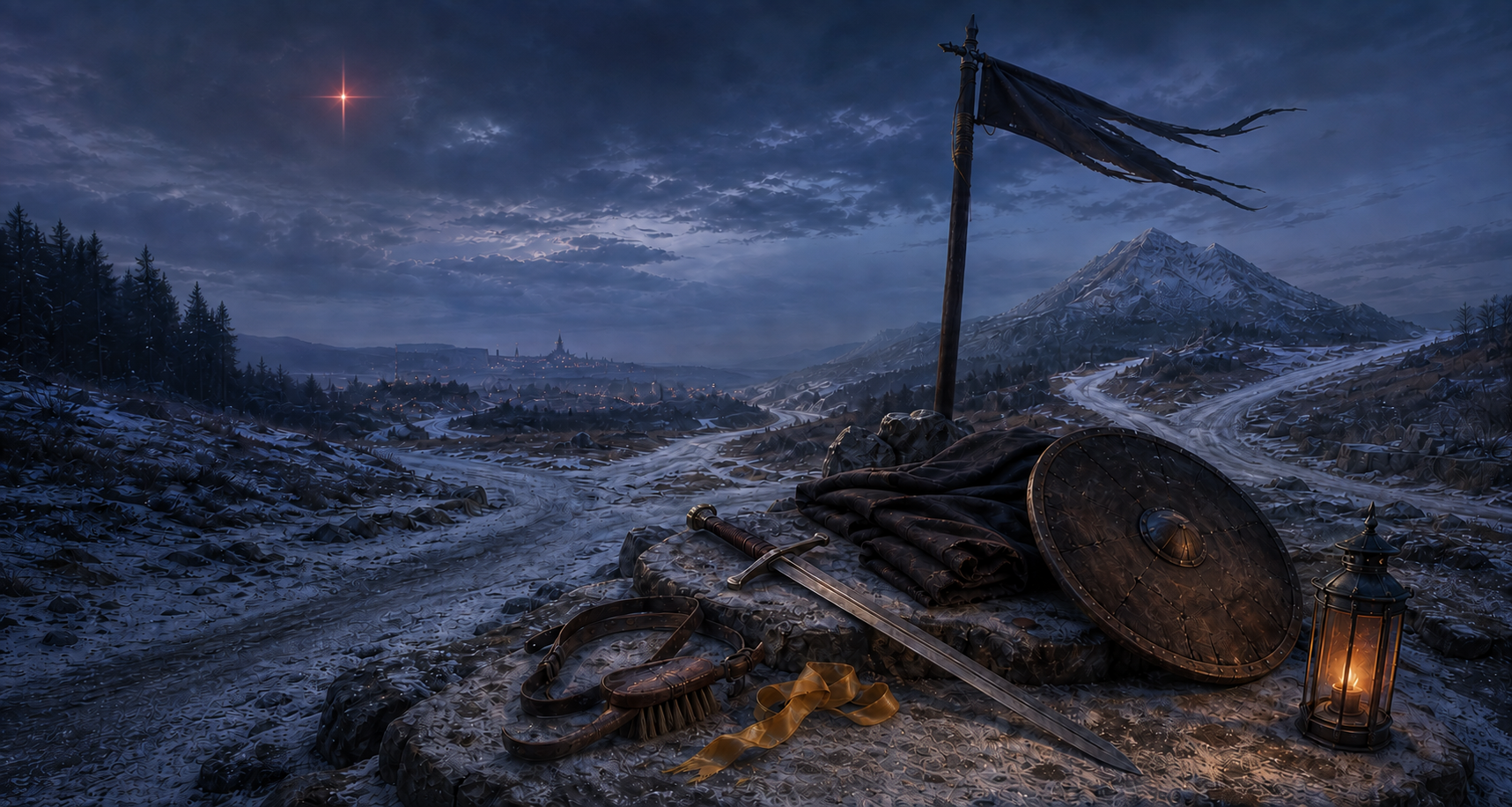
To Green Angel Tower, Part I: Becoming Is Not the Same as Arriving
Titles, reunions, recovered legends, love confessions, and military plans all look like destinations. This volume keeps exposing them as the next difficult beginning.
How the volume changes people
The ceremony happens first. The person has to catch up afterward.
To Green Angel Tower, Part I is ruthless about the gap between identity as a public label and identity as repeated practice. Simon becomes a knight before he knows how to command. Camaris becomes “returned” before he can explain where he went. Josua becomes the leader of an army that still looks like a displaced town. Miriamele becomes Simon’s beloved and political symbol in other people’s minds while privately preparing a mission neither role can contain.
The book also rejects the idea that pain automatically produces wisdom. Elias grows worse. Maegwin’s visions close around her. Cadrach’s remorse does not reliably govern his next decision. Guthwulf’s terror clarifies the Hayholt but does not erase what he did before losing his sight. Change is measured in choices under pressure—and sometimes the pressure reveals a person has built an entire identity around not changing.
Simon
Sir Seoman still has to learn how not to be a fool with better accessories
Simon’s vigil, banner, squire, and accolade make his new status visible. Internally, he remains furious that the “Dragon Slayer” story has replaced his real encounter with Igjarjuk. He knows Thorn acted through him, suspects the dragon survived, and remembers terror rather than triumph. That resistance to his own legend is one of his healthiest instincts.
His less healthy instincts remain fully operational. Simon is jealous, eager to prove usefulness, careless around supernatural access, and convinced that adulthood should feel more decisive than it does. Binabik gives him the correct answer: the ceremony did not transform him because growth happened on the road and will keep happening at its own pace. Simon is still extremely Simon. The book considers that a condition to manage, not a curse to cure.
First command pushes theory into consequence. Simon scouts Fengbald’s army with Hotvig, Sludig, and Thrithings riders. He accepts that Hotvig may be Josua’s safeguard rather than turning supervision into an insult. He contributes, listens, and helps carry knowledge back. At the Lake of Glass, collective tactics win while Deornoth and Snennq die. Simon wants enemies dead and remembers some Erkynguards as men who once gave him sweets. Binabik refuses to solve the contradiction for him. Adulthood means choosing while uncertainty remains.
Camaris then demolishes the fantasy that a sword tap finishes making a knight. Horse care, balance, equipment, mercy, discipline, and the Canon come before glamorous technique. Simon ends the volume applying that lesson imperfectly but genuinely. When Miriamele leaves, he does not claim her life as payment for saving it. He invokes his freely offered service, writes an awful farewell, retrieves the White Arrow and mirror because promises have owners, and follows. It may be strategically disastrous. It is still a more ethical choice than demanding her secret or letting rank decide she must travel alone.
Miriamele
She stops confusing surrender with patience—and secrecy with freedom only slowly
Miriamele opens at sea trying to reinterpret submission to Aspitis as drifting with the tide. Her body and mind are exhausted; reframing captivity is a survival maneuver, not consent. Cadrach’s confession and Gan Itai’s plan return information and choice. Gan Itai’s sacrifice creates the physical escape, but Miriamele must carry its cost into every later decision.
The landing boat strips away rank, beauty, and romance-novel staging. Miriamele rows, dresses Cadrach’s torn hands, uses Gan Itai’s supplies, travels as a beggar, and revisits the wreckage of her earlier certainty. She recognizes that both of her preferred extremes—charging ahead and surrendering direction—have failed. The “third path” she wants requires consultation without obedience and courage without impulsiveness. She has not mastered it by naming it.
Reunion with Simon makes that unfinished work visible. She sees that he has grown into his long-boned face and may become handsome. She values his courage and pledge. She also feels the burden Aditu later explains to him: owing your life to someone can make intimacy frightening, especially when everyone expects gratitude to mature into romance. Miriamele refuses the White Arrow because it belongs to Jiriki’s promise, not because Simon’s feeling means nothing.
Her final departure asserts agency and repeats an old danger. She believes the task is hers, refuses to explain it, and plans to use the camp’s confusion as cover. The narrative respects her right to act while refusing to call isolation automatically wise. Simon’s decision to follow does not cancel her mission. It forces the next volume to test whether partnership can exist without possession or concealment.
Camaris
The returned legend insists on remaining a damaged human being
Camaris reenters public history while still carrying the childlike Ceallio self that survived outside it. Josua kneels. The camp invents explanations. Towser recognizes him and dies with an old secret still guarded. Political leaders immediately understand that the name Camaris can raise Nabban, and the reader can see how quickly a vulnerable person becomes public equipment.
The old knight does not merely resist through silence. He restores the moral content other people strip from knighthood. His training of Simon begins with the horse and the Canon. He will lead if Josua chooses Nabban, but he mourns Leobardis, condemns Benigaris, and treats his own survival as burden rather than proof of divine favor. His unease around Thorn and his intimate knowledge of Amerasu’s song suggest a hidden life no heroic pageant can contain.
Camaris’s arc is therefore not “legend awakens.” Technique returns before explanation. Political usefulness returns before personal integration. The strongest fighter in the coalition may also be the person whose consent everyone is most tempted to skip because history has already decided what he is for.
Leadership
Josua, Binabik, Sisqi, and Eolair practice authority through relationship
A prince learns that civilians are the campaign
Josua mourns Deornoth without hiding the moments when grief makes him unfair. He lets Simon walk with him rather than demanding ceremonial distance. When New Gadrinsett becomes an army, he refuses proposals that quietly define the slow, sick, young, or swordless as expendable drag. Choosing Nabban combines food, ships, politics, and timing rather than pretending courage is a route plan. He still uses Camaris’s name as a banner, but the discomfort remains visible.
Love stops waiting for ceremony to become real
Sisqi names the night she rode to free Binabik as their marriage, whether or not formal words follow. Her hundred riders join the lowlander war because cooperation may protect Yiqanuc. Binabik admits his bond with Simon is friendship—not disguised fatherhood—and accepts that Simon’s independence changes what care requires. Both relationships mature by abandoning ownership.
Kindness becomes action when certainty is unavailable
Eolair witnesses the Sithi fulfill the Fox’s Bargain and carries intelligence toward the coalition. His hardest duty remains Maegwin. Kira’athu cannot cure her and offers one instruction: be kind. When Maegwin confesses love while believing both are dead, Eolair cannot answer honestly without entering the delusion or hurting her. Loyalty becomes presence inside an impossible question.
Translation becomes emotional strategy
Aditu links Sithi history, Witness danger, shent, Camaris, and the Nenaïs’u–Drukhi catastrophe. Her most immediate intervention is explaining that rescue can burden the rescued. She teaches Simon to imagine Miriamele’s mind rather than treating his good intention as sufficient evidence. The ancient envoy helps the adolescent romance by making it less self-centered.
People breaking in different directions
Maegwin, Elias, Guthwulf, and Cadrach refuse the comfort of tidy redemption
Maegwin’s leadership began as fierce protection, but trauma and vision have fused into a closed spiritual system. The Sithi victory looks like heaven because she believes she has already died. Her confession to Eolair is emotionally true inside a reality claim he cannot share. Love reaches him; correction cannot safely reach her. The arc hurts because courage and delusion remain intertwined.
Elias continues choosing the story that makes his suffering everyone else’s crime. Sorrow, dreams, Pryrates, grief for Ebekah, and physical deterioration all constrain him. None removes agency. When Fengbald falls, Elias doubles down on Josua’s supposed treachery and threatens anyone approaching the Dragonbone Chair. Even Pryrates becomes uneasy—not because the king has recovered independence, but because instability is becoming harder to steer.
Guthwulf achieves terrible clarity after losing status, sight, and confidence. He hears the Hayholt’s overlapping realities and understands that Sorrow recognizes him. This knowledge does not retroactively purify the Hand who served conquest. It turns him into a witness precisely because his former intimacy with power leaves him inside the collapsing structure.
Cadrach confesses that he gave Pryrates access to forbidden knowledge and asks no forgiveness. He assists Miriamele’s escape, rows until his hands split, cares, lies, panics underground, understands Nisses’s text, and may still flee the responsibility closest to him. Remorse has made him legible, not reliable. The distinction keeps every useful choice meaningful.
The volume’s group arc
Everyone becomes more useful to one another—and less easy to arrange
The resistance ends Part I with more knowledge, more allies, Camaris, Tiamak, the Sithi, Qanuc riders, Hernystiri volunteers, and a route toward Nabban. It also ends with Simon and Miriamele gone, Maegwin unstable, Vorzheva’s pregnancy endangered, the Talons inside the abandoned camp, and the enemy’s cosmic timetable accelerating.
That is the actual coming-of-age argument
Growing up does not mean becoming predictable enough for the war council to place you on its board. It means learning what you owe, what you cannot own, when to listen, when to refuse, and how to choose while every answer remains incomplete. Part I stops exactly when those private choices begin colliding with the coalition’s public plan.
On the record
Read front-to-back, then reconciled by choice and consequence
Return to the To Green Angel Tower, Part I hub → · Read the complete Plot → · Open Tropes & Themes → · Open the series hub →