
Memory, Sorrow, and Thorn · Canonical Character Profile
Thrinin
Thrinin is a Rimmersman soldier of Saegard, named with Hani and Utë among the dead when Bukken attack armed people on open ground. The series preserves no heroic last stand for him. It preserves something strategically colder: his death helps prove that the North’s remembered rules no longer work.
At a Glance
A named soldier inside the report that turns folklore into military intelligence
- Name
- Thrinin
- People
- Rimmersman
- Home or unit association
- Saegard
- Role
- Soldier
- Companions named in the same report
- Hani and Utë
- Enemy
- Bukken / Boghanik
- Historical significance
- One of the armed people killed when Bukken attack in the open
- Status
- Dead
A Soldier of Saegard
Thrinin’s surviving identity begins with military service and a northern place
Thrinin is identified as a Rimmersman soldier associated with Saegard.
That is a narrow biography, but it is not an empty one. “Soldier” places him among armed people whose ordinary job requires collective movement, watch, discipline, and response to danger. “Saegard” places that service within a named northern community rather than an anonymous fantasy army.
The record does not establish whether Saegard is his birthplace, residence, garrison, lord’s holding, or simply the company named in the report. It does not supply his rank, years of service, oath, pay, family, commander, or earlier campaigns.
Calling him a veteran would be invention. Calling him inexperienced would be invention too.
His Rimmersman identity matters because the council where his death is discussed is already full of southern dismissal and inherited contempt. Men who live closer to the danger know Bukken behavior as practical survival knowledge; southern delegates initially treat the creatures as superstition.
Thrinin’s death is therefore not a spooky rumor floating free of institutions. A named soldier attached to a named place has been killed in an attack northern witnesses recognize as abnormal.
Future site connections should link Saegard, Rimmersgard, the Bukken explainer, Isgrimnur’s northern testimony, and Jarnauga’s evidence map. They should not build an invented family tree merely to make one casualty feel important.
The Open-Ground Bukken Assault
The creatures leave their remembered pattern and kill people prepared to fight
Thrinin dies with Hani and Utë during a Bukken attack against soldiers on open ground.
The location and target pattern carry the significance. Bukken are understood as subterranean threats, scarce even in the Frostmarch and associated with attacks from concealment. They do not ordinarily emerge to challenge armed groups in open country.
This time they do.
The record does not isolate Thrinin inside the assault. It does not tell us where he stood, whether he was on watch, what weapon he carried, whom he warned, how long he fought, whether he wounded an attacker, or which creature killed him.
No final words survive. No named witness describes his body. No burial is recorded.
That absence blocks cinematic invention, not meaning. Thrinin’s military status sharpens the violation of expectation: the dead are not lost children or lone travelers selected because they fit an old pattern. They are armed people in the open.
The attack changes risk calculation for every northern road and camp. If experienced local assumptions can no longer predict where the creatures will strike or whom they will avoid, ordinary defense planning collapses.
Thrinin becomes part of that new fact. His profile must not give him a fake duel to earn significance he already possesses.
From Casualty Report to Storm King Warning
Jarnauga does not wave at “bad omens”; he builds a chain, and Thrinin is one of its receipts
The Naglimund council begins by arguing over mortal responsibility: Elias’s rule, Skali’s seizure of Elvritshalla, taxes, imprisonment, territorial threats, and whether Josua should resist his brother.
Isgrimnur brings northern testimony into that room. His journey includes the massacre at Saint Hoderund, dispossession at Vestvennby, and the Bukken assault.
Jarnauga then connects that attack to other observed changes. Winter has displaced summer. Hunën move south. Stormspike’s forges burn and sound through the night. Norns act under Utuk’ku. Bukken leave the earth to attack soldiers.
Thrinin’s death belongs to the reported-military-event layer of that argument. Jarnauga is not established as the eyewitness who watched him fall, and his interpretation should not be mislabeled direct observation.
The distinction strengthens the evidence map. Named casualties and northern testimony support changed Bukken behavior; Jarnauga combines this with personal observation and wider League knowledge; only then does he identify Ineluki as the final enemy.
Thrinin is not proof by himself that the Storm King commanded every creature’s movement. The report does not identify orders, magic, messenger, or chain of command.
He is proof that something real and operationally dangerous happened before the council began debating its cause.
That difference—event first, explanation second—is one of the trilogy’s smartest habits. The profile preserves it.
Northern Knowledge Meets Southern Disbelief
A dead soldier becomes easier to dismiss when the room thinks his killer is folklore
Devasalles initially treats Bukken as the kind of northern tale educated southerners need not respect. The dismissal is not harmless skepticism. It decides whose danger counts as evidence.
Isgrimnur emphasizes that the creatures are scarce even where northern people know them. Their rarity does not make them imaginary. It makes the mass open-ground assault more alarming.
Binabik’s presence exposes the same hierarchy. Rimmersmen insult Qanuc as baby-stealers while southern listeners ask the troll to authenticate Jarnauga’s warning. The room wants northern expertise without automatically granting northern people dignity.
Thrinin sits at the sharp end of that contradiction. He is a northern soldier killed by a threat outsiders can call superstition from a warm council table.
The profile should not claim Thrinin personally knew Binabik, Jarnauga, Isgrimnur, Devasalles, or anyone at the Raed. His relationship to them is evidentiary: they argue over the event in which he died.
Nor should it reduce every skeptic to a fool. Extraordinary claims deserve questions. The failure comes when social prejudice decides the answer before testimony is heard.
Thrinin’s name helps resist that erasure. “Three soldiers died” can remain remote. Hani, Thrinin, and Utë were people before they became a talking point.
Hani, Thrinin, and Utë
A shared sentence creates common context, not one interchangeable character
The report groups three names: Hani, Thrinin, and Utë.
All three belong to the same fatal event and Saegard association. That shared evidence will necessarily appear on all three canonical profiles.
It does not authorize cloning.
Thrinin’s confirmed differentiator is that the record explicitly calls him a Rimmersman soldier. Hani is identified as a young Rimmersman; Utë is identified as a soldier of Saegard. The available evidence does not say that Hani was younger than Thrinin, that Thrinin outranked the others, or that Utë belonged to a different people.
Each future portrait needs a distinct face and body. Each directory card needs the same canonical image used on that person’s hero. A group battle image may support the Bukken React or Story 101 page, but it cannot substitute for three identities.
The site also must not distribute invented actions for visual variety—Thrinin with a spear, Hani with a bow, Utë dying at a shield wall—unless later verified text actually supplies them.
Individuality does not require fan fiction. Names, roles, evidence boundaries, and honest visual design are enough to keep three people from collapsing into “miscellaneous dead soldiers.”
Connections
The fellow dead, northern witnesses, skeptics, and larger winter around Thrinin
Hani
A young Rimmersman of Saegard named among the dead in the same attack.
Utë
A Saegard soldier killed with Thrinin and Hani during the open-ground assault.
The Bukken
The subterranean creatures whose altered target and terrain pattern turns these deaths into a wider warning.
Duke Isgrimnur
Brings the northern attack report into the Naglimund council as part of his dispossession testimony.
Jarnauga
Places the changed Bukken behavior within a larger evidence chain pointing toward Ineluki.
Devasalles
Represents the southern skepticism the northern witnesses must overcome before the event is treated seriously.
Character Image Continuity
A distinct Saegard soldier, alive before the casualty report and never reduced to gore
Visual state: approved editorial reconstruction. Thrinin now has one permanent living identity and the canonical profile is published.
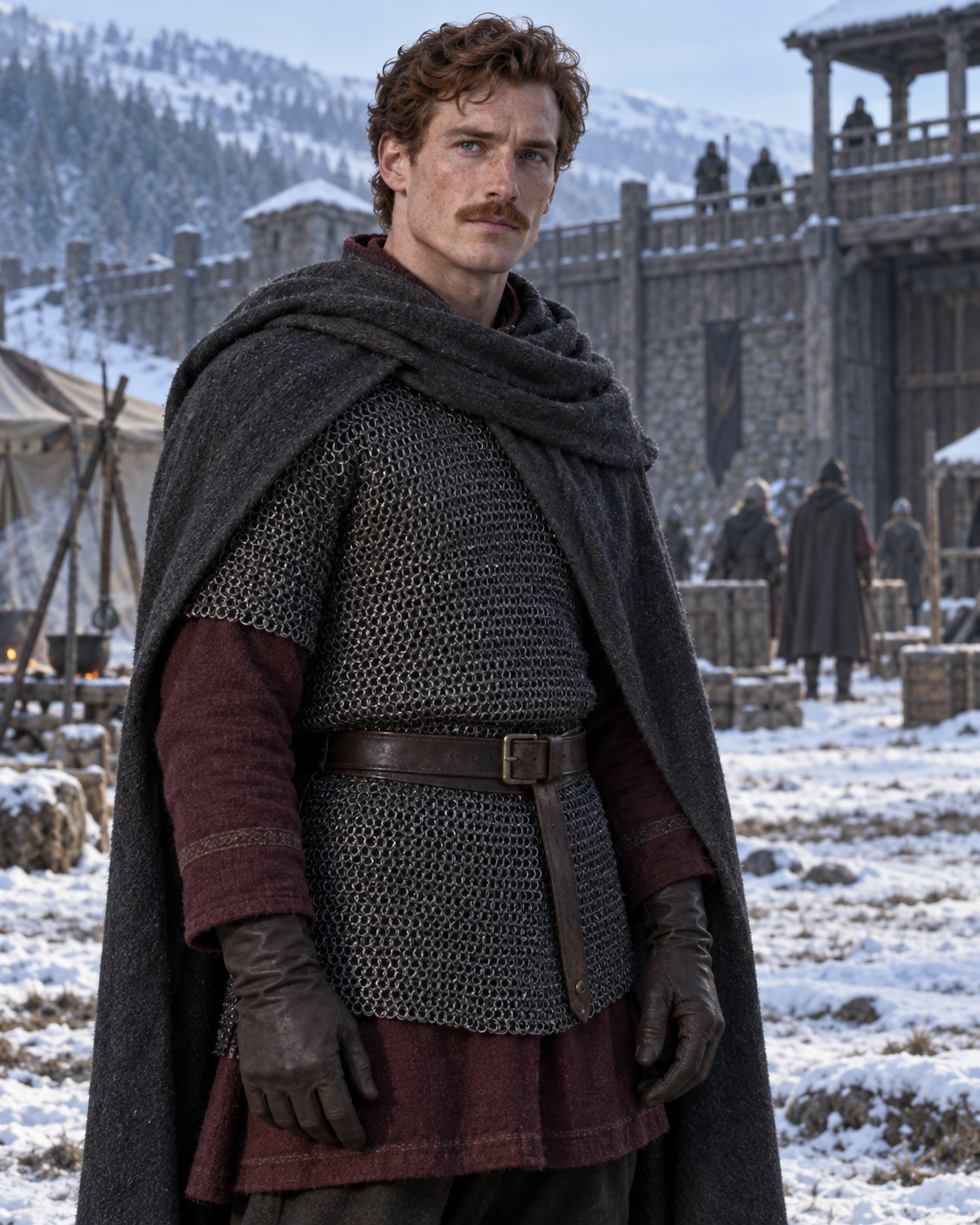
CVM depicts Thrinin as an exceptionally handsome adult Rimmersman around twenty-nine: lean powerful endurance build, deep-blue eyes, fair cold-reddened freckled skin, thick short wavy auburn-brown hair, one neat narrow auburn mustache with clean-shaven jaw, and calm observation. He remains visually distinct from Hani, Utë, Stortfot, Sludig, Isgrimnur, and the larger northern cast.
Canon supplies no exact age, skin, hair, eyes, facial hair, height, build, clothing, armor, rank marks, heraldry, weapon, mount, injuries, or death pose.
The approved portrait represents him alive on snow-dusted ground outside Saegard in muted burgundy, charcoal, worn mail, dark leather, and gloves. A canonical portrait is an identity, not a corpse card.
Scene art may depict open ground, an armed camp, displaced winter, and Bukken emerging outside their remembered terrain. It must not assign Thrinin a final stand, specific opponent, wound, or weapon unsupported by the text.
Do not use Hani’s or Utë’s future face with different hair. Do not make every Rimmersman the same fur-draped fantasy raider. Saegard’s visual language can be shared through materials and climate while faces and bodies remain individual.
Preserve this exact face, adult baseline, body, complexion, freckles, eyes, auburn-brown hair, narrow mustache, clean jaw, burgundy/charcoal/mail/leather wardrobe, and quiet vigilance across featured image, profile hero, directory card, social metadata, Bukken 101 references, and every later visual callback. The same attachment powers all canonical placements.
Why Thrinin Matters
He gives the supernatural escalation a human, military, and named cost
Thrinin matters because the series does not announce the changing world with a weather graphic and move on.
It names people killed when an old danger changes behavior.
His death connects local knowledge to strategic consequence. It shows that weapons and open ground no longer provide the security northern communities expect. It gives Jarnauga’s supernatural warning a material foundation. It exposes how political rooms rank testimony by region and culture.
Most of all, his name prevents the event from becoming clean lore.
The Bukken are fascinating. Their changed behavior is a useful clue. Thrinin is the reminder that clues arrive through somebody’s loss.
On the Record
Book 1 wartime testimony, fully spoiled and tightly bounded
This is Thrinin’s one canonical, full-spoiler character profile. His confirmed evidence belongs to The Dragonbone Chair through the northern report discussed at Naglimund.
The record identifies Thrinin as a Rimmersman soldier associated with Saegard and names him with Hani and Utë among the dead from an unprecedented Bukken assault against armed people on open ground.
His death contributes to the evidence chain Jarnauga uses to argue that the displaced season, Hunën migration, Stormspike activity, Norn action, and changed Bukken behavior belong to a danger larger than Elias alone.
The record does not confirm Thrinin’s exact age, family, rank, appearance, equipment, individual action, killer, wounds, final words, body recovery, burial, friendship with the other dead, or direct relationship with the council witnesses.
Status: dead; killed during the open-ground Bukken assault.
Visual state: approved editorial reconstruction. One canonical attachment powers featured image, hero, directory card, and social metadata; all unsupported appearance, clothing, camp, and pose details remain disclosed as CVM reconstruction.