
Memory, Sorrow, and Thorn · Canonical Character Profile
Thane Stortfot of Vestvennby
Stortfot is the thane who meets his dispossessed duke with fifty housecarls, refuses Isgrimnur passage through Vestvennby, announces that Elvritshalla now belongs to Skali, and offers to escort him into the usurper’s “mercy.” Later, Sludig wants blood. Binabik insists the mission matters more.
At a Glance
The local thane who makes Elias’s dispossession order physical
- Canonical name
- Stortfot
- Title
- Thane of Vestvennby
- People
- Rimmersman
- Force
- Fifty housecarls
- Action
- Refuses Duke Isgrimnur passage and reports Elias’s dispossession order
- Offer
- Escort into Skali’s mercy
- Later consequence
- Sludig wants to detour and kill him
- Status
- Alive at Vestvennby; later fate unknown
The Road Through Vestvennby
Isgrimnur reaches his own North and finds another man controlling the threshold
Isgrimnur’s northbound party reaches Vestvennby after violence, loss, and worsening evidence that the realm’s danger exceeds ordinary politics.
Thane Stortfot meets him with fifty housecarls.
The number matters. Stortfot is not delivering a private letter or apologizing for a closed gate he cannot control. He has enough armed support to make refusal enforceable.
He denies Isgrimnur passage.
The record does not describe a fight, siege, arrest, or weapon drawn at the meeting. Isgrimnur turns back toward Naglimund rather than submit.
The confrontation demonstrates how royal orders become local reality. Elias does not need to stand at Vestvennby himself. A thane, soldiers, and a blocked road can enact dispossession.
Elias’s Dispossession Order
Stortfot presents treason as administration
Stortfot reports that Elias has dispossessed Isgrimnur.
Elvritshalla has been granted to Skali. Isorn is held.
Within the legal vocabulary of Elias’s kingship, Stortfot can present the transfer as a royal order. Within Isgrimnur’s feudal and family reality, it is seizure by an enemy supported from the throne.
The record does not say when Stortfot receives the order, through which messenger, whether he verifies it, whether he swears new loyalty to Skali, or what penalty he faces for refusal.
It also does not establish whether Stortfot privately believes Elias’s accusations or acts from fear, ambition, opportunism, old grievance, or coercion.
His confirmed choice is enforcement.
That is enough for Isgrimnur and Sludig to call him traitor without requiring the profile to invent an inner monologue.
The Offer of “Mercy”
Escort language turns surrender into a favor
Stortfot offers to escort Isgrimnur into Skali’s mercy.
The phrase carries menace because Skali is Isgrimnur’s blood rival and beneficiary of the seizure.
An armed escort toward the man occupying Elvritshalla would place the dispossessed duke under hostile control.
The record does not specify Skali’s promised terms, whether Stortfot believes the offer sincere, or what would happen on arrival.
“Mercy” therefore remains Stortfot’s reported framing rather than a verified safe-conduct guarantee.
Isgrimnur refuses the route.
The moment belongs to the trilogy’s larger interest in coercive language: imprisonment called protection, forced marriage called duty, dispossession called royal order, and submission offered as mercy.
Stortfot’s role is not ornamental. He is the mouth and armed gate through which that language becomes actionable.
Sludig Wants the Detour
Stortfot becomes the target in an argument about what loyalty demands
Later, the Thorn party rides north around Drorshull Lake.
Sludig wants to detour through Vestvennby and kill Stortfot.
His desire is emotionally intelligible. Stortfot denied their duke, helped enforce Isgrimnur’s dispossession, and converted a northern strongpoint into a barrier.
Binabik argues that serving Isgrimnur means completing the mission rather than spending it on private revenge.
Sludig accepts the correction.
The scene does not forgive Stortfot. It redefines immediate duty.
Killing him might satisfy blood and honor while delaying Thorn’s delivery and risking the larger struggle.
Stortfot therefore shapes character development without appearing again. Sludig must decide whether loyalty means avenging an insult to his lord or accomplishing the task his lord’s cause requires.
Binabik’s argument wins because strategy, not mercy toward Stortfot, governs the choice.
Isgrimnur’s Fury
The jokes about killing Stortfot sit over grief, homelessness, and a captured son
Isgrimnur responds with violent humor about disemboweling Stortfot and making Skali eat steel.
The bluster repeatedly cracks around actual loss.
Elias has named him traitor. His home has been handed to a blood rival. His son Isorn is imprisoned. He admits he has no land and nowhere else to go.
The profile should not treat the threats as a confirmed future execution plan.
They are anger, humiliation, grief, and the duke’s familiar method of rebuilding motion after despair.
Stortfot is still responsible for the refusal he enforces. Isgrimnur’s emotional context does not require the page to transform either man into a cartoon.
The power imbalance is also unstable: Stortfot has the gate and fifty men at Vestvennby; Isgrimnur retains ducal identity and fierce loyalty but lacks control of his own territory.
The Spelling Record
Stortfot is canonical; Storfot remains a searchable legacy alias
The reconciled reading ledger and Book 1 character table use “Stortfot.”
The original registry placeholder used “Storfot.”
This profile repairs the public canonical name to Thane Stortfot of Vestvennby while retaining Storfot as a search alias and keeping the stable existing post slug.
A stable slug preserves links. A corrected display name preserves the reading record.
The site should not create a second profile to fix one missing letter.
Fifty Housecarls
An armed formation proves enforceable authority, not fifty identical motives
Stortfot meets Isgrimnur with fifty housecarls.
The company makes the denied passage materially credible and shows that Vestvennby’s command structure is functioning under the new order.
It does not tell us whether every housecarl supports Elias, prefers Skali, fears Stortfot, obeys customary duty, doubts the decree, or understands the larger conspiracy.
The profile therefore attributes the confrontation to Stortfot’s command without assigning collective enthusiasm to unnamed soldiers.
Likewise, Isgrimnur’s decision to turn back avoids forcing a clash whose casualties would include men with unrecorded choices.
The fifty are military capacity, not a survey of northern political belief.
Alive at the Gate
Sludig’s later threat confirms anger, not Stortfot’s eventual death
Stortfot is alive when Isgrimnur leaves Vestvennby.
Sludig later wants to return and kill him, but abandons the detour.
No later death receipt appears in the reconciled record used for this profile.
His status therefore remains alive at last confirmation, with later fate unknown—not “killed by Sludig,” “executed for treason,” or presumed dead because the war moves north.
Connections
The dispossessed duke, blood rival, loyal soldier, and royal command around Stortfot
Duke Isgrimnur
The dispossessed lord denied passage through Vestvennby.
King Elias
The king whose order removes Isgrimnur and grants Elvritshalla to Skali.
Skali Sharp-Nose
The blood rival receiving Isgrimnur’s home and the supposed source of “mercy.”
Isorn
Isgrimnur’s imprisoned son, whose captivity sharpens the duke’s fury.
Sludig
Wants to kill Stortfot before accepting that the Thorn mission outranks revenge.
Binabik
Redirects Sludig from vengeance toward the duty Isgrimnur actually needs completed.
Why Stortfot Matters
He is the human-scale mechanism by which a king gives another man’s home away
Stortfot matters because political betrayal requires implementation.
Elias issues the order. Skali benefits. Stortfot holds the road.
His fifty housecarls convert a disputed decree into immediate control of movement.
He also becomes the test case for Sludig’s understanding of honor. The loyal impulse to punish treason can itself betray the mission when vengeance chooses the route.
The profile does not need to invent a secret ideology to make Stortfot consequential. His action is enough.
He refuses passage, reports dispossession, offers hostile mercy, survives the encounter, and remains behind when the heroes decide the world’s larger need matters more than killing him.
Character Image Continuity
An attractive northern thane with his own identity—not a minor Skali
Visual state: approved editorial reconstruction. Stortfot now has one permanent living identity and the canonical profile is published.
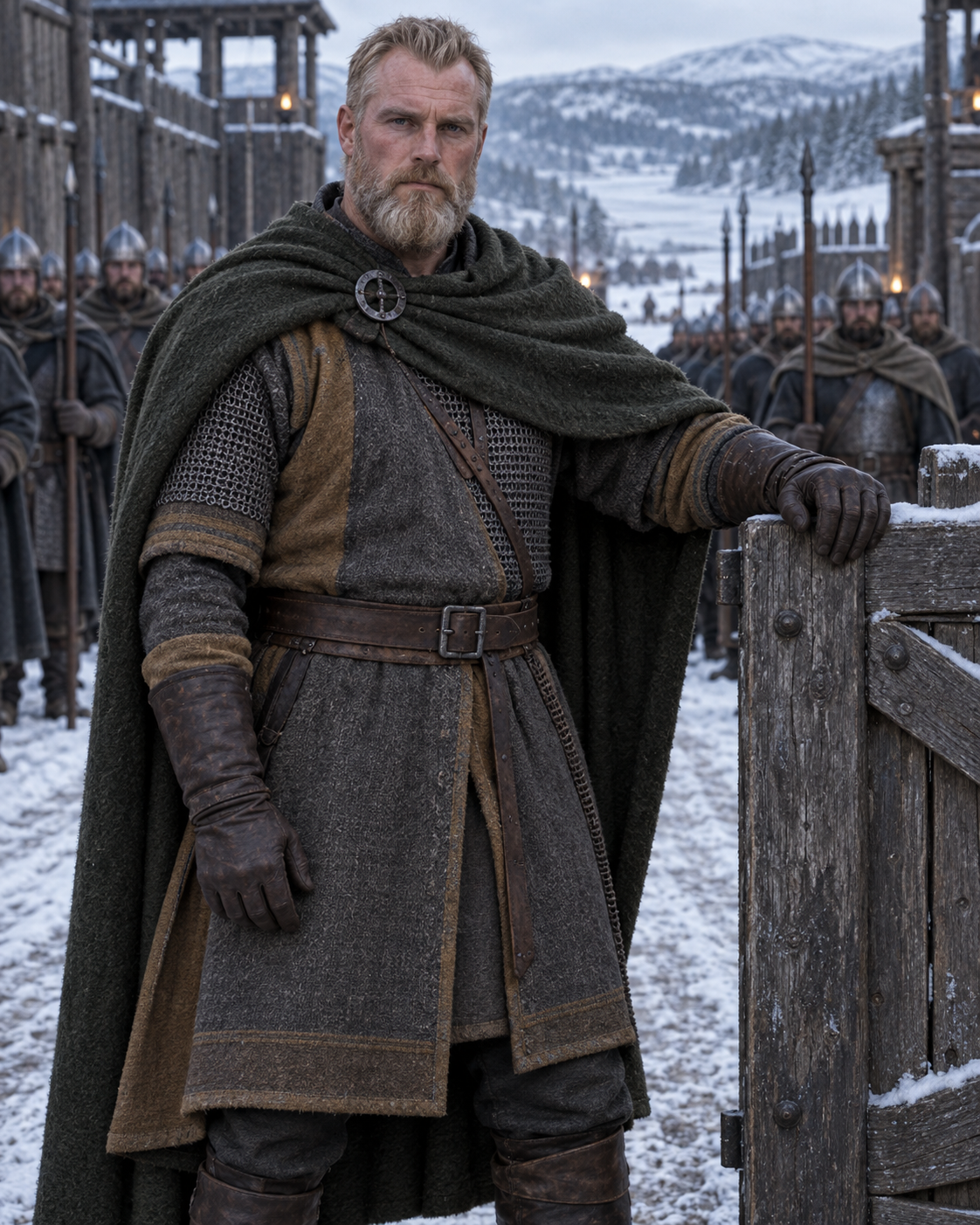
CVM depicts Stortfot as a strikingly attractive mature Rimmersman thane around forty-five: tall thick-set disciplined build, dark gray-blue eyes, fair weather-reddened skin, closely cropped pale ash-blond hair with a pronounced widow’s peak, a full square-cut pale beard lightly threaded with silver, and a controlled unsmiling expression. He remains distinct from Isgrimnur, Sludig, Skali, Ingen Jegger, and every other approved northern man.
Canon supplies no face, skin, hair, eyes, age, height, build, facial hair, clothing, armor, weapon, heraldry, scars, horse, or private expression.
The approved portrait places one gloved hand on Vestvennby’s closed gate beam while a disciplined blurred line of housecarls holds the snowbound road. Iron-gray, muted-ochre, deep-pine, brown leather, restrained mail, and a plain iron clasp communicate local military authority without heraldry or invented weaponry.
Do not make him physically resemble Skali merely because he enforces the transfer.
Preserve this exact face, mature baseline, thick-set body, complexion, eyes, cropped pale-hair/widow’s-peak map, square beard/silver map, iron/ochre/pine/brown wardrobe, mail, gloves, clasp, and controlled-road authority across the hero, directory card, Isgrimnur route imagery, and Sludig’s revenge-rant art. The same attachment powers featured image, hero, card, and social metadata.
On the Record
Book 1 political evidence, corrected spelling, and unresolved later fate
This is Thane Stortfot’s one canonical, full-spoiler character profile. His confirmed evidence belongs to The Dragonbone Chair.
The record confirms Stortfot is Thane of Vestvennby. He meets Isgrimnur with fifty housecarls, refuses passage, reports that Elias has dispossessed the duke and granted Elvritshalla to Skali, says Isorn is held, and offers an escort into Skali’s mercy.
Later, Sludig wants to detour through Vestvennby to kill him. Binabik persuades Sludig that completing Isgrimnur’s mission matters more than private revenge.
The record does not confirm Stortfot’s appearance, family, motive, receipt of the order, relationship with Skali, intended treatment of Isgrimnur, later actions, punishment, or final fate.
Status: alive at Vestvennby; later fate unknown.
Visual state: approved editorial reconstruction. One canonical attachment powers featured image, hero, directory card, and social metadata, with unsupported appearance, gear, gate, and soldier details disclosed as CVM reconstruction.