
Stone of Farewell: What Actually Happens
The survivors keep moving toward refuge while every road carries a different piece of the war. Convergence finally arrives—and discovers sanctuary was never the same thing as safety.
The opening position
Nobody begins Book 2 where Book 1 left them emotionally
Stone of Farewell opens after the quest victory has already curdled. Simon possesses the black sword Thorn, but Binabik and Sludig face execution in Yiqanuc. Josua’s Naglimund survivors are reduced to a hunted fragment in Aldheorte. Miriamele has crossed the sea under a false identity. Isgrimnur searches south. Eolair returns toward occupied Hernystir. The Hayholt belongs increasingly to Pryrates’s machinery.
The novel’s plot is not “everybody travels to the same place” with decorative suffering in between. Each road discovers a different part of the system: Qanuc law, refugee politics, Norn strategy, occupied culture, Nabban’s captured institutions, Tinukeda’ya history, Sithi withdrawal, and the physical infrastructure of Witnesses. Sesuad’ra matters because the knowledge converges there with the people.
The hidden clock
Truth still has to arrive in time
Time is the invisible antagonist tying the routes together. Mortal hunger, pregnancy, wounds, weather, armies, and political deadlines move daily. Sithi councils can deliberate for weeks or years. Birds cross distance imperfectly. Dreams arrive without instructions. A message received one chapter late can become a death sentence. The plot keeps asking not only whether knowledge is true, but whether truth can reach the person who needs it before the world changes around the answer.
That pressure is why apparently domestic scenes remain causal. A meal, wedding, repaired boat, language lesson, piece of clothing, or safe bed can determine whether the resistance survives long enough to become political. Epic scale still depends on maintenance.
The scattered roads
Four movements toward the same unfinished answer
Acquittal does not end the obligation
In Yiqanuc, Binabik must answer for abandoning apprenticeship and bringing danger home. Sisqi, Ookequk’s writings, Simon’s testimony, and Qanuc law prevent a tidy outsider-rescues-friend solution. The company eventually carries Thorn south while Simon struggles with knighthood, dragon marks, prophetic dreams, and the embarrassing fact that a title has not turned him into a finished adult.
A prince becomes useful only after despair stops being the plan
Josua’s survivors are harried rather than simply killed. Deornoth recognizes the strategic question: the Norns are steering them. The company crosses Thrithings law, captivity, hunger, and a brutal wager before reaching Sesuad’ra, where displaced Erkynlanders have begun making New Gadrinsett around the ancient hill.
One false name opens the next cage
Miriamele reaches Nabban, witnesses Mother Church’s collapse, and escapes Pryrates only because Cadrach knocks her unconscious and carries her away. Aboard Aspitis Preves’s Eadne Cloud, hospitality becomes surveillance, marriage becomes ownership, and sexual intimacy occurs inside a structure of coercive control. Gan Itai’s resistance and kilpa song give Miriamele and Cadrach a path into the storm.
Mezutu’a preserves knowledge without preserving certainty
Hernystir’s survivors retreat into the dwarrow city while Maegwin’s visions harden into a divine explanation nobody around her can safely challenge. Eolair finds maps, Witness history, and the truth that Bright-Nail is Minneyar. The information can change the war; Maegwin’s interpretation can endanger the people she is trying to save.
The Hayholt and Nabban
The enemy wins by controlling institutions before armies arrive
Inside the Hayholt, Elias deteriorates while Pryrates’s access expands. Blind Guthwulf hears Sorrow hunting through walls and realizes the castle no longer obeys one stable reality. Inch builds and burns prisoners beneath the fortress. Living servants can enter the warded Hayholt even when Ineluki and the Red Hand cannot, making political collaboration the bridge supernatural power requires.
In Nabban, Dinivan and Ranessin prepare to oppose Elias while Benigaris’s household force is already positioned inside the Sancellan. Pryrates exposes Dinivan as a Scrollbearer, receives excommunication, murders Ranessin and Dinivan, burns the holy place, and begins shouting the Fire Dancer cover story before anyone can inspect the bodies. Propaganda is not the explanation after the atrocity. It is one of the atrocity’s planned components.
Dinivan still gets the route out. Dying, he directs Isgrimnur toward Miriamele, Kwanitupul, Pelippa’s Bowl, Tiamak, and the warning about false messengers. The messenger dies; the network continues moving.
Kwanitupul and the Wran
The “supporting” routes retrieve the person and knowledge the war needs
Tiamak leaves the Wran carrying his people’s demands, Nisses’s parchment, scholarship, and a lifetime of drylander condescension. A ghant attack nearly transforms or kills him; Miriamele, Isgrimnur, and Camaris enter the nest while Cadrach turns fear and technical knowledge into a fire weapon that brings them out.
At Pelippa’s Bowl, Isgrimnur recognizes the childlike old man called Ceallio as Camaris. The greatest knight is alive without accessible selfhood. The plot refuses to treat the discovery as opening a weapons chest. Feeding, sheltering, protecting, and listening to him come before the legend can return.
Aspitis later captures the group. Miriamele converts his vanity into a public champion’s wager and chooses apparently helpless Camaris. Ancient sword-memory returns through the body; Camaris defeats Aspitis without killing him. Miriamele uses the earl’s life to obtain horses and bows, turning capture into mobility.
Sesuad’ra
Refuge becomes a city, then a battlefield, then a departure point
At the Stone of Farewell, Josua’s company and New Gadrinsett build food systems, defenses, governance, marriage, intelligence, and mutual obligation. Simon arrives with Thorn and finds that reunion does not erase guilt, grief, rank anxiety, or the need to learn. He trains, receives arms, and begins seeing responsibility where he once saw only recognition.
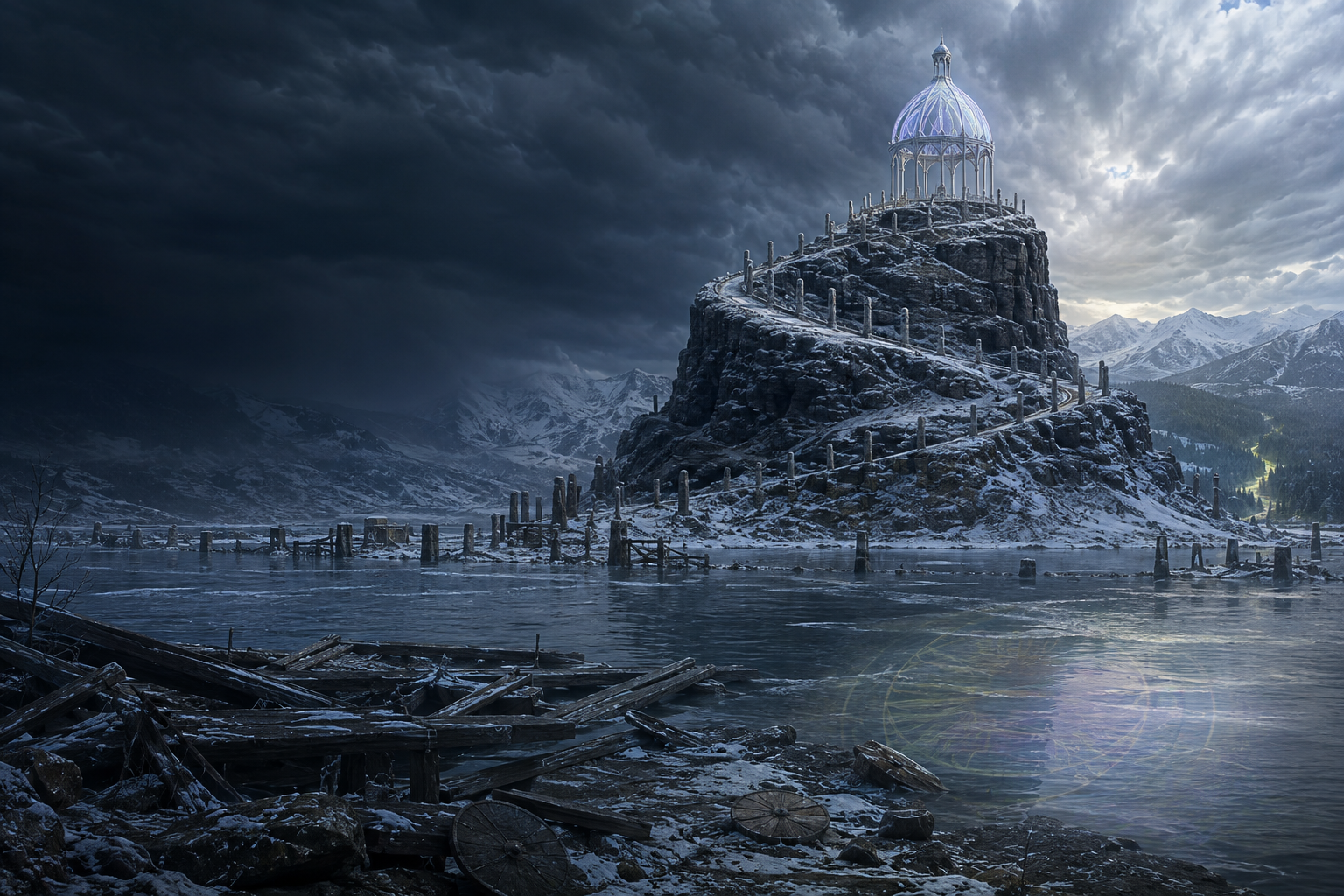
Fengbald attacks. Josua’s defenders dismantle riverboats into shields, use Qanuc nail-spikes and Thrithings horsemanship on the frozen lake, adapt when sand defeats the first plan, and survive two days of fighting remembered under several names, including the Lake of Glass. Helfgrim and his daughters bring Fengbald onto prepared ice and die collapsing it beneath him.
Victory costs Deornoth, Snennq, soldiers, refugees, and whatever clean story Simon still carried about battle. Simon wants to go home. The hill is the closest thing left, so survival must keep doing civic work before mourning is finished.
The immortal road
Jao é-Tinukai’i is beautiful enough to make captivity look benevolent
Separated from the others, Simon is rescued by Aditu and brought into the hidden Sithi city. He becomes an honored prisoner while immortals deliberate on a scale that could consume his mortal life. Paths answer intention, summer refuses the world’s winter, butterflies gather for unresolved decisions, and ordinary navigation cannot produce escape.
Amerasu reads Simon’s memories without permission, apologizes, and discovers connections he does not know he carries. His encounters with the Road of Dreams, Jiriki’s mirror, Sorrow, the Pact, and the enemy’s pressure reveal that Ineluki’s design is more subtle than the Sithi understood. Amerasu must persuade Likimeya and Shima’onari to act.
Meanwhile, Witnesses connect the scattered plot. Simon, Geloë, Binabik, Strangyeard, and Leleth reach Tiamak and try to reach Miriamele. The same channels create exposure. Simon’s reckless solo attempt nearly gives the hostile presence a route through him. Jiriki rescues him and warns that communication is a door in both directions.
Chapters 27–28
Amerasu names the sickness—and is murdered before she can explain the cure
Amerasu summons the Sithi to the Yásira and speaks in Westerling because much of her evidence came from Simon. She argues that the Gardenborn carried Unbeing’s shadow from Venyha Do’sae and have nursed loss until extinction itself seems beautiful. Their withdrawal is not morally neutral simply because it produced extraordinary art.
The Mist Lamp opens to Utuk’ku. The Norn Queen confronts her descendant, a Red Hand presence breaches the sanctuary, the butterfly roof burns, and white hounds attack. Shima’onari is mortally wounded. One hound retrieves Sorrow. Ingen Jegger seizes Amerasu and kills her with a crystal dagger at the exact moment her understanding could change the war.
Jiriki kills Ingen, but the silencing succeeds. It also creates the political consequence the enemy underestimated. Amerasu’s murder reunites Sithi Houses and pushes them toward war. Her last wish frees Simon. Aditu gives him Amerasu’s sealed burden for Josua and sends him through the failing Summer Gate.
The last scene earns the middle-book ending
Simon crosses floodwater, sees torchlight, recognizes Binabik, sweeps him into an embrace, and cries. Everyone has reached Sesuad’ra carrying more than they left with: Thorn, Camaris, Nisses’s puzzle, Amerasu’s parcel, wounds, dead mentors, compromised stories, and an enemy plan still missing its final explanation. Convergence is real. Resolution is not.
On the record
Read front-to-back, then reconciled
Return to the Stone of Farewell hub → · Follow the character arcs → · Open Tropes & Themes → · Open the series hub →