
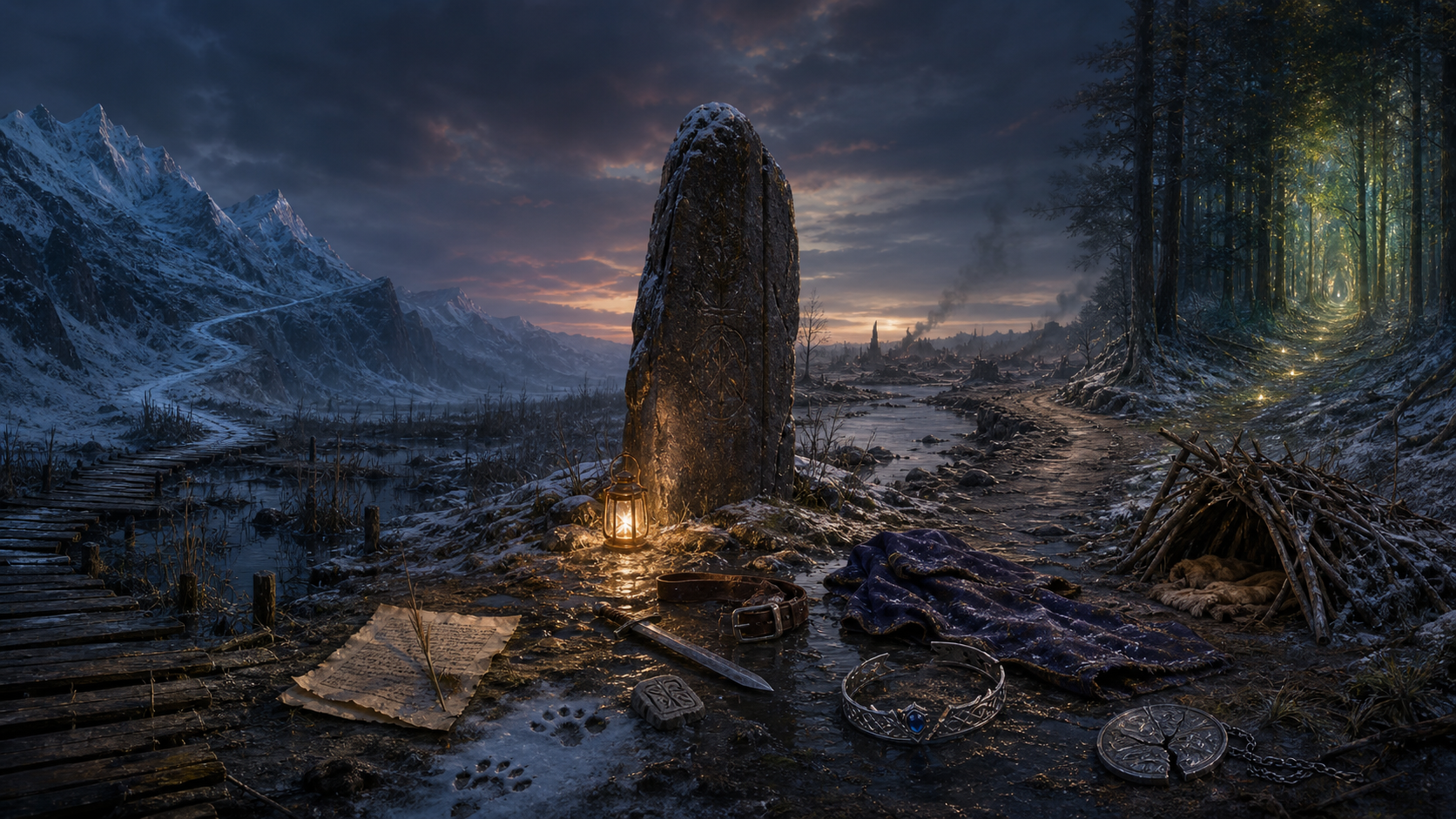
Stone of Farewell: The People the Road Refuses to Leave Alone
This is the volume where survival stops looking like a finish line. Every road demands a new self, and almost nobody likes the invoice.
How these arcs work
Change is a trail of decisions, not a before-and-after haircut
Stone of Farewell scatters its cast so thoroughly that “the group” barely exists for most of the book. That is the point. Distance strips away the roles everyone borrowed from the people around them. Simon cannot remain merely Binabik’s frightened responsibility. Miriamele cannot hide inside Marya forever. Josua cannot call despair wisdom once refugees need breakfast. Maegwin cannot keep receiving visions without deciding what they mean. Amerasu cannot preserve her people by refusing the mortal emergency at her door.
The characters do not all improve. Some harden, some retreat, some are broken open, and some turn their private damage into public danger. The book’s strongest arc work comes from the gap between what a person believes they are doing and what their choices actually produce.
Simon
A title arrives before the emotional equipment
Simon begins with Thorn, a dragon scar, a heroic reputation, and no reliable idea what any of those things require from him. Yiqanuc makes that painfully clear. He cannot simply rescue Binabik through loyalty and volume. Sisqi, Ookequk’s record, and Qanuc law matter. Simon must testify inside a culture he does not control, then accept that his friend’s life belongs to more relationships than the road-companionship Simon knows.
On the journey south, he grows taller, trains, fights, and receives the outward grammar of knighthood. None of it deletes the mooncalf. He is jealous of Miriamele, hungry for recognition, frightened by dreams, careless with supernatural access, and mortified whenever adulthood refuses to arrive on schedule. That mixture is the arc’s honesty: growth does not replace immaturity in one clean ceremony. Responsibility starts appearing beside it.
Jao é-Tinukai’i tests him more deeply than a battlefield could. The Sithi treat him as an honored guest while preventing him from leaving; beauty disguises the cage without making it less of one. Amerasu reads his memories without permission, yet what she finds makes him essential evidence. Simon becomes a witness because he has been invaded, watched, marked, and connected—not because he is the smartest person in the room.
During the attack on the Yásira, rage nearly makes killing feel righteous. He recognizes that danger in himself. Then Amerasu dies and leaves him a burden for Josua. The boy who once wanted stories to happen to him crosses the failing Summer Gate because somebody else’s last wish now depends on his delivery. His reunion with Binabik is not a coronation. It is a sobbing embrace. Thank goodness. Adulthood here means becoming accountable while remaining human enough to need your friend.
Miriamele
Running away becomes a fight over who gets to author her life
Miriamele’s Book 2 journey is easy to flatten into romantic adventure if one ignores how consistently men convert “protection” into possession. She travels under a false identity because being Princess Miriamele makes her a dynastic object. Nabban should offer sanctuary; instead, Church politics, Benigaris’s household, and Pryrates’s reach prove that rank merely changes the architecture of the trap.
Cadrach saves her from Pryrates by knocking her unconscious and deciding the route himself. Aspitis Preves offers luxury aboard the Eadne Cloud, then treats marriage as an answer he can secure through pressure, isolation, and sexual entitlement. The surrounding comfort does not neutralize coercion. Miriamele’s arc is not that she learns every danger in advance. It is that she keeps reclaiming decision after other people insist the sensible choice belongs to them.
Gan Itai helps create an escape route, and the storm throws Miriamele into the wider Kwanitupul story. By the time Aspitis captures the company again, Miriamele no longer waits for rescue to come wearing the correct noble crest. She reads his vanity, forces a public wager, chooses the apparently helpless Camaris, and turns the earl’s defeat into horses and bows. That is political intelligence under pressure—not a sudden transformation into an invulnerable action heroine.
Her road also complicates her bond with Simon. His longing is real; so are the huge gaps in what each understands about the other’s experience. Stone of Farewell keeps them apart long enough to prevent romance from swallowing their individual development. They are becoming people who might one day choose each other, rather than children assigning each other roles in a private rescue fantasy.
Leadership under pressure
Josua, Maegwin, and Amerasu offer three answers to unbearable inheritance
Despair stops being a personality and becomes a public hazard
After Naglimund, Josua’s instinct is to interpret catastrophe before he has secured the people who survived it. Deornoth repeatedly drags him back toward material questions: food, pursuit, horses, shelter, alliance. At Sesuad’ra, the prince begins becoming useful through civic labor. New Gadrinsett needs rules, marriage, defense, and a reason to remain together. His victory over Fengbald belongs to collective adaptation, not royal destiny. Deornoth’s death ensures leadership never feels like proof Josua was right to hope.
Vision becomes dangerous when nobody can challenge the interpreter
Maegwin carries Hernystir’s trauma into Mezutu’a and receives experiences that feel divine. Her conviction gives terror a shape, but it also makes disagreement look like spiritual failure. Eolair’s loyalty becomes trapped between compassion and alarm. The tragedy is not that Maegwin lacks courage. It is that grief, isolation, authority, and revelation fuse until she cannot distinguish protecting her people from demanding they inhabit her explanation.
Preservation finally admits it has been another form of surrender
Amerasu has knowledge, age, and moral stature, but the Sithi scale of deliberation threatens to consume mortal time. Simon’s memories force the hidden war into her sanctuary. At the Yásira, she names her people’s devotion to loss as a sickness and argues that beautiful withdrawal still serves extinction. She moves from understanding to public action—and is killed at precisely that hinge. Her arc completes in consequence: her murder pushes the Zida’ya toward the war her argument had demanded.
One man deteriorates while the other converts access into rule
Elias’s kingship contracts around pain, dependency, and Sorrow. Pryrates expands into every space the king abandons. The alchemist does not merely manipulate a weak ruler; he builds control through institutions, servants, terror, staged explanations, and supernatural logistics. Their paired arc turns the Hayholt from a captured palace into a machine that can use living collaborators to admit powers barred from entering alone.
The people carrying what the epic needs
Eolair, Tiamak, Camaris, and Cadrach make knowledge physical
Eolair’s arc is endurance without the reward of certainty. He enters Mezutu’a seeking survival and leaves carrying evidence that could alter the entire sword quest: Bright-Nail is Minneyar. Yet the same place deepens Maegwin’s break from shared reality. He cannot extract the useful map and abandon the suffering person. His loyalty becomes painful work rather than a flattering trait printed under his name.
Tiamak begins as a scholar whose drylander learning has never erased the contempt drylanders aim at him. Leaving the Wran forces him to turn knowledge into transportable responsibility. Nisses’s parchment, the demands of his people, marsh craft, and lived survival all travel together. A ghant attack makes the cost bodily. The resistance needs him not because he resembles a conventional northern hero, but because its world has been too narrow to understand the danger.
Camaris returns as the most famous warrior in Osten Ard and the least usable legendary weapon imaginable. As Ceallio, he is childlike, vulnerable, and unable to narrate himself to the people who recognize him. Care must precede recovery. When Miriamele chooses him against Aspitis, sword-memory returns through his body, but the scene does not magically restore a complete person. The legend and the damaged man coexist.
Cadrach keeps proving that cowardice and usefulness can occupy the same skin. He lies, drinks, calculates, and repeatedly knows something the others need. He can save Miriamele and violate her agency in the same movement. He can turn technical fear into a weapon against ghants. His arc refuses the clean pleasure of either redemption or condemnation because his next choice remains genuinely unstable.
The group arc
The scattered cast becomes a resistance only by carrying difference into one place
Sesuad’ra does not erase the roads. It collects what they taught. Qanuc law and tactics, Thrithings horsemanship, Hernystiri intelligence, Nabbanai collapse, Wran scholarship, Sithi history, refugee maintenance, and royal legitimacy become mutually necessary. The Lake of Glass victory works because people adapt across those differences. The war’s answer is not a chosen hero standing alone with a sword. It is an unruly coalition learning how much survival depends on knowledge that power previously dismissed.
The emotional ending is not “everyone is together now”
Amerasu is dead. Deornoth and Snennq are dead. Maegwin is further inside her certainty. Miriamele and Camaris remain elsewhere. Simon returns carrying a sealed obligation and grief he cannot organize. The reunion with Binabik matters because connection does not solve any of that—and still makes the next step possible.
On the record
Read front-to-back, then reconciled by decision and consequence
Return to the Stone of Farewell hub → · Read the complete Plot → · Open Tropes & Themes → · Open the series hub →