
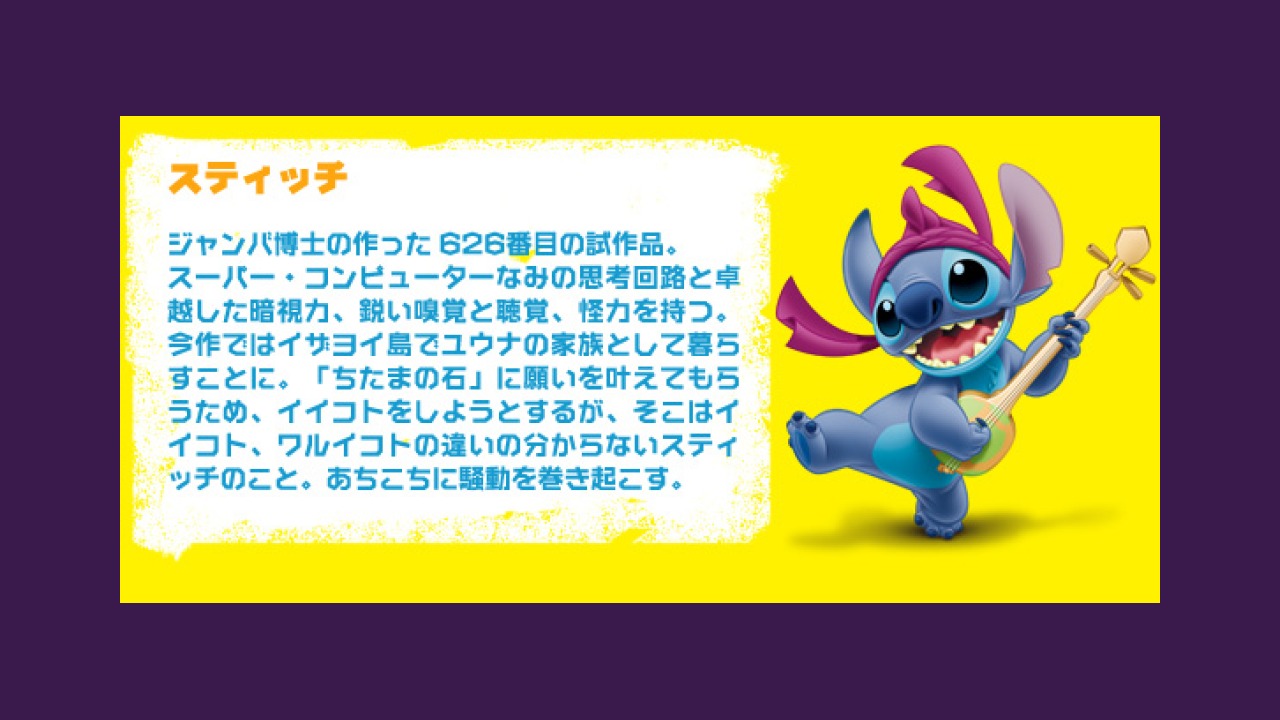
STITCH! CHARACTER PROFILE · EXPERIMENT 626 · ALL THREE SEASONS
Stitch Character Profile: What Happens When Experiment 626 Starts Counting Good Deeds
Forty-three counted deeds can win a wish. They cannot prove Stitch noticed who carried the damage while he was busy becoming good.
Profile record
Name: Stitch
Experiment number: 626
Creator: Jumba Jookiba
Japanese-branch homes: Izayoi Island and New Town
Closest Japanese-branch relationships: Yuna, Obaa, Kijimunaa, Jumba, Pleakley
Central season-one goal: Forty-three good deeds for a Chitama Stone wish
Japanese voice: Kōichi Yamadera
Appears in: All three Japanese television runs and later specials
He arrives with a history the anime cannot erase
The Japanese Stitch! anime does not receive an empty blue mascot. Experiment 626 arrives with a history of engineered destruction, capture, exile, adoption, grief, repair, and a Hawaiian family whose promise shaped the franchise. Even when an episode avoids naming that past, the audience brings it into the room. His new bond with Yuna therefore begins beside an old bond rather than before one.
That fact makes every shortcut in the transition visible. A space storm can move a body. It cannot automatically explain why a character built around refusing abandonment would stop returning, communicating, or waiting. The anime gains emotional power when it treats Stitch as somebody carrying unfinished attachment. It loses power when continuity becomes luggage the premise leaves at the airport.
Experiment 626 and the body built to win
Stitch was designed with strength, speed, durability, intelligence, climbing ability, sensory range, and an appetite for chaos. Those abilities make action comedy easy, but they also create an ethical imbalance in nearly every friendship. A tantrum from Yuna can hurt a feeling. A tantrum from Stitch can endanger a neighborhood. Equal affection does not mean equal capacity for harm.
The Japanese branch sometimes treats his body as an adorable solution machine. A deeper profile watches who anticipates the damage, who cleans it, and who is asked to forgive because Stitch eventually saves everybody from the crisis he helped intensify. Power remains part of character even when the animation turns it into a punchline.
The Chitama Stone makes morality transactional
Season one gives Stitch a direct bargain: complete forty-three good deeds and the Chitama Stone may grant his wish for supreme power. It is a wonderfully suspicious premise. He can behave generously while privately treating another person’s need as one more mark on a supernatural loyalty card. The action may help, but motive, attention, and repair remain unsettled.
Yuna becomes the pressure against that arithmetic. She asks him to recognize a person rather than a task, and the episodes reveal how often measurable goodness rewards spectacle over maintenance. Stitch can stop a monster and receive credit. Obaa can hold the household together every day without a glowing counter announcing that care occurred.
Yuna is a new friend, not a replacement child
Yuna Kamihara meets Stitch with her own history, martial discipline, absent-parent pain, island relationships, and temper. She does not exist to imitate Lilo until the franchise decides to remember Hawaiʻi again. Their bond works when the anime lets her needs alter Stitch’s habits instead of treating her as a new delivery system for an old lesson.
He also changes what friendship costs her. Yuna must negotiate with a being who can overpower almost any room, attract interplanetary enemies, and interpret rules according to his current desire. Her willingness to remain beside him is meaningful only if the story lets her set limits. Love without the possibility of refusal becomes supervision.
Kijimunaa proves Stitch did not invent Yuna’s wonder
Kijimunaa is Yuna’s friend before Stitch arrives. His presence prevents the alien from becoming the source of everything unusual, loyal, or magical in her life. Stitch enters a friendship network already shaped by Izayoi, Obaa, local spirits, and memories he does not own.
Jealousy inside that trio can expose Stitch’s hunger to be chosen first. The fair resolution is not to make Kijimunaa accept permanent third place. It is to make Stitch learn that intimacy is not a scarce prize he secures by dominating the scene. Yuna can love more than one impossible friend, and each relationship can retain its own history.
Obaa sees past the mascot performance
Obaa has very little reason to be impressed by noise alone. She understands spirits, family labor, and the difference between a dramatic rescue and reliable conduct. Her household offers Stitch belonging, but it also asks him to participate in routines whose value cannot be proved through combat.
That relationship matters because adults often excuse Stitch once his face becomes cute enough. Obaa can enjoy him and still name the broken object, frightened neighbor, ignored warning, or burden pushed onto Yuna. She gives the anime an authority figure whose care is not the same thing as surrender.
Jumba’s invention is also Jumba’s child
Jumba describes Stitch through design specifications whenever emotion becomes inconvenient. The language of invention lets him claim genius while avoiding the parental implications of creating a sentient being and then failing to prepare him for relationship. The Japanese anime continues that tension after the original films already made it visible.
Stitch wants approval from the person who understands his body and helped define his purpose. He also needs freedom from the premise that destructive programming explains every choice forever. A strong episode makes Jumba answer for both truths: Stitch was engineered under violent assumptions, and Stitch has since become a moral person capable of choosing beyond them.
Pleakley and the labor Stitch takes for granted
Pleakley frequently provides domestic care, translation, social interpretation, panic, and the warning everybody ignores until it becomes the plot. Stitch can treat that labor as background because it does not resemble strength. The joke often depends on Pleakley caring more visibly than the others.
Watching Stitch’s relationship with Pleakley reveals whether his idea of family has matured. Does he notice work before it stops? Does he respect fear that turns out to be accurate? Does he apologize to the person who fed, covered, distracted, and protected the household while the stronger characters chased the headline danger? Those are better measures of growth than another counted deed.
Returning experiments are cousins with complicated memories
The Japanese anime brings familiar experiments into a different location and moral structure. Stitch calls them cousins, but the franchise can slide between family, competitor, weapon, and collectible depending on the episode. A return should preserve the earlier experiment’s established function and placement unless the new story clearly explains the change.
Stitch’s reaction becomes part of the continuity test. If he once fought to find an experiment a home, he should not approach that cousin like a disposable weekly obstacle. Recognition, responsibility, and memory matter. Otherwise the anime borrows a beloved design while discarding the relationship that made the character more than a number.
Angel, Reuben, and the relatives who know his worst habits
Angel and Reuben can challenge Stitch in ways Yuna cannot because they understand the experiment family from inside it. Angel knows how affection can become manipulation, while Reuben knows how enormous capacity can hide behind deliberate avoidance. Neither cousin needs Stitch to explain what Jumba created or how quickly old programming becomes a convenient excuse.
Their returns should therefore do more than trigger recognition applause. Angel can question whether Stitch respects a partner whose power rivals his own. Reuben can expose the distance between being capable of change and choosing the comfort of doing less. Both relationships reveal whether Stitch treats cousins as independent people or supporting evidence in his personal redemption story.
New Town tests whether his growth travels
Season three relocates Yuna and changes the social environment around them. Urban school pressure, new classmates, new antagonists, and Shin-Ei Animation’s production handoff create a branch that feels different from the Izayoi years. Stitch can no longer rely on island familiarity to make every disruption seem charming.
The move tests whether he learned principles or merely adapted to one household. Respecting Yuna means taking her changing life seriously, including friendships and anxieties that do not revolve around him. If he sabotages those relationships and receives instant forgiveness, the season confuses attachment with entitlement.
Adult Lilo and the reunion that reopened the promise
The adult-Lilo episode attempts to explain how Stitch and his first human family separated. It also reveals Lilo as an adult and brings the franchise’s central promise back into a branch that spent years building Yuna’s place. The episode was always going to hurt because reunion forces continuity to answer questions that absence allowed it to postpone.
Yuna is not responsible for the explanation, and Lilo is not a villain for aging. The critical question belongs to the writing: does the reason for separation respect what both characters previously fought to preserve? Stitch’s response should contain love, anger, relief, grief, and the recognition that a new family does not cancel an earlier one.
Goodness after the counter stops
A completed good-deed count cannot serve as the final proof that Stitch changed. Numbers can document behavior while missing motive, repetition, private repair, and who absorbed the cost. The real test begins when there is no wish left to earn and no stone available to praise him.
His most convincing growth appears in ordinary restraint. He can pause before smashing, listen when Yuna says no, return to finish a repair, remember a cousin’s fear, or help without announcing the result. Those choices are smaller than a cosmic reward and far more difficult for a character built to make every room react to him.
Kōichi Yamadera’s Japanese performance
Kōichi Yamadera voices Stitch in the Japanese production, carrying the character through feral sounds, comic bravado, clipped language, vulnerability, and the moments when performance drops away. His work has to preserve recognizability while fitting the faster emotional and comic rhythms of a Japanese television anime.
This page records Yamadera as the central performer because it covers the Japanese branch. Other-language casts belong in version and distribution guides. Keeping those credits separate prevents an international franchise from flattening distinct performances into one apparently universal voice.
What this version of Stitch adds
The Japanese anime asks whether Stitch can belong again without repeating the exact emotional architecture of Hawaiʻi. Izayoi, Yuna, Obaa, Kijimunaa, the Chitama Stone, New Town, and the studio change give that question enough material to become its own long argument.
The answer is strongest when continuity remains complicated. Stitch can love Lilo and Yuna. He can carry engineered impulses and remain responsible for choices. He can perform a good deed and still owe somebody an apology. He can be adorable without making every person around him responsible for surviving the consequences.
Sources and image record
Character identification and the Japanese voice credit use the official TV Tokyo character archive, supported by Disney Japan release records and Japanese episode evidence across the three television runs and later specials.
The hero uses official TV Tokyo Stitch artwork stored locally and placed on a CVM Sekai 16:9 canvas without altering the figure. The identical file is used as featured image, hero, and directory card with complete source, credit, and editorial-use metadata.
Keep exploring
Return to the Stitch! anime hub, open the character directory, or return to the complete franchise.
The character thesis
Stitch is Experiment 626 rebuilding family in Japan after the franchise gives him a second home and a new human partner. That position should control the profile. A list of appearances, powers, and catchphrases cannot explain why the character matters or what the Japanese series changes by placing this person inside Yuna’s world. The useful question is what responsibility follows from the role, who benefits from the character’s labor, and what the story avoids when comedy arrives before an answer.
Stitch does not need a replacement family. He needs a continuity honest enough to admit that love can survive more than one home. That is the editorial standard for every section below. The profile follows choices, consequences, relationships, performance, and the gap between what the series says the character means and what the episodes actually show.
What the character wants
The central desire is belonging that does not require constant moral performance or the erasure of Lilo. Desire matters because a character cannot be reduced to the function performed for the plot. Even a recurring comic figure enters a scene wanting comfort, status, information, safety, recognition, privacy, or control. Tracking that want makes repeated behavior legible instead of random.
The conflict the premise keeps reopening
The recurring problem is that the forty-three-good-deed counter makes care measurable while the unexplained separation from Lilo makes every new bond emotionally complicated. A complete profile cannot file that tension under continuity trivia and move on. The premise touches trust every time an episode asks the audience to accept a new rule, new danger, or new emotional arrangement without accounting for who carries the cost.
Body, ability, and restraint
The relevant physical facts include alien strength, sensory range, durability, destructive programming, and a capacity for restraint learned through relationship. Ability is not personality, and power does not excuse weak emotional writing. The body changes what risks are possible, what other characters fear, and what kinds of help are actually useful. Those facts should remain consistent enough for choices to mean something.
Family is a network of obligations
The relationship map includes Lilo, Yuna, Obaa, Jumba, Pleakley, the experiments, and two homes the continuity refuses to reconcile cleanly. Calling these people family is the beginning of analysis, not the conclusion. Family determines who notices an absence, who pays for damage, who gets believed, who performs care, and who is expected to forgive before repair has happened.
Japanese voice performance
The primary performance record here is Japanese: Kōichi Yamadera’s Japanese performance carries comedy, aggression, fear, and affection through a vocabulary that remains deliberately compact. Delivery changes the scene. Pace can turn panic into comedy, a pause can expose grief beneath a joke, and a change in pitch can mark the instant confidence breaks. Those choices deserve description instead of a bare cast-credit line.
Where the writing fails the character
The clearest danger is treating a beloved character as a portable mascot who can be relocated without emotional consequences. Familiar franchise shorthand can make the audience feel that a scene worked because the character looked and sounded recognizable. Recognition is not development. A repeated gag becomes a writing problem when the same person always loses dignity, privacy, safety, or credit so everybody else can move on.
What growth would actually require
The meaningful growth path is choosing responsibility without becoming obedient, and loving Yuna without pretending Lilo never mattered. Growth must cost more than one speech. It should alter a routine, redistribute labor, change how information is shared, or make a later choice visibly different from an earlier one. Otherwise the episode delivers a lesson that the next script quietly deletes.
Consent and information
Care labor is part of the plot
Meals, cleanup, transport, supervision, translation, repairs, emotional reassurance, and research do not happen by magic. When Stitch benefits from or performs that work, the profile names it. Invisible labor often explains why one character appears relaxed while another is always anxious or interrupting.
Comedy, dignity, and the camera
Continuity needs an honest receipt
Place changes the character
Izayoi and New Town are not interchangeable backdrops. A place controls who knows the character, which routines feel ordinary, how quickly help arrives, and whether unusual behavior can disappear into anonymity. Stitch should respond to those differences instead of carrying one fixed personality between painted backgrounds.
Knowledge must have a source
Whenever Stitch supplies an answer, the profile asks where that knowledge came from. Training, lived experience, observation, records, rumor, and guesswork are not equal. Naming the source makes competence believable and leaves room for another character to know something different.
Friendship outside the central pair
Those connections also prevent the ensemble from becoming a wheel with two characters at the center and everybody else as spokes. Stitch deserves scenes where another person’s needs control the conversation and where loyalty is demonstrated through ordinary follow-through.
Repair after the episode ends
Repair is where stated values become measurable without a magical counter. Stitch may not be able to undo every harm, but choosing to remain present matters. Leaving somebody else to clean the emotional and physical mess is also a choice, and the profile records it.
Why this character belongs in the franchise
The answer cannot be that the plot already owns the character model. Stitch belongs when the Japanese branch discovers a conflict, relationship, or form of humor that only this person can carry. Familiarity should open the door to sharper writing rather than replace it.
The small-scene test
Big climaxes can make almost anybody look important. The better test is what Stitch does during breakfast, cleanup, travel, waiting, or an awkward silence. Small scenes reveal habits that spectacle can hide: who listens, who interrupts, who notices discomfort, and who assumes somebody else will handle the boring part.
What future episodes should remember
Future writing should preserve consequences already earned. If Stitch learned a boundary, accepted responsibility, or repaired a relationship, the next conflict should begin from that changed position. Repetition can be funny, but total emotional reset makes the character feel rented by each script.
The profile promise
This page will keep separating evidence from affection. Loving Stitch does not require defending every choice, and criticism does not erase the pleasure of watching the character. The receipt stays specific so praise can be specific too.
That balance is the point of fandom writing. We can laugh, argue, remember the performance, notice the craft, and still ask the story to honor the person it created.
The final character receipt
Stitch does not need a replacement family. He needs a continuity honest enough to admit that love can survive more than one home. The point is not to punish a children’s comedy for having jokes. The point is to respect the work enough to notice what those jokes, choices, and relationships repeatedly teach.
A JIN-format profile leaves the reader with a person rather than a database entry. Stitch should emerge with a desire, a pattern of decisions, a performance history, relationships that demand something, failures that remain visible, and a future that would require actual change.
Stitch after Lilo and before an easy answer
Stitch arrives in the Japanese anime with a problem the good-deed counter cannot solve. He already learned that ʻohana is chosen, practiced, and repaired with Lilo, yet the new premise places him beside Yuna while leaving the separation emotionally blurry. That absence is not trivia. It sits underneath every new promise he makes. Loving Yuna does not betray Lilo, but acting as though Lilo never shaped him would betray the character. The honest profile holds both homes in view and refuses the cheap language of replacement.
The forty-three good deeds turn morality into a visible chase, which is funny until the number begins doing the work of conscience. Stitch is most compelling when he chooses restraint without expecting a reward. He was engineered for destruction, so every pause contains history: the claw not used, the escape abandoned, the apology attempted before Jumba explains the lesson. A counted deed can mark progress, but it cannot prove that he understood who was hurt. The receipt is what he does when nobody is updating the total.
Yuna gives Stitch a relationship built around motion, competition, pride, and mutual stubbornness. She does not need to become Lilo with different scenery. Her value comes from the different pressure she applies. Yuna can match Stitch’s impulsiveness, challenge him physically, and demand loyalty while still making mistakes about what loyalty permits. Their bond works when each changes the other’s next decision. It weakens whenever conflict is solved by declaring them family before either one has repaired the actual breach.
Kōichi Yamadera’s Japanese performance protects Stitch from becoming a plush toy with action scenes. The limited vocabulary still carries calculation, panic, bravado, jealousy, and the softening that happens when he recognizes somebody is staying. A growl aimed at an enemy does not land like the same sound aimed at a friend who disappointed him. Those variations are the interior monologue. The animation and performance must be read together, especially when dialogue cannot explain whether Stitch is resisting his programming or merely redirecting it.
The anime’s island setting also tests what Stitch learned about belonging. A home is not only the person he sleeps beside. It includes neighbors who remember damage, places with spiritual rules, adults who provide food and shelter, and creatures such as Kijimunaa who are not extensions of his adventure. Stitch shows maturity when he accepts that being loved does not make every door his. The boundary he honors is often better evidence of growth than the monster he defeats.
Stitch can have more than one family, but the franchise owes him continuity sturdy enough to carry the weight. A future episode does not need a courtroom explanation for every production decision. It does need emotional evidence that memory survived relocation. Let him miss Lilo without diminishing Yuna, love Yuna without rewriting Lilo, and admit when fear of abandonment turns affection into control. That version is still chaotic and funny. He is simply allowed to remember the life that taught him why destruction stopped being enough.
Five receipts the next story cannot skip
Stitch needs an episode built around the unresolved emotional bridge between Lilo and Yuna. That subject cannot remain a line of continuity housekeeping because it determines how every new relationship reads. The script should stage a choice before the crisis, let the choice create a consequence, and return after the spectacle to show who performs the repair. A lesson delivered only in dialogue is too easy to reset. The camera needs to catch the changed routine later, when nobody is announcing that growth has occurred and the character could comfortably repeat the old habit.
The evidence should be ordinary and specific: the good-deed counter, the limits of strength, and the difference between being welcomed and claiming every space. These details turn a profile into a usable record instead of a collection of flattering adjectives. They also give future Reacts something concrete to test. If an episode says Stitch has matured while the labor, permission, and information remain distributed exactly as before, the claim has not been earned. If one small decision changes because an earlier failure is remembered, the series has created continuity without sacrificing comedy or pace.
The central contradiction remains an abandoned creation who can mistake control for security when he fears another person will leave. Contradiction is not a flaw that needs to be polished away. It is where the character becomes legible. The series can let affection and irritation coexist, let a good intention produce harm, and let an apology be sincere while still insufficient. What matters is that the next scene does not erase the difficult half. Stitch becomes more lovable when the writing trusts the audience to notice damage and tenderness at the same time.
A strong visual reading also watches who occupies the frame around Stitch. Distance can make a refusal look lonely. A crowded reaction shot can turn embarrassment into public pressure. A close-up held after the joke can return the point of view to the person who absorbed it. Those choices matter in a character whose dialogue may be brief, stylized, frantic, or diverted into comedy. Animation is performance, and posture, timing, eye line, and stillness belong in the receipt beside spoken words.
The final standard is simple enough to remember. Stitch should leave the episode with more than restored furniture and a repeated catchphrase. A boundary should be clearer, a relationship should carry new information, or a later choice should reveal that somebody remembered. The franchise can stay bright, strange, and episodic while allowing consequences to travel. That is the version of Stitch worth following across films, television branches, cultural settings, and all the messy continuity between them.