
EPISODE 9 · CHINESE TELEVISION BRANCH · THE PHOENIX · RAE RAE REACTS
Stitch & Ai Episode 9: The Phoenix
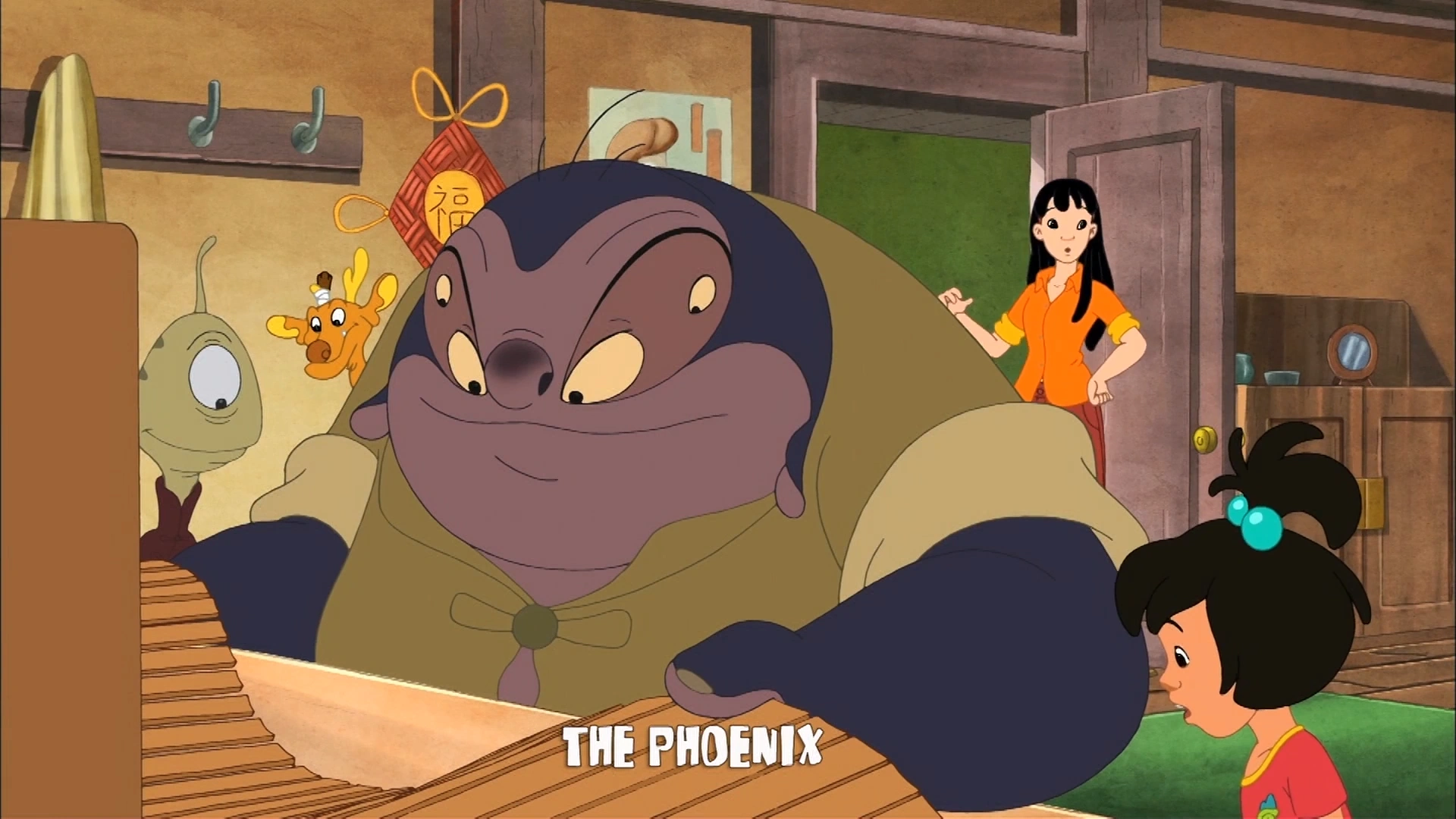
Daiyu brings cousin Bao to sell Ai on city life. Jumba creates a fenghuang that flies toward a ruined shrine. Then two bounty hunters arrive to sell the living creature to collectors because rarity apparently looks like a price tag from space.
Daiyu brings Bao as evidence for the life she wants Ai to choose
“The Phoenix” introduces Ai’s cousin Bao during the continuing argument about whether Ai should leave Huangshan for the city. Daiyu does not merely arrange a family visit. She presents Bao as a comparison, an example of opportunity, behavior, and future that may make Ai’s current life look smaller.
Children should never be used as exhibits in another child’s custody or education dispute. Bao deserves to visit as a cousin, not a recruitment brochure. Ai deserves information about city life without being asked to measure her worth against him.
Bao arrives inside a conflict he did not create
He may want to help, impress adults, defend his own home, or simply spend time with family. Daiyu’s plan places every comment under suspicion. If he enjoys the mountains, he appears to undermine her. If he praises the city, Ai may hear manipulation.
The adults need to tell both children the purpose of the visit and remove responsibility for the final decision. Cousins should be allowed to like different lives without turning affection into persuasion.
Ai’s resistance is about belonging, not fear of opportunity
Daiyu may interpret refusal as stubbornness or ignorance about what the city offers. Ai understands the proposed move as separation from Jiejie, school, friends, landscape, routines, and the place where she can read the world. Opportunity that requires losing every support can feel like another kind of deprivation.
A fair plan would examine local educational support, temporary programs, visits, remote options, and guaranteed contact rather than treating permanent relocation as the only serious choice.
Jumba creates a fenghuang before the dragon lesson has cooled
The household already contains the consequences of qilin and dragon creation. Jumba responds by engineering another culturally inspired being. His behavior proves that good intentions and happy endings have not changed the system around him.
An independent authority should have suspended sentient creation, secured the scroll, and required review. The fact that he can build a fenghuang does not answer who asked for it or who will care for it.
Fenghuang is not a simple translation of phoenix
English media often calls the fenghuang a Chinese phoenix because the familiar word offers a shortcut. The comparison can be useful and still misleading. Fenghuang traditions have different imagery, associations, histories, and narrative functions from the fire-death-rebirth phoenix common in Western popular culture.
The episode title may reflect localization, but a guide should retain “fenghuang,” explain why “phoenix” appears, and avoid claiming the creatures are identical.
The creature flies toward a ruined shrine because place matters to it
The fenghuang does not remain beside Jumba as a laboratory pet. It seeks a site connected to whatever knowledge or instinct shaped it. That movement suggests identity, memory, attraction, or need beyond the creator’s plan.
The family should observe without assuming destiny. A ruined shrine may be unsafe, protected, sacred, archaeologically significant, or privately managed. Following the creature does not grant permission to disturb it.
Bao joins the search and gains a life beyond the relocation debate
Traveling with Ai and Stitch lets him respond to danger, wonder, and uncertainty instead of merely representing the city. His choices can reveal loyalty, caution, curiosity, or conflict with Ai on terms that belong to him.
The episode should protect that growth. Bao should not become instantly good because he helps or permanently bad if he makes a mistake. Family comparison already places enough pressure on him.
Three children should not be conducting an unknown-species recovery
Ai, Stitch, and Bao head after the fenghuang while adults with scientific and security responsibility lag behind. The terrain, ruined structure, flying creature, and alien hunters create risks no child can manage alone.
Jiejie must know where they are. Jumba and Pleakley need tracking equipment, medical supplies, safe transport, and an evacuation plan. The children can contribute local knowledge without carrying the mission.
Noo-Bing and Zi treat life as collector inventory
The bounty hunters want to capture the fenghuang and sell it to collectors. Their plan makes explicit what often sits underneath magical-creature stories: rarity creates market value, and market value invites confinement. The creature’s cultural meaning becomes another selling point.
Trafficking is not made less violent because the buyer wants display rather than military use. A beautiful cage is still custody without consent.
Collectors create demand while pretending distance from harm
The unseen buyers may never touch a net or threaten a child. Their money makes the hunt profitable. They can tell themselves they preserve rare beings while separating them from habitat, relationships, autonomy, and culture.
Enforcement must target brokers, buyers, transport, payment systems, and exhibition venues, not merely the hunters caught on one mountain.
The fenghuang’s location data must remain confidential
A sighting near a shrine can attract traffickers, tourists, researchers, governments, and fandom hunters. Public celebration of the creature may expose it faster than the family can build protection.
Records should limit coordinates, nesting details, medical data, and predictable movement. Scholars can study cultural context without receiving the address of a living target.
Stitch understands being valuable to people who do not love him
He has been hunted as a weapon, specimen, and proof of Jumba’s genius. The fenghuang faces the collector version of the same violation. Stitch’s defense can grow from recognition rather than generic heroism.
That history also means he may react with overwhelming force. The rescue plan needs boundaries that stop hunters without endangering Bao, Ai, or the creature.
Ai’s cultural familiarity should not turn into ownership
She may recognize stories or significance better than the alien hunters. That makes her a useful advocate, not the fenghuang’s owner. Cultural connection does not erase the creature’s own preference or the need for recognized local expertise.
Ai can defend it precisely because she rejects the collectors’ claim, not because she replaces it with her own.
The ruined shrine deserves protection during pursuit
Weapons, footsteps, flying bodies, and hurried entry can damage fragile remains and disturb whatever community responsibilities surround the site. The hunters see a capture zone. The heroes risk doing the same while trying to stop them.
Responders should map safe access, avoid using structures as shields, and fund conservation after the incident. Rescue and preservation must happen together.
Calling the creature rare can increase the danger
Public language that emphasizes uniqueness, beauty, or last-of-its-kind status raises collector interest. Conservation messaging should focus on rights, legal protection, and the harm of capture without turning the fenghuang into a prize people need to see.
Images should be delayed, cropped, or withheld if they reveal location. The family does not owe the public proof that the creature exists.
Jumba’s genetic data becomes trafficking material
If he created the fenghuang, his laboratory may contain templates, samples, developmental records, and the method for making another. Capturing one creature may be less valuable than stealing the process. Noo-Bing and Zi could sell both body and recipe.
The records need independent custody, encryption, access logs, and limits on reproduction. Jumba should not control the only copy after repeatedly ignoring review.
Bao’s city knowledge may contribute without proving Daiyu right
He may understand technology, institutions, transport, or communication that helps during the rescue. Those skills are useful because Bao learned them, not because city life is inherently superior. Ai’s terrain knowledge can matter at the same time.
The episode can show exchange rather than hierarchy. Each cousin knows something the other does not, and neither lifestyle becomes the universal future.
Daiyu should not use the danger as evidence Ai must move
Alien hunters at a ruined shrine make Huangshan look unsafe. The threat follows Jumba’s creation and Stitch’s enemies, not rural life itself. Moving Ai to a city could expose more people and place her farther from the family members who understand the situation.
Daiyu can demand better security while keeping the relocation discussion separate. Trauma should not become leverage.
The omitted U.S. release creates a recordkeeping problem
Episode 9 was produced and broadcast but left out of the former American DisneyNOW offering. Viewers following that platform moved from Episode 8 to Episode 10 without Bao’s introduction or the fenghuang story. A directory must preserve the complete production rather than copying one distributor’s omissions.
Availability notes should distinguish “not released in that market” from “lost,” “banned,” or “noncanonical” unless evidence supports those claims.
Rescue should end with legal protection, not another hidden guest
Saving the fenghuang from hunters only postpones danger if it returns to an unsecured household. It needs recognized personhood, protected habitat, medical care, an advocate, and enforcement against future capture.
Keeping the creature secret may be temporarily necessary, but secrecy cannot replace legal status and funded protection forever.
Noo-Bing and Zi need accountability beyond comic defeat
They attempted trafficking and placed children at risk. Losing the chase should not send them away to hunt another rare being. Authorities need evidence, charges, asset seizure, buyer identification, and restrictions on travel and equipment.
If either hunter cooperates, that information should dismantle the network rather than purchase total immunity.
The cousins need a conversation after the rescue
Bao and Ai have now shared danger outside Daiyu’s script. They should talk about what each assumed, what the city and mountains actually mean to them, and whether Bao felt used as persuasion. That conversation can repair the family relationship without deciding the move.
Bao should be free to tell Daiyu that Ai’s home has value even if he still prefers his own city life.
Bao’s visit should not become public evidence in the family dispute
Adults should not photograph, quote, or post Bao as proof that city children are more successful, polished, or prepared. He deserves privacy around school performance, family expectations, and anything he says during the rescue. Ai also deserves protection from comparison content that strangers can keep repeating.
Daiyu needs to discuss the visit privately with both children and accept that neither owes her the conclusion she wanted. Family persuasion should never become a public campaign built from children’s images.
The trafficking investigation must search for earlier victims
Noo-Bing and Zi speak like hunters who understand buyers and transport, which suggests the fenghuang may not be their first target. Authorities should examine records, ships, financial transfers, storage sites, collector inventories, and communications for other captured beings.
Recovered creatures need medical care, independent advocates, and repatriation plans based on their own origins and preferences. Returning property to a previous owner is not enough when the victim is a person.
Protection cannot become indefinite confinement with a kinder label
The family may respond to trafficking by hiding the fenghuang in a secure enclosure and restricting all movement. Immediate containment can reduce risk, but permanent captivity would reproduce the collectors’ logic while claiming a better motive.
Security should follow the creature’s choices, allow flight and social behavior, and use the least restrictive measures possible. An independent advocate must review limits regularly and transparently. Safety exists to protect a life fully, not to remove the life from itself.
What I would keep
I would keep Bao entering as the supposed city comparison, the fenghuang immediately flying beyond Jumba’s control, the ruined shrine destination, Ai and Bao learning through the search, and Noo-Bing and Zi revealing the collector market around rare creatures.
I would also keep the episode’s absence from the former American release visible in the directory. Distribution history affects how audiences understand a series.
What I would repair
I would stop Jumba’s creation before activation, use “fenghuang” alongside the localized title, bring adults into the recovery, secure the shrine, prosecute the trafficking network, protect location and genetic data, and fund a habitat chosen around the creature’s welfare.
I would also keep Bao out of the relocation-salesman role and let his bond with Ai change the adult conversation rather than complete it.
RaeRae’s verdict
“The Phoenix” works because everybody wants the fenghuang to mean something useful. Jumba wants proof of invention, collectors want rarity they can own, Daiyu wants Bao to prove city life wins, and the children want the rescue to solve the family argument. The creature does the healthiest thing in the episode and flies toward the place that calls to it.
My verdict: call it a fenghuang, lock down the laboratory, arrest the buyers with the hunters, protect the ruined shrine, let Bao be a cousin instead of evidence, and stop asking living beings to validate somebody else’s plan. Rare does not mean available.
Where to watch
“The Phoenix” was produced and broadcast as Episode 9 but was not released through the former United States DisneyNOW offering. Stitch & Ai is not currently available there. CVM Sekai keeps all thirteen produced episodes in original Chinese broadcast order and will update legal availability when a complete licensed route appears.
Keep exploring
Return to the complete Stitch & Ai episode directory, return to the Stitch & Ai hub, or return to the full franchise hub.