
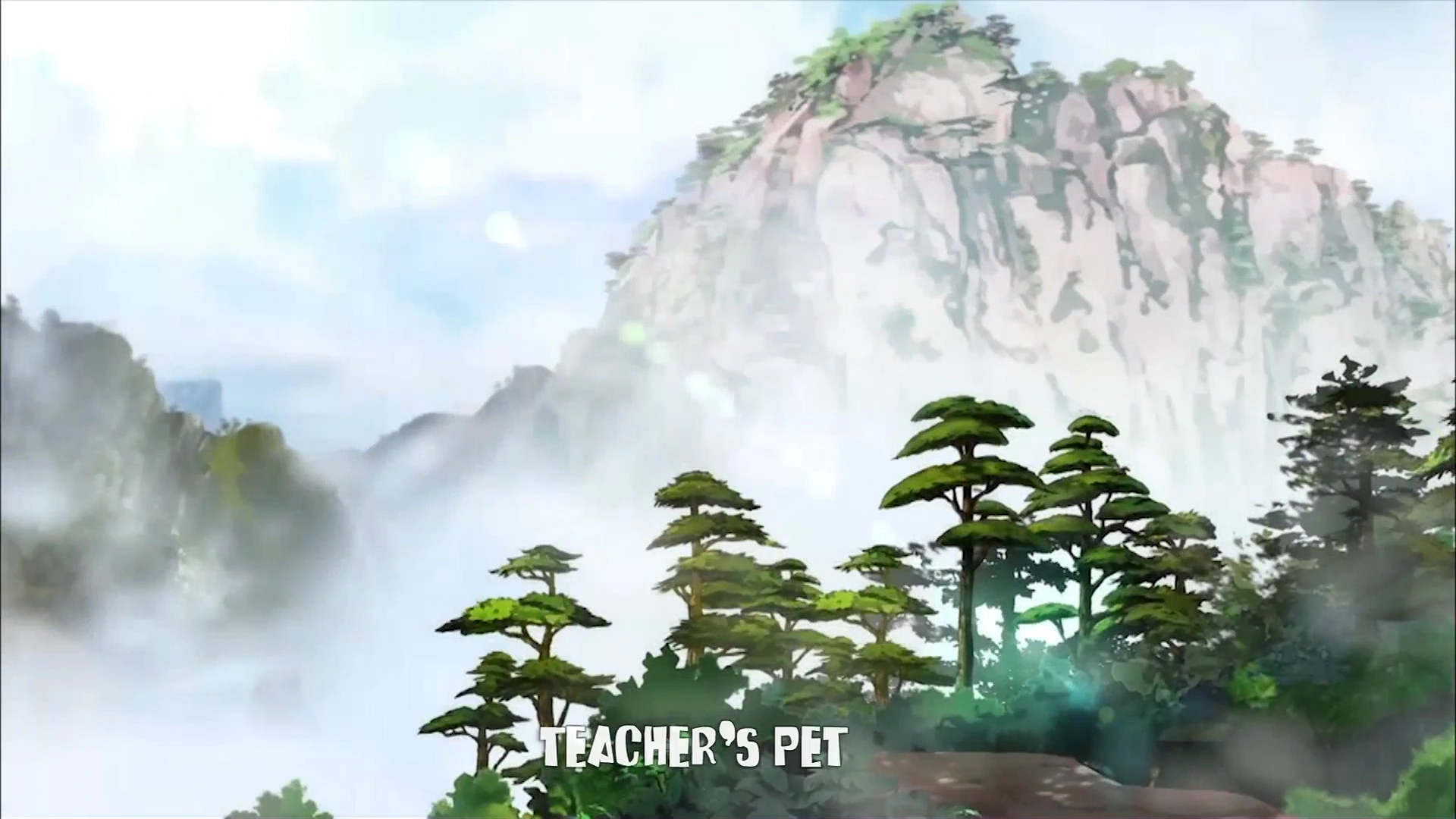
EPISODE 2 · CHINESE TELEVISION BRANCH · TEACHER’S PET · RAE RAE REACTS
Stitch & Ai Episode 2: Teacher’s Pet
Ai wants to present her strobe-light project. Stitch ignores her stay-home boundary. Then a Jaboodie possesses Mr. Ding and turns an ordinary school day into a lesson about authority, safety, and protection that refuses to listen.
Ai walks into school already carrying an adult argument
“Teacher’s Pet” begins with Ai trying to participate in ordinary school life while Aunt Daiyu keeps questioning whether the mountain school is good enough. That argument follows Ai into the classroom even when Daiyu is not physically beside her. Every assignment becomes evidence somebody may use to judge her home, her teachers, and whether she deserves to stay.
A child should be able to build a project without treating the grade as a referendum on her entire community. Daiyu may care about education, but pressure framed as rescue can make Ai feel responsible for proving that everyone around her is worthy. That is too much weight for one student and one strobe light.
The strobe-light project gives Ai competence before chaos arrives
Ai brings something she made and wants to show it off. The moment matters because the series could easily reduce her to Stitch’s guide or emotional caretaker. A school project gives her an interest, a task, and a chance to be proud without the alien plot doing all the work.
The production should tell us more about what she built, how she learned it, and what she hoped to demonstrate. Curiosity becomes character when the audience can follow the process. “Smart child holds gadget” is a pose. Letting Ai make mistakes, test parts, and explain her choices would turn it into a real skill.
Strobe lights require safety rules the episode cannot treat as decoration
Flashing lights can trigger seizures, migraines, dizziness, nausea, panic, or sensory overload. A classroom demonstration needs teacher approval, advance warning, an alternative space, controlled duration, distance, and a way for students to opt out without explaining private medical information.
Ai is a child completing an assignment. The school owns the safety responsibility. If Mr. Ding accepted the project, staff should have checked the device and notified families. If Ai brought it unexpectedly, the correct response is a calm safety conversation, not humiliation or confiscation presented as punishment.
Stitch hiding in the bicycle basket is adorable and still unsafe
He wants to stay close to Ai after their first adventure, so he rides toward school in her basket. The image sells companionship immediately. It also gives Ai an unsecured passenger who is heavier, stronger, and likely to leap out when frightened. One sudden movement can throw the bicycle into traffic or injure both of them.
A safer plan needs a proper carrier, visibility, weight limits, and an agreed signal before Stitch moves. He also needs to understand that following Ai everywhere can cross a boundary even when the motive is protection. Attachment after separation is understandable. Constant surveillance is not the cure.
Ai tells Stitch to stay home because school belongs to her too
The instruction is not rejection. Ai needs places where she can be a student rather than the person managing an alien emergency. She deserves friendships, disagreements, assignments, and private moments that do not automatically include Stitch. A healthy bond makes room for separate activity.
Stitch hears danger inside separation because he has recently escaped captivity and lost memory. The adults should help him tolerate short absences through clear plans: where Ai is going, when she will return, who can contact whom, and what counts as a genuine emergency. Sneaking behind her undermines the trust he wants to protect.
Mr. Ding becomes dangerous before anyone understands possession
A Jaboodie takes control of Ai’s teacher, turning a familiar authority figure into a threat inside a place children are required to attend. Possession stories are frightening because students are trained to obey teachers. The usual signals of safety become tools for access and control.
The school needs protocols for sudden behavioral change that do not depend on children diagnosing alien influence. Students should be able to leave, find another adult, and report that something feels wrong without being punished for disrespect. Emergency planning has to work even when the trusted adult is the emergency.
The alien uses authority more effectively than brute force
Taking Mr. Ding’s body gives the Jaboodie a classroom, a schedule, and children who expect instructions. That is more efficient than crashing through the roof. The episode exposes how power can move through ordinary roles when nobody is allowed to question them.
Ai’s skepticism becomes protective, but the story should avoid implying that every odd teacher is secretly dangerous. The lesson is about verifiable behavior: threats, isolation, unsafe demands, inconsistent identity, and refusal to let students seek help. Children need concrete reporting language instead of a general order to distrust adults.
Possession violates Mr. Ding even when the episode plays his body for comedy
He loses control of his movement, voice, workplace, and relationships. Students may remember what his body did without knowing he was not choosing it. Mr. Ding will need medical care, documentation, time away, and support repairing trust after the alien leaves.
The school should communicate without exposing private health details or blaming him for involuntary behavior. Possession cannot become a convenient excuse for harm if evidence is unclear, but confirmed loss of control changes responsibility. Recovery involves both protecting students and treating the teacher as a victim.
Ai notices the problem because she knows the ordinary version of her teacher
Her knowledge is relational. She can see that his reactions, timing, and priorities do not fit. Children often notice changes adults dismiss because they spend hours observing routines. The episode gives Ai credit for attention rather than waiting for Stitch to identify every alien threat.
That observation deserves a reporting route. Ai should not have to confront the possessed teacher herself to prove she is right. Another teacher, administrator, Jiejie, or Jumba should take the concern seriously and investigate while keeping students away from possible danger.
Stitch’s protective instinct helps and escalates
Once he realizes Ai is threatened, Stitch acts with the speed and force that make him difficult to capture. His loyalty is not in question. His judgment still needs work. A school contains children, fragile equipment, narrow exits, and adults who do not know what he is. A rescue can create secondary injuries if he treats the classroom like a battlefield.
The best version of protection matches force to risk. Stitch needs to move students first, contain the possessed adult without injuring Mr. Ding, and prevent the Jaboodie from transferring hosts. Winning the fight is only one part of keeping people safe.
The classroom should evacuate before anybody stages a showdown
Once Ai confirms immediate danger, the priority is getting classmates out through more than one route and accounting for everyone. Students with mobility, sensory, language, or medical needs require support. A loud alarm or flashing project may make evacuation harder for some of them.
The episode’s comedy runs faster than the safety logic, but a fandom guide can still name the missing steps. Nobody should lock children inside so the heroes can expose the villain dramatically. Evidence and spectacle come after survival.
Ai’s gadget can become a tool without turning her into equipment
The strobe light may disrupt, reveal, distract, or help separate the alien from its host. That payoff respects the project by letting something Ai made influence the conflict. Her intelligence enters the action instead of remaining a line in her introduction.
The adults still need to control exposure and warn everyone nearby. A useful invention does not erase its hazards. Ai should be praised for problem solving while the school updates rules around future demonstrations. Competence and supervision can exist together.
Jumba should have briefed the family on body-controlling enemies
If the factions hunting Stitch can possess humans, that risk changes every interaction. Jumba knows more about alien biology and technology than Ai’s household. Failing to explain recognition signs, transfer conditions, countermeasures, and medical follow-up leaves children discovering protocol while under attack.
He needs a plain-language field guide, a secure contact method, and equipment adults can use. Information should be specific enough to help without encouraging residents to accuse neighbors of being aliens whenever somebody acts strangely.
Pleakley belongs in the response because communication is part of safety
Pleakley is often treated as the person who panics while Jumba handles science. Yet an incident at school requires translation between alien facts and human institutions. Somebody has to explain what happened to staff, protect identities, document damage, and stop Jumba from speaking as if “temporary possession” answers every question.
His social attention can become operational skill. The series should let Pleakley coordinate people, check on frightened students, and ask the questions Jumba skips. Technical brilliance without communication leaves a dangerous mess.
Daiyu’s inspection of the school collides with the worst possible day
Her doubts about Ai’s education receive apparent confirmation when an alien possesses the teacher. That does not mean the school is inherently inferior. The attack follows Stitch and could happen in a city school, private academy, or government building. Treating extraordinary violence as a measure of educational quality would be dishonest.
Daiyu can demand better emergency planning without using the crisis to win the relocation argument. Ai’s safety matters, and so does her right not to have trauma weaponized against the home she wants to keep.
A rural school should not have to prove dignity through perfection
Resources, teacher training, transport, technology, and specialist access may differ from a city campus. Those gaps deserve honest attention and public investment. They do not make the students less capable or the community disposable.
The episode can hold both truths: Ai loves her school, and the school may need support. The answer should not automatically be removing the child with the loudest aunt. Strong communities require resources to reach people where they live.
Meiying and the classmates need interior lives beyond witnessing Ai
A possession crisis affects every student, but pilots often turn classmates into a chorus that reacts to the protagonist. Some may be frightened, skeptical, fascinated, injured, or angry that Ai brought Stitch near them. Those responses should carry into later episodes.
Friendship grows when other children retain memories and boundaries. Ai should not become socially untouchable because she is the lead. If classmates forgive secrecy or accept Stitch, the series needs to show why.
The Jaboodie’s failure exposes a strategy built on disposable hosts
The invader uses Mr. Ding because his welfare does not matter to the mission. When the plan fails, the host can be abandoned with the consequences. That is a form of violence beyond the immediate attack: somebody else’s body absorbs the risk, suspicion, and cleanup.
Future containment must focus on preventing transfer and preserving evidence about who controlled whom. The Federation should pursue the alien operator without detaining the host as if possession were collaboration.
Stitch should not receive unlimited school access as a reward
Saving Ai does not automatically make every classroom an appropriate place for Stitch. The school needs consent from staff and families, accessibility planning, food and allergy rules, supervision, and an honest explanation that fits whatever secrecy the Federation requires.
If Stitch attends occasionally, he needs a defined role and behavioral expectations. If he stays home, he needs meaningful activity and care rather than being told to wait alone for Ai. A boundary works better when both sides have a plan.
Ai’s education cannot become another custody contest
Daiyu, Jiejie, Mr. Ding, and eventually alien family members may all claim to know what Ai needs. The danger is turning school into a proxy fight over who controls her. Her grades, interests, friendships, safety, and future goals should be discussed with her rather than exchanged as arguments above her head.
A child’s voice is not the only factor in a major decision, but it is evidence. Adults who ignore it should not call the result care merely because they can describe a benefit.
The episode’s title points at two different pets
Stitch is treated as Ai’s “dog” for concealment, while the possessed teacher becomes the alien faction’s obedient tool. “Teacher’s Pet” therefore carries a joke about classroom favoritism and a darker question about who is being controlled. Stitch resists being owned even while using the pet disguise to stay close.
The disguise needs limits. Calling Stitch a pet may protect him publicly, but family members should never use it to deny his personhood, preferences, or legal needs. Safety language can become dehumanizing if nobody remembers it was supposed to be temporary.
What I would keep
I would keep Ai’s project, Stitch failing to respect the stay-home rule for emotionally understandable reasons, Ai recognizing that Mr. Ding is wrong, the school setting turning alien pursuit into an authority problem, and the gadget becoming useful during the rescue.
I would also keep Daiyu watching closely. Her pressure is frustrating, but the series needs an adult who asks whether this arrangement is safe. The writing becomes stronger when she is sometimes correct about the risk and still wrong about excluding Ai from the decision.
What I would repair
I would establish strobe-light precautions, evacuate the classroom earlier, give Mr. Ding visible medical follow-up, and let another staff member believe Ai before Stitch proves everything through force. Jumba needs to provide a possession protocol before the next faction tries the same tactic.
I would also give Ai and Stitch a real conversation about following her to school. She can appreciate the rescue and remain angry that he ignored her boundary. Affection should not erase accountability five seconds after danger passes.
RaeRae’s verdict
“Teacher’s Pet” understands that the scariest alien strategy is borrowing the face children are expected to obey. Ai survives because she pays attention, trusts what she knows, and has a project that becomes more than classroom decoration. Stitch helps because he loves hard and follows rules badly. That combination is funny until everybody remembers they are inside a school.
My verdict: keep Ai in the mountain classroom, fund the school properly, give Mr. Ding paid recovery time, put a safe carrier on the bicycle, and teach Stitch that “I protected you” does not cancel “you told me to stay home.” The friendship gets better when the rescue and the boundary both count.
Where to watch
Stitch & Ai is not currently available through its former United States DisneyNOW route. CVM Sekai records all thirteen produced episodes in original Chinese broadcast order and will update legal availability when a complete licensed option appears.
Keep exploring
Return to the complete Stitch & Ai episode directory, return to the Stitch & Ai hub, or return to the full franchise hub.