
Memory, Sorrow, and Thorn · Canonical Character Profile
Sigmar
Sigmar is the young Rimmerswoman Towser loved after Prester John conquered Naarved. She cleaned the hall occupied by the victorious king, accepted Towser’s courtship without surrendering her judgment, and refused to leave her family and land for his wandering life. Decades later, her handmade scarf and the choice she would not undo become the honest answer Simon needs when heartbreak makes hindsight look easy.
At a Glance
The woman who turns an old conquest story into a choice nobody gets to simplify
- Name
- Sigmar
- People
- Rimmerswoman
- Home
- Naarved and its surrounding northern land
- Work
- Cleaned the royal hall after Prester John’s occupation
- Appearance receipt
- Young, with hair described as nearly white
- Relationship
- Loved and courted by Towser after the conquest
- Defining decision
- Refused to abandon her family and land to travel with him
- Status
- Dead years before Towser recounts her story
Naarved After the Battle
Sigmar enters the record while somebody else’s victory is still being cleaned from the floor
Sigmar never appears in a present-tense scene. Towser remembers meeting her after Prester John’s conquest of Naarved, the northern stronghold where John defeated King Jormgrun.
Her surviving work is specific: she cleaned the hall where the victorious king stayed. That one detail carries more political weight than a decorative entry about a pretty northern girl ever could.
John’s heroic story centers endurance, a winter siege, the breached gate, the broken shield, Bright-Nail, and Jormgrun’s death before his altar. Sigmar’s story begins after those celebrated actions, among the people required to make an occupied royal space usable for the conqueror.
The text does not call her enslaved, imprisoned, conscripted, paid, threatened, or personally loyal to either ruler. It does not say she witnessed Jormgrun’s death or supported his cause. Cleaning the hall places her inside the material aftermath; it does not answer every question about the terms of her labor.
That boundary matters. Turning her into a secret resistance heroine would be invention. Turning her into a cheerful servant grateful for southern occupation would be invention too.
What survives is a young local woman working in a conquered hall while John’s company administers the territory. The great men decide which crown owns Naarved. Sigmar still has to live there the morning after.
Towser Courts Her
He remembers charm, food, and affection; the page also keeps the imbalance in frame
Towser is drawn to Sigmar. He remembers her as young and nearly white-haired, a striking Rimmersgard image preserved through the haze of old age.
His description of the courtship is affectionate and paternalistic. He compares winning her trust to taming a wild colt and remembers kind words and extra food for her family among the things that brought them closer.
The affection can be real while the language remains uncomfortable. Towser belongs to the conqueror’s traveling company. Sigmar belongs to the occupied place. He has access to provisions during an administration hard enough that he explicitly complains about the labor of governing conquered country.
Extra food may be a kindness. It is also a resource moving through unequal hands. The profile does not need to prosecute an elderly jester for remembering youth badly, but it absolutely does not need to turn his memory into spotless romance-cover copy.
Sigmar is not voiceless merely because Towser tells the story. Her eventual refusal gives us the clearest evidence of her judgment. Whatever warmth existed between them, she did not accept his desired ending.
The text confirms Towser thought he might marry her. It does not confirm an engagement, ceremony, sexual relationship, cohabitation, children, or promises exchanged. It does not tell us what Sigmar called the relationship or whether she imagined marriage on different terms.
The word “courted” is therefore useful. It recognizes sustained romantic attention without claiming an agreement the record never supplies.
The Scarf
A handmade object outlives the courtship and turns private memory into something Simon can see
Sigmar makes Towser a pale scarf woven with dark-blue Rimmersgard runes spelling her name.
The scarf matters because it is not abstract nostalgia. Towser has kept a material object made by her hands across decades of court life, campaigns, exile, ruined roads, and the journey to Naglimund.
It proves craft, gift, and remembered attachment. It does not prove that Sigmar expected him to keep it forever or that the gift functioned as betrothal.
The runes anchor the object in her northern culture rather than converting it into generic medieval embroidery. Future art must reproduce the pale cloth and dark-blue rune logic consistently, while avoiding invented claims about exact alphabet, fiber, stitch, dimensions, or ceremonial meaning.
The scarf also changes the emotional temperature of Towser’s advice. He is not handing Simon a neat proverb manufactured for a sulking boy. He is touching evidence from the choice that still has no clean verdict.
Objects across the trilogy carry contested history: swords, crowns, manuscripts, bones, masks, arrows, horns. Sigmar’s scarf is smaller and more intimate. Nobody raises an army over it. It still carries a life Towser might have lived.
She Refuses to Leave
Sigmar chooses family and land; Towser chooses John; love does not erase either loyalty
Towser wants Sigmar to leave Naarved with him. She refuses because she will not abandon her family and land.
That is Sigmar’s defining canonical action.
The refusal does not require that she loved Towser less. It establishes that romance did not outrank every other bond she possessed. Her family is not disposable background, and land is not merely scenery behind the person offering adventure.
Towser faces his own incompatible loyalty. He cannot leave Prester John. His devotion to the king structures his work, identity, stories, and eventual place in history.
Neither person accepts the other’s necessary condition. Sigmar will not turn her back on Naarved; Towser will not step away from John. The relationship ends without the record assigning a villain.
This is exactly why the story belongs beside Simon’s pain over Miriamele. Simon wants betrayal and repair to arrange themselves into something obvious. Towser answers with a relationship where two people may care for each other and still make choices that close the shared road.
Calling Sigmar the woman Towser “left behind” centers his movement. Calling her the woman who stayed restores her decision. She is not misplaced luggage from the conqueror’s campaign. Naarved is where her life, family, and obligations are.
The profile should not romanticize staying as effortless nobility. Sigmar lives in a recently conquered land and later dies there. Nor should it assume she regretted the refusal. The text does not preserve her later feelings.
The Story Told to Simon
Towser cannot give the boy certainty because Sigmar taught him that certainty arrives too late
Towser recounts Sigmar after Simon flees the Naglimund council in humiliation. Simon has just learned that “Marya,” the traveling girl he trusted and idealized, is Princess Miriamele.
The old jester first punctures Simon’s self-pity with humor, then stays with the injury instead of dismissing it. Sigmar’s story becomes his serious answer.
Simon asks whether Towser would go back and choose differently. Towser refuses to counterfeit certainty. Choices must be made before people know all the consequences; afterward, each closed path looks deceptively legible.
Towser does not know whether leaving John would have produced a better life with Sigmar. He does not know whether persuading her to leave would have made either of them happy. He knows the choice happened and that she later died.
Sigmar’s death gives the memory ache without proving the rejected path was destined paradise. That restraint is the point. Loss can be permanent without becoming evidence that the other decision was morally wrong.
For Simon, who is fifteen and experiencing revelation as catastrophe, the lesson is not “get over it.” It is that love, loyalty, class, disguise, duty, and incomplete knowledge can coexist. Feeling hurt does not grant access to the life another person should have chosen.
Sigmar never meets Simon, but her decision reaches him through Towser at the exact moment his romantic imagination needs somebody else’s agency placed back in the story.
Connections
The lover, conqueror, defeated king, and listening boy around Sigmar’s one surviving chapter
Towser
Courts Sigmar after the conquest, wants to marry or travel with her, keeps her scarf, chooses loyalty to John, and preserves her refusal decades later.
Prester John
The victorious king whose occupied hall Sigmar cleans and whose service Towser cannot abandon.
King Jormgrun
The defeated Rimmersgard king killed at Naarved; no personal relationship with Sigmar is confirmed.
Sigmar’s family
Unnamed but central: she refuses to leave them, making kinship an active force rather than absent backstory.
Simon
Receives Sigmar’s story while demanding an easy answer about deception, love, and roads not taken.
Miriamele
The immediate cause of Simon’s hurt; Sigmar’s agency quietly complicates his belief that another person owes him the ending he imagined.
Character Image Continuity
Nearly white hair, northern work, and absolutely no generic ice-princess nonsense
Visual state: approved editorial reconstruction. Sigmar now has one permanent living identity and the canonical profile is published.
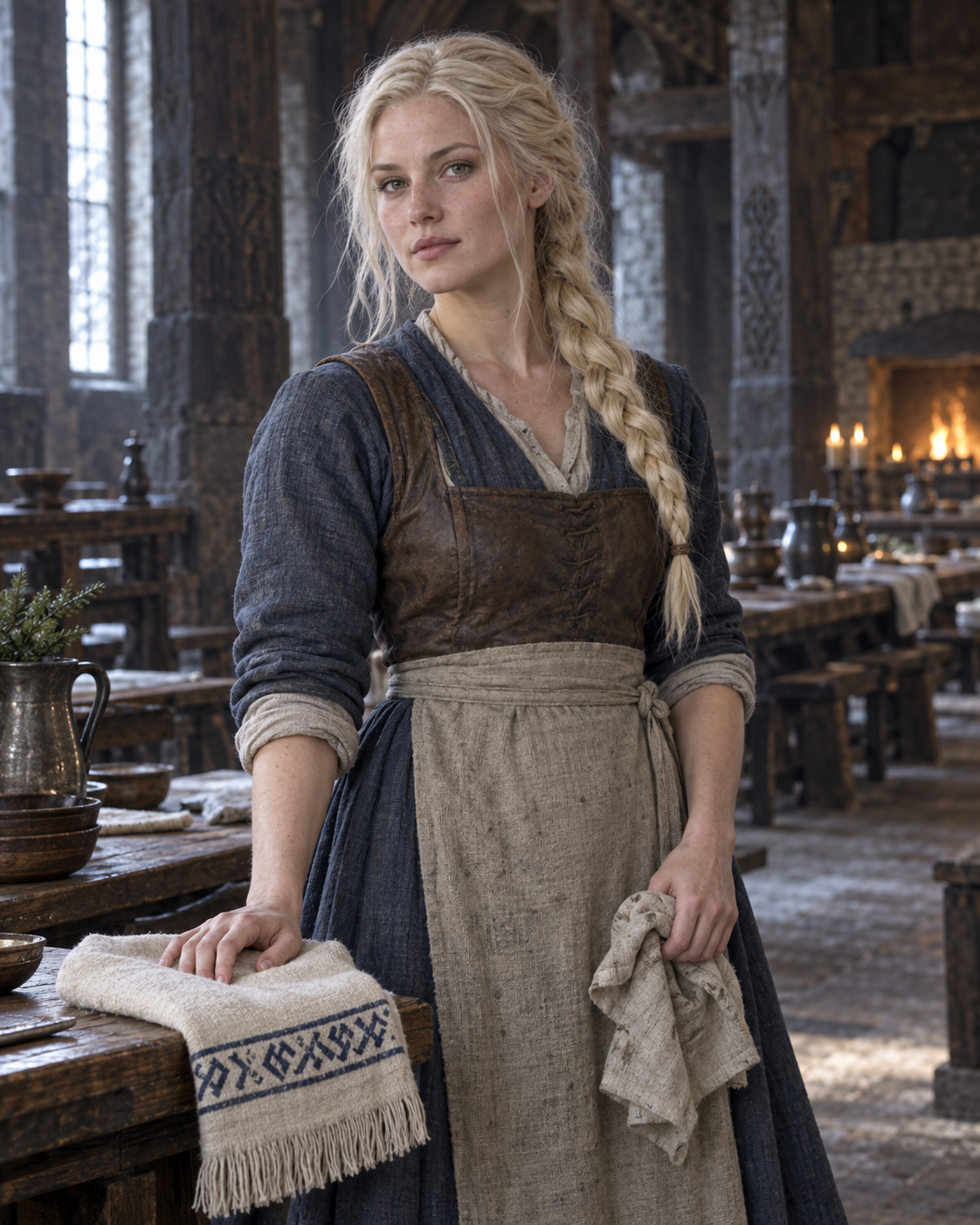
CVM depicts Sigmar as a breathtakingly attractive young adult Rimmerswoman around twenty-four: strong graceful working build, pale gray-green eyes, fair wind-touched skin with faint freckles, and extraordinarily thick nearly-white pale-gold hair in one practical long braid. Her calm guarded intelligence keeps her agency central inside the working context.
Canon does not give her exact age, skin tone, eye color, facial structure, height, build, hairstyle, clothing, jewelry, scars, or family resemblance. It does not make her royal, magical, prophetic, armed, or connected to snow powers.
The approved portrait shows her alive and self-possessed in the occupied hall with one plain cleaning cloth and the pale scarf under her hand. Its dark-blue geometric rune border follows the canonical color logic without claiming an exact alphabet, stitch, or spelling.
If Towser appears, use his approved elderly identity only for the Naglimund memory frame; a historical Naarved scene requires a consistent younger version of the same man. Do not place elderly Towser beside young Sigmar as though they occupied the same physical moment.
Preserve this exact face, young-adult baseline, strong body, complexion, freckles, eyes, nearly-white pale-gold hair/braid map, slate/heather/cream/leather workwear, apron, and scarf design across her hero, directory card, Towser’s profile, Naarved Story 101, React art, and every conquest-era timeline. The same attachment powers featured image, hero, card, and social metadata.
Why Sigmar Matters
She is the person who says no inside a story remembered by the man who wanted yes
Sigmar’s direct evidence is compact, but her narrative function is precise.
She puts civilian labor into the aftermath of heroic conquest. She reveals the unequal material conditions inside Towser’s affectionate courtship. She makes family and place rival loyalties to romance. She gives the old jester a loss he cannot solve by rewriting his past. She helps Simon encounter the fact that another person’s decision remains hers even when it hurts him.
Most importantly, Towser remembers her refusal accurately enough that it survives his longing. He may describe winning her trust in language that centers himself, but he does not erase the boundary she set.
A thin fandom entry would reduce Sigmar to “Towser’s old love.” The canonical profile keeps the possessive relationship from swallowing her only clear action.
She stayed.
On the Record
Book 1 memory, fully spoiled, with Towser’s perspective clearly labeled
This is Sigmar’s one canonical, full-spoiler character profile. Her confirmed evidence appears in The Dragonbone Chair when Towser comforts Simon at Naglimund after Miriamele’s identity is revealed.
The owned Kindle edition confirms her name as Sigmar. It identifies her as a young, nearly white-haired Rimmerswoman who cleaned the royal hall after John’s conquest of Naarved; received Towser’s courtship and help for her family; made him a pale scarf with dark-blue runes spelling her name; refused to leave her family and land; and died years before he retold the story.
The record does not confirm her exact age, surname, relatives’ names, appearance beyond hair, formal occupation, politics, religion, opinion of Jormgrun or John, conditions of labor, engagement, marriage, children, later life, cause of death, grave, or private regret.
The Book 1 appendix separately identifies Cruinh as Towser’s original name. Sigmar remains the verified narrative name of the woman; the two identities must not be merged.
Status: dead before the Naglimund recollection; timing and cause unrecorded.
Visual state: approved editorial reconstruction. One canonical attachment powers featured image, hero, directory card, and social metadata; unsupported physical, clothing, hall, and scarf-pattern details remain disclosed as CVM reconstruction.