
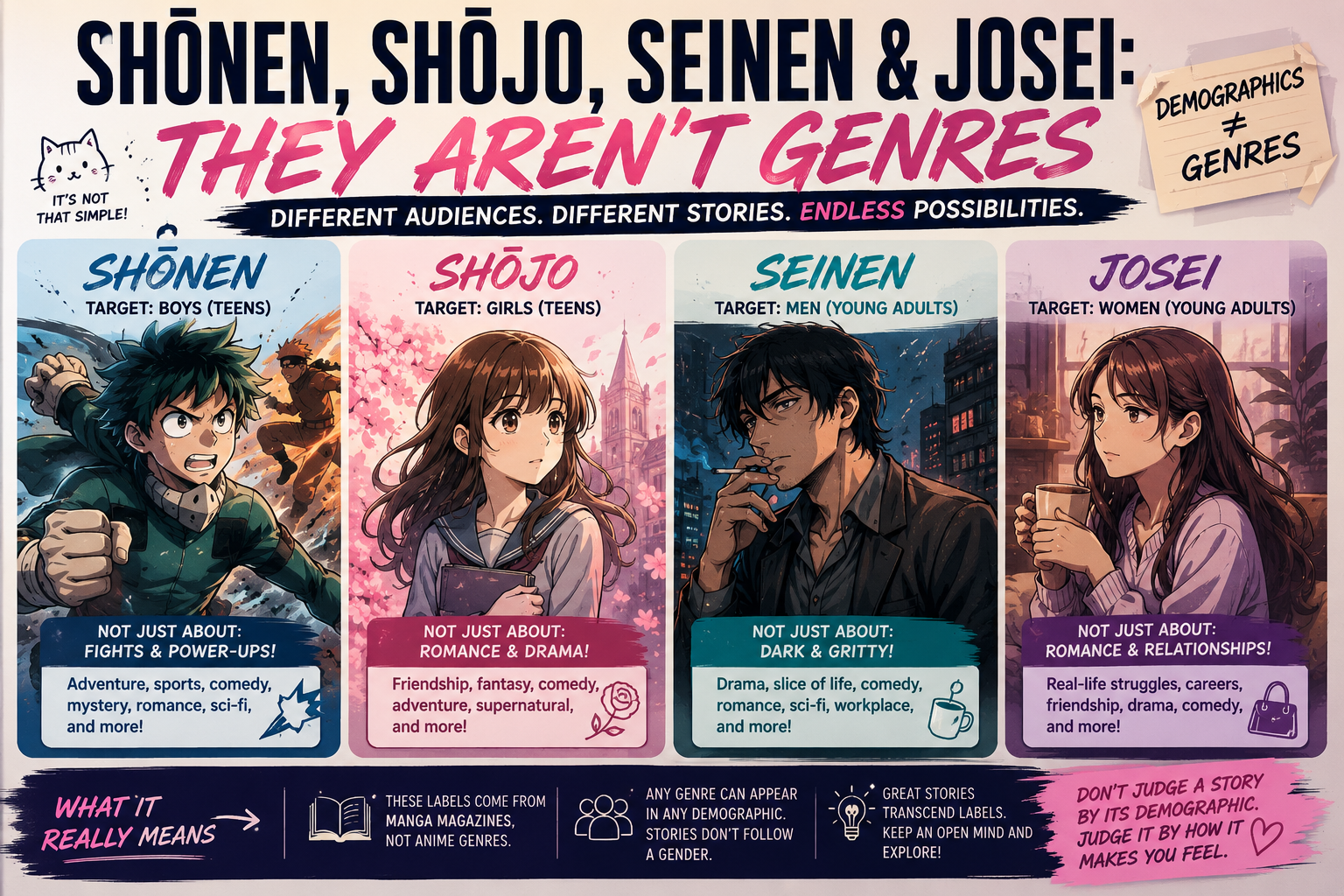
Shōnen, Shōjo, Seinen & Josei: They Aren’t Genres
For years, I thought I understood these four words because anime fandom uses them constantly. Shōnen was the fighting one. Shōjo was the romance one. Seinen was where everybody got traumatized with better lighting, and josei was apparently romance after the characters got jobs and started paying taxes. The problem is that none of those definitions actually explains what the words are doing in Japanese manga publishing.
- What the four words actually mean
- Where the labels come from
- What shōnen actually means
- What shōjo actually means
- What seinen actually means
- What josei actually means
- Genre vs. demographic
- Why magazines matter
- Target reader vs. actual reader
- How readership still influences content
- One genre, four demographics
- Why fandom says “shōnen anime”
- What about original anime?
- What changes after anime adaptation?
- Where the four-box chart fails
- Web manga and digital publishing
- International marketing confusion
- How to classify a manga properly
- Common demographic myths
- Why fans should care
- Sources and deeper reading
Ask two questions instead of forcing one label to do two jobs
If somebody hands me a manga now, I separate the questions. First I ask what kind of story I am reading. Is it romance, fantasy, horror, sports, comedy, mystery, historical drama, science fiction, slice of life, or some chaotic combination of six of those things? That is a genre conversation, and it is about the actual content and structure of the story.
Then I ask where the manga came from. What Japanese magazine, digital platform, imprint, or publishing line serialized it, and what readership was that publication broadly trying to reach? That is where shōnen, shōjo, seinen, and josei become useful. A manga can therefore be a shōnen romance, a shōjo fantasy, a seinen comedy, or a josei mystery without contradicting itself in any way.
The labels are sitting on different axes. We confused ourselves because international fandom took four readership terms and started using them as if they were four mutually exclusive story genres.
1. What do shōnen, shōjo, seinen, and josei actually mean?
The Japanese words themselves are a useful clue because none of them names a story genre. Shōnen (少年) refers broadly to boys or male youth. Shōjo (少女) refers broadly to girls or young girls. Seinen (青年) can refer to young men or male youth in an adult sense, while josei (女性) simply refers to women or females. When these terms are used around manga, they became shorthand for broad readership categories associated with publishing.
The age borders are not something I would treat like federal tax brackets. Different publishers and reference sources may draw slightly different lines, and the real readership of a magazine can be much broader than the target on the planning document. What matters for us is the broad distinction: shōnen and shōjo are associated with younger male and female readerships, while seinen and josei are associated with adult male and female readerships.
| Japanese | Romanization | Basic Meaning | Common Manga-Publishing Use |
|---|---|---|---|
| 少年 | Shōnen | Boy / male youth | Broadly associated with manga aimed toward boys and younger male readers. |
| 少女 | Shōjo | Girl / young girl | Broadly associated with manga aimed toward girls and younger female readers. |
| 青年 | Seinen | Young man / adult male youth | Broadly associated with manga aimed toward adult male readers. |
| 女性 | Josei | Woman / female | Broadly associated with manga aimed toward adult female readers. |
Already, this should make the usual fandom definitions look suspicious. Shōnen does not literally mean “power system.” Shōjo does not mean “romance with flowers around the confession.” Seinen does not mean “this manga contains blood and therefore has become intellectually serious.” Josei does not mean “the female protagonist owns business casual.”
↑ Return to top2. The labels make sense when you start with manga publishing instead of anime
A huge amount of the confusion comes from the order in which international fans encounter these words. Many of us meet the anime first. We watch Naruto, hear people call it shōnen, notice that Dragon Ball and other famous action series get called shōnen too, and naturally conclude that shōnen must mean a certain kind of action story. By the time anybody explains the magazine system, the wrong definition has already settled into the furniture.
The publishing side flips the logic around. Manga has historically been serialized through magazines and publishing lines with particular editorial identities and intended readerships. A title running in a publication aimed broadly toward younger male readers can be classified as shōnen even if the story is romantic comedy. A title in a seinen publication does not need to prove its adulthood by stabbing somebody before Chapter 3.
Content obviously matters to publishers. Editors know what kinds of stories their readers respond to, successful titles influence future commissioning, and magazines develop recognizable personalities. That produces patterns. The mistake is looking at those patterns later and deciding they were the original definitions.
3. Shōnen is much bigger than boys punching increasingly geological objects
Shōnen manga is broadly associated with publications aimed toward boys and younger male readers. The international stereotype exists for a reason: some of the most successful and exportable manga in the world are action-adventure series from shōnen magazines. Battles, rivals, training, tournaments, adventure, friendship, perseverance, and escalating power have become so culturally visible that “shōnen” and “battle shōnen” get treated as synonyms even though one is much narrower than the other.
The useful phrase here is battle shōnen. That describes a recognizable action-oriented branch of shōnen publishing instead of pretending the entire readership category has one plot. Naruto can be both shōnen by publication context and action-adventure by genre. Those labels tell us different things, which is exactly why keeping both is useful.
A shōnen magazine can also publish romance, sports, comedy, mystery, science fiction, fantasy, school stories, supernatural drama, cooking stories, and slice of life. The protagonist does not need to be male, and the story does not need to contain a tournament arc. What the broad label tells us is the publishing readership the work emerged from, not a mandatory recipe for what happens in Chapter 1.
4. Shōjo is not the Japanese word for “romance”
Shōjo manga is broadly associated with publications aimed toward girls and younger female readers. Romance is deeply important to shōjo publishing history, so the stereotype is understandable. The problem begins when “romance is common in shōjo” gets shortened into “shōjo means romance,” because then we erase fantasy, horror, adventure, mystery, historical drama, comedy, supernatural stories, action, and decades of experimentation that also developed inside shōjo publishing.
A work can focus heavily on emotional interiority, relationships, identity, aesthetics, or interpersonal conflict without making heterosexual romance the main engine. Another shōjo work can have a huge romance plot. Both fit because the demographic label is not measuring the percentage of kissing in the manuscript.
Sailor Moon is useful as a sanity check because the manga comes from shōjo publishing, yet the story includes magical transformations, monsters, battles, reincarnation, friendship, comedy, romance, mythology, and stakes involving the fate of the world. If shōjo literally meant romance genre, we would have to ignore most of what Sailor Moon is doing in order to keep the definition tidy.
What about the flowers, sparkles, and emotional panel layouts?
Publishing traditions can absolutely develop recognizable aesthetics. Shōjo manga has a rich visual history involving expressive page composition, decorative imagery, symbolism, fashion, emotional interiority, and paneling that can feel very different from other magazine traditions. Those patterns matter historically and artistically. They still do not turn every work using a flower motif into shōjo, because art style is not a demographic certificate.
↑ Return to top5. Seinen is not “shōnen after the content warning appears”
Seinen manga is broadly associated with publications aimed toward adult male readers. Some enormously visible seinen works contain graphic violence, sexuality, war, psychological trauma, political complexity, moral ambiguity, and material that would obviously contribute to a mature-content reputation. That reputation then became another fandom shortcut: if something is brutal, philosophical, or depressing enough, people start calling it seinen even when the original publishing history says otherwise.
Berserk is seinen and also happens to be extremely dark. Those two facts are both true. The second fact does not define the first one. Seinen manga can be romance, comedy, sports, workplace drama, cooking, hobbies, gentle slice of life, science fiction, or cozy stories whose greatest threat is somebody running out of snacks.
Adult readership gives publishers room to explore certain topics in certain ways, but “adult” does not only mean explicit. It can mean older protagonists, professional life, marriage, parenthood, work, money, politics, sex, social systems, or more complicated moral situations. It can also mean absolutely none of those things. A seinen magazine is allowed to publish something cute because adult men are apparently capable of enjoying peace.
6. Josei is not simply shōjo with rent, careers, and better wine
Josei manga is broadly associated with publications aimed toward adult female readers. Because romance and relationship stories are highly visible in this space, international descriptions often flatten josei into “adult romance.” That misses a lot. Adult female readership creates room for stories about work, family, friendship, marriage, divorce, parenting, ambition, sex, identity, caregiving, fantasy, history, mystery, comedy, hobbies, competition, and ordinary life.
The difference from shōjo is therefore not simply that the characters become older and the romance becomes more realistic. Publishing readership changes. Editorial traditions can change. The concerns a story chooses to explore may change. But there is no rule saying a josei protagonist must be twenty-eight, emotionally exhausted, and currently reconsidering a relationship with a man who owns too many black turtlenecks.
Chihayafuru is a particularly useful example because the manga was serialized in a josei magazine while its story revolves heavily around competitive karuta, ambition, friendship, rivalry, personal growth, team dynamics, and romance. If I used “adult romance” as my entire definition of josei, this work would immediately start fighting the box I built for it.
7. Genre and demographic are answering different questions, and that is the whole trick
Once I stopped trying to make one label describe everything, this subject became much easier. Genre tells me what kind of story I am entering. Fantasy tells me something about the world. Romance tells me relationships are important. Horror tells me the story intends to frighten or disturb me. Sports tells me competition is probably going to take over everyone’s personality. Those are story descriptions.
Shōnen, shōjo, seinen, and josei tell me something about manga publishing context and intended readership. They can sit beside genre, format, setting, theme, and trope labels rather than replacing them. A title can therefore be a shōjo fantasy romance, a seinen science-fiction mystery, or a shōnen sports comedy. The more specific description actually tells me much more than the demographic alone.
| Type of Label | What It Tells You | Examples |
|---|---|---|
| Demographic / Publishing Category | Who was the manga publication broadly positioned toward? | Shōnen, shōjo, seinen, josei |
| Genre | What kind of story is it? | Romance, fantasy, horror, sports, mystery, comedy |
| Setting | Where or in what kind of world does it happen? | School, workplace, fantasy kingdom, historical Japan, space |
| Format | What form does the work take? | Manga, TV anime, film, light novel, OVA, web manga |
| Trope / Structure | What recognizable storytelling device does it use? | Tournament, reincarnation, found family, rivals, time loop |
8. The magazine can be a better clue than the protagonist, art style, or plot
Manga magazines historically provide one of the easiest ways to understand these demographic labels because magazines build readerships and editorial identities over time. A publication aimed broadly toward younger male readers becomes associated with shōnen publishing. A magazine positioned toward younger female readers sits within shōjo traditions. Seinen and josei publications similarly build adult readerships, although real audiences always spill beyond the tidy labels.
This matters because the magazine can tell us something we cannot reliably deduce from the story. Two manga can both feature high-school girls drinking tea and still come from different demographic publications. Two violent fantasy stories can be published in entirely different readership contexts. The protagonist’s gender, amount of blood, romantic subplot, or drawing style does not override the publication history.
Individual magazines also develop identities inside the larger demographic. One shōnen magazine may favor a certain kind of high-energy entertainment, while another has a very different editorial personality. The demographic label therefore gives us a broad neighborhood. The actual magazine can tell us which street we are standing on.
↑ Return to top9. Target reader and actual reader are not the same person
This should probably be obvious, yet demographic language makes people act as if manga magazines check identification at the door. A shōnen publication being marketed primarily toward boys does not mean girls do not read it. A shōjo manga does not become inaccessible to male readers. Adults routinely enjoy media originally positioned toward teenagers, and younger readers routinely sneak into material aimed older than they are, as humans have been doing since books became portable enough to hide.
Successful series often develop massive crossover audiences. An adaptation can make that crossover even larger because the anime escapes the original magazine ecosystem and arrives on television, streaming services, social media, merchandise shelves, and international platforms. The audience that ultimately loves a franchise may look nothing like the target group used when the manga first entered publication.
| Claim | What Actually Makes Sense |
|---|---|
| “Girls don’t read shōnen.” | Shōnen describes broad target readership, not exclusive readership. |
| “I’m an adult, so shōnen is not for me.” | Adults can enjoy stories originally marketed toward younger readers. |
| “Lots of women love this shōnen series, so it became shōjo.” | Crossover popularity does not rewrite where the manga was published. |
| “Josei readers must all be adult women.” | Target demographic is not a census of everyone who bought Volume 1. |
This distinction is actually useful when analyzing fandom. A manga can be shōnen by original publishing context while developing a huge female fanbase, and that audience may influence merchandise, events, character popularity, marketing, and eventually even how the larger franchise is discussed. Publishing origin stays the same. The cultural audience grows around it.
↑ Return to top10. The demographic does influence publishing, just not in the simplistic way fandom thinks
Saying these labels are not genres does not mean audience targeting is meaningless. Publishers care deeply about readers. Editors choose work they believe will appeal to their publication’s audience, magazines build visual identities, advertisers care about readership, and successful series teach publishers what their audience might want next. That creates real patterns in style, themes, pacing, protagonist types, cover design, marketing, and editorial traditions.
The important distinction is between a pattern and a definition. Battle manga became incredibly important within shōnen publishing, but shōnen does not therefore mean battle manga. Romance became enormously important within shōjo traditions, but shōjo does not therefore mean romance. Mature, psychologically heavy stories can flourish in seinen magazines without turning darkness into the legal requirement for admission.
The first statement notices publishing history. The second turns a recurring publishing pattern into a rule and then gets confused the moment a romantic comedy appears in the same demographic.
↑ Return to top11. The same genre can exist in every demographic, which should kill the genre theory pretty quickly
Romance is probably the easiest example. Romantic stories can be marketed to younger male readers, younger female readers, adult men, or adult women. The relationship dynamics, editorial traditions, visual presentation, sexual content, character priorities, or expected audience may differ, but the underlying genre does not belong exclusively to one demographic.
The same applies to fantasy, comedy, mystery, sports, historical drama, and slice of life. A genre tells us what kind of narrative ingredients are important. The demographic tells us where that particular version was positioned in the publishing market.
| Genre | Shōnen | Shōjo | Seinen | Josei |
|---|---|---|---|---|
| Romance | Yes | Yes | Yes | Yes |
| Fantasy | Yes | Yes | Yes | Yes |
| Comedy | Yes | Yes | Yes | Yes |
| Mystery | Yes | Yes | Yes | Yes |
| Slice of Life | Yes | Yes | Yes | Yes |
| Historical | Yes | Yes | Yes | Yes |
Once I saw this laid out, the entire issue became almost embarrassingly simple. I had been treating shōnen, shōjo, seinen, and josei as four shelves containing different genres. They are better understood as four broad readership contexts that can each contain multiple shelves of their own.
↑ Return to top12. Why do we say “shōnen anime” if shōnen comes from manga publishing?
Because language gets lazy in very predictable ways. A manga serialized in a shōnen publication becomes an anime, and people naturally call the result “a shōnen anime.” Everyone understands that Naruto came from a shōnen manga, so nobody wants to say the full sentence every time. The shorthand works perfectly well until the shorthand begins pretending it is an animation genre.
International fandom made this even stronger because many viewers never see the original magazine. They encounter an anime streaming page, then learn through fandom that the series is “shōnen.” After seeing enough famous shōnen adaptations with fights, rivals, young heroes, training, friendship, and escalating powers, the brain builds a genre definition that the publishing word never actually had.
So I am not going to throw a chair every time somebody says “shōnen anime.” The phrase is deeply embedded in normal fandom language, and most of us know what the person is trying to communicate. I simply want to know which meaning they are using. Are they saying the anime is adapted from shōnen manga, or are they using shōnen as shorthand for battle-oriented action anime?
13. Original anime exposes the problem immediately
An original anime has no manga magazine sitting behind it to provide a shōnen, shōjo, seinen, or josei publication category. The anime can absolutely target younger men, adult women, families, children, hardcore hobbyists, or some other audience, but that does not automatically make the four manga labels the correct vocabulary for describing it. If we start assigning an original anime “shōnen” because it has a teenage boy who fights, we are back to guessing demographic from genre conventions.
This does not mean an original anime cannot borrow traditions strongly associated with shōnen manga, shōjo manga, magical-girl storytelling, sports manga, adult drama, or anything else. Creative traditions travel. The important thing is to distinguish resemblance from publishing origin. We have plenty of other vocabulary for describing genre, tone, audience, format, and style without pretending every animated work secretly belongs to a manga magazine that never existed.
14. Anime adaptation can completely change who actually encounters the story
A manga may begin inside a publication aimed at a relatively specific readership, but anime distribution can throw the doors open. Television, streaming platforms, international licensing, clips, memes, merchandise, and word of mouth reach viewers who have never seen the original Japanese magazine and may not even know which demographic category the manga came from.
This is where target audience and actual audience can become dramatically different. A shōnen manga can develop a huge adult audience. Women can become enormously important to the fandom of a series originally marketed toward younger men. A shōjo adaptation can find passionate male viewers. The success of the anime does not erase the manga’s publishing history, but it does show why demographic labels should never be treated as descriptions of everyone who actually loves the work.
The adaptation can also be marketed differently overseas. A streaming service may tag the show as action, fantasy, romance, or thriller and never mention shōnen at all. An international viewer may therefore encounter the genre before the demographic, while a Japanese manga reader encountered the magazine context first. Same property, different doorway.
↑ Return to top15. Real manga publishing is messier than beginner explanations make it look
Shōnen, shōjo, seinen, and josei are extremely useful introductory labels, but Japanese manga publishing is not organized into four perfectly sealed kingdoms. Publications develop specialized audiences. Age ranges overlap. Some magazines sit awkwardly between categories. Digital platforms publish broad mixtures of work. Individual titles can migrate between publications, and international publishers may market the same manga primarily through genre instead of preserving its original demographic terminology.
That does not make the four labels useless. It means they are tools, not natural laws. A beginner map is supposed to help you enter the city. The problem starts when we insist every alley, train station, shopping district, and weird underground ramen place must fit inside four rectangles because that is what the map showed on page one.
There are also manga categories and publishing contexts that do not fit neatly into this particular demographic quartet. Children’s manga is an obvious example. Specialized hobby publications are another. Digital manga further loosens the old relationship between one magazine identity and one reader group. The four terms remain culturally important, but they are not the entire taxonomy of Japanese comics.
16. Web manga and apps make the magazine shortcut less reliable
Traditional magazine serialization gives us a wonderfully convenient receipt. Find the original magazine, identify the publication’s general readership, and we have strong context for understanding the demographic label. Digital publishing makes that process less tidy because manga can launch through websites and apps carrying enormous catalogs across genres and readerships.
A digital platform might organize discovery around genre, popularity, recommendations, free chapters, browsing behavior, publisher, or algorithmic feeds rather than recreating one traditional magazine’s identity. Some digital publications still have very clear demographic positioning, while others are deliberately broader. This is another reason I would rather investigate a specific manga’s actual publication history than force every modern series into one of four familiar words.
The historical categories are still useful because Japanese publishing did not lose its entire history when phones appeared. We simply have a modern distribution environment layered over older demographic traditions, which is much more interesting than pretending the system froze in 1987.
↑ Return to top17. International marketing can make the same manga look like it belongs to a completely different filing system
This is probably a major reason the terminology becomes so strange outside Japan. An English-language publisher or streaming platform wants users to find stories quickly, so genre tags like fantasy, action, romance, horror, or comedy are often more useful than a Japanese manga demographic. The consumer sees those genre labels first, while fandom discussions later introduce shōnen or seinen as though they are another genre sitting beside them.
Now one database lists “Action, Adventure, Shōnen.” Another site calls shōnen a demographic. A streaming service never mentions it. A YouTube essay uses “shōnen” to mean battle storytelling conventions. Reddit uses it to compare power systems. Everybody is technically discussing related things, but the word has changed jobs four times before lunch.
Putting the publication context back does not mean everyone must speak like an academic paper. It simply gives us a reference point. When somebody says “shōnen,” I now know there is an original publishing meaning underneath the fandom shorthand, and I can tell which version actually matters to the conversation.
↑ Return to top18. How I would actually figure out whether a manga is shōnen, shōjo, seinen, or josei
I would not start with the story. I would start with the publication. Find where the manga originally serialized in Japan, then identify how that magazine, site, or publishing line is positioned. Japanese publisher pages, official magazine information, and original serialization records are much stronger evidence than somebody looking at a screenshot and declaring, “This gives seinen energy.”
This distinction between classification and interpretation is useful. I can say a series feels like the kind of mature psychological drama I associate with famous seinen works. That is a perfectly valid aesthetic observation. It is simply not evidence that the manga was actually published as seinen.
19. Demographic myths that make the whole system harder than it needs to be
20. Knowing this stops the labels from telling you what you are supposedly allowed to expect
The biggest payoff is not being able to correct somebody on Reddit. Please resist building your personality around that. The useful part is that the demographic stops acting like a genre cage. A shōnen label no longer makes me assume the story will eventually involve a tournament. A shōjo label does not make me dismiss a work because I am not looking for romance. A seinen label does not automatically convince me I am about to receive sophisticated adult storytelling merely because somebody lost an arm.
Instead, the label gives me context about where the manga came from. I can then look at genre, themes, magazine traditions, actual readership, adaptation history, and the specific story separately. That creates much better comparisons because two manga sharing a demographic can be completely different genres, while two romance manga aimed at different demographics can approach the same subject from very different editorial traditions.
It also helps when we move into anime. If somebody calls a show “shōnen,” I can ask whether they mean the source ran in a shōnen publication or whether they are describing battle-shōnen conventions. Neither use requires a courtroom. I simply know the word is doing different work depending on the sentence.
Most importantly, the real definitions make the medium feel larger. Shōjo contains more than romance. Seinen contains more than darkness. Josei contains more than adult relationships. Shōnen contains more than fighting. The stereotypes were not helping us understand manga. They were quietly hiding half the shelves.
Anime fandom somehow turned manga marketing into four personality types
This topic bothered me because I genuinely thought I already knew these words. I had watched enough anime and read enough discussions that the definitions felt obvious. Shōnen was Naruto-shaped. Shōjo meant romance. Seinen was where things became dark enough for people to start calling the writing “adult,” and josei seemed to appear mostly when somebody wanted to explain that the romance involved women old enough to own a coffee machine.
Then I started looking at actual publication categories and realized the stories were not breaking the rules. My rules were wrong. A shōnen romance was never strange. A cozy seinen manga was not an exception that needed explaining. A shōjo action fantasy was not secretly doing demographic gymnastics. I had taken patterns from famous exported works and mistaken those patterns for definitions.
I actually like the real system much better because it leaves creators more room. Younger male readers are not assumed to enjoy one kind of story. Younger female readers are not handed romance and told to remain in the enclosure. Adult men can read quiet stories about hobbies. Adult women can read fantasy, competition, comedy, horror, or whatever else a publication believes its readers will enjoy.
The categories become more interesting once they stop pretending to describe every person who reads them or every plot that appears inside them. They tell us something about publishing history, editorial culture, and the audience a work was originally positioned toward. Then the story gets to be whatever strange thing it actually is.
Demographic tells me who the publisher was broadly talking to. Genre tells me what kind of story showed up to the conversation. Fandom mashed those questions together and then wondered why the answers kept getting weird.
Sources and deeper reading
The four demographic labels are useful shorthand, but specific publication histories matter more than trying to classify a work from its plot. When I am checking a particular manga, I prefer original Japanese publisher information, magazine history, official serialization records, and the publication’s own positioning over databases that may mix genre, demographic, and fandom tags into one list.
- Shueisha and its manga magazine publications · Useful primary publishing context for major shōnen and other manga lines.
- Kodansha manga magazines and digital publications · Useful for comparing different readerships, magazine identities, and modern publishing structures.
- Hakusensha publications · Particularly useful for understanding shōjo and seinen publication contexts without trying to infer demographic from story content.
- Original Japanese serialization records · For a specific title, where it actually serialized is usually a much better receipt than the tone of the anime adaptation.
- CVM Sekai Anime 101 · How Manga & Light Novels Become Anime
- CVM Sekai Anime 101 · What Is a Japanese Anime Production Committee?
- CVM Sekai Anime 101 · What Is a Cour?