
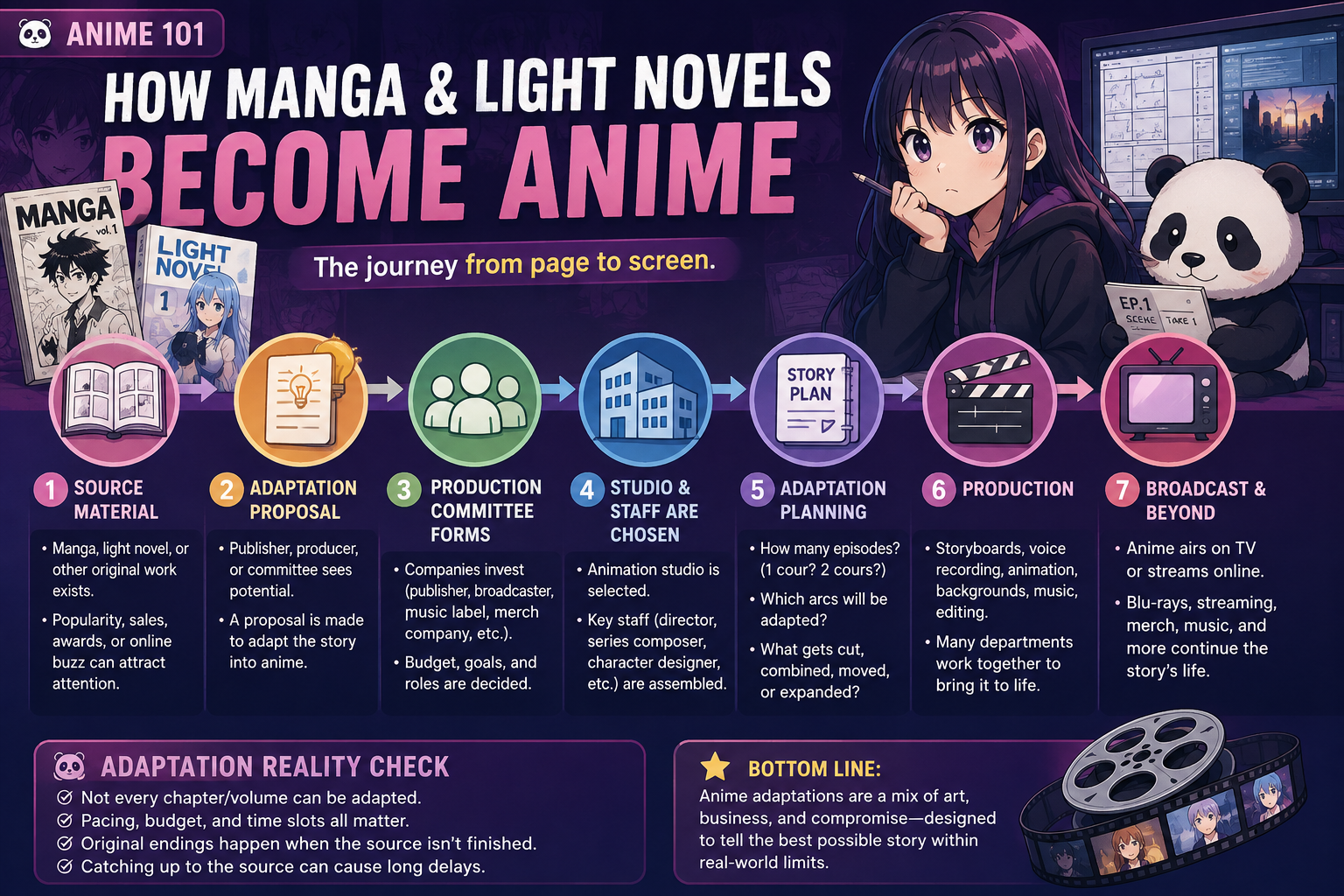
How Manga & Light Novels Become Anime
An anime adaptation is not a manga with color and movement sprinkled on top. Before Episode 1 reaches us, somebody has to secure the property, organize the business side, assemble a creative team, decide how much source material fits, rebuild that material into episodes, and then physically produce the animation. Somewhere in that process, a chapter you loved can become ten gorgeous minutes, forty seconds of exposition, a completely different scene, or nothing at all. This guide is about what happens in that gap.
- What counts as source material?
- Why does one story get adapted?
- The business side before animation begins
- Who actually shapes the anime?
- How an adaptation season gets planned
- Why manga is harder to adapt than it looks
- Why light novels create a different problem
- How chapters and volumes become scripts
- How storyboards reinterpret the source
- Why character designs change for animation
- What voice acting, music, and sound add
- How cours and episode counts squeeze the story
- Why chapters-per-episode math can lie
- Why scenes get cut, moved, merged, or expanded
- How adaptations quietly change characters
- Why different genres break differently
- What if the source is unfinished?
- What if the anime catches the manga?
- Anime-original material, filler, and endings
- Broadcast limits and practical changes
- The adaptation gets translated again
- Does faithful automatically mean better?
- Why Season 2 can take forever
- Why some adaptations start over
- How fans can compare adaptations better
- Common adaptation myths
- Why any of this matters
- Sources and deeper reading
Before we get lost in the machinery, here is the whole trip
Every anime has its own production history, and there is no one sacred checklist followed in exactly the same order by every company. Still, the broad shape is useful because it shows how much happens between “this manga is popular” and “Episode 1 premieres next month.” A property has to attract serious adaptation interest, rights have to be available, financing and production partners need to come together, staff have to be assembled, the source needs an adaptation plan, and only then does the enormous physical job of producing animation begin. By the time viewers complain that Chapter 17 was skipped, dozens of decisions have already happened upstream.
1. Manga and light novels are only two kinds of source material
Manga and light novels dominate a lot of English-language anime discussion because so many major adaptations come from them, but Japanese animation pulls stories from far more places. Anime can be adapted from web novels, standard novels, visual novels, console games, mobile games, children’s books, stage projects, music projects, toys, or other intellectual property. Some anime are original productions with no previous narrative version at all, which means their writers are solving a completely different problem because the anime is not translating an existing story into animation.
The original format matters because each medium hands the anime team a different problem. Manga already provides visual composition, character designs, expressions, dialogue, and a sense of action, but it is silent and static, and the reader decides how quickly to move through the page. Light novels contain prose, internal monologue, narration, and worldbuilding that may not have any obvious visual equivalent. Games may rely on player agency, exploration, optional conversations, repeated combat, branching routes, and dozens of hours of time with characters. A visual novel can have several mutually exclusive endings, which immediately forces the anime to decide what version of the story it intends to tell.
This is why I now care when somebody says, “The anime is based on a light novel,” instead of treating that as trivia under the title. That information gives me a clue about what might be lost in adaptation. If the source is prose, I immediately wonder how much of the character’s inner life exists outside dialogue. If it is manga, I start thinking about panel rhythm and page turns. If it is a game, I want to know whether the adaptation is compressing fifty hours of optional exploration into twelve episodes. The source format tells us what kind of translation problem the anime inherited before anybody even argues about whether the adaptation is faithful.
↑ Return to top2. Why does one manga get an anime while another waits forever?
Fans often talk about adaptation as though sufficiently good manga eventually graduate into anime, but there is no merit badge sitting at the end of Volume 10. Popularity can matter enormously because existing sales, readership, and name recognition give producers evidence that an audience already exists. Awards, critical attention, social buzz, a committed editor, strong publisher support, merchandising possibilities, streaming interest, and international potential can all help make a property attractive. None of those things, however, turns a story into an anime automatically.
Rights still need to be available, companies have to decide the project makes sense, producers need to organize financing and partners, and eventually a studio and key staff need enough room in their schedules to make the thing. This is why a smaller title can unexpectedly receive a gorgeous adaptation while a much more famous manga sits untouched for years. Fans can see sales numbers and online demand, but we cannot see every proposal that stalled, every rights discussion that went nowhere, every scheduling conflict, or every producer who chose to pursue another project instead.
3. The anime needs a business structure before it becomes twenty-four minutes of television
Japanese anime projects often involve several companies rather than one animation studio financing and controlling every part of the production. Publishers, broadcasters, distributors, music companies, advertising firms, merchandise companies, game companies, streaming partners, and sometimes the animation studio itself can participate in financing, rights, licensing, marketing, or commercialization. The exact arrangement differs between projects, which is why I do not want to pretend every anime has one identical corporate flowchart hidden behind the opening credits.
Those companies may also define success differently. A publisher may be thrilled if the anime sends viewers back to the manga. A music company may care about the opening theme and artist exposure. A merchandise company may discover that the quiet supporting character nobody expected to dominate the fandom is suddenly selling every acrylic stand they can manufacture. A streaming company cares about subscribers and audience reach. The television series is therefore both a creative work and one piece of a larger business life surrounding the property.
The animation studio is obviously central because somebody has to physically produce the animation, but making the anime does not automatically mean owning or controlling every decision around the franchise. Japan’s Fair Trade Commission has examined anime production structures, production committees, subcontracting, copyright, and secondary-use revenue precisely because the relationships between producing companies, animation production companies, and rights holders can be complicated. That matters for fans because “the studio decided this” is often treated as a universal explanation when the public evidence may not tell us that at all.
If you want the corporate side in full detail, that is what What Is a Japanese Anime Production Committee? is for. The important part here is simply recognizing that adaptation choices are created inside both a creative process and a business structure, and the two do not always belong to the same people.
↑ Return to top4. Once a story becomes anime, the original author is no longer the only storyteller in the room
The source creator remains enormously important because the characters, world, themes, relationships, and original narrative came from them, but an anime introduces a new group of artists and decision-makers who have to interpret that material. Directors, series-composition writers, screenwriters, storyboard artists, episode directors, character designers, animators, art directors, composers, sound staff, editors, producers, and voice actors all contribute information the manga or novel never contained in exactly the same form. The moment the adaptation begins, authorship becomes layered.
The director may emphasize melancholy that felt quieter on the page, while another production might lean harder into comedy. Series composition can determine how arcs are distributed across the season and what information moves from one episode to another. A storyboard artist can turn a small manga panel into a major visual moment, while a voice actor can make one ordinary sentence sound frightened, sarcastic, affectionate, or dishonest. Two teams can therefore receive equally strong source material and create anime that feel completely different because adaptation is an act of interpretation, not mechanical transfer.
5. Before adapting chapters, somebody has to decide what this season is actually trying to become
This is one of the most important parts of adaptation because a television season needs a shape, not merely a pile of sequential chapters. Suppose the manga has eighty chapters available. The anime does not automatically begin at Chapter 1 and keep swallowing chapters until Episode 12 runs out of minutes. Staff have to identify what emotional and narrative unit those episodes are supposed to form. Where does the season begin? What arc gives it a satisfying ending? Which relationship needs enough development before that finale can work? What information must be established now because the next arc assumes the audience already understands it?
Sometimes the source makes that easy because a clean arc ending lands almost perfectly inside the available runtime. Sometimes the best stopping point is inconveniently far away, and the adaptation has to choose between stopping earlier or moving faster. That is where cuts, compression, reordered scenes, merged conversations, or accelerated pacing can begin. These choices are not automatically mistakes, but they create the architecture of the adaptation long before viewers start counting missing panels.
This is also why two adaptations of the same source can make completely different first seasons. One team might decide the heart of the opening arc is a relationship and protect every small interaction, while another team might decide the audience needs to reach the first major battle before the season ends. Both teams can be adapting the same chapters faithfully in broad plot terms while creating very different experiences because they disagree about what deserves the limited screen time.
↑ Return to top6. Manga looks almost pre-animated until you notice everything the page is doing
Manga is already visual, which makes it tempting to imagine adaptation as a simple process of coloring the panels and adding movement. The problem is that manga controls attention through tools animation cannot reproduce literally. Panel size tells your eye what matters. Page composition lets several images exist in front of you simultaneously. A page turn can hide a reveal until the exact moment you physically expose it. Negative space can slow your reading, while a dense action page can make your eye sprint even though no actual clock controls you.
The reader also owns the pacing. You can stare at a character’s expression for twenty seconds because something about it feels wrong, then flip backward to check what they said three pages earlier. You can rush through an action sequence in seconds, or study every impact panel. Animation takes that flexible experience and converts it into fixed time. The production now decides exactly how long the audience sees the face, when the reaction appears, how quickly the attack happens, and whether the reveal is accompanied by silence, music, a camera move, or somebody screaming the obvious.
This is why an iconic splash page can become strangely underwhelming in an anime that technically reproduces the drawing perfectly. If the anime flashes the image for two seconds and immediately cuts away, the visual weight the page gave it may disappear. Another adaptation can spend thirty seconds building toward the same image, remove the music, let the audience sit in the reveal, and turn that panel into the scene everyone remembers. The drawing may be faithful in both versions, but the timing changes its meaning.
↑ Return to top7. Light novels can lose entire characters when the internal narration disappears
Light novels create one of the nastiest adaptation problems because a huge amount of story can exist somewhere the camera cannot physically go: inside the character’s head. A protagonist may spend several pages analyzing an opponent before making what looks, from the outside, like an impulsive decision. A romantic lead may notice another character constantly without ever saying why those details matter. A narrator can misunderstand events, hide information from the reader, or explain a political system that becomes essential several volumes later.
When an anime removes that internal narration, it has not necessarily removed an event from the plot, but it may have removed the information that tells us how to interpret the event. The character still makes the same decision, yet anime-only viewers now think the decision was stupid because the reasoning vanished. The confession still happens, but the relationship feels sudden because three volumes of quiet noticing became a handful of neutral-looking scenes. This is how an adaptation can preserve the storyline while quietly changing the person we think we are watching.
| What the Novel Gives You | If the Anime Removes It | Possible Viewer Result |
|---|---|---|
| Detailed reasoning | The decision remains but the thought process disappears. | A clever character can look reckless or stupid. |
| Hidden affection | Dialogue remains emotionally neutral. | A later romance can feel sudden or unsupported. |
| Fear and hesitation | The character simply performs the action. | A difficult decision looks effortless. |
| Worldbuilding narration | Only visible action survives. | Rules may feel arbitrary or invented when needed. |
| Unreliable perspective | The camera appears more objective than the narrator was. | The audience may miss that the character misunderstood events. |
The opposite problem exists too. Keeping every paragraph of a dense novel would create episodes where characters spend half the runtime explaining the manual. Anime has to decide what can be demonstrated visually, what genuinely needs dialogue, which details can wait, and which pieces of worldbuilding the audience can infer. Good compression can make a complicated novel easier to understand. Bad compression can make a carefully designed fantasy system look as though the rules are changing every time the protagonist needs a new power.
8. Chapters and volumes do not magically become episode scripts
The script is where source material starts becoming something actors, storyboard artists, directors, and production staff can actually use. Manga dialogue that feels natural inside speech bubbles may sound long or repetitive when performed aloud. Light-novel narration may need to become dialogue, voice-over, visual acting, or a completely new scene. Exposition spread across several chapters may be reorganized so the audience gets the information at a moment when it matters rather than hearing the same explanation three weeks in a row.
Episode structure creates another problem because manga chapters already have endings, but chapter endings are not automatically strong television endings. An episode may combine several chapters to reach a better cliffhanger, stop in the middle of a chapter because that moment produces a stronger emotional break, or move a reveal earlier so the episode has enough shape to feel complete. The source material can remain recognizable while the experience of receiving it changes because the adaptation has reorganized when each piece of information arrives.
Spoken dialogue has weight the page does not
A long explanation that the reader skims in fifteen seconds can take a voice actor a full minute to perform, and one minute of a twenty-four-minute episode is expensive territory. Writers therefore have to decide which words are doing essential work and which ideas animation can communicate another way. Sometimes that means shortening a speech without losing anything important. Sometimes the line that gets removed was the exact line explaining why the character’s behavior makes sense. The difference between elegant compression and accidental character assassination can be one sentence.
↑ Return to top9. Storyboards are where the manga panel stops being the camera
A manga panel can inspire a shot, but the anime still has to decide how the audience arrives at that image and what happens after it. Is the camera close to the character or far away? Does the scene begin with the reaction or the cause? Does the camera move, or is the stillness itself the point? How many cuts occur during the fight? Does the episode reproduce the iconic panel exactly because fans expect it, or build a completely different sequence that eventually lands on the same composition?
These decisions matter because animation forces visual information into time. Manga can place several reactions on the same page and let your eye jump between them. Anime has to choose who reacts first. That choice can alter comedy, suspense, sympathy, and even who looks suspicious. A mystery adaptation that shows one character’s face two seconds too early can accidentally turn a subtle clue into a giant glowing arrow.
This is also why recreating a famous manga panel can be so satisfying. The anime can spend an entire sequence building toward an image readers already know, then use movement, sound, and anticipation to make reaching that image feel like a payoff. The manga gave the reader the picture. The anime can give the viewer the wait.
↑ Return to top10. Why do anime character designs sometimes look simpler than the source art?
A beautiful manga illustration and a character who must survive thousands of drawings have different jobs. A manga artist can spend extraordinary detail on a cover, splash page, or dramatic close-up, while an anime needs a design that can be drawn from multiple angles, in motion, by many artists, across different episodes, under real production schedules. Hair may simplify, decorative clothing details may change, proportions can become easier to reproduce, and complicated accessories may be reduced so the character remains manageable without losing their identity.
Light novels create another version of this problem because their character illustrations may be gorgeous but relatively infrequent. The anime needs a design that can turn around, run, fall down, cry, fight, appear tiny in the background, and still look like the same person next week. Color also becomes part of the adaptation because a black-and-white manga may not have answered every question the animated production now needs to answer.
11. Voice acting, music, and sound can change a scene without changing the words
This is one of the great advantages animation has over a printed source. A voice actor can make a perfectly ordinary sentence sound frightened, sarcastic, affectionate, resentful, exhausted, or dishonest without changing a single word. Music can tell us where the emotional center of the scene is before the character understands it. Silence can turn an ordinary pause into something unbearable, and sound design can make a weapon feel heavy or a room feel empty before the viewer consciously notices what changed.
Imagine the manga gives us two words: “I’m fine.” The anime can add a small inhale before the sentence, a hesitation between the words, no background music, and a character who refuses to make eye contact. The adaptation has now communicated an entire paragraph of emotion without adding another line of dialogue. That is not less faithful because the manga did not contain a soundtrack. That is the new medium doing work the old medium could not do in the same way.
Comedy can live or die inside half a second
Comedy is especially sensitive because timing becomes part of the joke. A manga gag lets the reader control speed, but anime decides exactly how long to wait before the reaction shot and how quickly to cut away afterward. Voice performance, silence, music, and editing can make a joke much funnier than it felt on the page. The same adaptation can also hold the pause three seconds too long and slowly watch the joke die on the floor.
↑ Return to top12. Then the cour walks in and gives all this creativity a number
The anime cannot adapt infinite source material. A project eventually receives a planned production length, and for television anime that often means working inside one or more cours. One cour is roughly a three-month broadcast block, commonly producing around twelve or thirteen weekly episodes. Two cours give the adaptation much more space, but even twenty-four episodes are still a finite container that has to end somewhere.
Episode count can dramatically affect the kinds of adaptation choices staff face. A slow romance can survive when there is enough room for small relationship scenes, but those scenes become tempting cuts when the production is racing toward a major climax in twelve episodes. Dense worldbuilding can emerge naturally across two cours but become compressed into explanation scenes when the same material has half the runtime. Supporting characters who felt fully developed in the manga may look decorative in the anime because their quieter chapters were the easiest material to sacrifice.
| Source Problem | One-Cour Pressure | More Runtime Can Allow |
|---|---|---|
| Large supporting cast | Side-character development competes aggressively for minutes. | More setup, relationships, and follow-through. |
| Dense worldbuilding | Rules may be compressed into exposition or removed. | World details can emerge through scenes. |
| Slow romance | Small relationship beats become tempting cuts. | Buildup can survive without strangling the main plot. |
| Long story arc | The production may rush to reach the climax. | Setup, midpoint, climax, and aftermath can all receive room. |
More episodes do not automatically create a better adaptation because someone still has to use that space well. A twenty-four-episode show can waste time, while a disciplined twelve-episode production can be incredibly efficient. Runtime gives the production room. It does not guarantee the furniture will be arranged intelligently.
For the scheduling side in full, read What Is a Cour?.
↑ Return to top13. “They adapted four chapters this episode” tells me much less than fandom thinks it does
Chapters are not standardized units of story. One manga chapter may contain a battle with huge panels and very little dialogue, while another chapter contains a political conversation, a flashback, new world rules, and enough character psychology to ruin everyone’s evening. Adapting four chapters of the first kind can feel leisurely. Adapting four chapters of the second kind can make the episode feel as though it is fleeing the police.
Page count is not a perfect shortcut either because the function of those pages matters. Twenty pages of rapid action do not behave like twenty pages of dialogue. Light novels make the math even worse because “one volume in four episodes” tells us nothing about how dense that volume is, how much of the story exists inside narration, or how much can be converted into visual information without losing anything. Adaptation speed needs to be judged by narrative load, not merely chapter arithmetic.
14. All cuts remove material, but all cuts do not cost the story the same thing
Fans often talk about cuts as if every missing scene belongs in one category, but losing a repeated joke and losing the only conversation that explains a character’s worldview are not remotely the same adaptation event. A scene can be removed because the anime communicates the same information visually, because the episode needs better pacing, because the season is being structurally rebuilt, or for production reasons we may never know from the finished work. The visible fact is that the material disappeared. The useful analysis is asking what function disappeared with it.
Moving a scene can change the story even when nothing is technically cut
Imagine the manga shows a character’s traumatic memory before that character makes a terrible decision. The anime preserves the flashback but moves it until after the decision. Every major piece of information still exists, yet the audience experiences the character differently. Manga readers understand the decision while it happens, while anime viewers judge the action first and receive the explanation later. The adaptation did not delete the character’s motive. It changed when we were allowed to sympathize with it.
This is why “nothing important was cut” can still be a weak defense. Order, emphasis, and timing are part of storytelling. Adaptation can change meaning by moving pieces around even when the checklist says all the pieces survived.
↑ Return to top15. Adaptations can change characters without changing the plot at all
This is one of the adaptation problems I notice most because character damage often happens through accumulation. Imagine a manga repeatedly showing a supposedly cold character checking whether his teammate ate, remembering every injury, silently noticing who is frightened, and positioning himself closer when danger appears. None of those moments changes the plot. Remove enough of them and the anime still hits every major story beat, but the character feels less caring because the evidence of caring disappeared.
The same thing happens with romance. A source may build attraction through dozens of tiny conversations that do not advance the main storyline, which makes them vulnerable when the adaptation needs to save time. Cut the walk home, the awkward lunch, the small act of remembering a favorite drink, and the scene where one person notices the other is pretending to be fine, then keep the confession. The anime has technically preserved the romance plot, yet anime-only viewers reasonably ask when these people developed feelings because the emotional bridge is gone.
| Source Material Lost | Possible Anime-Only Interpretation |
|---|---|
| Internal reasoning | A smart decision can look impulsive. |
| Small acts of affection | A friendship or romance can feel sudden. |
| Fear and hesitation | A difficult choice can look emotionally effortless. |
| Foreshadowing | A later reveal can feel random. |
| Context behind resentment | A character can look petty or irrational. |
| Cultural or historical context | A decision that made sense in context can look bizarre. |
This is why source readers can insist that “the anime changed the character” while anime-only viewers point out that the character still performs all the same major actions. Both sides may be observing something real. Plot is not the only place characterization lives. A person is often built out of tiny evidence, and adaptation can lose enough of that evidence to change the audience’s interpretation without changing the event summary.
↑ Return to top16. Action, romance, comedy, mystery, and horror all break differently during adaptation
One adaptation strategy cannot serve every genre equally well because different stories depend on different kinds of information. Action may benefit enormously from expansion because animation can add choreography, spatial logic, weight, timing, sound, and character acting to a sequence that occupied only a few panels. Romance often depends on tiny relationship scenes that look expendable if you only follow the main plot. Mystery requires careful control of clues and information order. Comedy lives inside timing, while horror can be weakened by showing too much of something the manga allowed the reader to imagine.
Action can become more than the source gave it
A manga may show a sword attack in three panels, but an anime can turn that moment into ninety seconds of choreography that reveals strategy, fear, physical exhaustion, and personality. That is not automatically padding. If the animation uses movement to tell us something the still page could not express in the same way, the adaptation is adding value through its medium. The question is whether the expansion is doing narrative work or merely occupying minutes.
Romance is easy to damage because its most important scenes often look optional
Slow romantic development frequently lives in moments that do not move the external plot. Two characters talking after school, noticing small habits, or learning how the other person handles embarrassment can look like easy cuts when an adaptation is short on time. Remove enough of those scenes and the eventual confession may still happen at exactly the same point in the story, but the audience has not been given the same emotional evidence. Romance can therefore be structurally preserved while emotionally hollowed out.
Mystery can be broken by moving one reaction shot
Mystery depends on when the audience knows things. Reveal a clue too early and the viewer solves the case before the detective. Remove a clue and the solution can feel unfair. Move one character’s suspicious reaction to a different moment and the adaptation may accidentally announce the culprit. Story order is especially fragile when the audience is supposed to reason alongside the characters.
Comedy and horror live inside timing
Comedy depends on the exact duration of pauses, reactions, and cuts, while horror often depends on how much the audience is allowed to see. Animation can make a joke much funnier through performance or absolutely flatten it by holding too long. A monster can become more terrifying through sound and motion, or much less frightening once the impossible manga image has to move like a physical body. Different genres therefore expose different strengths and weaknesses in the adaptation process.
↑ Return to top17. What happens when the anime is adapting a story that does not have an ending?
Anime adaptations do not need to wait for the original work to finish, which means a production can be building a season around a story whose final destination does not yet exist. The safest option may be to adapt a completed arc and stop there. Another project may create an anime-original conclusion, diverge from the source, or simply end with unresolved threads because the animated production was never designed to finish the entire story.
This becomes especially important when people compare an older adaptation with manga chapters written years later. A television anime cannot faithfully adapt Volume 18 if Volume 18 did not exist when its scripts were being produced. Before accusing an adaptation of ignoring a later explanation or ending, check the chronology. Sometimes the anime did not reject the source. The source had not reached that point yet.
18. Long-running anime can literally run out of manga
A weekly manga creates new source material at one rate, while a weekly anime can consume that material at another. If the anime keeps moving faster than the manga, eventually the distance between them becomes dangerous. Older long-running adaptations handled this in several familiar ways: slower pacing, expanded scenes, recap, anime-original side stories, full filler arcs, or long stretches where the television series deliberately avoids advancing the main source plot.
Seasonal production changes that pressure because the anime can stop and allow more manga to accumulate before another season begins. That does not guarantee a sequel, because financing, scheduling, staff availability, and business decisions still exist, but it removes the immediate weekly problem of producing new episodes while the source author is only a few chapters ahead.
19. Anime-original material is not automatically filler, and filler is not one magical category
“Anime-original” simply means material that was created for the anime rather than directly reproduced from the source in the same form. That can include a completely new arc, but it can also mean a short connective scene, expanded character interaction, additional dialogue, or an original ending. “Filler” is a fan term more often used for material perceived as delaying or sitting outside the main source progression, especially in long-running adaptations. The categories overlap sometimes, but they are not synonyms.
Original material can solve adaptation problems. A novel may need a visual scene to communicate information previously contained in narration. Two manga chapters may need a transition that never existed on the page. A television season may need a stronger ending than the available source material provides. The anime can create new material that respects the characters and strengthens the adaptation. It can also create twenty minutes where everyone suddenly behaves like cousins who vaguely remember the plot.
Anime-original endings are a much bigger commitment
Once an adaptation creates a different ending, the anime and source can become genuinely separate versions rather than one simply being shorter. That can be fascinating because the anime gets to answer the story’s questions in its own way, but it can also make later continuation awkward if the manga eventually develops in a completely different direction. This is one reason a future adaptation may choose to start over from the beginning instead of trying to build another season on top of an older divergence.
↑ Return to top20. The anime has to exist in a real release environment, not an artistic vacuum
Television, streaming standards, intended audience, scheduling, sponsors, platform policies, and practical production realities can all affect the version of a story that reaches viewers. Violence or sexual material may be handled differently from the printed source, and some content may change between television broadcast and later home-video versions. A scene that works in a book sold to one audience may be presented differently when animation reaches another.
The important part is not automatically calling every difference censorship. Sometimes the production deliberately changes a scene for creative reasons. Sometimes release standards or other practical considerations may matter. Sometimes we simply do not know. The effect of the change is visible in the finished anime, but the internal reason often requires comments from staff, official material, or reliable production reporting before we can state it as fact.
21. International fans are often watching an adaptation that gets translated one more time
The source becomes Japanese animation, then that Japanese animation becomes subtitles or a dub in another language. Dialogue, jokes, honorifics, wordplay, cultural references, speech patterns, names, and emotional nuance now have to cross another bridge. A line that already changed from novel narration to anime dialogue can change again during localization because the translator has to produce something that works in another language and, for a dub, something performers can actually say in time.
This does not mean translation is inherently distorting the work. Translation is another act of interpretation under constraints. A Japanese pun may have no direct English equivalent, while a character’s speech register can contain information English cannot reproduce with the same grammatical tools. What matters for fans is remembering that the subtitle is one layer of the text, not a magical transparent window into the exact sentence the source author wrote.
22. “Faithful to the manga” and “good anime” are not the same score
Faithfulness matters because adaptations can absolutely remove the motivation, relationship development, themes, or context that made the source work. Source readers are not unreasonable for caring when the anime changes those things. The problem is treating literal sameness as the only form of fidelity. An anime can reproduce every major event and still lose the emotional logic, while another can change scene order, rewrite dialogue, and compress material yet preserve what the characters wanted and why the story mattered.
I find it more useful to separate several kinds of fidelity. Plot fidelity asks whether the same events happen. Character fidelity asks whether the people still behave according to the same motives. Emotional fidelity asks whether the relationships and payoffs have enough buildup to land. Thematic fidelity asks whether the story still means roughly the same thing. Then there is a separate question entirely: did the production create good animation?
| Question | What It Really Measures |
|---|---|
| Did the anime keep the same events? | Plot fidelity |
| Did the characters still want the same things? | Character fidelity |
| Did the relationships retain their development? | Emotional fidelity |
| Did the world still obey the same important rules? | Worldbuilding fidelity |
| Did the story still mean the same thing? | Thematic fidelity |
| Did motion, sound, music, editing, and performance improve the material? | Adaptation quality as animation |
Sometimes the most faithful thing an anime can do is change the delivery while preserving the function. A three-page internal monologue might become a quiet twenty-second scene with almost no dialogue. If the viewer still understands the character’s fear, reasoning, and emotional shift, the words disappeared but the purpose survived. That matters far more to me than treating adaptation as a photocopy contest.
↑ Return to top23. Why can Season 2 take four years when the manga is sitting right there?
Because unadapted chapters are only one ingredient. Another season needs another production, which can mean financing, business approval, rights coordination, committee decisions, studio capacity, director availability, staff schedules, release plans, and enough production time to actually create the episodes. The manga can have two hundred unadapted chapters and still not produce twelve finished television episodes by itself.
The source also needs to offer a usable adaptation unit. There may be plenty of material but no clean stopping point yet. A key director may be committed to another project. The animation studio may be booked, or the companies involved may be waiting for another strategic moment to continue the property. Sometimes a sequel was planned from the beginning, and sometimes it genuinely was not. Without an announcement or reliable reporting, “nothing has been announced” can be the complete answer even when every fan desperately wants a more satisfying explanation.
24. Why does a new adaptation sometimes start over from Episode 1?
A new anime may want a clean foundation because the earlier adaptation diverged from the source, created an original ending, stopped before the story had enough material to continue, or belongs to a production era the new team does not want to inherit. Starting over also lets new staff establish their own visual language, pacing, character designs, cast, continuity, and interpretation without asking viewers to understand which episodes of a twenty-year-old adaptation still count.
Remakes are especially interesting because now we have three texts to compare: the source, the older adaptation, and the new adaptation. Which scenes did both anime protect? Which one understood the characters better? Did the newer version fix pacing problems, or did it move too quickly because the creators assumed viewers already knew the beginning? Did the old adaptation add anime-original material fans still love even though it never appeared in the manga? This is adaptation archaeology, and it can reveal how different eras understood the same story.
↑ Return to top25. How to compare an anime with its source without becoming a missing-panel accountant
If you really want to understand an adaptation, start by asking what changed, then ask what the original material was doing before you decide whether the change was harmful. A missing scene may have been repetitive exposition, or it may have contained the only evidence that a friendship mattered. A moved flashback may improve episode pacing while changing our sympathy for a character. An expanded fight may be padding, or it may be using movement to reveal strategy and personality the manga only implied.
The most useful comparison is functional. What did the original scene accomplish? Did the anime preserve that function somewhere else? What did the viewer lose? What did animation add? Once you answer those questions, you can criticize the adaptation much more precisely than saying “they skipped Chapter 12.”
Example: the “stupid character” problem
Suppose an anime-only viewer says, “Why would she trust him? This writing makes no sense.” Then a source reader points out that the novel spent several pages explaining exactly why the decision looked dangerous but was reasonable from her perspective. The useful criticism is no longer that the character became stupid. The anime preserved the decision but removed the reasoning that made the decision believable. Now we know precisely what the adaptation lost and why the anime-only audience experiences the character differently.
Example: the “padding” problem
Suppose the manga uses three panels for a sword attack and the anime turns it into a long sequence involving footwork, failed attacks, environmental interaction, and the weaker fighter slowly realizing the opponent has been controlling distance the entire time. That extra runtime may be adding strategy, personality, and physical storytelling rather than merely slowing the plot. Counting panels cannot answer whether the expansion worked. We have to look at what the animation did with the time.
26. Adaptation myths I would like us to stop repeating
27. Why knowing the adaptation process makes watching anime more interesting instead of turning it into homework
Once you understand the machinery, adaptations stop looking like binary tests where the only two possible grades are “faithful” and “ruined.” You start noticing what the anime prioritized and what kind of information is most vulnerable when a story changes medium. A light-novel adaptation that removes internal thought may preserve the plot while changing the protagonist’s intelligence in the eyes of the audience. A manga adaptation that cuts several quiet relationship scenes may reach the same confession while losing the emotional buildup that made the confession satisfying.
You also get better at recognizing when the anime adds something genuinely valuable. A small manga fight can become character writing through movement. A novel’s long description of anxiety can become one silent shot of a hand trembling under a table. A page-turn reveal can become a carefully staged sequence where music drops out and the camera refuses to move. Adaptation is not only a story losing material. It is also a new medium finding different ways to communicate.
The knowledge also makes criticism more accurate because it separates what we can observe from what we cannot prove. We can know the anime removed a scene and analyze exactly what that removal did to the character. We may not know whether the cause was series composition, runtime, director preference, production schedule, business pressure, or another factor unless somebody involved actually explains it. That distinction does not weaken criticism. It prevents us from aiming the criticism at a company or person based on vibes.
“The adaptation sucks” is a reaction. “The adaptation kept the betrayal but removed the three earlier scenes establishing why the friendship mattered, so the emotional payoff is much weaker for anime-only viewers” is analysis. That second sentence gives us something useful to discuss, and that is the entire point of Anime 101 for me. I do not want terminology that makes us sound smarter. I want context that makes us notice more while we watch.
“The manga was better” can be true and still be the least interesting sentence in the room
Sometimes the manga absolutely was better. I have read source material after watching an anime and suddenly understood why source readers were acting like somebody broke into their house. The character was not colder in the novel. The anime removed half the tiny acts of care. The romance was not random in the manga. The adaptation cut the conversations where those people actually became important to each other. The villain did not suddenly become evil because the plot needed a boss fight. The source spent forty pages building a worldview that the anime condensed into two lines while everyone was running down a hallway.
That stuff matters, and I do not think “well, adaptations have to cut things” is enough of an answer. Of course they have to cut things. The interesting question is what they chose to cut and what the story lost because of that choice. If you remove three pages of repeated exposition, I may thank you. If you remove the scene explaining why the main character forgives someone, keep the forgiveness, and then expect me to believe the relationship, I am going to stare at the screen like somebody deleted a paragraph from my own brain.
At the same time, I love when anime takes something that was merely fine on the page and finds the version that could only exist in animation. A voice actor hesitates before one word and changes the entire line. Music enters at exactly the moment a character understands something they cannot say. The camera stays on a face instead of cutting away. A fight that took three panels becomes character writing through movement. A silent manga image becomes thirty seconds where nobody speaks and somehow the anime tells me more.
That is why I do not want anime to be a moving photocopy. I want the adaptation to understand what made the original work, protect the pieces carrying the emotional weight, and then use animation to add something the source could not. When it succeeds, I get another version of a story I love rather than a copy. When it fails, I want enough context to explain where the damage happened instead of simply yelling that the manga was better.
Every adaptation changes the source. The interesting question is what the change did to the story.
Sources and deeper reading
Anime production histories differ by project, and this guide deliberately avoids pretending there is one universal adaptation pipeline. The industry sources below are useful for understanding Japanese anime production, publishing, production committees, creative labor, and how manga editorial work develops before a property ever becomes an adaptation.
- Japan Fair Trade Commission · Fact-finding Survey on Animation Industry · Production structures, production committees, copyright, and secondary-use issues.
- Japan Fair Trade Commission · Trading Environment for Creators at Film and Anime Production Sites · More recent examination of transaction conditions within film and anime production.
- MANGA Plus by Shueisha · Interviewing Editors · Shueisha editorial material showing the role editors play alongside manga creators in developing serialized work.
- MANGA Plus by Shueisha · Insights from the Creators Behind the Magic · Creator discussion of story structure, panel layouts, editorial collaboration, and manga development.
- Shueisha · Corporate Publishing Overview · Primary publisher context for manga and other publishing businesses.
- CVM Sekai Anime 101 · What Is a Cour?
- CVM Sekai Anime 101 · What Is a Japanese Anime Production Committee?