
Memory, Sorrow, and Thorn · Canonical Divine Profile
Sedda
Sedda is the Qanuc Moon Woman and Dark Mother: pale, black-haired daughter of the sky-lord Tohuq, unwilling bride in the great bird-marriage cycle, mother of nine, and protector of the hidden twins Lingit and Yana. Her jeweled night-net becomes a constellation, her children’s choice explains mortal and Sithi descent, and her song travels from starlit camp to a mixed Qanuc–Aedonite funeral without becoming decorative folklore.
At a Glance
The Dark Mother whose family story turns mortality into an inheritance with agency
- Names
- Sedda, Moon Woman, Dark Mother
- Tradition
- Qanuc sacred song and cosmology
- Appearance in song
- Pale and black-haired
- Father
- Tohuq, sky-lord
- Husband
- Kikkasut, also rendered Isiki, the bird-lord
- Children
- Nine, including the hidden twins Lingit and Yana
- Sky sign
- Sedda’s Blanket, the constellation also called Mezumiiru’s Net
The Bird Marriage
The song begins with a bargain over Sedda, not a romance she freely authors
In the Qanuc cycle Binabik sings beneath the stars, the bird-lord Kikkasut becomes Sedda’s husband through a bargain involving her father, Tohuq. The ledger explicitly frames the marriage as coerced. That boundary matters: sacred story does not make lack of consent romantic merely because the participants are divine.
Sedda bears nine children. Kikkasut neglects the family and takes the children away. Before he can remove them all, Sedda hides the youngest pair, Lingit and Yana. She answers power with concealment, protection, and eventually her jeweled net of night.
The surviving summary is part of a much longer song cycle. It gives the architecture—marriage, neglect, children, concealment, loss, and resistance—without every stanza or divine motive. A complete profile can honor what the song establishes while refusing to manufacture missing dialogue between gods.
Nine Children
Motherhood is cosmic in scale and still painfully specific
The nine children make Sedda a creation ancestor, but the song does not flatten her into a serene fertility emblem. She is a mother responding to removal. Hiding Lingit and Yana is an act taken under pressure after the elder children are endangered or taken beyond her protection.
The story concerns the Death of the Moon and the Death of the Bird. Those names signal different models of mortality rather than a simple contest between living and dying. The divine family conflict becomes a way to think about what kind of continuation different peoples inherit.
Sedda’s protective act preserves the possibility of choice. The youngest children survive long enough to decide between Moon-death, which returns cyclically, and Bird-death, which continues through descendants. The mother cannot prevent mortality, but she prevents the father’s removal from being the only force determining their future.
Lingit and Yana
The hidden twins choose different deaths, and whole peoples remember themselves through the split
Lingit and Yana are Sedda’s youngest children. In the Qanuc account, Yana chooses Moon-death and becomes a foremother of the Sithi. Lingit becomes the ancestor through whom the Qanuc trace mortal descent.
Moon-death returns in cycles; Bird-death survives through children. The distinction turns mortality into more than punishment. It is a pattern chosen inside sacred time and inherited by communities who use the story to explain kinship, difference, and continuity.
The myth also puts Qanuc and Sithi inside one family structure. They are not unrelated species occupying adjacent fantasy biomes. Their ancestral traditions meet in Sedda’s hidden twins. Jiriki’s later confirmation that Sithi once loved the Qanuc gives this shared cosmology historical resonance rather than leaving it as a charming campfire tale.
The profile should not convert “foremother” into a modern genetic claim the text never makes. Sacred descent can carry cultural, spiritual, and genealogical meanings at once. The important receipt is how the Qanuc tell their place in the world: through Sedda’s protection and Lingit’s chosen mortal pattern.
Sedda’s Blanket
The same stars become a net, a blanket, and proof that the sky can hold more than one people’s memory
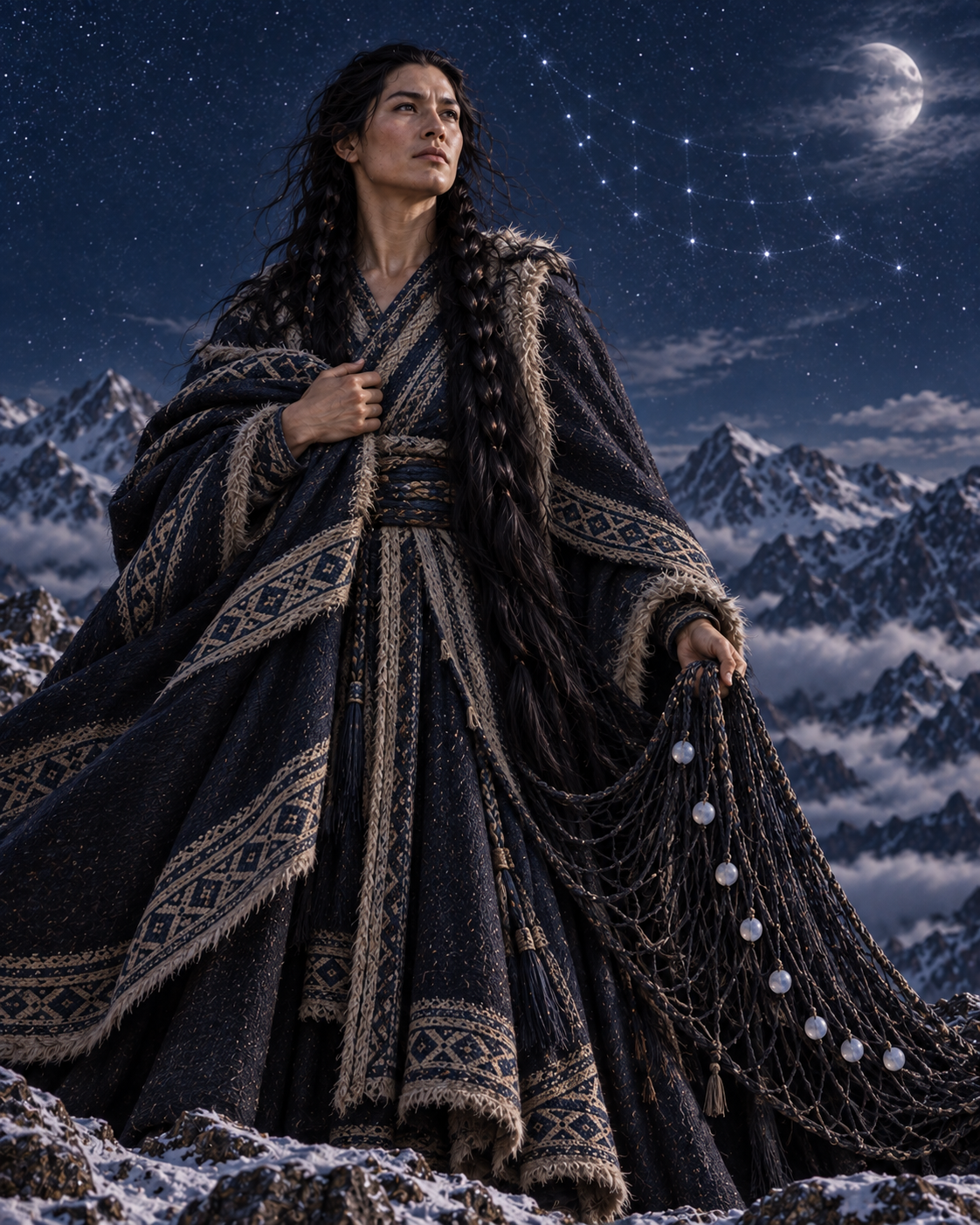
Binabik points out a faint constellation that other traditions call Mezumiiru’s Net. The Qanuc call it Sedda’s Blanket. In the song, Sedda uses a jeweled night-net against the husband who takes her children.
The dual naming is one of the series’ cleanest lessons in cultural astronomy. The stars do not change when the name changes. The relationship does. One culture sees a net associated with Mezumiiru; another sees the Dark Mother’s protective, resistant blanket.
Simon hears the story while traveling through danger with Binabik and Qantaqa. He eventually falls asleep under Sedda’s stars. Later, when he must counsel himself rather than outsource every moral judgment to Morgenes or Binabik, the same sky holds companionship, distance, and growing responsibility.
Sedda is therefore present without descending as a plot-solving goddess. Her constellation structures a night, her song provides a theory of life and death, and her name lets the travelers inhabit a sky already made meaningful by Qanuc memory.
Book 2 · Living Tradition
Her name belongs in law, migration, marriage hopes, and burial—not just mythology class
At Yiqanuc, Sedda remains part of active communal speech. When the leaders reverse Binabik’s sentence and pardon Sludig, the judgment invokes Sedda alongside Qinkipa, Morag Eyeless, Chukku, and the spirits of the high places in case the council has erred.
Sisqi imagines a future on Mintahoq with children and Qinkipa’s protection, inside the broader sacred world Sedda’s family story helps organize. Ookequk’s death-song identifies Qanuc people as Children of Lingit, making Sedda’s lineage part of public identity and legal memory.
After the mountain party suffers deaths, ten stone cairns rise: nine smaller Qanuc graves and a larger one for Haestan. Binabik sings the Sedda–Lingit–Yana wind-song in Westerling for Haestan. Sludig adds an Aedonite prayer and leaves his wooden Tree on the cairn.
The rites coexist without either being reduced to colorful garnish. Sedda’s song can carry a non-Qanuc friend because the mourners translate relationship as well as words. Haestan is not posthumously converted into a Qanuc, and the Qanuc dead are not overwritten by Sludig’s Tree. Shared grief makes room for parallel sacred languages.
The Moon Woman and the Story’s Women
Sedda’s cycle gives motherhood power without pretending power prevents loss
The series repeatedly places women inside dynastic systems that treat marriage and children as political resources. Sedda’s divine story does not sit outside that pattern. Her marriage is bargained; her children are taken; her resistance works through concealment and preserved choice rather than sovereign control.
That does not make every mortal woman a one-to-one Sedda parallel. It creates cultural language through which Qanuc listeners can understand coerced bonds, maternal protection, separation, and survival through descendants.
The Dark Mother title is especially important. Darkness here is not moral corruption. Night covers, hides, reveals stars, and gives the jeweled net its field. Sedda’s darkness is protective and generative—the opposite of the trilogy’s lazy southern tendency to label unfamiliar northern or feminine power as sinister.
Connections
The divine family and mortal communities held beneath Sedda’s Blanket
Tohuq
Sky-lord and father whose bargain places Sedda in the bird marriage.
Kikkasut / Isiki
Bird-lord husband whose neglect and removal of the children drive the sacred conflict.
Lingit
Hidden son and Qanuc ancestor through the mortal pattern that survives in descendants.
Yana
Hidden daughter and Sithi foremother associated with cyclical Moon-death.
Binabik
Singing Man who carries Sedda’s cycle into Westerling and uses it to honor Haestan.
The Qanuc
Children of Lingit whose law, identity, burial, and sky knowledge keep Sedda present.
Why Sedda Matters
She makes cosmology feel like memory people actually use
Sedda’s story explains descent and mortality, names a constellation, and establishes sacred relationships between Qanuc and Sithi. But its importance is not limited to lore accuracy.
The song travels. It comforts Simon, defines the Children of Lingit, enters legal invocation, and becomes funeral language for a mixed company. Every use changes context without emptying the tradition of its Qanuc meaning.
Sedda also complicates the trilogy’s moral vocabulary. Darkness can protect. Death can describe different forms of continuation. A coerced bride can be a creator without the story pretending coercion created happiness. A mother can lose children and still preserve agency for those she saves.
On the Record
Books 1–2, sacred rather than biographical, and clearly labeled visual interpretation
This is Sedda’s one canonical full-spoiler divine profile. Books 1 and 2 contain the relevant song, constellation, descent, invocation, and funeral material. The existing two-book scope is retained. She is not a present-tense mortal character and should not receive invented volume-by-volume “alive” statuses.
The record confirms the names Sedda, Moon Woman, and Dark Mother; pale coloring; black hair; Tohuq as father; Kikkasut/Isiki as bird-lord husband; nine children; the hidden twins Lingit and Yana; the two death patterns; Qanuc and Sithi descent traditions; the jeweled night-net; Sedda’s Blanket; and living ritual use. It does not confirm exact age, clothing, facial details, weapons, temple iconography, or a materially witnessed divine body.
The approved devotional interpretation presents one beautiful, powerful mature humanlike Moon Woman with a broad heart-shaped face, high cheekbones, cool moon-pale skin, midnight-brown eyes, extremely long blue-black braided hair, indigo high-mountain textiles, protective mantle, and jeweled hand-net beneath a starry net and veiled moon. Her exact apparent age, body, face, eye color, hair arrangement, braid count, clothes, fur, cords, beads, net construction, constellation geometry, mountains, pose, weather, moon phase, and light are CVM editorial reconstruction.
This identity governs song, constellation, lineage, ritual, funeral, directory, hero, social, and later devotional art. Every use must remain visibly interpretive: never a claim of witnessed divine anatomy, never romance imagery for the coerced marriage, never fertility-goddess posing, and never evil-witch coding simply because the Dark Mother belongs to night.