
Memory, Sorrow, and Thorn · Canonical Character Profile
Brother Sceneseafa
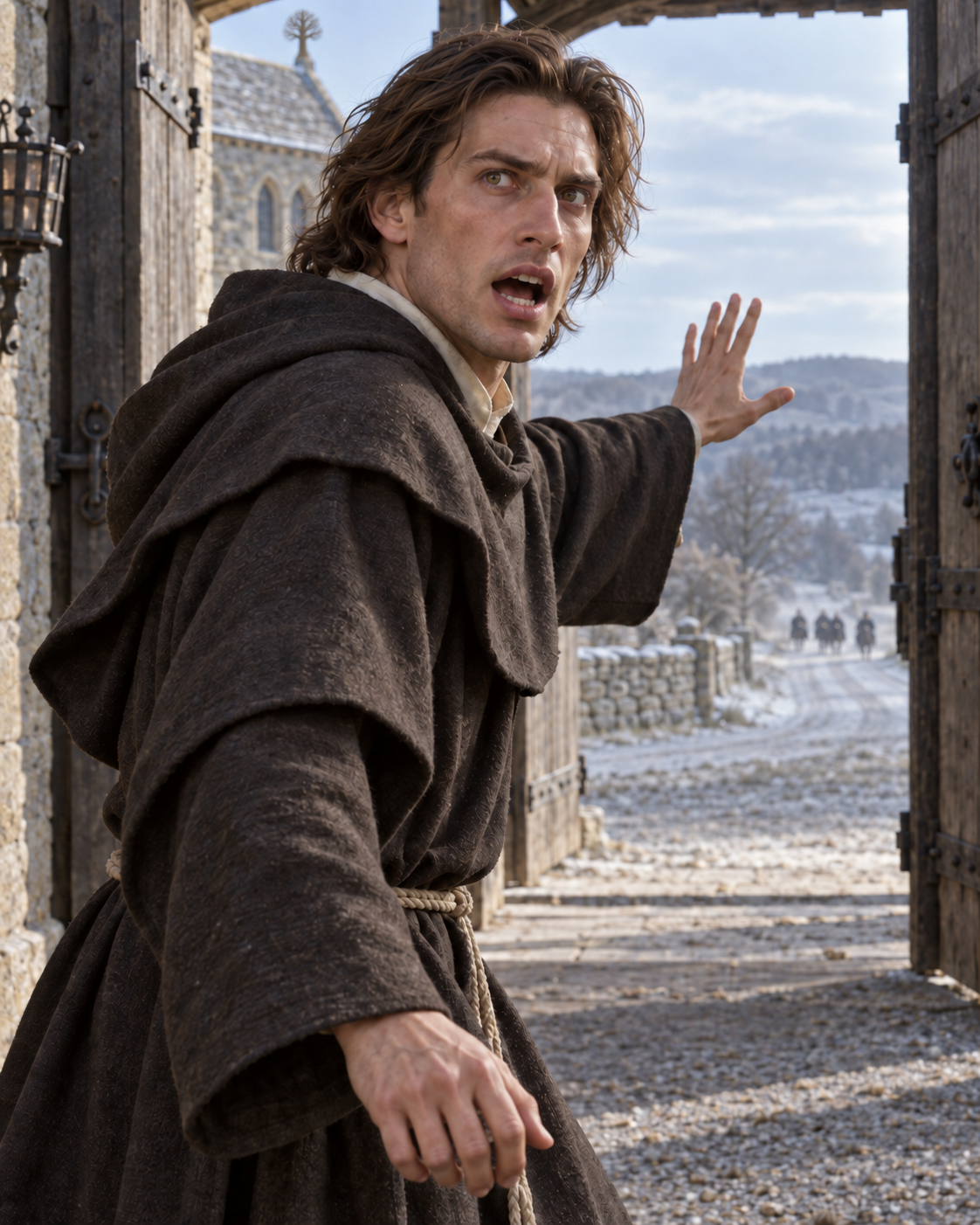
Brother Sceneseafa is the monk at Saint Hoderund’s who sees the abbey’s false hospitality collapse into slaughter and runs for the gate to warn the approaching company. He is shot in the back before the warning can become safety. One action. A complete moral choice.
At a Glance
The brother who spends his last movement trying to carry warning
- Name
- Sceneseafa
- Title
- Brother
- Community
- Saint Hoderund’s Abbey
- Role
- Hoderundian monk and massacre victim
- Confirmed action
- Runs toward the courtyard gate and shouts a warning to the approaching company
- Killer
- One of the original cloaked armed guests; individual identity unknown
- Death
- Shot in the back during the abbey massacre
- Status
- Dead
Saint Hoderund’s Hospitality
The massacre begins because armed strangers exploit a place built to receive travelers
Roughly a dozen armed travelers arrive at Saint Hoderund’s under a pale-eyed leader in dark armor.
The abbey houses them in Travelers’ Hall.
Later, another company approaches from the south. The first leader greets them as though they are reinforcements, but a brother glimpses a concealed sword.
Abbot Quincines confronts the original guests and orders them to disarm.
The leader kills him by cutting his throat.
At that point, hospitality has been converted into tactical vulnerability. The cloaked company has entered under peaceful expectations, positioned itself within the abbey, and concealed its purpose until another force arrives.
Sceneseafa’s action follows inside that collapse.
The record does not tell us where he was before the killing, what he saw personally, or whether somebody orders him to run.
The Run to the Gate
Sceneseafa’s final act faces outward
Brother Sceneseafa runs toward the courtyard gate and shouts a warning.
The warning is intended for the approaching second company.
The text does not preserve his exact words.
It also does not confirm whether the riders hear him, understand him, change formation, survive because of him, or belong to a clearly identified faction.
Langrian later believes the two armed groups fight one another as well as slaughtering the unarmed residents, but he cannot identify either force.
Sceneseafa therefore acts under profound uncertainty.
He does not need to know the newcomers’ allegiance to understand that hidden swords and a murdered abbot make silence deadly.
His direction of travel matters. He could seek deeper shelter inside the abbey. Instead, he moves toward the exposed boundary where warning might still cross from one threatened group to another.
The profile should not embellish the action with a sermon or battle cry. The run and shout already carry the choice.
Shot in the Back
The wound confirms flight toward duty, not flight from danger
One of the original cloaked guests shoots Sceneseafa in the back.
The position of the wound fits the witnessed action: he is running toward the gate and away from the armed infiltrators long enough to warn others.
It should not be framed as cowardice.
Nor should future art turn the scene into graphic spectacle. The important fact is that violence stops a messenger.
The record does not name the archer, weapon type, number of arrows, point of impact, distance, Sceneseafa’s final words, length of survival, burial, or exact location of his body afterward.
His death belongs among the abbey massacre’s many unarmed casualties.
That context keeps him from becoming an isolated cinematic martyr while still preserving his individual action.
The attackers kill not only bodies but communication. Quincines’s authority is silenced at the confrontation; Sceneseafa’s warning is attacked in motion.
Langrian’s Testimony
Sceneseafa survives in the narrative because another wounded brother reconstructs the attack
Langrian lives long enough to tell Simon and Binabik what happened.
His account supplies the sequence: first company, second approach, concealed weapon, Quincines’s challenge and murder, Sceneseafa’s run, the shot, then fighting through the abbey.
This is survivor testimony, not an omniscient battle map.
Langrian cannot identify either armed force and believes the groups fight each other as well as the monks.
The profile therefore attributes only what his account supports.
Sceneseafa’s name is not lost inside an anonymous body count because Langrian remembers who tried to warn the gate.
That act of naming matters. Massacre reduces people to numbers; testimony restores action, relationship, and sequence.
It also leaves uncertainty honest. We know what Sceneseafa does. We do not know every motive around him.
A Messenger Who Cannot Finish
The trilogy repeatedly makes information physical—and therefore vulnerable
Warnings in Memory, Sorrow, and Thorn travel through birds, letters, riders, songs, dreams, mirrors, and living messengers.
Sceneseafa uses the most immediate method available: his own body and voice.
His death exposes how fragile communication becomes when violence controls thresholds.
The abbey gate is both exit and contact point. Reaching it could alert the newcomers; controlling it allows the infiltrators to preserve surprise.
The text does not say Sceneseafa belongs to a formal messenger role. He becomes a messenger through emergency.
That distinction is important. Heroic function can arise from ordinary communal responsibility rather than title or training.
Faith Without a Death Speech
Sceneseafa’s monastic identity matters even though the novel does not narrate his theology
Sceneseafa is a brother of Saint Hoderund’s.
The abbey’s community offers shelter, burial practice, learning, and religious life, but his personal beliefs are not quoted.
We should not invent a prayer as he runs or assign him certainty about martyrdom.
His action can be morally meaningful without turning it into a doctrinal performance.
The record also does not identify his office, years in the order, vows, education, family before the abbey, or relationship with Abbot Quincines.
“Brother” and community membership are sufficient to locate him. The rest remains open.
Connections
The abbot, survivor, armed companies, and abbey around Sceneseafa
Abbot Quincines
Challenges the armed guests and is killed immediately before Sceneseafa’s warning run.
Brother Langrian
Survives wounded and preserves Sceneseafa’s final action in testimony.
The cloaked guests
The original armed company whose member shoots Sceneseafa in the back.
The approaching company
The unidentified force Sceneseafa tries to warn at the courtyard gate.
Simon and Binabik
Reach the ruined abbey and receive Langrian’s reconstruction.
Saint Hoderund’s
The religious and hospitality community destroyed around Sceneseafa.
Why Sceneseafa Matters
One named brother keeps the massacre from becoming anonymous atmosphere
Sceneseafa matters because atrocity coverage fails when victims become scenery for the heroes who arrive afterward.
His name and action return individual agency to the abbey’s dead.
He cannot stop the massacre. He cannot deliver a strategic report. He can recognize immediate danger and spend his last movement trying to reduce somebody else’s surprise.
The profile also demonstrates why minor characters belong in the uncapped directory. A person does not need multiple chapters to make a morally complete choice.
At the same time, respect does not require invention. Sceneseafa remains undescribed, his words unrecorded, his private life unknown, and his warning’s outcome uncertain.
What survives is enough: brother, runner, shouter, murdered messenger.
Character Image Continuity
An individual monk, not a generic corpse in abbey ruins
Sceneseafa’s approved living identity is an exceptionally attractive Hoderundian brother around twenty-nine with a lean abbey-labor build, long heart-shaped face, high cheekbones, urgent hazel-green eyes, warm fair-olive skin, narrow straight nose, jaw-length chestnut hair, and a clean-shaven face.
Canon supplies none of those appearance details. It also does not establish his clothing beyond monastic context, tonsure, jewelry, weapon, or visible wound detail beyond being shot in the back; all visible choices are CVM editorial reconstruction.
The hero preserves the urgent run without displaying the arrow: one raised open hand, mouth mid-warning, open abbey gate, and the distant company that later confirms his shout gave Isgrimnur’s men time to brace.
The corrected architectural finial uses the Aedonite Tree rather than a Christian cross. It is restrained setting language, not a claim that this exact carving appears in the text.
Preserve this same face, age, body, hair, clean-shaven jaw, monastic clothing logic, warning gesture, and abbey palette across hero, directory card, massacre coverage, and Saint Hoderund Story 101 pages. Any death image must remain non-graphic and cannot replace his living identity.
On the Record
Book 1 survivor testimony and a repaired death status
This is Brother Sceneseafa’s one canonical, full-spoiler character profile. His confirmed evidence belongs to The Dragonbone Chair through Langrian’s reconstruction of the Saint Hoderund’s massacre and Isgrimnur’s later confirmation of the warning’s effect.
The record confirms Sceneseafa is an abbey brother. After armed guests reveal their violence and their pale-eyed leader kills Abbot Quincines, Sceneseafa runs toward the courtyard gate and shouts a warning to the approaching second company. Isgrimnur later confirms the warning gives his party enough time to brace. One of the original guests shoots Sceneseafa in the back.
The record does not confirm his appearance, age, office, family, exact words, which riders personally hear him, the shooter’s identity, weapon, wound detail, final words, burial, or prior history.
Status: dead in the Saint Hoderund’s massacre. This repairs the earlier generic “status unknown” placeholder.
The approved living warning portrait is an evidence-bounded CVM editorial reconstruction. Its single local attachment powers featured image, hero, directory card, and social metadata.