
Memory, Sorrow, and Thorn · Canonical Character Profile
Ruben the Bear
Ruben the Bear is a Hayholt blacksmith, drinking companion to Shem and Towser, and one link in the working people’s rumor chain carrying news of Guthwulf’s plague measures. Simon later remembers him among the ordinary faces that made the castle home. In Book 2, a nightmare borrows Ruben’s familiar body for an immortal, inhuman voice. The horror belongs to the dream—not to the blacksmith whose familiarity made him useful as a mask.
At a Glance
The familiar blacksmith whose face becomes frightening only after a nightmare steals it
- Name
- Ruben the Bear
- Occupation
- Hayholt blacksmith
- Community
- Castle craftspeople and workers
- Companions
- Shem Horsegroom and Towser
- Information role
- Passes Meremund plague news to Jakob
- Book 2 image
- Appears as a borrowed figure in Simon’s crown-of-fire dream
- Actual status
- Alive at last direct confirmation; later fate unrecorded
The Hayholt Blacksmith
His work belongs to the castle’s material life, not its throne-room mythology
Ruben is identified as a blacksmith at the Hayholt. The record does not give a tour of his forge, list his commissions, or stage a dramatic sword-making sequence.
That restraint matters. Fantasy castles are often described through the spectacular objects forged inside them while the smith becomes a pair of anonymous arms. Ruben receives a name, an epithet, friendships, and a place in the information network.
“The Bear” suggests how other people recognize him, but the text preserved in the completed ledger does not define whether the name refers to size, strength, hair, temperament, or an old story. A profile can acknowledge the epithet without turning assumption into anatomy.
His profession still supports reasonable art direction. Blacksmithing demands practiced physical labor, heat tolerance, tool control, and repeated strength. It does not authorize a modern bodybuilder, fur costume, or literal bear iconography.
Ruben belongs among the workers whose craft keeps the Hayholt operating while kings and priests claim the foreground. Metal fittings, tools, repairs, horses, kitchens, guards, and household infrastructure all depend on labor like his even when the novel does not inventory each product.
News from Meremund
A friar tells the smith, the smith tells the chandler, and horror enters the servants’ world
During the plague crisis, information moves through an ordinary chain. A mendicant friar brings a report. Ruben tells Jakob the chandler. The news reaches younger castle workers through their everyday relationships.
The report is terrible: Guthwulf’s Erkynguard allegedly nail infected families inside their homes and burn the buildings unopened to prevent escape and contagion.
The ledger correctly preserves this as transmitted testimony rather than direct eyewitness proof. Ruben is a source in a chain, not the original observer. That does not make his role meaningless. In a court where official language may conceal violence, workers pass urgent knowledge horizontally.
A blacksmith’s shop is an ideal social crossing point even without inventing a specific conversation there. Soldiers, grooms, artisans, messengers, and household staff need metalwork. Ruben’s relationships let news move between occupational worlds.
He does not become a journalist or resistance organizer because he repeats what he heard. He becomes evidence that working people are already trying to understand state violence while the ruling court remains insulated by ceremony.
Drinks Beneath the Hayloft
Ruben helps create the ordinary room where Towser can finally speak freely
After Elias expels Towser, the jester enters the stable with Shem Horsegroom and Ruben. They are singing and carrying drink. Simon hides in the hayloft above them.
The setting is crucial. Towser has just used a dynastic ballad to tell a dangerous truth at court. Guthwulf calls the song treason and draws steel. Elias prevents immediate violence but drives the jester out.
With Shem and Ruben, Towser can discuss where he might go, whether kin in Grenefod or Josua’s people at Naglimund would receive him, and what he believes about the prince’s disappearance.
He also reveals the Bright-Nail transfer: John entrusted the sword to him for Elias; Elias dropped it, later accepted it, said it twisted, and ordered it buried with John. Josua performed the burial.
Ruben’s dialogue is not preserved in the ledger. His presence still gives the conversation social shape. Towser is not delivering exposition to an empty stable. He is drinking with trusted castle workers after losing court protection.
The three men form a temporary downstairs council. They do not command armies, but they carry firsthand proximity to horses, metal, service, kings, and the emotional weather of the Hayholt. Simon’s hidden listening turns their private survival talk into his widening political education.
A Face in Simon’s Home
Ruben becomes part of what Simon means when he remembers the Hayholt as people
On the river, Simon tells stories about Rachel, Tobas, Peter Gilded-Bowl, Ruben, and other workers. Binabik shares travel tales, and Miriamele contributes observations from her own life around Meremund and the Hayholt.
Ruben’s inclusion matters because Simon’s idea of home is not architecture alone. The Hayholt is a network of adults whose work, tempers, jokes, and routines shaped his childhood.
The novels do not record which Ruben story Simon tells. Inventing a funny forge accident would be tempting and wrong. The fact of storytelling is enough: Ruben is memorable to Simon and recognizable to his companions as part of the lost household world.
This is how supporting characters gain emotional scale. A person may have few direct lines and still occupy the memory through which a protagonist explains where he came from.
The Crown-of-Fire Dream
An inhuman conversation uses Ruben’s familiarity as camouflage
In Book 2, Simon dreams of the Hayholt loft. Shem speaks with Pryrates’s rasp. Ruben answers in an immortal, inhuman voice.
The figures enact a supernatural exchange concerning Elias, the Red Hand, the Dark One, and the Words of Changing. A fire-crowned presence warns that all Change has a cost and that Pryrates will scream.
Simon wakes believing the conversation was real in some meaningful sense, woven through familiar Hayholt imagery. He connects it to other dream-road experiences and suspects Pryrates’s assault opened an involuntary door in his mind.
Nothing in the scene reveals Ruben as secretly supernatural, complicit with Pryrates, or aware that his image is being used. The dream borrows him.
His face is effective because Simon knows it. A cosmic conversation presented through unknown monsters would announce itself as alien. By placing impossible voices inside Shem and Ruben, the dream violates home from within.
This distinction must govern every directory card and future illustration. Book 2 can truthfully include Ruben because his recognizable dream-image appears. His status should not change to possessed, evil, or dead. The actual blacksmith remains separate from the projection.
The Bear and the Mask
The epithet makes him memorable; the dream proves memory can be weaponized
Ruben’s nickname already gives him the compact force of folklore. “The Bear” is easy to remember, easy to picture, and easy for a boy to carry away from home.
The dream weaponizes that memorability. It does not need to construct a stranger. It selects an existing figure from Simon’s internal Hayholt and changes only the voice.
This connects Ruben to the series’ wider treatment of memory without pretending he controls it. Familiar people can become containers for messages, fears, and distortions in the Road of Dreams.
The ethical work of the profile is restoration. It must return the face to the person after discussing what the dream did with it. Ruben is a blacksmith, drinking companion, news-bearer, and remembered worker first. The nightmare is an event in Simon’s consciousness, not Ruben’s biography.
Connections
The workers, exile, apprentice network, and dreamer around Ruben’s record
Shem Horsegroom
Ruben’s drinking companion beneath the hayloft and the other familiar face borrowed by Simon’s later dream.
Towser
Shares drink and dangerous post-expulsion truth with Ruben and Shem.
Simon
Listens from the hayloft, later tells stories of Ruben, and dreams an inhuman voice wearing his image.
Jakob
Receives the Meremund plague report from Ruben through the workers’ information chain.
Jeremias
Part of the younger craft-worker circle to which the rumor eventually travels.
Pryrates
Appears through Shem’s borrowed dream-voice in the supernatural exchange where Ruben’s image answers.
Why Ruben Matters
He shows how a minor worker can carry information, belonging, and supernatural violation
Ruben’s direct page time is limited. His narrative functions are not.
As a blacksmith, he represents skilled labor inside the Hayholt. As a link in the plague rumor chain, he shows news moving through working relationships. As Towser’s drinking companion, he helps create a trusted space for politically dangerous truth. As one of Simon’s remembered workers, he becomes part of home.
The Book 2 dream depends on all four layers. The inhuman voice is frightening because it occupies someone ordinary, useful, sociable, and known.
A thin encyclopedia entry would list “blacksmith; appears in dream.” A full profile explains why those facts belong together and why the dream must not overwrite the man.
On the Record
Books 1 and 2, with the dream explicitly separated from the living blacksmith
This is Ruben the Bear’s one canonical full-spoiler profile. Book 1 identifies him as the Hayholt blacksmith, places him in the Meremund rumor chain and the stable conversation with Shem and Towser, and preserves him in Simon’s stories of home. Book 2 uses his recognizable image in Simon’s crown-of-fire dream. No direct Ruben receipt appears in Books 3 or 4.
The record confirms Ruben’s name, epithet, occupation, companionship with Shem and Towser, information passed to Jakob, place in Simon’s memory, and dream-image. It does not confirm his exact age, height, build, face, hair, eye color, family, workshop details, politics, fate after the Hayholt’s collapse, reason for the epithet, or any supernatural identity.
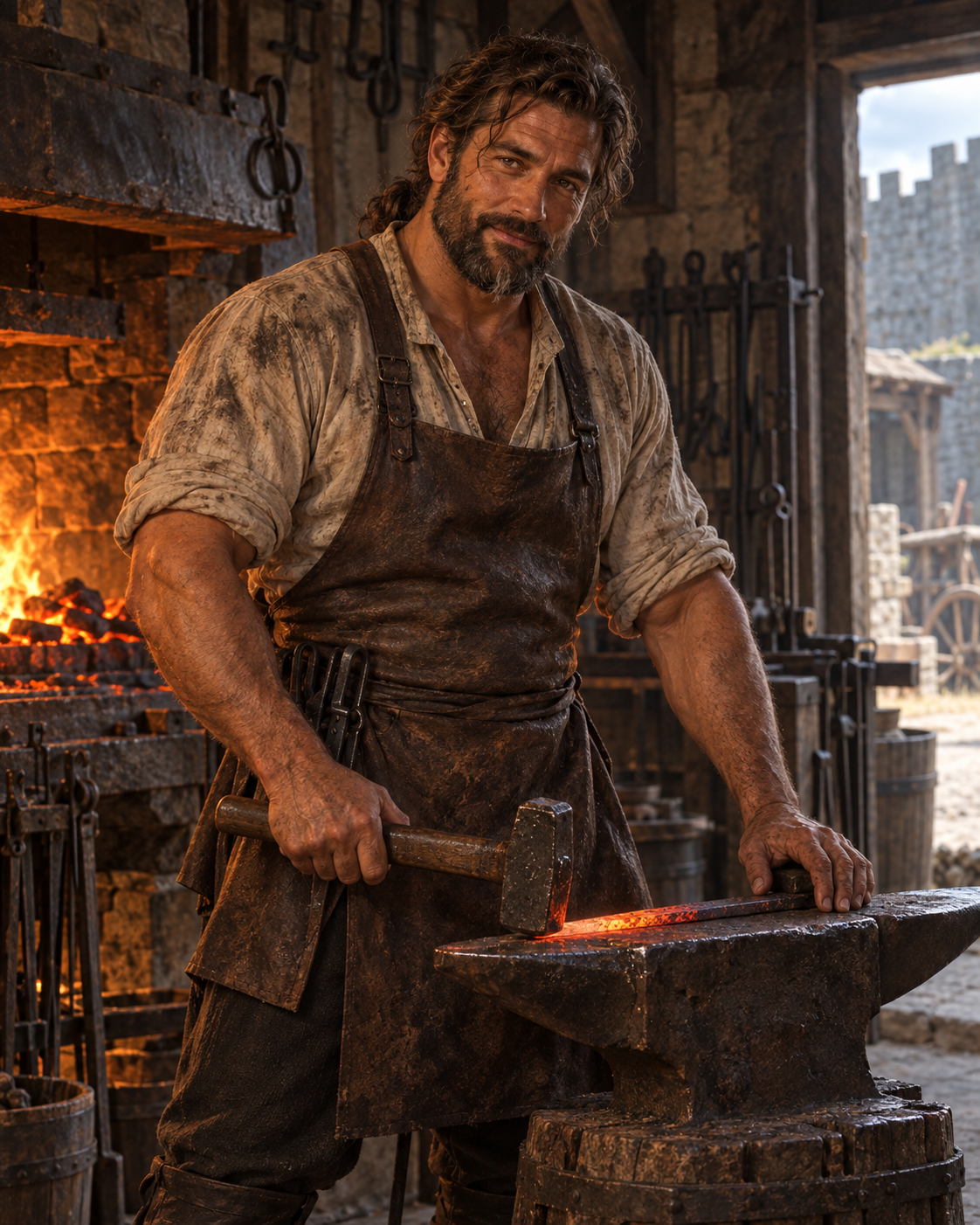
The approved identity establishes an exceptionally handsome adult working blacksmith with a broad functional build, warm medium-brown forge-reddened skin, dark-hazel eyes, dark wavy hair tied at the nape, short beard with one lighter chin streak, rolled cream shirt, worn leather apron, hammer, anvil, and plain iron work. His exact age, height, body, face, complexion, eyes, nose, hair, beard, clothing, apron, tools, forge, metalwork, pose, weather, and light are CVM editorial reconstruction—not an explanation of “the Bear.”
This exact living face, body, coloring, hair, beard, working clothes, apron, and forge presence now govern the rumor chain, hayloft context, Simon’s memories, directory, hero, social image, and every later scene. Dream imagery must reuse the same face while distinguishing the alien voice through atmosphere; it may never redesign Ruben as a demon, literal bear, secret immortal, or possessed man.