
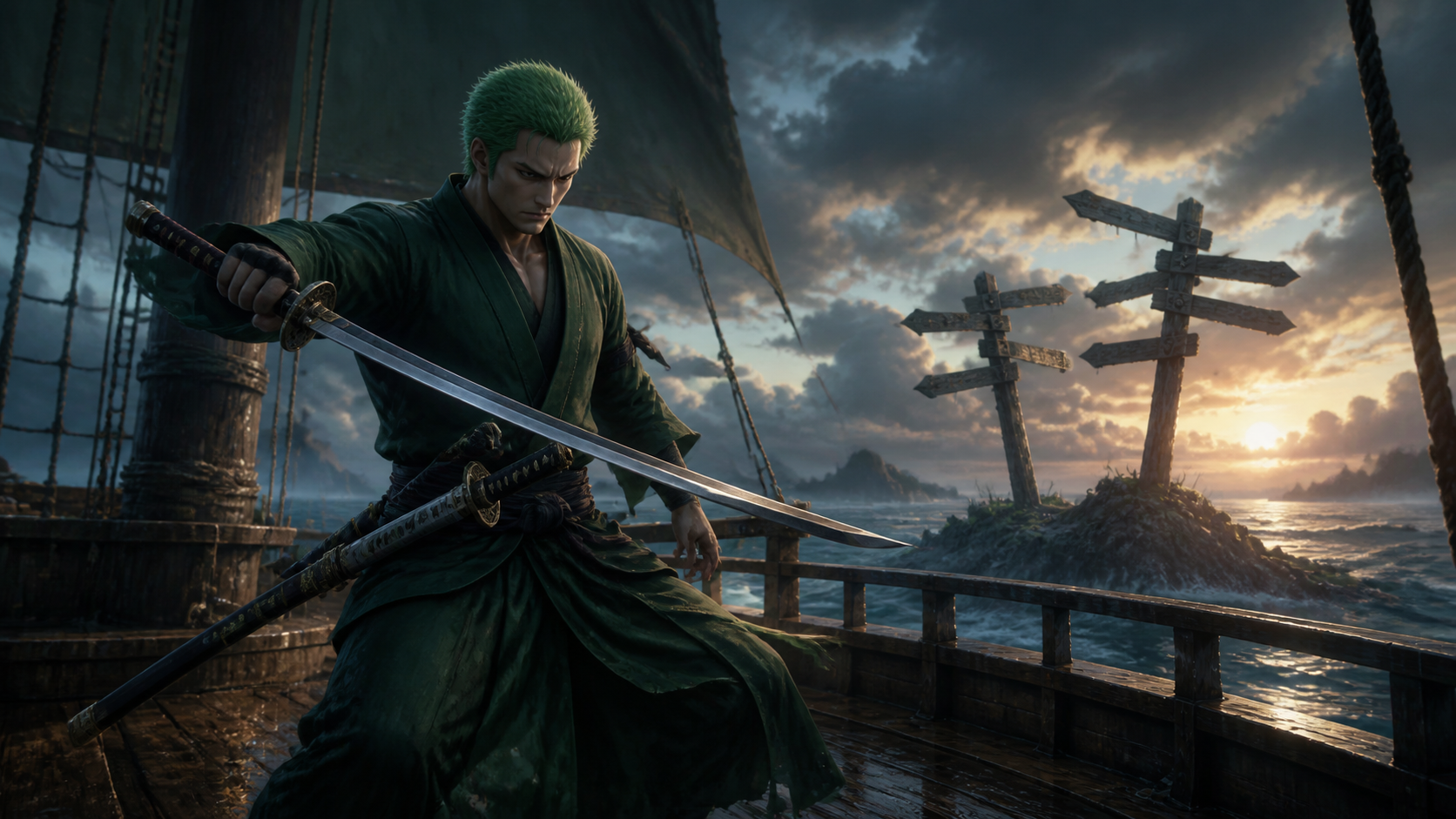
Roronoa Zoro: One Piece Character Profile
Quick profile
Full name: Roronoa Zoro
Known as: Pirate Hunter Zoro
Role: Swordsman and combat pillar of the Straw Hat Pirates
Origin: Shimotsuki Village, East Blue
Age: 21 after the time skip
Birthday: November 11
Style: Three-Sword Style
Haki: Armament, Observation, and Conqueror’s
Current bounty: 1.111 billion berries
Japanese voice: Kazuya Nakai
Bottom line
Roronoa Zoro turns discipline, grief, and bodily sacrifice into strength, but his best loyalty does not require disappearing inside Luffy’s dream. Zoro joins the crew with a goal already in progress. He will become the world’s greatest swordsman because he promised Kuina, because the promise became part of his identity, and because losing to Dracule Mihawk shows exactly how much work remains.
Fandom loves the silent pain, the impossible endurance, and the moments when Zoro stands like nothing can move him. I do too. The danger comes when suffering becomes the only proof of devotion anybody recognizes. “Nothing happened” is iconic because something absolutely happened to his body, and he chose to keep the cost private.
Kuina, Shimotsuki Village, and the promise
Zoro trains at the Isshin Dojo and repeatedly loses to Kuina. Their rivalry gives him a standard he cannot dismiss. Kuina’s fear that gender will eventually close the physical gap adds bitterness to their shared dream. Zoro argues for the value of skill and effort, but her death prevents the story from resolving the argument through adulthood.
Wado Ichimonji carries that unfinished future. The sword is not a trophy taken from a defeated rival. Koushirou entrusts Kuina’s blade to Zoro after her death, and Zoro carries both names toward the title they promised one of them would claim. Later Wano connections deepen the history around Shimotsuki Village and its swordsmiths without replacing Kuina’s central place in his ambition.
Why Zoro follows Luffy
Zoro begins as a feared bounty hunter facing execution after protecting a child from Helmeppo’s wolf. Luffy sees the moral choice before he sees a convenient fighter. Zoro accepts rescue and joins the first crew position, while making clear that the captain cannot interfere with his own ambition.
The arrangement works because Luffy treats Zoro’s dream as part of the voyage. Mihawk’s defeat at Baratie nearly ends that dream and produces one of Zoro’s most important promises: he will not lose again before becoming worthy of the title. Luffy does not demand smaller ambition in exchange for belonging.
Three-Sword Style is technique, not a visual gimmick
Zoro fights with one, two, or three swords, but Three-Sword Style defines his public identity. A blade in each hand and a third held in his mouth creates unusual demands on balance, neck strength, foot placement, spatial judgment, and attack timing. The style looks absurd on paper. Zoro’s commitment makes the absurdity feel physically dangerous.
His attacks progress from close-range cuts to flying slashes, rotating force, defensive counters, and techniques framed through demonic imagery. Asura gives his fighting spirit a terrifying visual form. The anime can heighten the scale through effects and staging, yet the character remains most convincing when each victory still depends on reading an opponent and controlling a specific blade.
The swords carry history and limits
Wado Ichimonji connects Zoro to Kuina and swordsmith Shimotsuki Kozaburo. Sandai Kitetsu introduces a cursed blade whose reputation tests whether Zoro trusts luck, instinct, or skill. Yubashiri is destroyed at Enies Lobby, proving named weapons are not protected from consequence. Shusui carries Ryuma’s legacy before Zoro returns the blade to Wano.
Enma forces Zoro to confront control. The sword draws out excessive Haki and punishes hesitation or weak regulation. Mastery does not mean owning a famous object. Mastery means surviving the demands the object places on his body and accepting that borrowed prestige cannot replace technique.
Haki, King of Hell, and the cost of output
Zoro specializes in Armament Haki, uses Observation Haki, and awakens Conqueror’s Haki. Coating his blades with Conqueror’s power creates the King of Hell style and raises the force he can deliver against opponents such as King. The upgrade fits a swordsman whose ambition has always required a will strong enough to dominate fear.
Power still carries a bill. Enma drains him. High-output attacks require timing. Broken bones and accumulated wounds do not vanish because a scene looks cool. The story sometimes uses medicine or extraordinary endurance to keep him moving, but recovery remains labor performed by his body and the crew’s medical support.
Major battles and what changes
Mihawk at Baratie teaches scale and humility. Mr. 1 in Alabasta forces Zoro to understand cutting as judgment rather than raw effort. Kaku at Enies Lobby tests adaptation against a bizarre body and the Six Powers system. Ryuma at Thriller Bark links swordsmanship to memory, burial, and cultural ownership. Pica at Dressrosa turns observation and mobility into a problem of locating the real body inside overwhelming stone.
Wano brings Zoro into a country where blades, inherited names, graves, and national history cannot be treated as collectible upgrades. The rooftop fight proves he can wound Kaido and protect allies under extreme pressure. The fight with King then asks whether Zoro can control Enma and recognize the biological and tactical rules behind an opponent who appears impossible to damage.
First mate work without an official title
Zoro often performs the crew’s disciplinary function. Water 7 makes that role explicit when Usopp wants to return after challenging Luffy and leaving. Zoro insists that affection cannot erase the authority crisis. A crew that ignores the rupture will make every future conflict harder to survive.
His intervention protects structure, but rigidity also has limits. Respect cannot mean silence, and leadership cannot become a performance where nobody admits fear or error. Zoro is most useful when he names the consequence everybody else wants to avoid. He is less useful when endurance becomes the only moral language available.
Relationships and accountability
Luffy and Zoro trust one another’s combat decisions with very little explanation. Nami repeatedly saves Zoro from his nonexistent navigation skills. Sanji is rival, rescuer, cook, and the person whose judgment Zoro must trust during crisis even while they insult each other. Chopper’s care exposes how often Zoro treats injury as private property. Robin shares his restraint without copying his temperament.
Kuina remains the foundation of his goal. Mihawk becomes rival, future target, and reluctant teacher. Asking Mihawk for training requires Zoro to place the crew’s survival above pride. That choice does not end their rivalry. The humiliation becomes part of the work required to continue.
Navigation is not his ministry
Zoro’s terrible sense of direction works because spatial confusion sits beside extraordinary combat awareness. He can read distance, trajectory, terrain, and killing intent during a fight, then walk the wrong way down a straight road. Competence in one domain does not create competence everywhere.
The joke also gives the crew permission to manage him. Zoro may be one of their strongest fighters, but somebody still has to point his body toward the correct building. That dependence keeps strength from becoming social authority over every task.
Design chronology
Early Zoro wears a plain shirt, dark trousers, boots, green haramaki, earrings, and three visible swords. The silhouette is practical and easy to read. After the time skip, the long green coat, scar over his left eye, broader frame, and changed sword placement make his discipline look heavier and more formal.
Arc clothing can place him inside local genres, especially Wano’s samurai imagery, but the swords and green palette keep the character recognizable. His scars operate as continuity marks. They record defeat and survival rather than decorating a body that resets between arcs.
Kazuya Nakai’s Japanese performance
Kazuya Nakai gives Zoro restraint, dry irritation, sudden violence, and an unexpectedly elastic comic rhythm. The voice rarely begs the audience to notice affection. Loyalty appears through readiness, timing, and small shifts around people Zoro trusts.
The performance also separates calm from emotional absence. Zoro can sound controlled while carrying grief, rage, embarrassment, or pain. That distinction matters for a character whose silence is often mistaken for simplicity.
Anime, films, games, and continuity
Zoro appears throughout the television anime, theatrical films, specials, OVAs, games, crossovers, and promotional projects. Those appearances do not all share the manga’s main continuity. A film may use familiar techniques or supervised character material without becoming an event the television story must later remember.
The profile keeps alternate appearances connected while labeling the boundary. Zoro’s core chronology follows the manga adaptation and numbered television route. Movie and game feats belong to their own versions unless official material states otherwise.
RaeRae’s verdict
Zoro is compelling because he chooses what pain is for. Discipline serves a promise, a crew, and a craft rather than turning suffering into a personality by itself. His loyalty protects two dreams at once when One Piece gets the balance right.
I want the story to keep respecting the difference between endurance and healing. A man can survive an impossible wound and still need care. Zoro does not become weaker when Chopper treats him, Sanji carries him, or the crew keeps him from wandering into another county. Dependence is part of the voyage too.
Discipline is not the same as emotional silence
Zoro is frequently treated as the crew member who does not need anything. He trains, sleeps, bleeds, and appears wherever the next impossible wall needs cutting. That reading makes his loyalty look simple and his pain look like set decoration. The more interesting Zoro is a man who built discipline around grief, then slowly learned that devotion to a promise does not require disappearing inside the promise.
Kuina is not merely the tragic girl who motivates his dream. She is the first person who makes the dream feel real because she can defeat him and name the gendered limits waiting outside the dojo. Her death leaves Zoro holding both a promise and an argument the world never allowed her to finish. Every new sword technique carries that loss, but the story is strongest when Zoro remains a living person rather than a memorial machine. He laughs with the crew, gets embarrassed, makes petty decisions, and becomes protective in ways he would never describe aloud.
I do not read “nothing happened” as proof that suffering is noble when nobody sees the suffering. The scene hurts because Zoro chooses a terrible bargain to protect Luffy and then refuses to turn that sacrifice into social currency. Sanji still finds him. The audience still sees the blood. The story does not actually let the pain vanish. What concerns me is how quickly fandom can transform that moment into a demand that Zoro must always absorb damage quietly. Loyalty should not require a person to become disposable, even when the person volunteers.
The swordsman inside a collective project
Zoro wants to become the world’s greatest swordsman, a goal that sounds solitary until the crew changes what reaching the summit means. His duel with Mihawk establishes the scale of the dream. His years beside Luffy establish responsibility. He cannot pursue strength as though nobody else will live with the choices he makes. Thriller Bark, Sabaody, the time skip, and Wano keep returning him to the tension between individual ambition and collective survival.
His confrontation with Luffy after Usopp leaves is one of the clearest examples. Zoro is not defending hierarchy because captains deserve obedience. He is defending the crew as a structure where words and departures carry consequences. His position can sound brutal, especially when everybody is grieving the Going Merry, but the concern is material: if nobody can trust how conflict will be handled, the ship becomes unsafe long before an enemy attacks.
Wano gives Zoro ancestral echoes, legendary blades, and conqueror imagery, yet the strongest material remains practical. He notices hunger. He responds to cruelty inflicted on people with less power. He learns that Enma cannot simply be dominated through bigger muscles; the sword demands control over how much of himself he pours into a strike. My Zoro is not compelling because masculinity made him immune to need. He is compelling because a lonely promise became part of a crew where his strength has somewhere specific to go.
Sources and official routes
ONE PIECE.com: Roronoa Zoro official character profile
ONE PIECE.com: anime staff, cast, and broadcasters
Watch One Piece on Crunchyroll
Return to the One Piece anime hub
Browse One Piece character profiles