
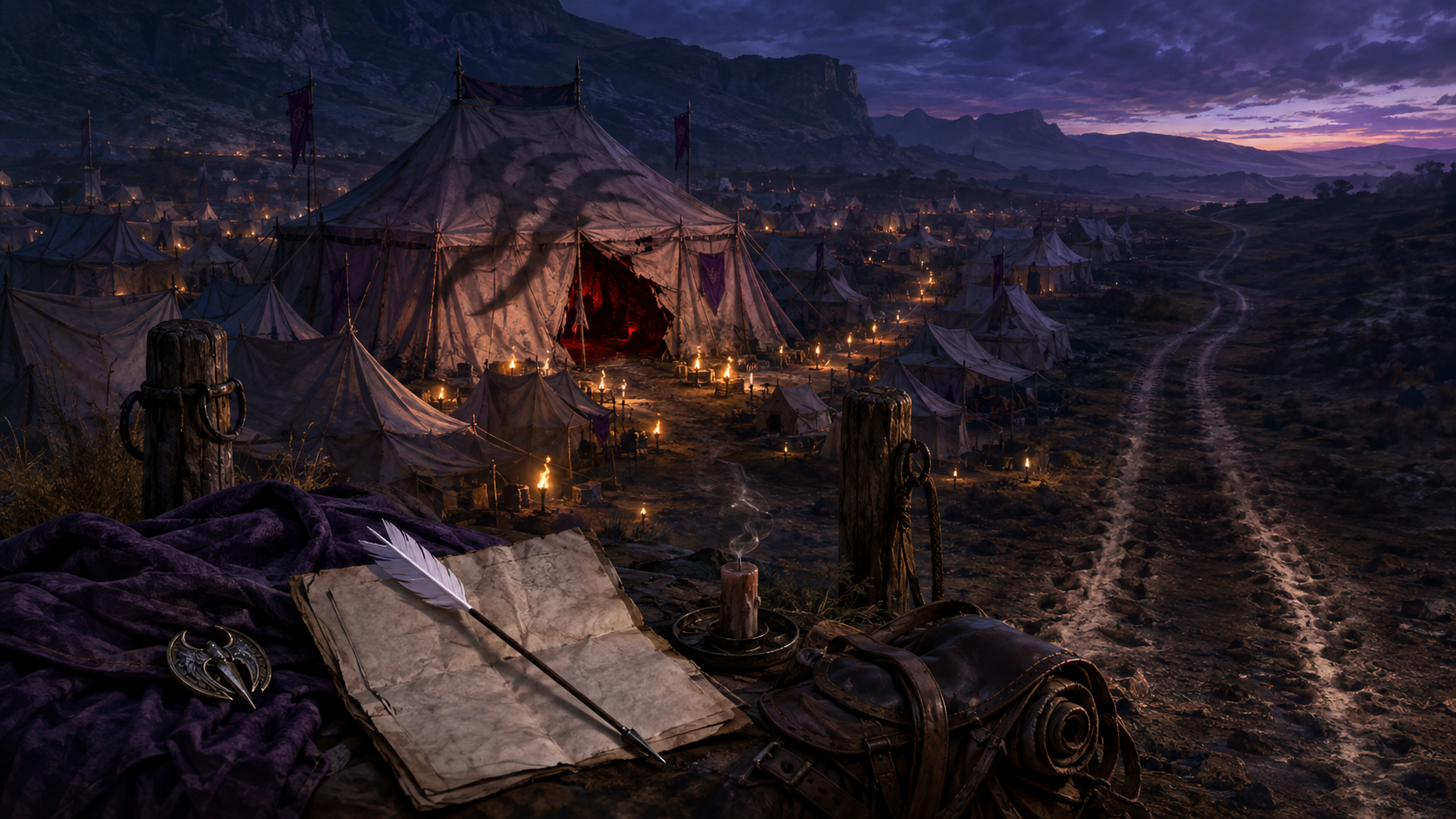
To Green Angel Tower, Part I
The installment where everybody finally gathers—and almost immediately proves that occupying the same camp is not the same thing as moving in the same direction.
Author: Tad Williams
Series: Memory, Sorrow, and Thorn
Read coverage: Full narrative plus people, places, creatures, things, language, pronunciation, and acknowledgment
Ending type: Deliberate split-volume departure
Central pair: Simon / Seoman Snowlock and Miriamele
Final location: 12,656 of 12,661
What changed while I was reading it
At the start: I expected the pleasure of convergence. The cast has spent two enormous books scattered across Osten Ard, and this is where roads begin folding back toward one another. Simon has survived the north. Josua has a cause and a sanctuary. Camaris is alive. The Sithi can no longer pretend the war belongs exclusively to mortals.
In the middle: convergence started looking less like relief and more like a pressure cooker. A refugee settlement needs food, medicine, command, and political legitimacy. A returned hero cannot remember how to be the symbol everyone needs. The twins promised by prophecy have to arrive through Vorzheva’s bleeding body. Love makes Simon and Miriamele braver and much less sensible.
By the ending: the book reveals its real shape. It is not about gathering every useful person in one place. It is about forcing them to decide what they will leave that place to do. Miriamele goes first. Simon follows, with a terrible farewell letter and excellent instincts about exactly one thing: letting her disappear is impossible.
Where I landed: Part I is structurally awkward by design and emotionally better for it. It ends without pretending to be a whole third-act climax, but the departures are irreversible enough to make the cut feel like a hinge rather than an interruption.
The part where the reunion refused to behave
Everybody is here. Nobody is okay.
That is the delicious cruelty of this volume. Williams gives us the visual grammar of epic-fantasy readiness—armies, councils, legendary warriors, ancient peoples, heirs, prophecies—and fills it with people who cannot simply become their assigned functions.
Camaris is the greatest knight alive, but “alive” turns out to be the least interesting part of restoration. Vorzheva carries dynastic hope, but the prophecy does not experience pregnancy for her. Simon has been knighted by suffering in every way except the tidy ceremonial one, yet he can still turn jealousy into an entire internal weather system. Miriamele is vital to the future of the realm, which is precisely why every faction is tempted to convert her into a piece of policy.
The book keeps asking the same rude question: what good is the correct legendary piece if the human being underneath it refuses to fit?
The structure: a camp built over fault lines
The refugee stronghold functions as more than a headquarters. It is a political experiment under siege. Josua has to transform the displaced into a community without reproducing the coercion they fled. Food, healing, family, rumor, allegiance, and strategy matter as much as the swords everybody thinks will decide history.
That makes the volume’s long middle purposeful even when it is heavy. The apparent pause allows relationships and institutions to show their stress fractures. News arrives unevenly. Ancient explanations compete with immediate needs. People who love one another make decisions in secret because disclosure feels more dangerous than departure.
Meanwhile, the Sithi and Norn history expands the scale backward. The present war is not one evil immortal waking up in a vacuum. It is a family catastrophe preserved until grief becomes culture and culture becomes military policy.
What works
Domestic survival, political legitimacy, romance, and mythic history occupy the same narrative system. The little things never stop mattering just because the old magic gets louder.
What fights the reader
The physical split of the original final novel leaves this volume carrying extensive setup without the release that setup conventionally promises. Some readers will feel the cut as publishing architecture no matter how carefully the departures are staged.
Simon and Miriamele: yearning with absolutely no project management
Simon is growing up, but thank heaven Williams does not confuse growth with becoming smooth. He is leaner, scarred, white-streaked, tested by combat, and capable of real courage. He is also still Simon: insecure around rank, easily wounded where Miriamele is concerned, and prone to performing the version of knighthood he thinks a story expects.
That is why the farewell letter is perfect. It is earnest, overcooked, and very nearly funny enough to disguise how frightened he is. He wants to sound like a noble knight because plain Simon does not yet believe plain Simon is allowed to ask a princess not to vanish.
Miriamele’s secrecy is not decorative stubbornness. She has spent the series being treated as a daughter, heir, diplomatic object, and symbol. Her private mission is dangerous, but the need to own one decision completely is emotionally coherent. The book lets her agency be real without pretending every autonomous choice is automatically wise.
They are not a polished power couple here. They are two young people becoming capable of that future by making choices that reveal what they cannot abandon.
Camaris: the fantasy of the returned hero meets the person
Camaris is the volume’s sharpest argument against restoration as a shortcut. Everyone needs the old knight to be a weapon, witness, father figure, symbol, or solution. His body has returned. His identity has not returned on command.
His recognition of Amerasu’s intimate song makes the mystery more unsettling, not less. Some knowledge has survived below speech. The past is present inside him in fragments nobody else can safely interpret.
The point is not simply “amnesia is sad.” The point is that legend erases the right to be complicated. A continent has remembered Camaris as a function for so long that his broken humanity feels like disobedience.
The old wound: immortal history is still family history
Aditu’s account of Nenaïs’u, Drukhi, Utuk’ku, and Ineluki changes the emotional geometry of the war. The Sithi–Norn fracture is not abstract racial opposition or a decorative myth appended to the human conflict. It is grief, blame, exile, loyalty, and loss hardened across generations until nobody living is allowed to stop paying.
Williams is very good at making longevity look like the opposite of wisdom. Immortality does not automatically produce perspective. Sometimes it gives resentment a larger archive.
That history also prepares the series’ final argument: memory can preserve truth, but it can also preserve the identity of the wound so perfectly that healing begins to feel like betrayal.
Vorzheva and the twins: prophecy has a body count before the battle
The twins matter politically and prophetically, but Vorzheva’s pregnancy refuses to become a clean dynastic diagram. There is bleeding. There is fear. There is intimate labor by people whose names will never carry the same historical weight as the children they help deliver.
That distinction matters in a series obsessed with kings, bloodlines, and inherited legitimacy. “An heir is born” is how a chronicle writes it. A novel can insist on the body, the risk, and the community that made survival possible.
The prophecy may care about two children. The book cares that Vorzheva could have died bringing them into its machinery.
The ending: leave the safe place before it becomes another cage
Miriamele leaves on a mission she will not explain. Simon initially tries to make himself behave like the version of a knight who accepts the princess’s distance with tragic dignity. Then reality wins.
He turns back for Jiriki’s mirror and the White Arrow, follows her trail, and chooses the dangerous road. Behind him, the Fire Dancer camp burns.
It is not a conventional climax. There is no final villain defeated, no sword raised over a decisive battlefield, no emotional conversation that tidies the romance. Instead, the volume ends by removing retreat. The sanctuary is no longer safe, the old alliances are no longer theoretical, and the central pair are moving toward the heart of the danger without having solved themselves first.
That is exactly why Part II has somewhere urgent to begin.
My side-eye packed for the journey too
The physical-book problem is real. Calling this Book 3 in a four-volume set while also calling it Part I of the original third novel creates a structural expectation the text cannot entirely control. It is a complete published volume and an intentionally incomplete narrative movement at the same time.
The romance can also be maddening. Simon and Miriamele are brave enough to cross battlefields and secret roads but repeatedly incapable of one clean conversation. The frustration is character-grounded; it is still frustration.
And as the lore expands, proper nouns arrive in battalions. The appendix is genuinely useful because ancient kinship, multiple languages, titles, aliases, and geographic history are all doing plot work. Useful does not always mean effortless.
Final take
To Green Angel Tower, Part I is the volume where the series’ scale becomes social rather than merely geographic. The war is not only armies and supernatural weapons. It is whether refugees can become a polity, whether a returned legend may remain a person, whether a princess owns her choices, whether prophecy can be separated from reproductive danger, and whether ancient grief has any right to command the living.
Its greatest strength is also the reason it can feel unwieldy: everything matters to everything else. A song heard by Camaris touches immortal history. A pregnancy touches succession and prophecy. A bad farewell letter reveals Simon’s whole unfinished idea of manhood. A private mission destabilizes the public war.
The published-volume ending cannot provide the release of a true finale. It provides something more honest for the midpoint of one: momentum with consequences.
Everybody finally gathered. Then everybody had to decide who they were willing to follow out.
On the record
This verdict is grounded in the exact owner-accessed Kindle edition, ASIN B0GYH22SLL, read sequentially through location 12,656 of 12,661. Coverage includes the full narrative; People, Places, Creatures, and Things; Words and Phrases; the pronunciation guide; and the May 2016 acknowledgment.
Return to the Book 3 hub → · Read the complete series verdict → · Meet Tad Williams →