
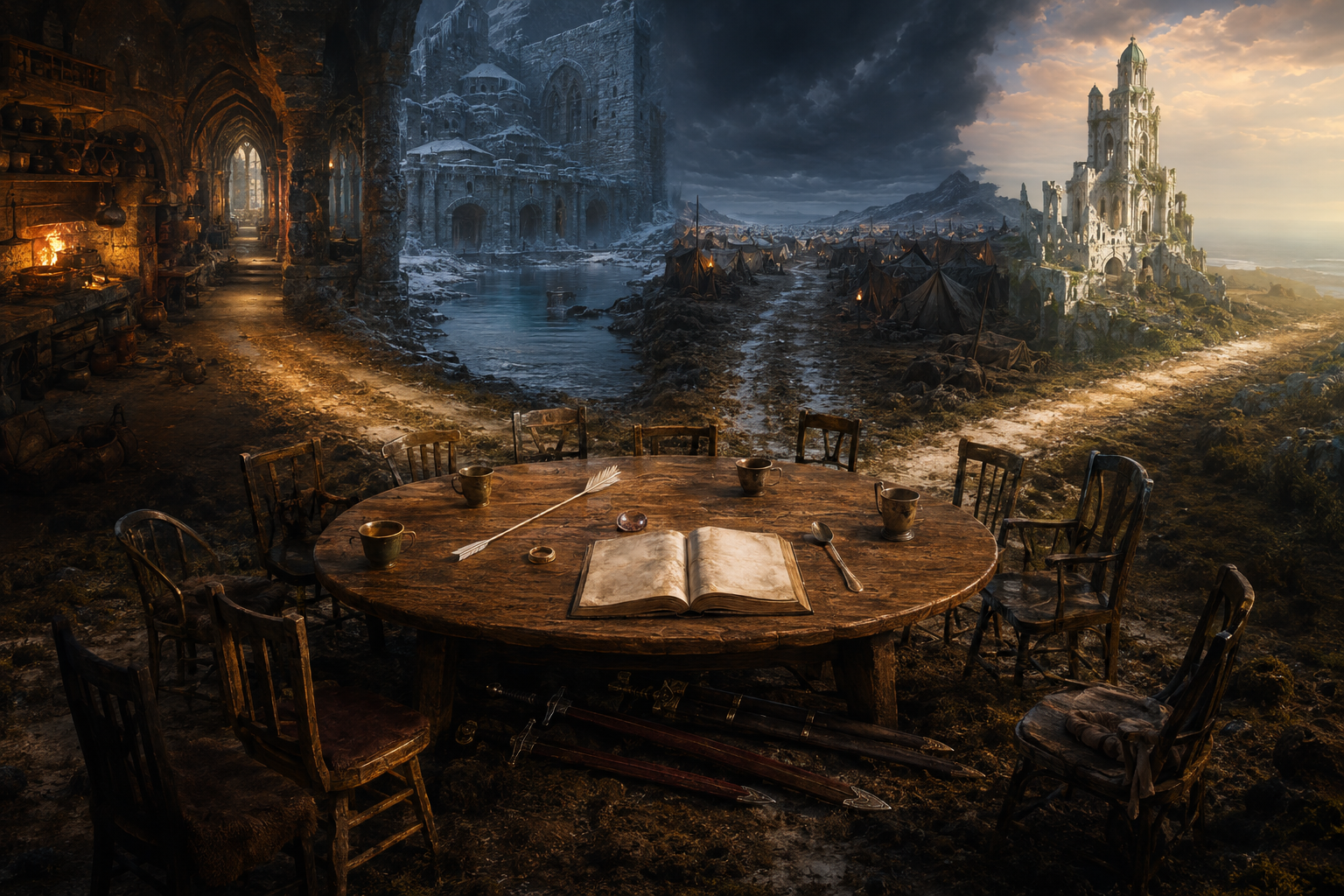
Memory, Sorrow, and Thorn
The epic fantasy that builds a continent out of inherited stories, then spends four enormous published volumes asking who benefits when everybody keeps believing them.
Genre: Epic fantasy · secondary world · coming of age
Published sequence: Four owned Kindle volumes
Reading status: Every narrative and reference layer complete
Central pair: Simon / Seoman Snowlock and Miriamele
Ending: Costly victory, rebuilding, romantic HEA
Canonical scope: Original trilogy architecture, split final novel
What changed across four books
During The Dragonbone Chair: I thought the series’ patience was either architectural confidence or a personal attack. Simon begins as a distractible castle boy in a world that does not pause to label the important furniture. By Urmsheim, every apparently separate history—John’s conquest, the Sithi, Morgenes’s books, the swords, the royal succession—has started charging interest.
During Stone of Farewell: sanctuary became the theme rather than the solution. Sesuad’ra floods. Jao é-Tinukai’i burns. Camaris returns without restoration. Amerasu has to tell immortals that hugging death like a cherished child is not the same thing as wisdom.
During To Green Angel Tower, Part I: convergence acquired commitment issues. Refugee politics, twins, a returned legend, an ancient family wound, secret missions, and Simon and Miriamele’s spectacular inability to communicate all gather—then begin pulling apart.
During Part II: the series flips its own quest. The swords are not the cure. The prophecy never promised victory. Every brave delivery has been feeding Ineluki’s mechanism. The story escapes not through superior violence, but through compassion, forgiveness, refusal, and people choosing not to become what the ritual requires.
Where I landed: this is one of those foundational fantasies whose imitators often remember the map, the ancient enemy, and the slow farm-boy ascent while forgetting how relentlessly the original interrogates conquest, bloodline, heroic certainty, and inherited grievance.
The four-published-volume road
The naming matters. This remains an original trilogy: The Dragonbone Chair, Stone of Farewell, and To Green Angel Tower. The owned edition divides the third novel into Parts I and II, producing four published volumes. The site tracks both structures instead of pretending one of them does not exist.
The structure: slow because it is carrying a civilization
Williams does not build Osten Ard as a painted corridor between action scenes. Languages, burial customs, household labor, religious institutions, climate, roads, songs, archives, inherited names, animals, architecture, and food distribution all become plot-bearing systems.
That is why the beginning is slow. It is also why the ending can make a scholar’s translation, Rachel’s food, Cadrach’s remembered line, a manacle, a White Arrow, five Houses, and three swords belong to the same climax without feeling like randomly collected keys.
The series’ structure repeatedly turns background into evidence. The Hayholt is Asu’a. Prester John’s peace rests on conquest and suppressed fracture. The Dragonbone Chair is a dead creature made into political furniture. The prophecy is not false; the heroic assumption attached to it is false. The world was telling the truth before the protagonists had the framework to hear it.
What works
Late revelations do not replace early material. They reinterpret it. Minor labor, old vocabulary, physical geography, and intimate choices become functional at the end.
What fights the reader
The architecture asks for an enormous attention span. Travel and disorientation recur. Some danger repeats before it deepens. The books occasionally make patience pay rent in advance.
Simon: worth without destiny doing the paperwork
Simon grows from a gawky scullion into a lean, scarred, white-streaked swordsman and king. The physical transformation is satisfying. The moral transformation matters more.
Inside Igjarjuk’s dying consciousness, Simon survives by remembering his small mortal name. At the end of the series, Bright-Nail offers another annihilating identity: glory, certainty, heroic hatred. He refuses that too.
The Eahlstan ancestry reveal could have reduced the entire coming-of-age story to secret blood finally arriving at its correct chair. Simon objects. A ring may establish descent, but it does not explain the person formed by Rachel, Morgenes, Binabik, Jiriki, Josua, Miriamele, hardship, friendship, error, and repair.
He becomes King Seoman. He does not become worthy because he was secretly royal.
Miriamele: the princess is not the quest reward
Miriamele spends the series escaping other people’s plans for her body and title. Elias wants obedience. Josua’s cause needs legitimacy. Aspitis converts vulnerability into possession. The barons later treat rumor and paternal crime as stains on her capacity to rule.
She travels in disguise, shoots, infiltrates, survives betrayal, and returns to the Hayholt to confront the father she still loves. Her choices can be dangerous and secretive without becoming narratively illegitimate. Agency is not the same thing as perfection.
Her final refusal of another political marriage matters because Simon does not receive her as a reward. She names him as her choice. He finally stops treating rank as proof that his feelings are ridiculous. They choose one another before the crown becomes a shared office.
Queen Miriamele is not a softer version of the princess. She is the person who made the title answer to her.
The supporting cast is not wallpaper
Binabik makes scholarship, loyalty, humor, and practical survival inseparable. Rachel turns household competence into resistance and reconstruction. Tiamak’s knowledge becomes indispensable because the series respects careful reading as action. Strangyeard converts memorial into archive. Jiriki and Aditu keep the Sithi from collapsing into one beautiful immortal mood.
Josua’s ending rejects the clean heroic promotion. He survives through Elias’s old manacle, remains officially dead, refuses the throne, chooses Vorzheva and the twins, and imagines a useful life connected to the Scrollbearers. Camaris, his biological father, survives as another person to find rather than a bloodline to display.
Cadrach, Guthwulf, and Elias receive meaningful final choices without reputation laundering. One act cannot erase betrayal, service to violence, or catastrophic rule. It can still matter.
Even the animals retain narrative identity. Homefinder is Simon’s mare. Qantaqa is never transportation with fur. The gray tunnel cat remains unnamed and still belongs to the emotional aftermath.
The central argument: memory is a tool, not a moral achievement
The title names three swords, but it also names three relationships to the past.
Memory can preserve knowledge, kinship, crimes, promises, and routes home. It can also preserve grievance until suffering becomes a claim on everyone else’s future. Sorrow can make compassion possible, or become identity so absolute that healing feels like betrayal. Thorn is pain given an edge: useful, dangerous, and never automatically just because the wound was real.
Ineluki builds an age from a true injury and an intolerable answer. Five centuries of pain do not make domination justice. The final ritual requires the living to carry his wound, his weapons, his interpretation of prophecy, and the hatred that lets him remain.
Simon apologizes for the suffering without accepting its command. Camaris forgives. Elias refuses immortality. The circuit breaks because recognition does not become obedience.
The Three Swords: a quest designed by the destination
Memory, Sorrow, and Thorn are not neutral legendary weapons waiting for correct hands. Their materials resist the Art of Osten Ard. Words of Making force those resistant substances into function. The contradiction gives the swords appetite, song, bearer-choice, and a drive toward reunion.
Every recovery therefore feels heroic while serving the trap. The prophecy accurately predicts return, changed Fate, and Time’s clearing. The characters supply the missing promise of victory because that is what heroic prophecy is supposed to mean.
The reveal is fair because the series has spent four volumes warning us about inherited stories. Everybody examines who wrote the chronicles, who named the castle, who occupied the land—then temporarily forgets to ask who benefits from the quest.
When the swords dissolve, the world is not losing sacred inheritance. It is ending a coercive system.
The ending: the throne belongs to climbing children
After the tower falls, the series refuses to roll credits over magical victory. Bodies need burial. Josua’s survival must remain private. Succession becomes an argument. Miriamele confronts misogynistic suspicion. Simon’s ancestry appears. Marriage is chosen. Homes are rebuilt. Records are assembled.
Strangyeard creates an archive where Green Angel Tower stood. Rachel becomes Dragon General of reconstruction. Tiamak completes his book. Binabik returns to Sisqi. The Great Table makes room for friends still unknown.
And the Dragonbone Chair—the object that turned conquest into sacred furniture—sits outdoors while children climb it.
Simon and Miriamele govern elsewhere.
That is not a cute final image pasted over difficult politics. It is the political thesis. Power becomes safer when it is less sacred, more accountable, and no longer mistaken for the body of history itself.
Global impact: the fantasy after it
The series helped establish a mode of epic fantasy in which familiar mythic architecture could carry political ambiguity, deep history, emotionally vulnerable protagonists, and a villain whose wound had explanatory force without becoming exoneration.
Its visible descendants often borrow the long winter, the conflicted dynasties, the ancient returning threat, the large map, and the apparently ordinary young protagonist. The more important inheritance is methodological: interrogate the legend while still delivering the wonder.
That balance is difficult. Cynicism alone cannot reproduce it. Neither can nostalgia. Osten Ard works because the books love stories enough to ask what stories conceal.
My side-eye crossed the entire continent
The series is extremely long. It sometimes repeats captivity, underground travel, dreamlike disorientation, bad weather, interrupted explanation, and difficult communication after the thematic point has already registered.
Simon and Miriamele can survive armies more efficiently than they can complete one emotionally honest conversation. The frustration is character-grounded; it remains frustration.
The final parentage and legitimacy receipts arrive in a crowded corridor. Simon descends from Eahlstan. Josua is Camaris’s son. Several political questions reshuffle while the dead are barely cold. Simon’s rejection of bloodline logic protects the larger argument, but the genre’s attraction to secret lineage does not vanish merely because the hero side-eyes it.
The gender politics are intentionally visible and still ugly. Miriamele earns authority through action, yet male approval and marriage remain politically reassuring in a way her own record apparently is not. The chosen romance is real. The system’s appetite for a man beside her is also real.
Final take
Memory, Sorrow, and Thorn is not flawless. It is monumental, humane, funny in places people forget, emotionally patient, and occasionally exhausting enough to make the appendix look like a spa treatment.
Its achievement is not merely scale. The series makes scale answer to human meaning. A continent-wide apocalypse can still turn on a boy’s relationship to his own name, a princess’s refusal to become policy, a scholar reading carefully, an old woman preserving food, a disgraced man choosing one useful act, and an enemy’s suffering being recognized without being obeyed.
The prophecy is a delivery scam. The swords are access keys. Secret blood is information, not worth. The legendary king built peace over somebody else’s house.
Then the kitchen boy refuses hatred, the princess chooses him, the tower becomes an archive, and children climb the throne.
Yes. That is an epic.
On the record
This verdict is grounded in complete, sequential passes through all four owner-accessed Kindle volumes and their reference layers: The Dragonbone Chair through page 652; Stone of Farewell through page 589; To Green Angel Tower, Part I, ASIN B0GYH22SLL, through location 12,656; and To Green Angel Tower, Part II, ASIN B0GYH6FNDN, through location 12,850, including its Afterword. Appendices, people, places, creatures, things, language notes, pronunciation guides, and acknowledgments were reconciled after each narrative pass.
Return to the series hub → · Explore the complete character shelf → · Meet Tad Williams →