
Stone of Farewell
The middle volume where everybody reaches sanctuary just in time to discover sanctuary has inherited trauma, political plumbing, and a murder problem.
Author: Tad Williams
Series: Memory, Sorrow, and Thorn
Read coverage: Full narrative and complete appendix reference layer
Ending type: Costly convergence
Central witness: Simon / Seoman Snowlock
Final page: 589
What changed while I was reading it
At the start: I expected the scattered-road book. The first volume broke the old kingdom apart, and the obvious work now is survival: get Simon down from the mountain, get Josua’s people somewhere defensible, understand what the swords are doing, and locate anyone capable of explaining the supernatural weather.
In the middle: the roads become arguments. Refuge is political. Memory is unreliable. Camaris returns without the self everyone remembers. The Sithi possess centuries of knowledge and still need Amerasu to tell them that beautiful grief has become an excuse for inaction.
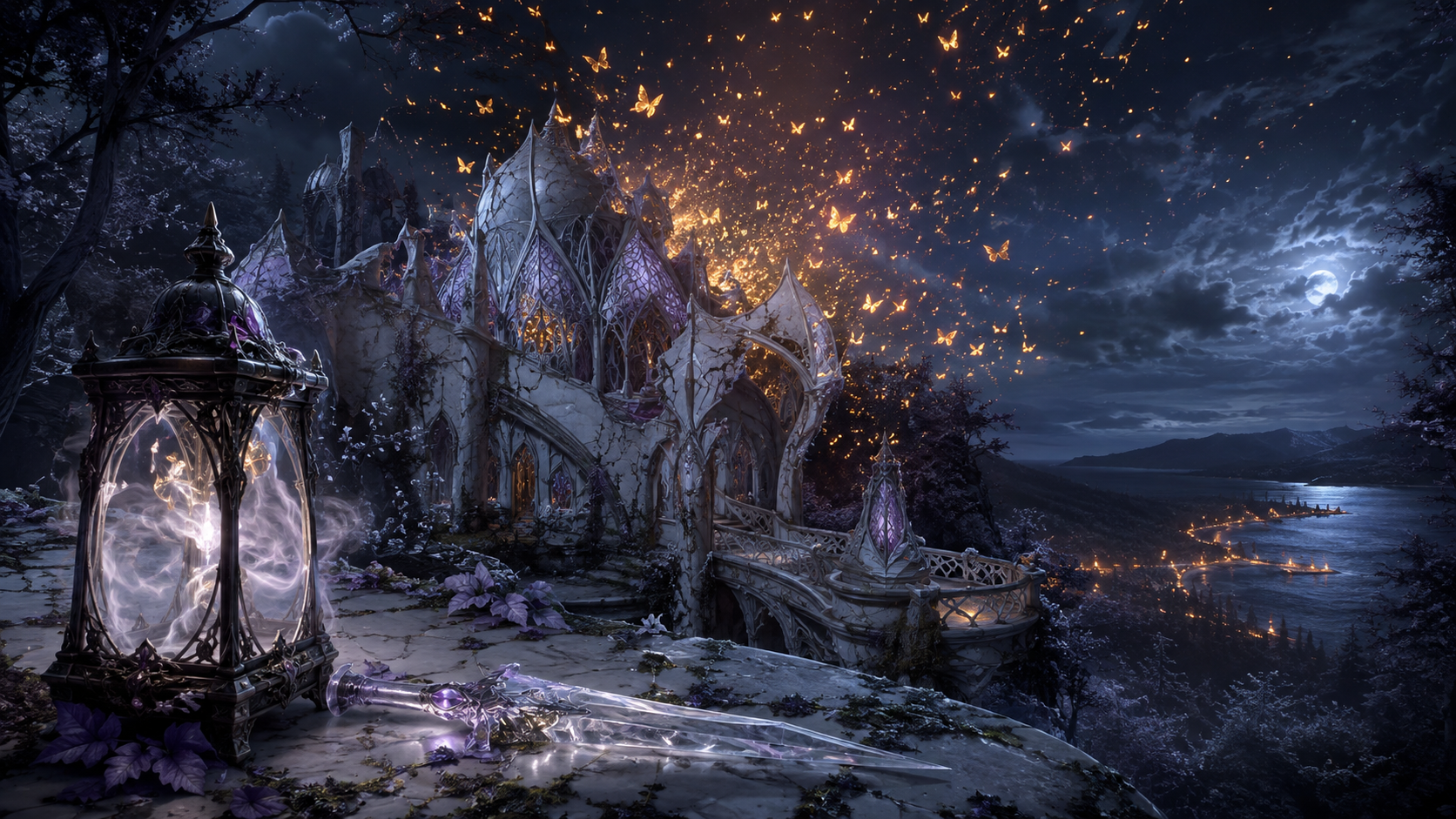
At the ending: Williams detonates the safest place in the book. Utuk’ku cuts off Amerasu’s revelation through the Mist Lamp. Ingen Jegger finishes the silencing with a crystal dagger. White hounds carry destruction into the hidden sanctuary. The butterflies burn.
Where I landed: this is exactly what a middle volume should do. It gathers threads, deepens the governing mystery, and makes every apparent gain incur a new obligation.
The part where refuge sent an invoice
Stone of Farewell is allergic to uncomplicated return.
Simon returns from Urmsheim, but the dragon has left a scar, a white streak, and knowledge he cannot comfortably explain. Camaris returns, but memory and identity do not arrive with his body. Josua finds the Stone of Farewell, but the sanctuary becomes a flooded, hungry political experiment. The Sithi begin to rejoin the war only after Amerasu is murdered inside the place built to preserve them.
The book’s emotional rhythm is therefore not triumph followed by setback. It is recovery revealing the shape of the damage. That distinction keeps the volume from feeling like a bridge made of errands.
The structure: convergence with consequences
The volume manages several kinds of movement at once. Characters cross physical distance, information crosses cultural boundaries, and old history begins crossing into the present as evidence rather than legend. Those streams do not arrive at equal speed. That inequality creates the tension.
Simon’s captivity among the Sithi gives the reader access to Jao é-Tinukai’i without turning the hidden people into a lore vending machine. Josua’s settlement at Sesuad’ra shows that resistance requires grain, shelter, trust, and legitimacy. Miriamele’s road keeps her choices distinct from the coalition forming around her uncle. Binabik and Thorn remain tied to a quest whose meaning is still dangerously incomplete.
The final attack succeeds structurally because it hits every lane at once: sanctuary, prophecy, cultural memory, the sword quest, Simon’s personal rage, and the possibility of alliance.
What works
The scattered viewpoints are never merely simultaneous. Each one changes what another road means, and the finale makes those dependencies visible.
What fights the reader
The middle remains deliberately patient. Travel, recovery, counsel, and withheld explanation can make the book feel as though it is circling the revelation it knows you want.
Simon: surviving rage without calling rage maturity
Simon’s growth is physical and emotional, but it is not a makeover montage. He is stronger, leaner, scarred, and more capable than the castle scullion who wandered into Morgenes’s chambers. He is also frightened by the violence available inside him.
During the Yásira attack, he confronts lethal rage rather than receiving it as proof that he has finally become a warrior. That matters. The book is full of cultures and rulers who treat old pain as permanent authorization. Simon can feel the seductive certainty of hatred without letting it become his identity.
Amerasu’s final burden turns survival into responsibility. He is not released merely to go home. He must carry what she understood toward Josua and the larger war.
Then he reaches the torchlit shore and finds Binabik. The embrace works because the book lets him stop functioning. For one moment, reunion is allowed to be grief, relief, and love instead of strategy.
Amerasu: wisdom finally becomes public action
Amerasu is powerful because the book does not make her wisdom synonymous with calm neutrality. She is angry. She indicts her own people. She names the death they have held like a cherished child and refuses to pretend aesthetic sorrow is the same thing as moral seriousness.
Her insight into Ineluki’s design is dangerous because it could move the Sithi from preservation to participation. Utuk’ku does not merely interrupt exposition. She prevents a political and metaphysical realignment.
Ingen Jegger’s crystal dagger turns that interruption into murder. Amerasu dies because understanding becomes action before action becomes safety.
The Sithi: haunted is not the same thing as wise
The Sithi are beautiful, ancient, and grieving. The novel never denies any of those things. It simply refuses to let beauty and longevity function as moral immunity.
Amerasu’s accusation is devastating because it is internal. The Sithi have made a home with death. Their withdrawal protects memory while surrendering the future to people willing to weaponize that memory. Preservation becomes complicity when it refuses every cost except disappearance.
The attack on Jao é-Tinukai’i makes the argument physical. Hiddenness cannot remain outside history when Utuk’ku already knows where to strike. The sanctuary burns. The Yásira falls. Butterflies become fire in the air. The Red Hand and the white-hound pack force a war council that moral persuasion alone could not secure.
The Sithi join because the cost of not joining has finally entered the room.
Camaris: a legend returned without restoration
Camaris embodies the book’s governing refusal. Finding the lost hero does not restore the world that lost him.
His survival answers one mystery and opens several more. Memory is absent or inaccessible. The body associated with heroic certainty now carries vulnerability and silence. Every faction that wants to use him must confront the fact that a person is not identical to the story preserved about him.
That makes him more interesting than a late-arriving superweapon. He is living evidence that history does not come back clean.
The ending: butterflies, a dagger, and one honest embrace
The final movement is brutal because it combines revelation and silencing. Amerasu begins to expose Ineluki’s design through the Mist Lamp. Utuk’ku interrupts. Ingen Jegger kills her. White hounds and the Red Hand breach what should have been untouchable.
The attack destroys more than safety. It destroys the Sithi’s argument that isolation can keep the catastrophe outside.
Simon is released by Amerasu’s final wish and sent carrying unfinished knowledge. He reaches Sesuad’ra above the drowned valley and finds Binabik on the torchlit shore.
Simon sweeps his friend into his arms and cries.
No speech about destiny would improve it. The volume has spent hundreds of pages turning people into carriers of political, magical, and historical burden. The ending briefly lets two friends be glad the other is alive.
My side-eye found shelter too
The book sometimes withholds information so insistently that mystery starts wearing the same coat as delay. Readers who need the sword mechanism to move decisively will spend long stretches receiving atmosphere, partial records, interrupted explanation, and another reminder that old names matter.
The distributed structure also means emotional momentum repeatedly changes hands. A thread can become urgent, disappear for a while, and return after another road has established a different rhythm.
And the Sithi’s beautiful melancholy is intentionally criticized by the text, but beauty still occupies a lot of page space before the criticism becomes action. Amerasu earns the impatience some readers may already feel.
Final take
Stone of Farewell is a middle volume with teeth because convergence costs more than separation.
It deepens Simon without turning trauma into instant masculine competence. It makes Amerasu’s wisdom politically dangerous. It complicates Camaris before anyone can use him as a solution. It converts the Sithi from beautiful background history into a culture responsible for what its withdrawal permits.
The finale is excellent: interrupted revelation, murdered knowledge, a sanctuary breached, an ancient people forced into the present, and Simon carrying a burden toward a resistance camp already drowning in practical need.
Then Binabik appears on the shore, and the book remembers that friendship is not a side quest.
On the record
This verdict is grounded in the owner-accessed Kindle edition read continuously through page 589, including Chapter 28, “Sparks,” and the complete appendix reference layer. Character, place, language, and pronunciation records were reconciled after the narrative rather than substituted for it.
Return to the Book 2 hub → · Read the complete series verdict → · Meet Tad Williams →