
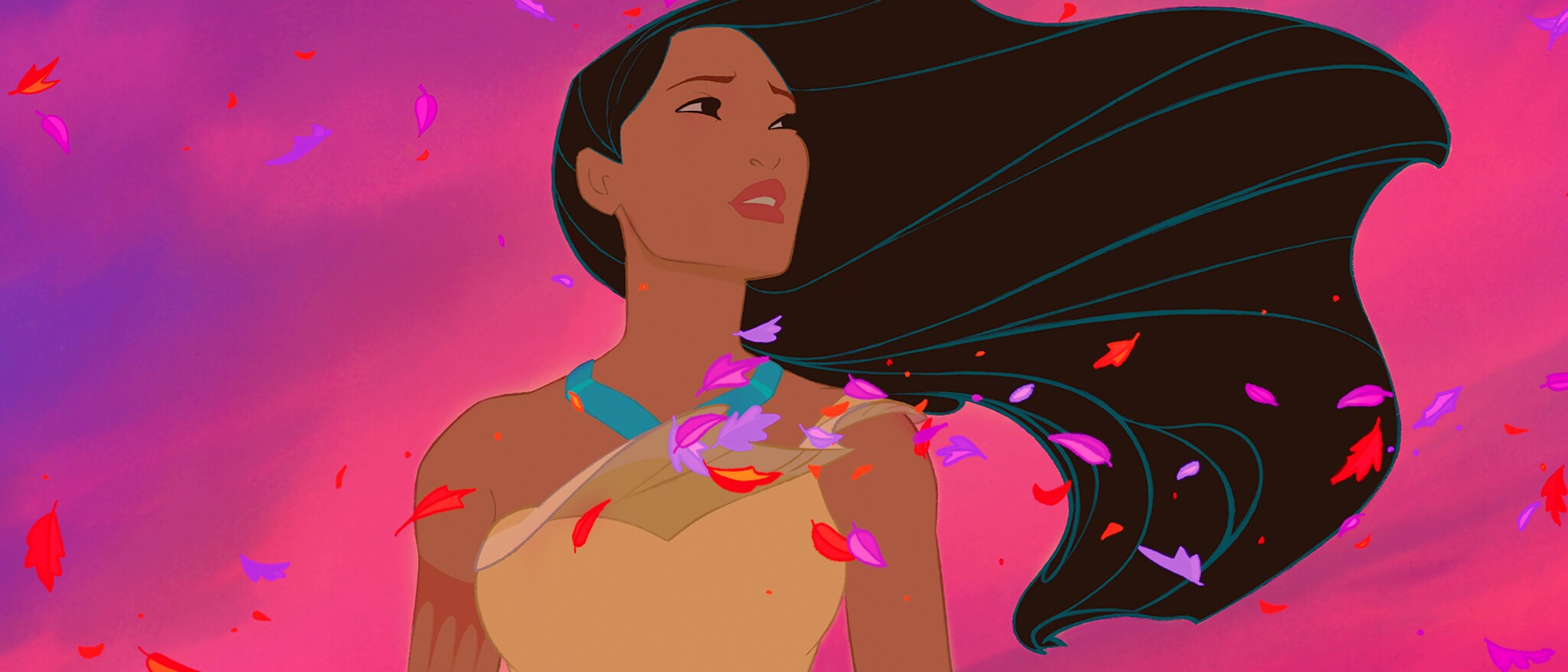
Just Around the Riverbend
The river was a question before Disney turned it into directions toward John Smith.
The river is not asking Pocahontas to chase a man
John Smith has not entered her life when she sings. The choice belongs to her conflict about Kocoum, leadership, expectation, and the feeling that a predetermined future may be too small. Remembering the order matters because romance often colonizes a heroine’s earlier desires after the fact. Her restlessness existed before the English ship. The river represents uncertainty, not a blond destination waiting beyond the bend.
Powhatan offers a marriage that makes political sense
Kocoum is respected, capable, serious, and connected to community stability. Powhatan is not selecting a random punishment. He is thinking as a leader and father inside the film’s compressed political world. Pocahontas hears the proposal as a future whose shape has been decided without enough attention to her temperament. A choice can be reasonable for the community and still feel unlivable to the person expected to embody it.
Kocoum is treated as a path rather than a full person
The song imagines him as steady, safe, and emotionally fixed. Those qualities become the opposite of adventure, which reduces a man to the future Pocahontas fears. Later events give him loyalty, suspicion, anger, and vulnerability, but the romance structure never grants him comparable interior space. He becomes the straight river in someone else’s metaphor and eventually pays with his life.
The straight river is not actually inferior
A calm path can represent stability, shared work, family, and knowledge deepened over time. The song frames movement and surprise as emotionally alive because Pocahontas currently experiences certainty as confinement. That feeling is valid without becoming a universal truth that settled lives are cowardly. Freedom means choosing the path, not automatically selecting the most dramatic current.
Judy Kuhn sings curiosity as a physical need
The phrasing accelerates, pauses, reaches, and doubles back like water meeting terrain. Pocahontas does not sound mildly undecided. She sounds starved for a future she cannot yet name. The vocal performance turns uncertainty into energy rather than weakness. She knows the approved answer and cannot make her body believe it.
The canoe proves she is already skilled
Pocahontas navigates rapids with control, reads water, balances risk, and treats the landscape as familiar rather than exotic. The sequence gives her physical competence before colonial conflict defines the plot. She is adventurous inside her own homeland, not awakened by European arrival. That distinction resists the idea that history begins when settlers appear.
Meeko chooses snacks over existential crisis
His comic interruptions prevent the song from floating into abstract destiny for too long. Ordinary appetite remains present while Pocahontas considers the shape of a life. The humor also establishes relationship. She does not explore alone even when the decision feels private. Companionship can coexist with autonomy.
Flit represents caution without becoming an enemy
The hummingbird reacts to danger and often distrusts unfamiliar change. Caution is framed comically, but it is not irrational in a world about to receive armed colonists. The film later proves that suspicion can be protective. Adventure stories need to stop treating every warning as proof the cautious friend lacks imagination.
The dream about the spinning arrow lacks instructions
Pocahontas receives an image that feels significant and cannot interpret it. The symbol offers direction without clarity, which lets her project hope, anxiety, and desire into the unknown. Spiritual guidance in the film functions more like a prompt than a command. That ambiguity gives her agency while also moving plot through mystical shorthand.
Grandmother Willow asks questions instead of issuing orders
She listens, jokes, and helps Pocahontas attend to what she already senses. Her guidance contrasts with institutions that define duty before hearing the person who must live it. Mentorship becomes a practice of creating room for judgment. The tree is a magical invention carrying a recognizable relational skill: let the younger person think aloud.
The river metaphor can hide material limits
Pocahontas imagines multiple paths, but her social position, family responsibility, gender, and political context constrain what choices can safely become action. Metaphors of personal destiny can make structural barriers look like failures of courage. Wanting the bend does not guarantee the world will let someone follow it without cost.
The film gives an Indigenous heroine individualism in a Disney key
The song translates conflict into a familiar American argument between personal desire and prescribed community duty. That makes Pocahontas legible to the studio’s audience. It may also project modern corporate individualism onto a historical Indigenous setting without sufficient specificity. Representation is not improved by assuming every heroine wants freedom in exactly the same cultural vocabulary.
Community obligation is not the villain
Pocahontas cares about her father, people, and future responsibilities. She does not want freedom from all relationship. She wants participation in defining what duty will mean. The difference matters. Autonomy is not isolation. Her final decision to remain home confirms that belonging can be chosen rather than merely imposed.
The song builds desire through geography
Every bend, branch, waterfall, and open view turns landscape into a map of possibility. Motion through space makes an interior question visible. Animation can externalize thought without explaining it in dialogue. The land is beautiful, but it should not be reduced to a projection screen for one character’s feelings.
Powhatan’s comparison to the river carries another truth
He describes Kocoum as steady, which frames leadership through reliability. Communities facing pressure may need people who can hold a course rather than chase every possibility. Pocahontas rejects the conclusion, not necessarily the value of steadiness. Her own arc will combine movement with responsibility instead of permanently choosing one against the other.
The waterfall makes danger look ecstatic
Pocahontas approaches the drop with confidence, and the animation turns risk into exhilarating flow. A real fall would demand different caution. Musical geography follows emotion before physics. The exaggeration lets viewers feel her appetite for uncertainty without requiring the story to injure her for it.
The compass image will be claimed by the colonial plot
The spinning arrow from her dream later resembles John’s compass. The connection turns spiritual uncertainty into a bridge toward the English arrival. This is narratively elegant and politically uncomfortable. Her inner life becomes routed toward a colonizer’s object. The symbol could have opened many futures. The film narrows it into romance because that is the story Disney decided to sell.
A compass does not make colonization destiny
The plot may frame their meeting as spiritually significant, but no dream can absolve the expedition’s material purpose. Fate language can make power look inevitable. John’s arrival is a choice produced by company ambition, imperial expansion, and his own participation. Pocahontas can find meaning in the encounter without the film declaring occupation cosmically approved.
The number gives her joy before trauma
Pocahontas laughs, moves, explores, and argues with herself before violence takes over the story. That joy is important character evidence. Indigenous heroines should not exist only as victims, teachers, or symbols of historical loss. The scene preserves vitality even inside a film that will ask too much of her.
The song asks whether safety is enough
Pocahontas worries that accepting the proposed path will end inquiry. Safety without self-recognition can feel like a slow disappearance. The question is emotionally real and socially privileged. Many people do not receive a safe option at all. Her dilemma should be understood within the responsibility and status the film gives her as Powhatan’s daughter.
She wants to know what the dream means, not simply escape
Curiosity directs the song. Pocahontas is drawn toward understanding, and the unknown is valuable because it may change what she knows. That intellectual appetite connects her to later ecological teaching and political intervention. She is not reckless because routine is boring. She is attentive to unresolved evidence.
The river keeps moving after every decision
Choosing one path does not freeze identity forever. Water changes course, returns through cycles, and joins larger systems. The metaphor contains more flexibility than the binary lyric sometimes suggests. A person can choose home now, adventure later, duty differently, and still remain recognizably herself.
The song becomes sadder after Kocoum’s death
On rewatch, the proposed future is not merely refused. The person associated with it is killed during conflict tied to the new path. Pocahontas did not cause colonial violence by wanting more from life. Still, grief attaches itself to the earlier choice. The film moves quickly past that emotional reckoning because romance and peace need the remaining runtime.
Nakoma understands consequences the song temporarily ignores
Her friend worries about danger, reputation, and community response. Those concerns can look restrictive beside the music’s freedom. Later events prove Nakoma was reading real risk even when her intervention contributed to tragedy. Friendship needs both the person who imagines another path and the person who asks who may be harmed along the way.
The sequence is a perfect “I want” song and an imperfect history frame
It establishes desire, conflict, personality, visual language, and the question that will organize the plot. As musical storytelling, it is extraordinarily efficient. As a story attached to Pocahontas’s name, it participates in turning a real Indigenous child into a modern adult heroine seeking individual romantic destiny. Craft and distortion occupy the same canoe.
Pocahontas has political responsibility the song cannot pause
As Powhatan’s daughter, her decisions are watched and may be interpreted as signals about leadership, alliance, marriage, and succession. Private desire carries public meaning whether she wants that burden or not. The film uses princess language familiar to Disney audiences while leaving the actual political structures vague. That vagueness makes the conflict feel universal and prevents viewers from understanding what her position specifically requires.
The song confuses predictability with absence of growth
Pocahontas imagines the proposed future as a completed map where every bend is already known. Real relationships and communities continue changing even when people remain in one place. Kocoum may have contained possibilities the screenplay never explores because he must symbolize the wrong choice quickly. A deep reaction separates her legitimate lack of desire from the story’s decision to flatten the person she does not choose.
Adventure is not automatically liberation for Indigenous women
Western storytelling often celebrates leaving home, crossing boundaries, and rejecting tradition as signs of modern freedom. Those values can repeat colonial assumptions that mobility toward the outside world equals progress. Pocahontas’s final choice to remain complicates that pattern, but the middle of the film still makes the English encounter the primary route to discovery. Her homeland already contains intellectual, spiritual, political, and emotional worlds.
The current carries her because animation converts fear into play
Pocahontas leans into rapids that would overwhelm a less skilled traveler. The visual rhythm makes risk feel collaborative, as though water recognizes her ability. That is fantasy, not proof of mystical racial connection to nature. The sequence works best when read as practiced knowledge made lyrical rather than blood-based magic.
A choice can reject marriage without rejecting the man’s humanity
Pocahontas does not owe Kocoum romance because he is honorable, approved, or politically suitable. Consent is enough reason to refuse. The movie could preserve that truth while giving him interiority, friendship, grief, and a future beyond being rejected. Her autonomy and his full personhood do not need to compete. The screenplay made them compete for efficiency.
The song anticipates leadership through uncertainty
Leaders are often portrayed as people who possess immediate answers. Pocahontas begins by admitting she does not know which path carries meaning. Her later intervention succeeds because she can hold uncertainty long enough to see alternatives other people’s certainty excludes. Questioning becomes a leadership skill, not evidence she is unprepared.
The visual freedom belongs to artists working inside a corporate frame
Animators, layout artists, background painters, musicians, performers, and editors created a sequence whose movement still feels alive. Their craft should not disappear inside criticism of Disney as an institution. The same institution selected the historical name, adult romance, and marketable version of Indigenous identity. Authorship is layered. Praise and accountability should be specific enough to recognize those layers.
The bend is meaningful because she cannot see around it
If the destination were visible, the song would become a calculation rather than an encounter with uncertainty. The hidden path allows hope and projection to occupy the same space. That is also why prophecy must be handled carefully. An unseen future can hold many possibilities until the plot declares only one of them important. Pocahontas deserves a horizon wider than the ship arriving on schedule.
RaeRae’s final reaction
I love this song when I protect it from the romance that comes next. Pocahontas is not singing because she senses a blond man across the water. She is singing because everybody handed her a future with no room for her own judgment and expected gratitude for the safety. I also need us to stop acting like Kocoum was boring and therefore disposable. Stable is not stupid. Serious is not loveless. He becomes a path she does not want, then the movie kills the person and keeps the metaphor moving. I have receipts about that. The riverbend works for me as a question, not a prophecy. Pocahontas wants participation in her own life. She deserves that without John Smith becoming destiny, colonization becoming adventure, or community becoming the obstacle freedom must escape.