
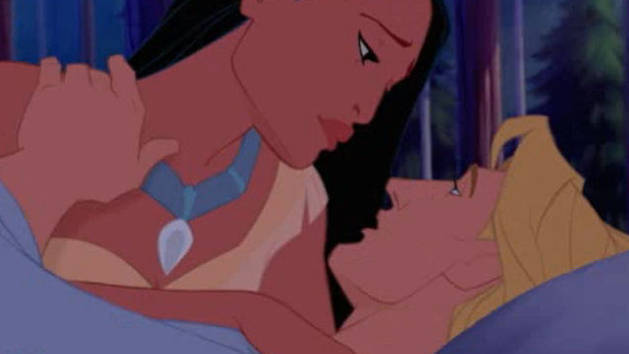
The Farewell
The fictional woman gets to choose home. History refuses to let the goodbye stay clean.
Pocahontas saves Powhatan before she saves John
The climax is often remembered as a romantic rescue, but her first intervention is political. She stops her father from carrying out an execution that would trigger more bloodshed. She does not arrive as John’s girlfriend asking for a favor. She speaks as Powhatan’s daughter, a member of the community, and the person who understands the immediate cycle of retaliation. The scene grants her moral clarity while making one young woman responsible for containing violence produced by armed colonial arrival.
John takes the bullet Ratcliffe intended for Powhatan
Ratcliffe fires after Powhatan chooses peace. John moves into the shot and is wounded by his own commander, turning colonial violence inward. The action proves John’s change through risk rather than speech. He finally uses his body against the project he joined. One act of sacrifice matters. It does not erase his participation in the expedition or convert the colonial structure into a misunderstanding between two bad leaders.
Ratcliffe’s men arrest him because loyalty finally breaks
The settlers have tolerated greed, lies, forced labor, and escalating violence. Shooting John after peace becomes the visible line they can no longer rationalize. Their revolt shows institutions are maintained by people who can withdraw obedience. It also arrives late, after land has been occupied and both communities have suffered. The movie gives accountability a satisfying theatrical moment without showing what repair would require afterward.
Powhatan offers medicine without surrendering authority
He allows his healers to help John and approaches the departure with dignity. Care is not presented as defeat. This distinction matters because colonial stories often interpret Indigenous generosity as consent to occupation. Powhatan can protect a wounded person while rejecting the expedition’s claim. Hospitality and sovereignty are not opposites.
Pocahontas is offered England and chooses home
John asks her to come with him, and the film lets her refuse. The romantic plot does not end with the heroine abandoning nation, family, and responsibility for the European man. Her choice protects an interior life larger than romance. She recognizes that leadership and belonging require her presence. The refusal is one of the film’s strongest fictional decisions, especially because actual history moved in a far more coercive direction.
The film gives her a choice history did not
The historical Pocahontas was a child when John Smith arrived. Years later, English colonists captured her, held her, converted and baptized her, and connected her to John Rolfe. She eventually traveled to England and died there while still young. The surviving record is shaped by colonial sources and leaves major questions about coercion, consent, and her own perspective. Disney’s farewell creates a freely chosen separation that can conceal the violence of the life attached to her name.
The adult romance is a corporate invention, not a disputed detail
Aging Pocahontas into an adult was necessary for Disney’s love story. That choice is not a harmless compression like moving a date or combining minor figures. It transforms the relationship category, sexualizes a real Indigenous child’s name, and makes colonization emotionally consumable through mutual attraction. The fictional characters can produce feeling while the historical distortion remains unacceptable.
John Smith’s writings cannot be treated as transparent truth
Smith described rescue stories in ways historians have questioned, and his accounts served self-presentation as well as record. Disney selects the version most useful for romance and moral transformation. The uncertainty becomes cinematic certainty because certainty sells cleaner emotion. A responsible reaction names the source problem instead of repeating legend as biography.
The farewell cliff turns separation into visual equality
Pocahontas stands high above the water while the ship moves away. She is not framed as abandoned on a dock beneath European progress. Her stillness carries authority, and John’s movement becomes departure rather than destiny. The land does not vanish when the ship leaves. The composition gives the fictional heroine a sovereignty the history and sequel will complicate.
The wind returns as memory and communication
Leaves travel across distance, connecting the farewell to earlier scenes of spiritual attention and romantic recognition. The device makes separation emotionally continuous without requiring Pocahontas to follow. Love can matter after a relationship ends. It is beautiful symbolism and another example of the film packaging Indigenous spirituality into a universal visual effect.
The settlers leave, but colonialism does not end
One ship’s departure cannot reverse the Virginia Company, English expansion, disease, warfare, land seizure, or the founding of Jamestown. The ending uses a contained expedition so peace can feel achieved within one movie. Historical colonization was not a problem that sailed away with Ratcliffe in chains. The emotional closure belongs to fiction, not the timeline that follows.
The Powhatan community watches from shore
Pocahontas is surrounded by people, which helps the ending resist total romantic isolation. Her decision occurs within a nation that has survived immediate violence. Still, most community members remain background to the central couple. Their futures receive less emotional attention than John’s wound and departure. A deeper franchise hub must restore attention to Nakoma, Kocoum, Powhatan leadership, families, and collective survival.
Kocoum’s death cannot be repaired by the farewell
Thomas kills Kocoum during a confrontation intensified by colonial intrusion, secrecy, and fear. The movie mourns briefly, then moves toward reconciliation. Peace may prevent additional death. It cannot make the existing death a narrative fee paid for romance. Kocoum deserves to remain a person, not the obstacle removed so John can become sympathetic.
Thomas receives forgiveness without sustained accountability
He admits what happened and later participates in arresting Ratcliffe, but the ending does not stay with the consequences of killing Kocoum. His remorse matters. The speed of resolution reflects whose guilt the story prioritizes and whose grief it can leave mostly offscreen. Reconciliation without memory becomes another form of narrative convenience.
Nakoma’s fear was reasonable
She warned about danger, sought help, and became connected to the chain of events leading to Kocoum’s death. The film can make caution look like failure because Pocahontas holds the heroic vision. The ending validates peace but does not prove Nakoma was wrong to fear armed strangers. Friendship deserves repair beyond a brief return to community unity.
Powhatan’s peace is not proof both sides caused equal harm
He stops an execution and chooses not to continue battle. That moral decision should not be converted into a statement that invasion and defense were symmetrical mistakes. The settlers entered Powhatan territory seeking extractable wealth under imperial authority. The political origins remain unequal even when individuals on both sides choose violence. Peace can be necessary without rewriting causation.
The emotional score makes critique harder because it works
Alan Menken’s themes return with enough force to make the farewell feel earned, tragic, and hopeful. Music organizes memory from the entire film around one separation. Being moved is not evidence a historical claim is sound. It is evidence the filmmakers understood emotional architecture. Criticism becomes more honest when it admits the craft succeeded.
Irene Bedard’s performance gives Pocahontas restraint
Her spoken voice carries focus rather than melodrama. The character has already made the decision before John’s ship disappears. That restraint protects the farewell from becoming a plea. Pocahontas can grieve while remaining oriented toward responsibilities beyond him. The performance gives dignity to a script that asked one character to carry impossible symbolic weight.
The sequel reopens the choice through another colonial frame
Pocahontas II sends her to England and redirects romance toward John Rolfe, borrowing names and events from history while continuing fictional relationships. The first ending feels stronger because it allows her to remain home. The sequel demonstrates how a franchise can treat a resolved act of agency as material to be rearranged. Branch labels matter so audiences do not mistake continuity decisions for recovered history.
John’s departure is not a punishment for choosing justice
He leaves because he needs medical care, not because the story declares cross-cultural solidarity impossible. His wound is the consequence of opposing Ratcliffe at the critical moment. The ending permits moral growth without awarding possession of Pocahontas. That is a useful distinction. Redemption should change how someone acts. It does not create a right to the person who taught the lesson.
Pocahontas does not owe him a lifetime because he changed
She helped expand his worldview, and he risked his life. Neither creates a romantic debt. Her refusal to board the ship recognizes that meaningful love can end when futures, responsibilities, and places diverge. The film is more mature here than stories that treat sacrifice as a purchase contract.
The ending turns home into a chosen future rather than a restriction
Earlier, Pocahontas wonders about the river bend and resists a prescribed marriage. Remaining could look like surrender to the path others selected. By the finale, she chooses community after encountering an alternative. Choice changes the meaning of the same geography. Home becomes something she claims with knowledge, not a cage she never tested.
That chosen-home reading still risks romanticizing limited options
The English voyage is attached to the man she loves, but it also leads into the colonial society endangering her people. Refusal is sensible within the fictional setup. Real freedom would include more than two paths arranged by empire and family. Agency should be recognized without pretending the available options were neutral.
The movie wants a hopeful ending on top of catastrophic history
A family film needs emotional containment. The filmmakers build it through Ratcliffe’s arrest, a prevented execution, offered medicine, a loving farewell, and a community still standing. Historical knowledge breaks that container because viewers know settlement continues and the real Pocahontas’s life does not follow this choice. Hope becomes responsible only when it does not demand forgetting.
The cliff image belongs to the fictional character
The animated Pocahontas has become culturally recognizable apart from the historical person, but the shared name keeps the two connected. Fans can discuss the character’s arc while labeling invention clearly and refusing to use Disney as biography. Separation is not disrespect. It is the minimum needed to stop entertainment from overwriting a real Indigenous life.
The wounded body makes John temporarily dependent on Powhatan care
John entered with a company that assumed European tools, weapons, and medicine proved superiority. His survival now depends on people the settlers described as primitive. The reversal exposes the fragility of colonial confidence without turning Indigenous healing into magic. Care is skilled practice offered within political judgment. Receiving help should produce humility, not a new story in which the colonizer becomes central because he was saved.
Ratcliffe becomes the container for a larger system
Arresting one greedy governor gives the film a villain viewers can remove. The company, crown, economic incentives, and settler assumptions remain less visible. Personal villainy is real, but colonial projects do not depend on one uniquely bad man. They are built through institutions that reward extraction and make replacement easy. A chained Ratcliffe gives closure the structure cannot honestly provide.
The ship carries a divided record away
Some settlers witnessed Powhatan restraint, Pocahontas’s intervention, Ratcliffe’s violence, and John’s refusal. What they report in England will shape future decisions. The movie does not follow that information struggle, but colonial archives are created through exactly these unequal acts of narration. Who gets believed can determine whether peace becomes memory, propaganda, or permission for another expedition.
Pocahontas’s wave is both intimate and public
She says goodbye to John while standing before both communities. The gesture belongs to a relationship and also signals that departure will not restart immediate violence. Her private feeling is repeatedly required to perform political work. Love becomes diplomacy because formal institutions failed. That burden makes the image powerful and unfair at once.
The ending grants John an honorable exit the real project did not earn
He departs as a changed man surrounded by comrades who rejected Ratcliffe. The ship can appear purified by moral awakening. Yet the expedition arrived to extract wealth, occupied land, and helped produce death. Individual improvement does not make the vessel innocent. The farewell should not convert retreat into a completed act of repair.
Remembering the real Pocahontas changes the direction of sympathy
The film directs grief toward John leaving and the couple separating. Historical context redirects attention toward the Indigenous girl whose name was transformed into romance and national myth. That shift does not forbid emotion for fictional characters. It asks why corporate storytelling made settler heartbreak easier to see than captivity, conversion, displacement, and early death. The question belongs inside the reaction, not hidden in a footnote.
RaeRae’s final reaction
This ending gets me because Pocahontas says no to the version of romance that requires disappearing into somebody else’s future. John changed, took a bullet, and loved her. She still does not owe England her body, her home, or the rest of her life. Then history walks into the room and ruins the clean cry. The real Pocahontas was a child when Smith arrived, later became a captive, was converted, married John Rolfe, traveled to England, and died young. Disney gave the fictional woman a gorgeous free choice while using the name of someone whose choices were constrained by colonial power. So I can honor what the scene says and refuse what the movie asks me to forget. The wind can carry love across the water. It cannot carry away Kocoum, colonization, captivity, or the real girl buried underneath an adult romance Disney knew would sell.