
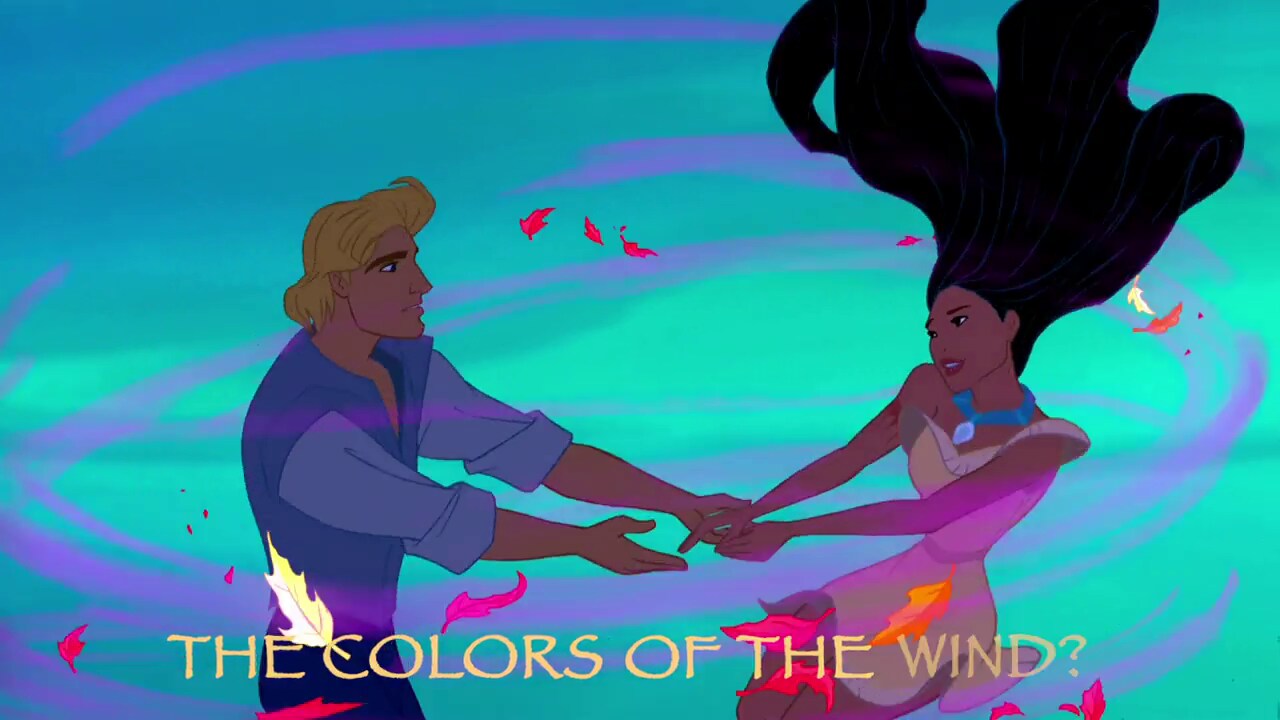
Colors of the Wind
The song reads colonial arrogance for filth. Disney still asks Pocahontas to do all the teaching.
The song begins by answering an insult
John Smith describes land as something waiting to be claimed and people as savage because their relationship to property does not resemble his own. Pocahontas does not respond with a polite cultural exchange. She challenges the arrogance inside his vocabulary. That opening matters. The number is not initially a romance montage. It is an argument with a colonizer who mistakes unfamiliar values for absence of civilization.
“Savage” is the word the film wants to reverse
The lyric asks which person is ignorant, violent, and unable to recognize life. It turns the colonial label back toward the speaker who arrived assuming superiority. That reversal is satisfying because the film lets an Indigenous woman identify the violence in the English worldview. It is limited because the story later treats prejudice as a misunderstanding that two exceptional individuals can sing through.
Judy Kuhn gives the lesson warmth without making it soft
The vocal begins with controlled disbelief and expands into invitation, grief, wonder, and insistence. Pocahontas is not begging John to approve her culture. She is showing how little his certainty allowed him to perceive. The performance keeps intelligence inside melody. Every beautiful phrase remains attached to an accusation: your categories are too small, and your hunger to own everything has made you blind.
Nature becomes a relation rather than scenery
Rivers, animals, wind, earth, and weather are addressed as participants in a living world. The song rejects the idea that value begins when land is fenced, mined, named, or sold. This is the sequence’s most enduring ethical force. It asks viewers to imagine obligation before ownership and kinship before extraction.
The animation makes interdependence visible
Color moves through leaves, bodies, sky, and water as though boundaries are permeable. The visual language does not prove a scientific or spiritual doctrine. It makes connection emotionally legible. Pocahontas and John move through the same currents, but she understands the world as relationship while he begins as a tourist being taught to notice it.
The leaves are gorgeous and dangerously easy to commodify
Disney turns ecological relation into a marketable swirl of color that can live on posters, dresses, toys, and theme-park imagery. The corporation profits from the visual language of resisting possession. That contradiction does not erase the artists’ craft. It should remain visible whenever the song is praised as anticolonial wisdom delivered by one of the largest entertainment companies on earth.
The song makes Pocahontas responsible for educating John
She does the intellectual and emotional labor of interrupting his racism, expanding his senses, and giving him a moral vocabulary. He receives transformation through her patience. This is a recurring colonial romance pattern. The Indigenous woman becomes guide, conscience, landscape interpreter, and evidence that the settler can be redeemed. Her interior life risks becoming curriculum for him.
John gets wonder before accountability
He sees animals, rivers, moons, and impossible color. The sequence rewards openness quickly because musical time compresses moral learning. Yet recognizing beauty is not the same as rejecting colonial power. A person can admire a landscape and still participate in occupation, extraction, or violence. The song begins change, not completion.
The phrase about owning land identifies the material conflict
Colonization is not only a bad attitude. The English company arrives seeking gold, territory, labor, and profit. Pocahontas correctly connects the insult to a property system that turns relationship into resource. The film weakens its own insight when later conflict is framed mostly as mutual fear. One group came armed under commercial authority to seize value. Symmetry cannot explain that.
The wolf, bobcat, and mountain lion create a fantasy ecology
The animals gather as symbols of wild kinship rather than behaving like a documentary ecosystem. Their presence builds a poetic world where difference can coexist without ownership. That fantasy is artistically effective. It can also feed the stereotype that Indigenous identity is naturally mystical, timeless, and closer to animals than history.
Indigenous people do not exist outside modernity
The film places Pocahontas inside a precolonial setting, but audiences often carry the imagery forward as though Native peoples belong only to forests, ancestors, and the past. A responsible reading must reconnect the song to living nations, contemporary governance, land struggles, languages, families, art, and political claims. Reverence that erases survival is another form of disappearance.
Pocahontas is rendered as an idealized adult rather than the historical child
The movie ages and redesigns the historical Pocahontas into a romantic heroine. That decision makes the John Smith relationship consumable and separates viewers from the documented violence surrounding her life. No amount of visual beauty turns the romance into history. The song belongs to a fictional Disney character built from a real Indigenous girl whose story was dramatically altered.
The performance model controversy matters
Disney promoted Pocahontas as an Indigenous heroine, but the final design emerged through studio processes that combined multiple influences and beauty standards rather than documenting one Powhatan woman. The user’s objection to seeing a Filipina model folded into the character is not trivial. Representation cannot be repaired by calling any brown woman interchangeable with a specific Native nation.
The film consulted Native people and still produced distortion
Production contact with Indigenous advisers does not create a blanket certificate of accuracy. Consultation can be selective, overruled, or used to legitimize decisions already shaped by romance and corporate storytelling. The existence of research should make critique more precise, not impossible.
“Paint with all the colors” is about perception, not decoration
The lyric asks John to encounter forms of value he cannot measure through possession. Painting becomes a metaphor for learning through relation and attention. The merchandising afterlife often reduces the phrase to rainbow aesthetics. The original argument is sharper: a person who knows only ownership is missing entire categories of experience.
The song treats listening as bodily practice
John is asked to run, taste, hear, follow, and feel. Knowledge is not delivered only as facts. Pocahontas changes where he stands and what he attends to. Embodied learning can disrupt certainty because the world resists abstraction. It does not substitute for historical or political education, but it can make denial harder to maintain.
Romance enters through shared motion
Hands meet, bodies move together, and the visual distance between them collapses. The song turns argument into intimacy because John’s willingness to follow is framed as emotional compatibility. That transition is seductive and risky. Being teachable is attractive. It should not make Pocahontas responsible for loving the student.
The wind translates without solving language
The film uses magical communication so Pocahontas and John can understand each other. The device prioritizes emotional clarity over the difficult realities of translation, diplomacy, and unequal power. A shared language makes romance possible quickly. It also removes labor that real cross-cultural contact requires and can conceal who controls the terms of communication.
Grandmother Willow’s worldview shapes the lesson
Pocahontas does not invent every idea alone. Her guidance comes through family, community, memory, and a spiritual relationship the film embodies in a talking tree. John encounters one charismatic teacher, while the song gestures toward knowledge held collectively. The distinction matters because colonial stories often detach wisdom from the nation that sustains it.
The river metaphor holds movement and consequence
Water refuses permanent capture. It connects places while changing around obstacles, and Pocahontas uses it elsewhere to think about choice. The song’s ecological imagination works best when relation includes change rather than freezing Indigenous culture into timeless purity.
Alan Menken and Stephen Schwartz build persuasion through expansion
The melody grows as John’s field of perception grows. Musical form performs the argument: the world becomes larger than the categories he brought with him. The craft is extraordinarily effective, which is why critique must go beyond declaring the song pretty or problematic. Its persuasive power is exactly what deserves examination.
The sequence distinguishes price from worth
John’s expedition understands value through gold and ownership. Pocahontas points toward forms of worth that cannot be exhausted by exchange. That argument remains urgent in a climate crisis driven by systems that treat land, water, animals, and communities as costs to be externalized.
Environmental language can become a way to avoid sovereignty
Non-Native audiences may celebrate the song as a general ecology anthem while ignoring specific Indigenous nations and their political rights. Loving nature is easier than returning land or respecting treaty obligations. The song’s broad appeal should lead toward specificity, not replace it.
The conflict is not actually equal on both sides
The movie later stages two groups preparing for battle and uses parallel music to emphasize shared hatred. Colors of the Wind already showed why that symmetry is false. The settlers brought an extractive mission and weapons into Powhatan territory. Indigenous defense is not morally identical to invasion.
Pocahontas deserves interests beyond John’s improvement
She has relationships with her father, Nakoma, Kocoum, Grandmother Willow, land, responsibility, and a future the movie keeps redirecting around an English stranger. A deeper fandom reading restores those networks instead of treating the romance as the only plot with emotional weight.
The song can be loved without becoming a history lesson
Its ecological argument, vocal performance, color design, and moral challenge are real achievements. Its fictionalization, romantic framework, and cultural flattening are also real. Mature criticism does not need to choose between worship and disposal. It needs enough room to hold craft, harm, feeling, and context at once.
The song’s universalism creates access and erases specificity
Children anywhere can understand that animals, rivers, and people have worth beyond ownership. That reach helps the song survive across languages and generations. Universal language becomes dangerous when audiences use it to avoid learning who the Powhatan people are, what colonization did, and how specific descendants describe this history. A doorway is useful only if somebody walks through it.
John’s change depends on Pocahontas being exceptionally persuasive
The scene implies a colonizer may revise himself after meeting the right Indigenous woman with enough beauty, patience, poetry, and moral clarity. That places responsibility on the target of prejudice. Most oppressed people will never receive a musical number, suspended danger, or an audience willing to follow. Justice cannot depend on producing a perfect teacher for every powerful person.
The landscape is drawn as abundance before the settlers call it empty
Color, animal life, water, and movement fill every frame. The visual density rejects the colonial fiction that land without European property markers was unused. Calling a place empty is not a neutral mistake. It creates permission to occupy it while ignoring relationships and stewardship already present. The animation answers that fiction through fullness, even when the screenplay lacks political vocabulary for sovereignty.
Meeko and Flit are witnesses, not just merchandise
The animals contribute comedy and recognizable silhouettes, but they also establish Pocahontas within ongoing relationships before John arrives. She is not alone waiting for romance to create a world. She already knows patterns, companions, paths, and responsibilities. Their presence can support relation without pretending wildlife substitutes for human community.
The sequence makes education feel instantaneous
John moves from insult toward wonder inside one song because musical storytelling condenses time and rewards emotional openness. Real unlearning requires repetition, historical knowledge, material choices, accountability, and willingness to lose benefits attached to ignorance. Feeling moved is an opening. It is not evidence the work is finished.
Listening becomes political only when behavior changes
John later resists Ratcliffe and tries to prevent violence, so the song does affect action. That follow-through matters more than whether he enjoyed the view. Even then, one individual refusal cannot dissolve a colonial company, military force, crown claim, or profit system. Personal transformation and structural change belong in the same analysis because neither can replace the other.
The song asks a question Disney should answer too
If everything has life, spirit, name, and value beyond possession, what does it mean for a corporation to trademark the heroine, sell the imagery, and control the official version of her story? The contradiction is not an argument against art. It is an argument for examining who owns representation, who receives revenue, and whose objections remain outside the frame. The lesson points back at the company that packaged it.
Beauty can carry an argument farther than a lecture
The melody, color, and movement make viewers emotionally available to ideas they might resist in plain prose. That is artistic power, and it helps explain why this number remains culturally present. The same beauty can soften the history until colonization feels like a disagreement resolved through empathy. The scene’s emotional access should become a reason to learn more, not a substitute for the difficult record.
RaeRae’s final reaction
I still understand why this song owns people. It is beautiful, Judy Kuhn sings the roof off the whole colonial worldview, and John Smith gets read for filth while leaves perform backup choreography. I am seated. But I am not letting Disney turn one fictional Indigenous woman into a spiritual customer-service desk for a colonizer. Pocahontas should not have to educate him, heal him, romance him, represent every Native nation, and make colonialism feel like a communication problem.
The best line of the song is not a pastel slogan. It is the demand to recognize life you cannot own. If we keep that demand, then the listening cannot stop at pretty wind. It has to reach living Native people, specific nations, sovereignty, land, history, and the receipts the movie tried to float away on those gorgeous leaves.