
Pain and Nagato
Bottom line
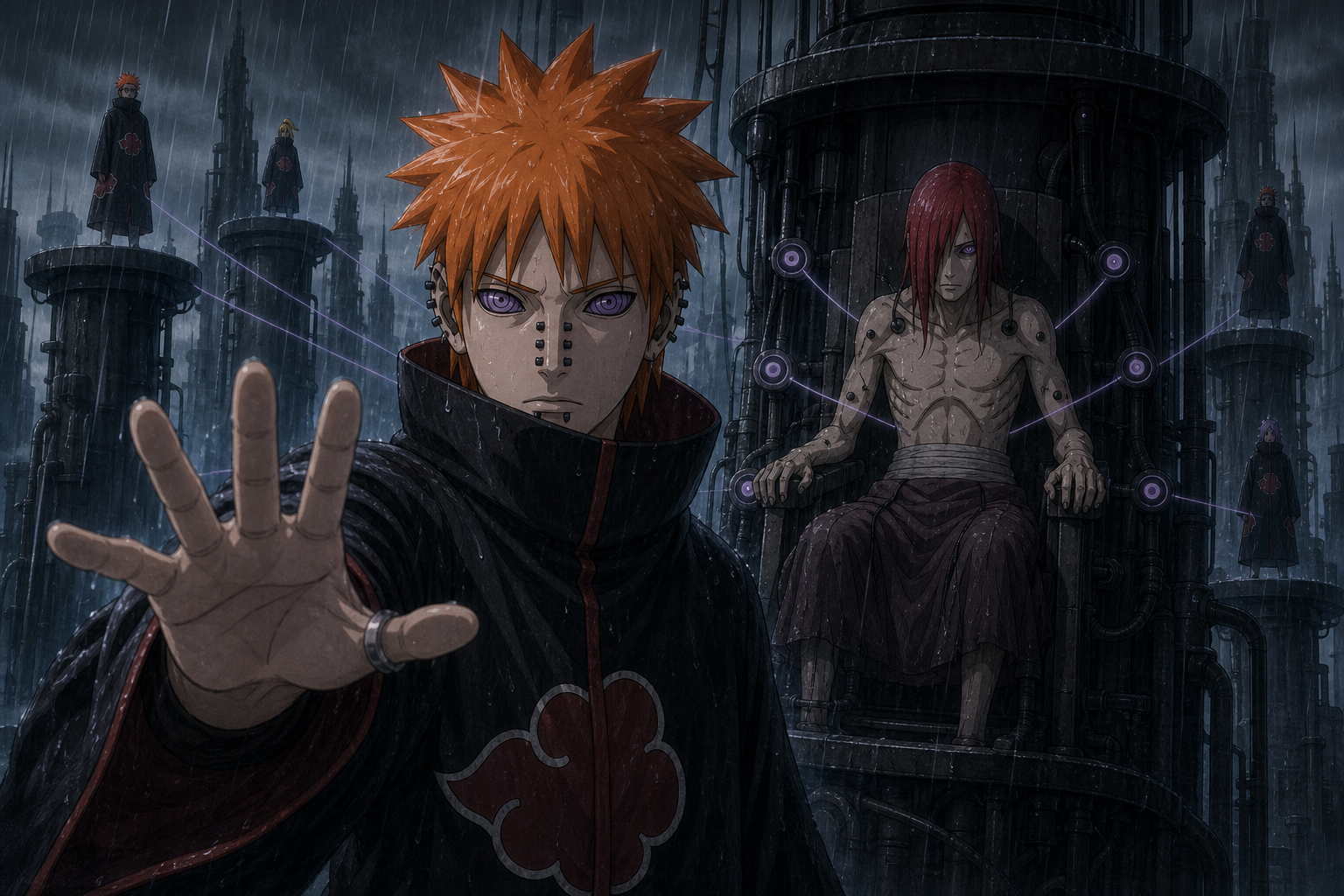
Pain is not one man. Pain is Nagato’s argument wearing six dead bodies. The orange-haired face most fans call Pain belongs to Yahiko, Nagato’s dead friend. Nagato preserves that body as the Deva Path, gives the corpse his Rinnegan vision through chakra receivers, and turns Yahiko’s appearance into the public leader of Akatsuki. Five other corpses complete the network. Nagato remains hidden, physically damaged and connected to all six.
The system is tactically brilliant and emotionally horrifying. Nagato converts grief into infrastructure. He says the world will learn peace after experiencing unbearable pain, then builds a machine that lets him distribute pain without standing beside the people receiving it. His story never asks us to pretend the diagnosis is stupid. Small nations really are crushed between larger powers. Amegakure really does become a battlefield for other countries. Konoha shinobi really do kill Nagato’s parents. Hanzo and Danzō really do destroy Yahiko’s movement. The diagnosis has receipts. The prescription is mass murder.
Pain and Nagato Essential File
Nagato. Nagato is an Amegakure war orphan, member of the Uzumaki clan, student of Jiraiya, founding member of the original Akatsuki, wielder of the Rinnegan, controller of the Six Paths of Pain and later an Edo Tensei combatant. His birthday is September 19. Pain. Pain is the identity Nagato projects through six corpses. Each Path receives one major branch of the Rinnegan’s power and shares vision with the others. The Deva Path uses Yahiko’s body and functions as the public face.
Debut boundary. The manga introduces the Akatsuki leader’s presence before revealing the system. Pain’s formal on-page identity emerges during the Jiraiya and Amegakure material, while Nagato’s living body and complete history arrive later. A profile should not treat the first orange-haired appearance as proof that Yahiko came back to life. Original Japanese performances. Ken’yū Horiuchi performs Pain and the adult Nagato presentation in the original Japanese anime. Junpei Morita performs Yahiko as a living young man. Tomoaki Maeno performs younger Nagato. These credits follow different identities and ages inside one story, not a dub comparison.
A Child Born Where Great Nations Hold Their Fights
Nagato grows up in Amegakure during war. The Hidden Rain sits between larger military powers, which means other villages use its land as transit route, battlefield and casualty bin. Konoha shinobi enter his home and kill his parents after mistaking them for hostile combatants. The soldiers realize the error too late. Nagato’s Rinnegan power erupts and kills them.
This is the macro argument of his whole life in miniature. A great village calls its operation necessary. A family in the smaller country loses everything. The official report may record a mistake. The child receives bodies. The Rinnegan Is Power Before He Has Language for Power. Nagato possesses Madara’s transplanted Rinnegan without knowing the full manipulation behind that inheritance. The eyes give him access to extraordinary abilities, but childhood does not arrive with an instruction manual.
Power appears during terror and grief. That association matters. Nagato learns that overwhelming force can stop immediate danger when human institutions fail. Later, Obito and Black Zetsu exploit the eye’s history and Nagato’s trauma. The Rinnegan makes him strategically valuable long before he understands whose plan placed him on the board. Yahiko and Konan Create a Family. Yahiko and Konan meet Nagato as fellow war orphans. They steal food, survive rain and create a family from shared need. Yahiko supplies outward direction. He believes Amegakure can become strong enough to stop being trampled. Konan supplies care, practical judgment and creative discipline. Nagato carries terrifying power and a desperate desire to protect both.
The trio is not important because destiny gathered three special children. They become important because children abandoned by every formal structure build mutual obligation themselves. Jiraiya Teaches Them to Survive. After the Second Shinobi World War, Jiraiya stays behind to train the three orphans. Jiraiya teaches ninjutsu, provides food and gives them a language for peace.
He interprets Nagato’s Rinnegan through prophecy and hopes the boy may change the world. That hope helps Nagato imagine a purpose larger than survival. Jiraiya also leaves. The children become capable, but mentorship has a geographic limit. The teacher returns to Konoha. The students remain inside the political conditions that produced them.
The Original Akatsuki Was a Peace Movement
Yahiko leads the first Akatsuki as an Amegakure organization seeking peace without domination by the great nations. The red clouds later worn by international criminals begin in a different moral ecosystem. The movement gains support because people recognize the problem. A small country needs power to negotiate. Good intentions do not make the organization harmless, but the founding goal is not tailed-beast extraction. History gets rewritten after Yahiko’s death. Nagato keeps the name while changing the method. The brand survives. The politics mutate.
Hanzo and Danzō Turn Peace Into a Hostage Scene
Hanzo fears Akatsuki’s influence. Danzō helps frame the organization as a threat. Konan becomes a hostage, and Yahiko is forced toward a choice designed to destroy the trio regardless of outcome. Yahiko takes Nagato’s weapon into his own body and dies. The act saves Konan in the immediate moment while shattering Nagato’s belief that cooperation can defeat entrenched power.
Nagato summons the Demonic Statue, kills attackers and suffers severe bodily damage. The lesson he accepts is not merely that Hanzo is cruel. He decides hope itself was naive. Yahiko’s Body Becomes the Deva Path. Nagato preserves Yahiko’s corpse and turns it into the Deva Path. The decision is grief, strategy and theft at once.
Yahiko remains the face because people followed him. Nagato hides because distance protects the controller. The dead friend becomes a leader who can never disagree with the new program. This is not resurrection. Yahiko’s personality does not return. Nagato supplies movement, voice, chakra and orders. The body functions as icon and weapon. Konan Stays Beside Nagato. Konan becomes Pain’s messenger and Amegakure’s “Angel.” She understands the controller behind the public god and protects Nagato’s hidden body. Her loyalty grows from shared history, grief and continued belief in what Yahiko wanted. Loyalty does not make every later decision healthy. Konan helps operate an organization that commits enormous harm. After Naruto changes Nagato’s final decision, Konan entrusts their hope to Naruto. She does not erase the past. She changes whom she believes can carry the future.
The Six Paths Are a Surveillance and Weapons Network
Each corpse carries chakra receivers and receives Nagato’s Rinnegan vision. Shared sight lets the Paths cover blind spots, coordinate attacks and react as one distributed system. The setup reduces individual uncertainty. A corpse does not panic, question policy or protect a private family. Nagato centralizes judgment while distributing physical risk. That is why the design is political, not merely cool. Pain imagines peace through centralized terror. The body network makes the ideology visible. The Deva Path. The Deva Path controls attractive and repulsive forces. Almighty Push drives targets away. Universal Pull drags them close. Planetary Devastation creates a gravitational core that gathers surrounding matter. Large-scale use requires recovery time and enormous chakra. The attack that destroys Konoha leaves a window Naruto later exploits. Yahiko’s face turns the most authoritative Path into a permanent speech from a dead revolutionary.
The Asura Path. The Asura Path transforms its corpse body into a mechanized weapons platform. Extra limbs, blades, armor and projectiles turn human anatomy into modular equipment. The body appears less human as firepower increases. Nagato’s system does not preserve identity. That choice preserves utility. The Human Path. The Human Path can read minds and extract souls through direct contact. Intelligence gathering and execution become one gesture. The technique turns private memory into seized property. Pain’s peace requires no consent because the system assumes security outranks personhood.
The Animal Path. The Animal Path summons multiple creatures, many marked with chakra receivers and Rinnegan eyes. The summons expand surveillance, mobility and battlefield pressure. Jiraiya recognizes one body as a shinobi he encountered in life, helping expose the corpse-based secret. A familiar face becomes evidence against the god performance. The Preta Path. The Preta Path absorbs chakra-based attacks. Against ordinary ninjutsu, the ability can make direct offense disappear. Natural energy creates a danger the Path cannot safely process without balance. Naruto uses that limit during the Konoha battle. Absorption is powerful, not universal.
The Naraka Path. The Naraka Path summons the King of Hell for interrogation and restoration. That choice can repair damaged Paths, making the network harder to dismantle permanently. Repair infrastructure changes combat priorities. Naruto targets the restoration Path because defeating other bodies means little if the system keeps putting them back into service. The Outer Path and Nagato’s Own Body. Nagato controls the Paths, summons the Demonic Statue and can use the Outer Path’s life-and-death techniques. Black chakra receivers transmit his will. His own body pays. Connection to the statue leaves him emaciated and dependent on mechanical support. Remote power protects him from direct combat while consuming the person behind the network.
Pain looks invincible because Nagato hides the hospital bed underneath the god. Taking Amegakure From Hanzo. Nagato eventually kills Hanzo and dismantles his regime. The revenge includes violence against Hanzo’s associates and connected families. A dictator falls, but collective punishment replaces justice. Amegakure citizens come to worship Pain as a god. Constant rain supports surveillance and creates an atmosphere where governance, security and divine performance blur. Nagato gives the village order. He does not give it democratic agency.
Akatsuki Becomes an Extraction Machine. Under Pain’s public leadership and Obito’s hidden manipulation, Akatsuki hunts jinchūriki and extracts tailed beasts. The organization plans to monopolize catastrophic force and make nations fear war. The theory resembles deterrence: deliver pain so large that nobody risks repetition. The victims are people such as Gaara, Yugito, Roshi and others whose bodies hold the weapons being collected.
Nagato says he wants the world to understand pain. His method requires choosing whose pain counts as tuition. Jiraiya Returns to Amegakure. Jiraiya infiltrates the Rain and confronts Konan and the Paths. He recognizes the Rinnegan and believes Nagato stands before him, but the bodies do not match the child he taught. Jiraiya fights through summons, shared vision and multiple abilities long enough to identify the secret: the real one is not among them. Pain kills his former teacher. Nagato frames the act as necessary while using Jiraiya’s own student network to prove that hope failed. Jiraiya uses his last strength to send Konoha the clue that later helps defeat the system.
The Assault on Konoha
Pain invades Konoha to capture Naruto. The Paths interrogate, kill defenders and tear through the village while Konan participates in the operation. Nagato questions Tsunade about great-nation hypocrisy. He is right that Konoha benefited from wars that devastated smaller countries. Then he destroys homes and kills civilians who did not write those policies. Collective guilt is doing the work of revenge. Almighty Push Destroys the Village. The Deva Path rises above Konoha and uses a massive Almighty Push. Buildings collapse into a crater. Pain turns a political argument into urban annihilation.
Tsunade and Katsuyu protect many lives, but the physical and psychological destruction is enormous. Kakashi and other defenders die during the wider attack. The spectacle makes Pain’s claim visible: he wants Konoha to feel what Amegakure felt. Reproduction of trauma becomes his evidence of justice. Naruto Returns as Jiraiya’s Answer. Naruto arrives in Sage Mode with the toads and a plan shaped by intelligence gathered at terrible cost. He dismantles the Paths by reading cooldowns, targeting restoration and using natural energy. The battle is not merely stronger student beats stronger student. Naruto inherits Jiraiya’s refusal to give up on people while Nagato inherits Jiraiya’s peace question and answers through coercion.
Both are war orphans created by village systems. Their similarity is why the confrontation matters. Hinata, Rage and the Nine-Tails. When the Deva Path pins Naruto down, Hinata intervenes. Pain strikes her, and Naruto’s rage releases the Nine-Tails’ chakra. Nagato treats the eruption as proof that pain creates hatred. He is not wrong about the mechanism. He is the person deliberately activating it. Minato intervenes within Naruto’s seal, allowing Naruto to recover and choose another response. The cycle is not broken because anger disappears. The cycle is interrupted because anger does not receive final authority.
Naruto Finds Nagato
After defeating the Deva Path, Naruto tracks the chakra receivers to Nagato’s real body. He arrives angry enough to kill and chooses to listen first. Nagato tells the story of his parents, Yahiko and the collapse of the original Akatsuki. Naruto does not offer a detailed peace policy. He admits he does not yet know the answer and refuses to abandon the search. That honesty reaches Nagato because Naruto carries Jiraiya’s book, name and stubbornness without claiming painless certainty.
Rinne Rebirth and the Cost of Reversal
Nagato uses the Outer Path: Samsara of Heavenly Life Technique to restore people killed during the Konoha assault. The act consumes his remaining life. The revival does not rebuild houses, erase terror or resurrect Jiraiya. Nagato can reverse many immediate deaths from his attack. He cannot make the attack unhappen. His final choice is meaningful because he stops defending the machine and spends his life restoring victims. The choice is not a receipt proving every prior murder has vanished. Obito Takes the Rinnegan. After Nagato’s death, Konan protects his body and eyes. Obito comes to claim the Rinnegan, revealing how Nagato’s supposed divine power remained embedded in another person’s plan.
Konan dies resisting him. One eye is taken for Obito’s war strategy. Nagato’s body becomes contested equipment again. The cycle he tried to control keeps treating people as containers for useful power. Edo Tensei and the Meeting With Naruto Again. Kabuto reanimates Nagato during the Fourth Shinobi World War alongside Itachi. Edo Tensei restores a more mobile body and places him under command. Nagato demonstrates multiple Rinnegan abilities directly, including absorption, summons and soul extraction. He threatens Naruto and Killer Bee while lacking control over his actions. Itachi breaks free of control and seals Nagato. Their exchange gives Nagato a final moment of trust in Naruto without pretending reanimation is a new life.
Power and Limitation Shelf
Shared vision. The Paths eliminate many blind spots, but smoke, barriers, separation and destruction of individual bodies can disrupt coordination. Chakra receivers. Black rods transmit chakra and control. They also provide investigators a physical clue leading back to Nagato.
Rinnegan paths. Gravity, mechanization, soul extraction, summoning, absorption, restoration and Outer Path control create enormous range. Dividing abilities across bodies makes roles predictable once the secret is known. Chibaku Tensei. Planetary Devastation captures targets through a gravitational core. Sufficient power can attack the core or break confinement.
Rinne Rebirth. The technique restores lives at extreme cost. Nagato’s depleted condition turns its use into a fatal final act. Distance and chakra. Remote control gives safety but depends on range, connection and Nagato’s body. Large techniques drain him and create timing windows. What Nagato Cannot Do. Nagato cannot make Yahiko consent to becoming Pain. He cannot force grief to become justice. He cannot make every Konoha resident individually responsible for Amegakure’s suffering. He cannot revive Jiraiya with his final technique. He cannot use fear to create trust. Power lets him distribute consequences. Power does not make his political theory complete.
Design and Visual Language. Pain’s orange hair preserves Yahiko’s silhouette while piercings and Rinnegan eyes announce that the body belongs to a system. The black receivers resemble jewelry until their control function becomes clear. Nagato’s red hair and damaged body reveal the cost behind the god. The public figure stands upright above a village. The controller sits hidden in machinery.
Rain gives Amegakure grief, surveillance and continuity. Pain appears to rule the weather because Nagato wants private suffering to become public climate. Original Japanese Performance. Ken’yū Horiuchi performs Pain and adult Nagato in the original Japanese anime. Junpei Morita performs living Yahiko, while Tomoaki Maeno performs younger Nagato. The casting map helps separate corpse identity, public persona and life stage. This profile records verified credits and dramatic contexts without inventing technical vocal analysis from an unavailable lawful rewatch. Manga, Anime, Games and Canon Boundaries. The manga establishes Nagato’s childhood, Yahiko and Konan, Jiraiya’s training, Hanzo’s trap, the Six Paths system, Konoha assault, Naruto’s confrontation, Rinne Rebirth and war reanimation. The anime expands selected childhood, Amegakure and battle material.
Games often combine every Path into one playable move set or let Nagato fight with fewer physical limits. Those choices serve gameplay. They do not automatically rewrite manga chronology or body condition. No movie appearance replaces the central canon. Alternate scenarios belong in their own shelf.
Political Violence and the Small-Nation Problem
Nagato’s strongest argument is that great nations call their own violence security while calling small-nation retaliation terrorism. Amegakure’s ruins support him. His failure is treating replicated suffering as structural reform. Destroying Konoha does not create accountable institutions, redistribute power or protect the next Rain child. Pain teaches empathy through terror. Terror teaches fear first. Confucian Duty and Betrayed Relationships. Jiraiya accepts responsibility as teacher, but distance leaves his students without protection against Hanzo and Danzō. Nagato inherits Yahiko’s name while betraying Yahiko’s method. Konan supports Nagato while carrying her own duty to the dead friend.
Naruto answers through a different transmission. He inherits Jiraiya’s question without obeying every conclusion. Respect for a teacher does not require repeating a teacher’s failures. Buddhist Pain, Attachment and Release. Nagato understands suffering but remains attached to controlling what suffering means. He turns Yahiko’s body into doctrine, the Rinnegan into authority and his own grief into a universal curriculum.
Release begins when he accepts that Naruto may continue the search without Nagato controlling the outcome. Rinne Rebirth becomes an act of relinquishment rather than possession. He cannot release the past by making everybody reenact it.
Fandom Misreadings
“Pain and Nagato are separate people.”. Pain is Nagato’s corpse network and projected identity. Yahiko’s body is the Deva Path, not a resurrected Yahiko. “Naruto talked him out of everything in five minutes.”. The confrontation rests on shared teacher, shared orphanhood, Jiraiya’s book, Nagato’s exhausted body and the collapse of his claimed certainty. “Rinne Rebirth erased the invasion.”. Lives return. Destruction, fear, Jiraiya’s death and political consequences remain. “Nagato was completely controlled by Obito.”. Obito manipulates conditions and plans. Nagato still makes consequential choices and bears responsibility.
“Pain was right, so the massacre was justified.”. A correct diagnosis of imperial violence does not justify collective punishment. “Yahiko wanted this version of Akatsuki.”. Nagato preserves Yahiko’s body and name while reversing the original movement’s method. Essential Reading and Viewing Path. Begin with the Rain orphan flashbacks and Jiraiya’s training. Continue through the original Akatsuki, Hanzo’s trap, Yahiko’s death and the emergence of Pain. Read Jiraiya’s infiltration and coded final message, then the complete Konoha assault, Naruto’s Sage battle, Hinata intervention, Nine-Tails eruption, Nagato conversation and Rinne Rebirth. Finish with Konan’s defense of his body and Nagato’s Edo Tensei encounter with Naruto, Bee and Itachi.
Consequence Ledger
Konoha shinobi kill Nagato’s parents. War orphans build a family. Jiraiya teaches them and leaves. Hanzo and Danzō destroy the original movement. Yahiko dies. Nagato turns corpses into Paths, kills Hanzo, militarizes Akatsuki, kills Jiraiya and destroys Konoha. Naruto refuses revenge, and Nagato restores many victims at the cost of his life. Konan dies protecting the future they entrusted to Naruto. Obito takes the Rinnegan. Amegakure survives without the god who ruled it.
Why Pain and Nagato Matter
Pain matters because Naruto gives its hero an enemy whose grievance cannot be dismissed as nonsense. Nagato is what happens when a victim gains enough power to make private suffering into public policy. Yahiko’s corpse gives that policy a beloved face. The Six Paths give it administrative reach. The Rinnegan gives it divine branding.
Naruto does not defeat the argument by proving pain unreal. He defeats the conclusion that pain must choose the future. Nagato built six bodies so the world would feel what happened to one child. His final human act is giving the bodies back.
Yahiko’s face is not Nagato’s permission slip
Nagato does not simply carry Yahiko’s memory. He makes Yahiko’s corpse perform agreement forever. That distinction is ugly, and the story needs it to stay ugly. The Deva Path can deliver speeches in Yahiko’s voice and silhouette, but it cannot tell us what the living Yahiko would have accepted after the hostage trap. Nagato removes that uncertainty by removing consent.
The choice explains why Pain feels persuasive even when the policy is monstrous. Yahiko’s face carries the credibility of the original peace movement. Amegakure remembers the young leader who wanted the village to stop serving as somebody else’s battlefield. Nagato takes that trust, straps chakra receivers into it, and uses the body to authorize a program Yahiko never designed. The dead friend becomes branding for the survivor’s despair.
Grief can explain the need to keep Yahiko close. It cannot make the body neutral. Nagato loves him, mourns him, and turns him into equipment in the same decision. Naruto repeatedly asks what happens when love becomes possession, and Pain gives the question a corpse with perfect posture.
Peace built on hostages keeps needing hostages
Hanzo and Danzō break the original Akatsuki with a hostage scene. Nagato answers by building a political theory that holds the whole world hostage. His tailed-beast plan promises that nations will avoid war because one concentrated weapon can punish everybody. That is not mutual understanding. It is the hostage trap scaled until no village can leave the room.
The Six Paths make that logic efficient. One body interrogates. One absorbs resistance. One repairs the others. One summons more force. The Deva Path announces the sentence from above. Nagato turns his worst day into an administrative system where he controls every role and nobody else gets a meaningful vote.
That is also why Naruto’s refusal matters more than a tidy speech about forgiveness. Naruto has the power to kill the exhausted man in front of him and the grievance to justify it to himself. He stops before repeating Nagato’s design. Listening does not excuse the invasion. It prevents Nagato from choosing Naruto’s next act for him.
Rinne Rebirth is repair, not an eraser
Nagato’s final technique restores lives, and that is enormous. It still does not convert the assault into a harmless lesson. Families experienced death. Konoha became a crater. Jiraiya remains dead. Konan must live with what she helped operate. Amegakure loses the ruler who had made himself its god without gaining a clear civic future in return.
Redemption is often flattened into a fandom receipt: he brought people back, so the account is settled. No. Rinne Rebirth is meaningful because Nagato finally spends power on people who cannot repay him and accepts that somebody else will carry the peace question. It is a reversal of direction, not a deletion of consequence.
That makes his ending stronger, not weaker. Nagato does not become secretly innocent. He recognizes that certainty turned his grief into policy and chooses one last act of repair. Naruto accepts the responsibility without pretending he has solved geopolitics before dinner. Hope survives because neither answer arrives polished.
Sources and canon boundary
Manga chronology controls this profile. Anime expansions, databook material, novels, games, films, and Edo Tensei staging are identified instead of being blended into one false continuity.
Primary franchise references: Naruto Official and VIZ Media Naruto. CVM Sekai’s conclusions about Yahiko’s body, Nagato’s political argument, the Six Paths, collective punishment, Rinne Rebirth, consent, and accountability are editorial analysis, not invented creator quotations.