
RaeRae Reviews: One Piece Film Strong World
Bottom line
Strong World is where the One Piece movie line stops asking permission to feel important. The tenth film brings all nine pre-timeskip Straw Hats together, gives Nami a crisis that depends on her actual expertise, introduces Golden Lion Shiki as a threat with history beyond the theater, and lets the crew walk into the final battle dressed like organized trouble.
Released in Japan on December 12, 2009, the film benefits from Eiichiro Oda serving as executive producer. That involvement does not make every event fit manga continuity, but the characters, world logic, designs, and emotional priorities feel connected to the larger series in a way several earlier films only approximated.
What happens in Strong World
News that East Blue faces a serious threat sends the Straw Hats toward home. Golden Lion Shiki intercepts them, recognizes Nami’s weather knowledge, abducts her, and scatters the rest of the crew across the floating islands of Merveille.
The islands contain animals altered through Shiki’s experiments and communities forced to live under his plans. Nami appears to join him while secretly working against his timetable. The crew reunites, reads her decision correctly, and attacks the palace before Shiki can unleash engineered devastation.
Shiki arrives with real historical weight
Shiki was a rival from the era of Gol D. Roger and Whitebeard. He escaped Impel Down by cutting off his own legs, replaced them with swords, and used the Float-Float Fruit to move ships, structures, weapons, and islands.
That history makes his theatrical scale believable. The film does not invent a random local villain who somehow commands a global fleet. Shiki belongs to the world’s older pirate generation, even though the specific Merveille conflict remains outside the manga’s main sequence.
Nami is kidnapped because she is brilliant
Shiki takes Nami after seeing her predict a cyclone. Her captivity begins with professional recognition weaponized into coercion. He wants her knowledge because weather controls the survival of floating islands and the timing of his attack.
The distinction matters. Nami is not selected as generic leverage against Luffy. Shiki needs labor only she can provide, then mistakes forced participation for allegiance. Her competence creates the danger and the route out.
The apparent betrayal never becomes cheap
Nami records a message and asks to join Shiki, knowing the crew will hear more than the literal words. She chooses the version of surrender most likely to protect them while preserving a chance to sabotage the plan.
The movie trusts the crew’s knowledge of her. Suspicion does not become a full manufactured subplot. They are angry about her isolation, not convinced that one frightened message erased years of shared choices.
Luffy hears the message badly before he hears Nami
Luffy’s first response centers the words that hurt him. He treats the recording as a challenge to loyalty before understanding the tactical decision underneath. His anger exposes a weakness without destroying the relationship.
Leadership requires knowing when a crewmate’s apparent rejection is actually a request for help. Luffy catches up because the bond has evidence. He does not need Nami to perform helplessness before he accepts that coercion shaped the message.
Merveille turns evolution into policy
Shiki’s animals have been altered by the IQ plant and forced into accelerated competition. Their exaggerated bodies create exciting spectacle, but the island ecology also exposes his governing philosophy.
He calls ruthless selection natural while engineering the conditions, choosing the subjects, and reserving control for himself. “Survival of the fittest” becomes propaganda spoken by the person who designed the cage.
Doctor Indigo makes science serve spectacle
Indigo develops the biological tools that support Shiki’s plan. His clownish movement and sound effects make him ridiculous without making the research harmless.
The film understands that cruelty can arrive through laboratories staffed by people who enjoy the performance. Technical ability does not create moral distance from the results. Indigo knows who will suffer and keeps polishing the presentation.
Scarlet turns brute force into a running joke
Scarlet serves as Shiki’s animal commander and physical enforcer. His attraction to Robin creates comedy built around a creature performing courtship while everybody else recognizes the danger and nonsense.
The joke works best when Robin controls the reaction. She does not become a passive prize inside an animal gag. Her calm refusal preserves her authority while Franky finds several opportunities to become loudly offended.
Every Straw Hat gets a job
Strong World has nine crewmates and gives each one a readable function. Zoro clears combat routes. Sanji handles speed and protection. Usopp improvises at range. Chopper reads the altered animals. Robin studies the island. Franky supplies machinery. Brook adds mobility and sword work. Nami controls the weather problem. Luffy makes the final call.
The film sometimes assigns brief showcase moments instead of full arcs, but nobody feels accidentally shipped with the luggage.
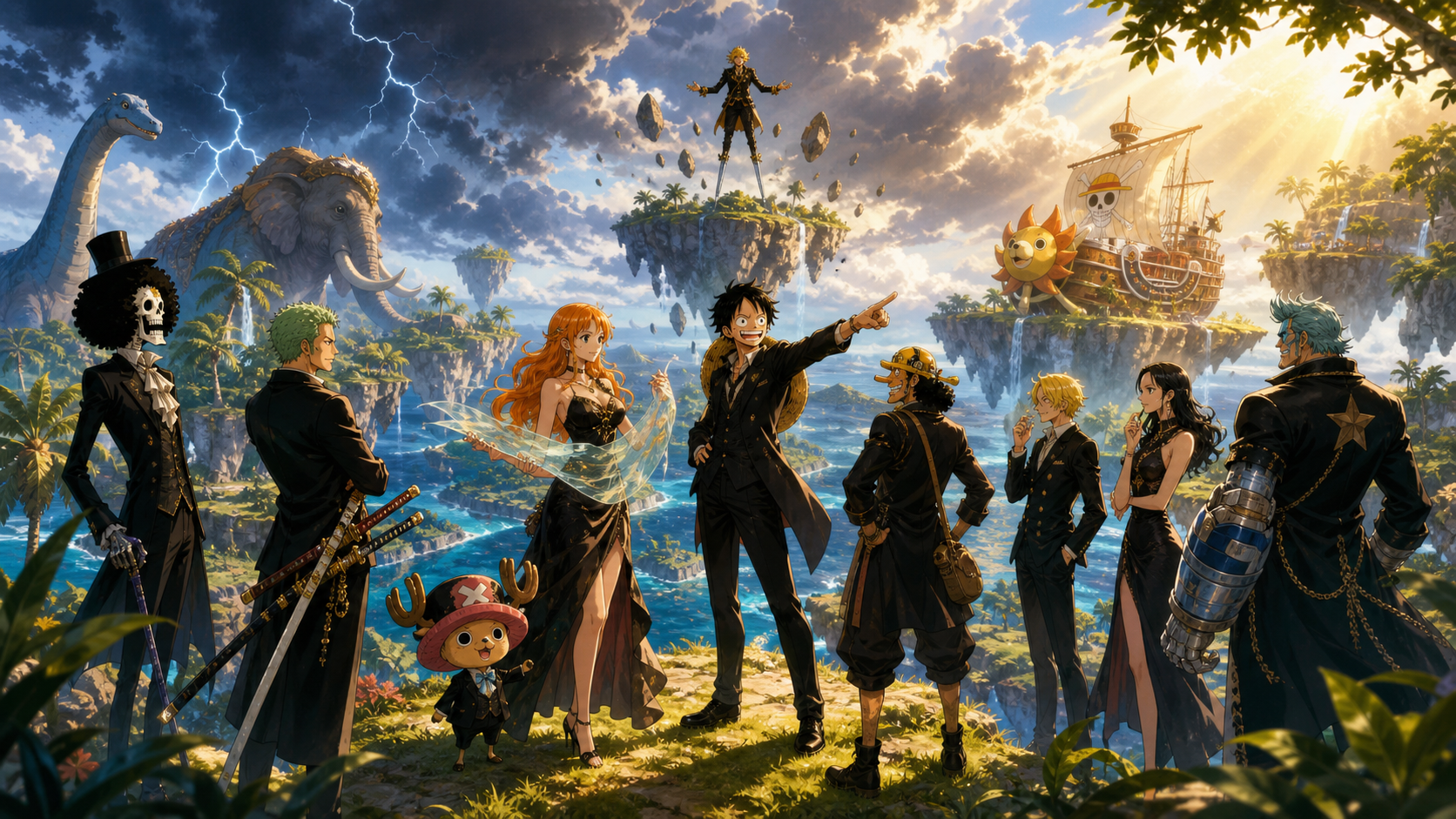
The black formalwear is visual storytelling
The coordinated attack outfits turn the crew into a deliberate unit before a word is spoken. Black suits, dresses, coats, weapons, and restrained accents replace their usual individual color chaos.
Uniformity does not erase personality. Each design translates the same mission through a different body and attitude. The entrance says the rescue phase is over. The people who scattered across Merveille have arrived together.
The palace assault earns theatrical scale
The Straw Hats do not sneak politely into Shiki’s operation. They interrupt the gathering with gunfire, explosions, collapsing architecture, and the confidence of people who already decided the villain’s schedule no longer matters.
The sequence works because the movie spent time separating them. Reunion changes the energy from survival to coordinated refusal. Scale arrives through relationships, not only debris.
Shiki’s Float-Float Fruit creates excellent geography
Floating islands allow battlefields to move vertically and horizontally. Land becomes a weapon, escape route, cage, and proof of Shiki’s reach. The power also explains why conventional navies struggle to contain him.
Nami’s weather reading becomes essential because elevation changes wind, pressure, and storms. The movie links villain mechanics to crew expertise instead of handing Luffy an isolated punching problem.
Luffy’s storm attack needs Nami’s sky
The final lightning-assisted blow succeeds because weather and rubber interact within a battlefield Nami understands. Luffy delivers force, but the environment is not neutral decoration.
That collaboration protects the ending from becoming a solo correction. Nami’s stolen labor, hidden sabotage, forecast, and trust all remain active inside the punch that ends Shiki’s control.
East Blue gives the threat emotional direction
The crew’s original homes make Shiki’s plan personal. East Blue is called weak by people who measure worth through conquest, yet the region produced the relationships and dreams carrying the Thousand Sunny.
Defending home does not require pretending every childhood was safe. Nami, Sanji, Usopp, Zoro, and Luffy each left difficult histories behind. Origin still creates responsibility when a powerful man decides “weak” means disposable.
Oda’s production role changes the movie
Official ONE PIECE.com records Eiichiro Oda as executive producer. His involvement extended to the story, designs, and production direction associated with the film and its Episode 0 material.
The result is not automatically perfect or fully canonical. The result feels authored around established values rather than assembled from franchise parts. Shiki’s history, crew behavior, animal designs, fashion, and East Blue stakes share one logic.
Episode 0 belongs beside the review
Strong World Episode 0 adapts material connected to the promotional Volume 0 and shows Shiki’s history around Roger’s era, the Edd War, and his escape. The prequel provides context that the feature can only summarize.
Watch Episode 0 before or after the film if available through an official release. The short does not turn Merveille into required manga canon. The short clarifies why the world once treated Shiki as a name equal to monsters.
Direction, animation, and music
Munehisa Sakai directs with an emphasis on clean group staging, creature scale, airborne geography, and sharp shifts between comedy and threat. The animation gives clothing, weather, animal movement, and collapsing terrain enough weight to justify the screen.
Kohei Tanaka and Shiro Hamaguchi’s franchise sound remains connected to the television identity while the film uses broader orchestral force. Mr. Children performs the theme song “fanfare,” giving the ending a celebratory release.
Japanese performances
Akemi Okamura gives Nami control under fear. Her performance keeps the recorded surrender from sounding emotionally simple. Mayumi Tanaka lets Luffy misread the message, become furious, and then act with a clarity that does not require a long apology speech.
Naoto Takenaka makes Shiki theatrical, amused, and genuinely dangerous. The regular cast sounds unusually unified across the nine-member crew, especially during the transition from scattered island pairs to the palace assault.
Continuity and watch order
Shiki exists in manga continuity, and Strong World draws on Oda-created history. The Merveille adventure does not fit cleanly into the numbered story. Brook is present, the crew remains pre-timeskip, and surrounding canonical events leave little room for the film’s scale.
Watch after Thriller Bark and before the timeskip for character familiarity. Episode 0 adds historical context. Treat the movie as an Oda-supervised companion story, not a missing numbered arc.
What the movie gets right
Nami’s expertise drives the plot. Shiki has credible history and a power suited to theatrical geography. Every crewmate contributes. Merveille has its own ecology. The formalwear assault delivers style after the story earns unity.
The movie also understands that rescue should not erase the captured person’s choices. Nami works on the problem before the crew reaches her, and the finale depends on that work.
What keeps Strong World from perfect
The village residents receive less depth than the crew and Shiki. Several evolved animals function primarily as design showcases. Shiki’s long historical reputation occasionally makes his defeat feel easier than the legend suggests.
The story also uses Nami’s abduction to motivate a large male-led rescue spectacle, even while protecting her agency better than many franchise movies would. More time inside her strategy could make the balance stronger.
My read: I enjoy Strong World because Shiki feels large enough for a theatrical event without making the crew irrelevant. Nami’s coerced role, the floating-island ecology, and the formal clothes give the movie a memorable identity. I also think the story becomes weaker whenever Nami’s competence is treated as proof that villains have earned access to her labor. Her skill is not consent.
RaeRae’s verdict
Strong World earns nine out of ten. The film is big without becoming empty, stylish without forgetting character, and connected to One Piece history without requiring viewers to lie about canon placement. Nami is the reason the villain’s plan works and the reason the plan fails.
The palace entrance remains one of the cleanest crew statements in the franchise. Everybody looks expensive, everybody looks angry, and Shiki learns that abducting the navigator was less a victory than scheduling nine separate problems to arrive in matching black.
Official sources and routes
Toei Animation: official Strong World story
Toei Animation: official English work listing
ONE PIECE.com: Oda executive-producer record and film legacy
ONE PIECE.com: Strong World Episode 0
Browse One Piece anime movies
Return to the One Piece anime hub