
RaeRae Reviews: One Piece 3D Straw Hat Chase
Bottom line
Straw Hat Chase is a thirty-minute 3D experiment built around the one object guaranteed to make Luffy abandon every reasonable safety rule. His hat disappears, a giant eagle-dog carries the evidence, the crew launches every available vehicle, and an elderly pirate’s terrible attempt at a goodbye turns the chase into something sweeter than the technical showcase needed to be.
Released in Japan on March 19, 2011, the eleventh film played as part of the Jump Heroes Film double feature with Toriko 3D. The short runtime keeps the story simple. The computer animation remains uneven, but the film understands that Shanks’s hat is not wardrobe. The hat is a promise with a brim.
What happens
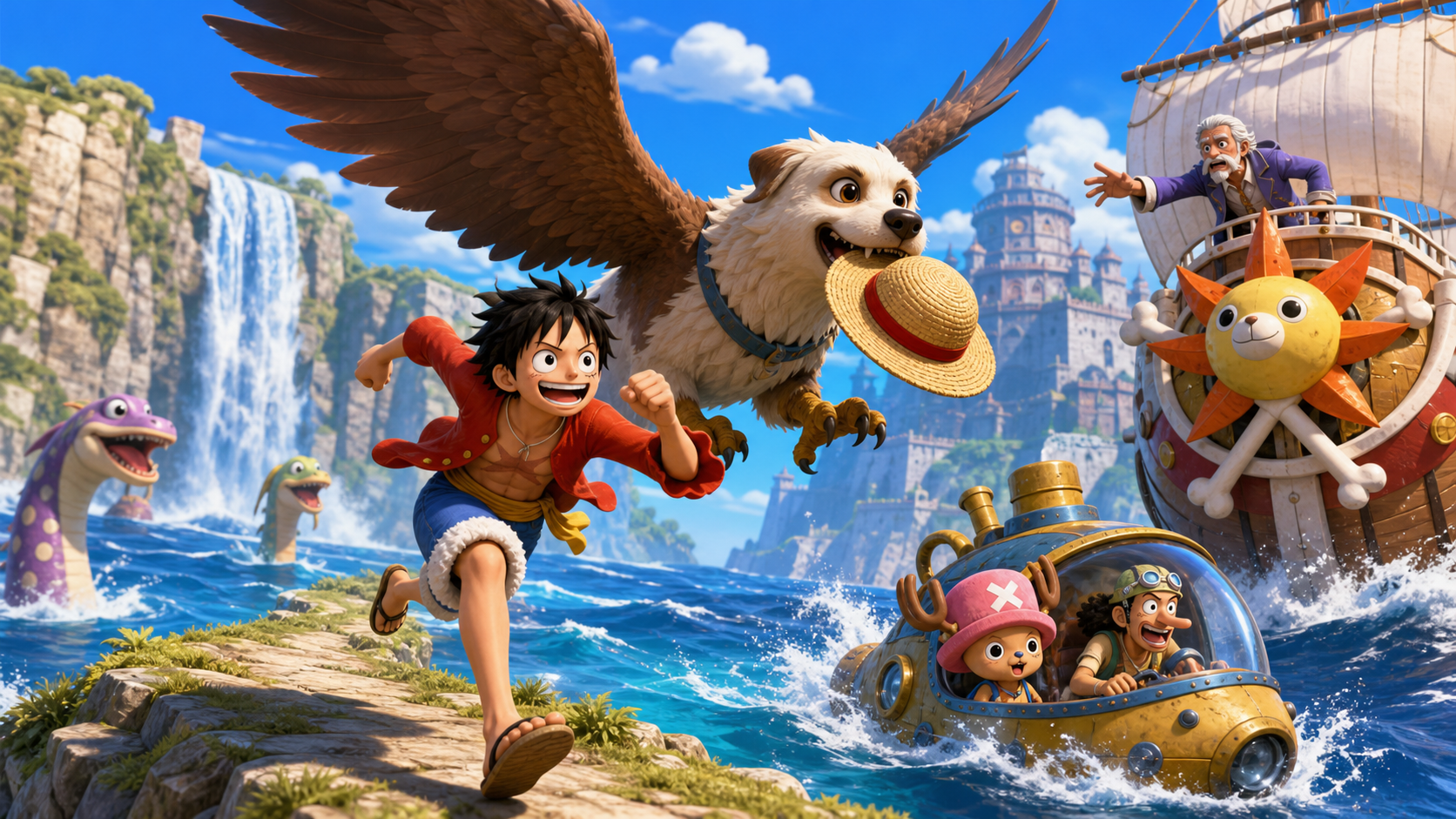
Luffy wakes aboard the Thousand Sunny and discovers his straw hat missing. Usopp remembers seeing a bird during the night, so the nine Straw Hats spread across the Sunny’s smaller vehicles and search the surrounding sea.
Usopp and Chopper find the sick elderly pirate Schneider on a drifting vessel. The crew then spots a giant eagle carrying Luffy’s hat. The chase crosses cliffs, waterfalls, Sea Kings, and a Marine base before the bird’s identity and Schneider’s reason for sending him away become clear.
The hat is Luffy’s first inherited responsibility
Shanks gave Luffy the straw hat with a condition: return the treasure when Luffy becomes a great pirate. The object connects childhood admiration to a future meeting and makes Luffy physically responsible for a promise.
Losing the hat feels worse than losing ordinary property because replacement is impossible. A new straw hat could block the sun. A new hat could not carry the same handoff, years, and unfinished return.
Luffy reacts before thinking
Luffy searches the Sunny, nearly throws himself into the sea, and turns the missing hat into a full emergency. The behavior is reckless and completely legible.
The crew does not debate whether the item is objectively valuable. They know what the hat means to their captain. Friendship begins the chase before anyone understands who took the treasure or why.
Every vehicle gets a theatrical lap
The Thousand Sunny’s soldier dock system lets different crew groups search by submarine, Mini Merry, waver, and ship. The movie uses those machines to demonstrate 3D depth and keep all nine members active inside a short plot.
The vehicle tour is promotional in the most honest sense. The filmmakers want audiences to watch familiar designs move toward and away from the screen. At least the demonstration serves the search rather than stopping the story for a catalog.
Buzz is a dog before he is a monster bird
Buzz ate a Bird-Bird Fruit model that allows him to become a giant eagle. His loyalty still behaves like a dog’s loyalty. He accepts Schneider’s impossible challenge because he believes success will preserve their life together.
The creature is not stealing from greed. Buzz is obeying the only person he has left and cannot understand that Schneider designed the task to push him away.
Schneider mistakes disappearance for mercy
Schneider believes he is dying and does not want Buzz to witness the death. Instead of sharing the truth, he orders his companion to steal Luffy’s hat, expecting the impossible assignment to keep Buzz away.
The choice is loving, cowardly, and unfair. Buzz receives rejection without context and spends his strength solving a problem that never needed to exist. Protecting somebody from grief by denying them a goodbye does not remove grief.
The fork punch line is ridiculous on purpose
Schneider’s bleeding and pain come from accidentally swallowing a fork, not a terminal illness. Chopper eventually identifies the cause, collapsing an elaborate death plan into digestive negligence.
The reveal is absurd, but the comedy exposes Schneider’s deeper mistake. He made a permanent relationship decision without seeking medical knowledge. A conversation and an examination could have saved everyone a Marine blockade.
Chopper is the person this story needs
Chopper treats Schneider while the rest of the crew follows the hat. His medical role separates perceived death from actual diagnosis and gives the elderly pirate information fear had replaced.
Chopper also understands nonhuman companionship. He can speak to Buzz and recognize a person inside a body humans may classify as an animal threat. The emotional and medical mysteries meet in one crewmate.
Usopp provides the first useful clue
Usopp saw the bird during the night and initially dismissed the sight. His memory gives the search direction once the loss becomes known.
The detail fits his place in the crew. Usopp notices strange things, doubts his own reading, then becomes essential when everybody else needs the observation. Courage and credibility remain ongoing negotiations for him.
The Marine base is an action obstacle, not a politics essay
The chase leads Luffy and Buzz into a Marine installation where seastone confinement and armed officers create a fast final barrier. The commander treats the hat as a tool for humiliating a pirate.
That choice guarantees escalation because he mistakes symbolic value for weakness. The base has little institutional depth, but a thirty-minute chase only needs the Marines to demonstrate how quickly authority becomes petty when somebody refuses submission.
Zoro cutting the cage raises continuity questions
The short gives Zoro a flashy rescue involving a seastone obstacle. The feat does not map neatly onto established canon mechanics, where seastone is exceptionally hard and suppresses Devil Fruit users.
The scene prioritizes three-dimensional spectacle and speed over power-system consistency. Enjoy the cut as movie action. Do not use the moment to calculate Zoro’s canonical material limits.
The 3D animation is the real experiment
Straw Hat Chase was the franchise’s first fully computer-animated theatrical film and was designed for stereoscopic presentation. Characters, ships, cliffs, projectiles, and chase routes repeatedly move through screen depth.
Some models look stiff in quiet close-ups, especially around mouths and cloth. Motion improves once the chase begins. The Sunny, Buzz, ocean routes, and large camera moves benefit more from the format than subtle facial acting.
The short runtime helps and hurts
Thirty minutes prevent the premise from becoming padded. Hat missing, bird spotted, old pirate found, chase launched, misunderstanding resolved. The film moves.
The same economy leaves Schneider and Buzz with only enough history to support one emotional turn. Their bond works because the idea is clear, not because the audience has lived with them for long.
Japanese performances
Mayumi Tanaka makes Luffy’s panic funny without trivializing the promise. Ikue Otani and Kappei Yamaguchi give Chopper and Usopp the film’s investigative warmth.
Tomomitsu Yamaguchi voices both Schneider and Buzz, linking the pair through performance even when one communicates through creature sounds. The regular nine-member cast keeps the chase lively despite limited individual dialogue.
Production credits and double-feature context
The Japanese Film Database credits Eiichiro Oda for the original work and Yasuyuki Tsutsumi for the screenplay. Toei Animation produced the short for the Jump Heroes Film pairing.
The double-feature context explains the length and technical emphasis. Straw Hat Chase is closer to a concentrated attraction than a full-scale successor to Strong World.
Continuity and watch order
The complete nine-member pre-timeskip crew appears aboard the Thousand Sunny. The story fits the general period after Brook joins and before the time skip, but the Marine and seastone details should not be treated as numbered canon.
Watch after Thriller Bark for the full crew and Sunny vehicles. No television episode depends on Schneider, Buzz, or the chase.
What works
The hat creates immediate stakes without inventing a world-ending weapon. Buzz has a sympathetic reason for taking the treasure. Chopper solves the medical misunderstanding. The short uses the Sunny’s equipment and 3D geography well.
The film also remembers that the crew does not need an explanation before helping Luffy recover something precious. They understand him first and gather facts during the chase.
What does not
The Marine material is generic, the seastone feat is sloppy, and several 3D faces look less expressive than their drawn counterparts. Schneider’s swallowed-fork diagnosis stretches cartoon logic even by One Piece standards.
Most supporting Straw Hats receive movement rather than meaningful character work. The format showcase wins several minutes that a longer Schneider-and-Buzz relationship could have used.
My read: I like Straw Hat Chase as a technical curiosity more than a major story. The missing hat gives Luffy an immediate emotional engine, and the short runtime keeps the search from becoming inflated. The 3D look will divide viewers. My bigger concern is whether movement still feels like these characters, and enough of the crew’s timing survives for the experiment to remain charming.
RaeRae’s verdict
Straw Hat Chase earns six and a half out of ten. The short is charming, fast, technically interesting, and aware that Luffy’s hat can carry an entire plot without another prophecy. Buzz is a good dog, even while shaped like an eagle large enough to ruin coastal insurance rates.
Do not expect Strong World scale. Expect a bright 3D sprint, one absurd medical reveal, and a reminder that asking the doctor before staging your own lonely death would save everybody a lot of fuel.
Official sources and routes
ONE PIECE.com: official Straw Hat Chase page
Japanese Film Database: story and production record
Toei Animation: Jump Heroes Film context
Browse One Piece anime movies
Return to the One Piece anime hub