
RaeRae Reviews: One Piece Film Red
Bottom line
One Piece Film Red gives the franchise a pop star who can end war by removing everybody’s ability to choose. Uta’s dream begins with a real wound: civilians suffer while pirates, Marines, and rulers keep deciding which bodies count as collateral. Her solution offers safety without consent, joy without grief, and a permanent concert nobody can leave.
Released in Japan on August 6, 2022, Film Red is part musical, part family tragedy, and part argument about parasocial love. Director Goro Taniguchi lets songs carry plot rather than decorate pauses. The result is emotionally ambitious, occasionally overcrowded, and willing to make Luffy’s childhood friend both victim and perpetrator.
What happens
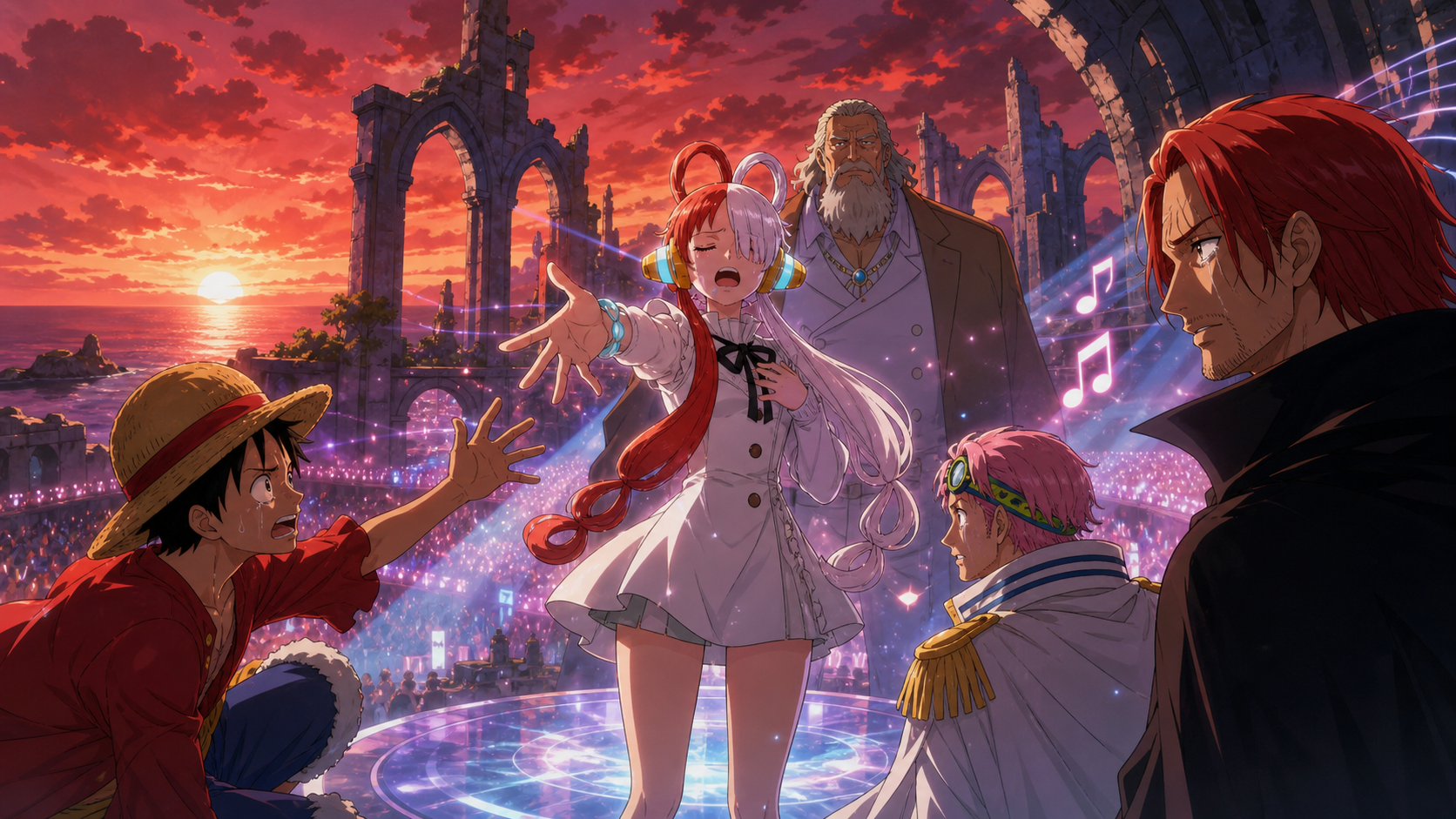
The Straw Hats travel to Elegia for Uta’s first live public concert. She reveals that Shanks is her father and recognizes Luffy from childhood in Foosha Village. Fans across the world join the broadcast, hoping her music can make suffering disappear.
Uta’s Sing-Sing Fruit pulls listeners’ consciousness into Uta World while their bodies sleep. She plans to keep everyone there forever. Wake-shrooms prevent her from sleeping and ending the effect, while the forbidden score Tot Musica threatens both the dream world and reality.
Uta is a child raised inside an edited memory
Uta remembers Shanks abandoning her after the destruction of Elegia. Gordon raises her among the ruins and allows the story that the Red-Haired Pirates caused the massacre to stand.
Adults make that choice to protect her from the truth, but protection built on a lie delays rather than prevents pain. Uta grows famous while constructing her identity around rejection and righteous anger.
Shanks takes blame instead of staying
Shanks claims responsibility for Elegia’s destruction so the world will not blame Uta for awakening Tot Musica. His decision protects a child from public punishment.
The same choice leaves her with abandonment, isolation, and no honest adult explanation. Taking the blame sounds noble until the protected person has to build a life inside the false story. Shanks saves her reputation and sacrifices their relationship.
Gordon confuses silence with care
Gordon remains on Elegia, raises Uta, and teaches her music. He carries guilt for the kingdom’s obsession with songs and for allowing Tot Musica to remain accessible.
His love is genuine. His secrecy is catastrophic. Gordon watches Uta build a worldwide mission around an inaccurate memory and waits too long to challenge the foundation. Adults cannot call silence protective after the lie starts directing somebody’s life.
Music gave Uta a route out of loneliness
Uta reaches people across oceans through broadcasts. Listeners respond because her voice acknowledges exhaustion, poverty, fear, and the wish for a world where ordinary people do not pay for powerful people’s conflicts.
The connection is not fake simply because the relationship is mediated. Fans hear something they need. Uta also receives affection that can feel endless, immediate, and safer than one difficult family conversation.
The New Genesis begins with a true complaint
Uta sees a pirate age full of raids, hunger, unstable governments, and civilian grief. Marines often defend order selectively, while pirates range from liberators to predators.
Her anger should not be dismissed as childish. The world has failed millions of people. The danger begins when she decides personal suffering gives her authority to define happiness for everyone.
Uta World removes consent from paradise
Inside the song-created world, food can appear, bodies can transform, and fans can remain near their idol. Material scarcity and physical danger seem solvable through imagination.
Listeners were not told that attending a concert meant surrendering their bodies forever. A paradise entered through deception is captivity, even when the prison serves unlimited meals and plays excellent music.
The fans become emotional evidence and hostages
Uta reads audience praise as proof that her plan is necessary. Negative reactions become confusion to correct rather than choices to respect.
That shift captures the ugliest side of parasocial power. A performer may know the audience’s messages, trends, and pain without knowing each person. Visibility at scale can feel like intimacy while making individual consent easier to ignore.
Wake-shrooms turn conviction into self-destruction
Uta eats wake-shrooms so she cannot fall asleep and release everyone from Uta World. The mushrooms also push her toward death and destabilize her judgment.
The choice is planned rather than accidental. She treats her own life as fuel for a permanent solution, which makes intervention harder because saving her threatens the world she has promised fans.
Luffy refuses to solve Uta with hatred
Luffy knows the child who competed with him, shared music, and loved Shanks. He also sees the adult trapping his crew and millions of listeners.
He resists her plan without reducing her to a monster. That distinction is central to the movie. Love does not require agreement, and opposition does not require pretending the person was never loved.
Their childhood rivalry gave both of them language
Young Luffy and Uta compete in games, argue about piracy, and use music and adventure to imagine their futures. Their rivalry lets two lonely children test identity without formal explanations.
Years later, the same language is strained by secrets. Luffy still recognizes the friend inside the performance persona. Uta recognizes the boy who kept moving toward a future she stopped believing reality could provide.
Shanks and Luffy fight on opposite sides of one wall
Tot Musica connects Uta World and the physical world. Luffy’s group attacks from inside while Shanks’s crew fights in reality. Observation Haki allows coordination across the divide.
The structure turns separated families into parallel action. Luffy and Shanks do not receive their long-awaited reunion, but they protect Uta through synchronized trust.
Tot Musica is pain performed without a listener
The Demon King of Songs emerges through a forbidden score and feeds on destructive emotion. The creature gives Uta’s internal collapse a body large enough for the movie’s climax.
The symbolism works better than the mechanics. Music normally connects singer and listener. Tot Musica converts music into domination, noise, and appetite, mirroring Uta’s movement from sharing a song to controlling everyone who hears one.
The Straw Hats become a concert rescue team
Every crew member contributes inside Uta World. Robin gathers information, Usopp links observation with Yasopp, Chopper supports frightened listeners, and the fighters create openings against Tot Musica.
The ensemble work helps prevent the movie from becoming only a triangle among Uta, Luffy, and Shanks. The Straw Hats protect strangers because freedom has to include people who once applauded the trap.
Usopp and Yasopp share sight before conversation
Father and son coordinate through advanced Observation Haki across the two worlds. The connection is tactically thrilling and emotionally uncomfortable.
A successful attack does not resolve Yasopp’s absence. Film Red offers proof of inherited ability and mutual awareness, not a substitute for accountability. Their unfinished relationship remains unfinished.
Koby speaks to the crowd as people
Koby organizes listeners, explains the situation, and asks them to act together. He does not treat Uta’s fans as stupid masses who deserve capture.
His leadership contrasts with both Uta and the World Government. Koby gives information and invites cooperation. Authority becomes credible because he preserves the public’s agency.
The Five Elders choose acceptable casualties
The World Government considers killing Uta and her gathered audience to prevent a larger catastrophe. Their arithmetic treats civilian deaths as a manageable cost.
That response strengthens Uta’s original criticism while proving her method cannot answer the problem. Both sides claim necessity. Both become willing to erase people who never consented to the plan.
Shanks’s Haki exposes cowardice at the top
Shanks uses overwhelming Haki to stop the Marines from escalating after Tot Musica falls. His presence forces powerful officers to calculate consequences they were ready to impose on civilians.
The scene is fan service with political weight. Government violence often advances when targets appear unable to retaliate. Shanks makes the cost visible.
Uta’s final song is a choice to care
After the immediate battle, Uta refuses medicine that would put her to sleep before she can release the trapped listeners. She sings again to return everyone to their bodies.
The decision reverses her earlier logic. She no longer spends other people’s freedom to preserve her dream. She spends her remaining strength to restore choices she stole.
The ending refuses a clean rescue
The film strongly implies Uta dies aboard Shanks’s ship, though the final images preserve some visual restraint. Her fate makes the conclusion painful rather than triumphant.
Death should not be mistaken for complete accountability or easy redemption. Uta causes enormous harm and then prevents worse harm. The tragedy comes from how many earlier chances adults had to tell the truth, stay present, and interrupt the collapse.
Ado’s voice makes the movie possible
Kaori Nazuka performs Uta’s spoken Japanese voice, while Ado supplies the singing voice. The separation allows conversation and music to carry different textures without making Uta feel like two unrelated people.
Ado moves through command, tenderness, rage, exhaustion, and desperation. The songs are story scenes, so vocal performance has to reveal decisions rather than merely sound impressive.
The seven-song structure
“New Genesis,” “I’m Invincible,” “Backlight,” “The World’s Continuation,” “Where the Wind Blows,” and the other featured songs map Uta’s changing emotional state. Different composers and arrangers give each stage a separate musical identity.
The variety risks making the film feel like connected music videos. The strongest transitions let a song change relationships or reveal the plan. The weakest pauses ask spectacle to carry information the screenplay should clarify.
Direction, screenplay, and visual identity
Goro Taniguchi, who previously directed the early One Piece special Defeat the Pirate Ganzack!, returns with a production built around performance spaces and emotional doubles. Tsutomu Kuroiwa’s screenplay connects Uta’s personal history to global audience fatigue.
The red-and-white character design, virtual stages, cathedral ruins, and concert lighting give Film Red a distinct identity. Visual overload occasionally hides geography during the final battle, but Uta remains readable inside the scale.
Canon connections and continuity
Film Red’s central concert story belongs to theatrical continuity. Uta exists within official One Piece material, and Shanks’s history, abilities, and family connections contain canon-adjacent information, but the Elegia crisis does not fit neatly into the manga timeline.
The film combines crew abilities and world events from around the Wano era. Separate the character’s existence from the movie’s exact sequence when discussing canon.
Watch order
Watch after substantial Wano material if you want every ability, cameo, and Shanks-related reveal to land with context. Television episodes 1029 and 1030 provide Uta and Luffy childhood tie-ins.
The movie explains their essential relationship, so the tie-ins are helpful rather than mandatory. Viewers avoiding later-series ability spoilers should wait until after the relevant Wano developments.
What works
Uta has a real political complaint, a horrifying answer, and relationships that keep her human without excusing captivity. The songs carry character development. Luffy’s refusal to hate her gives the conflict emotional maturity.
Shanks and Gordon are allowed to love Uta and fail her. Koby models leadership through information. The concert format makes the movie feel different from every earlier theatrical entry.
What does not
The final battle becomes crowded with cameos and cross-world mechanics. Tot Musica functions more cleanly as symbolism than as a clearly explained entity. Several World Government and pirate appearances feel designed for applause rather than story.
The film sometimes rushes past the consequences for millions of trapped listeners because Uta’s personal tragedy demands attention. Compassion for her should not shrink the people whose bodies and futures she commandeered.
RaeRae’s verdict
Film Red earns eight and a half out of ten. Uta is not correct, and the movie is stronger because her pain does not magically make captivity progressive. A world without hunger or war sounds beautiful until one singer controls the door.
The adults failed her through abandonment, secrecy, and political violence. She then failed her fans by turning their trust into ownership. The final song matters because she gives their lives back. Freedom is noisy, painful, unfair, and still worth more than a perfect chorus nobody may leave.
Official sources and routes
ONE PIECE.com: official Film Red page
Official One Piece Film Red site
Browse One Piece anime movies
Return to the One Piece anime hub