
RaeRae Reacts · One Piece Episode 44
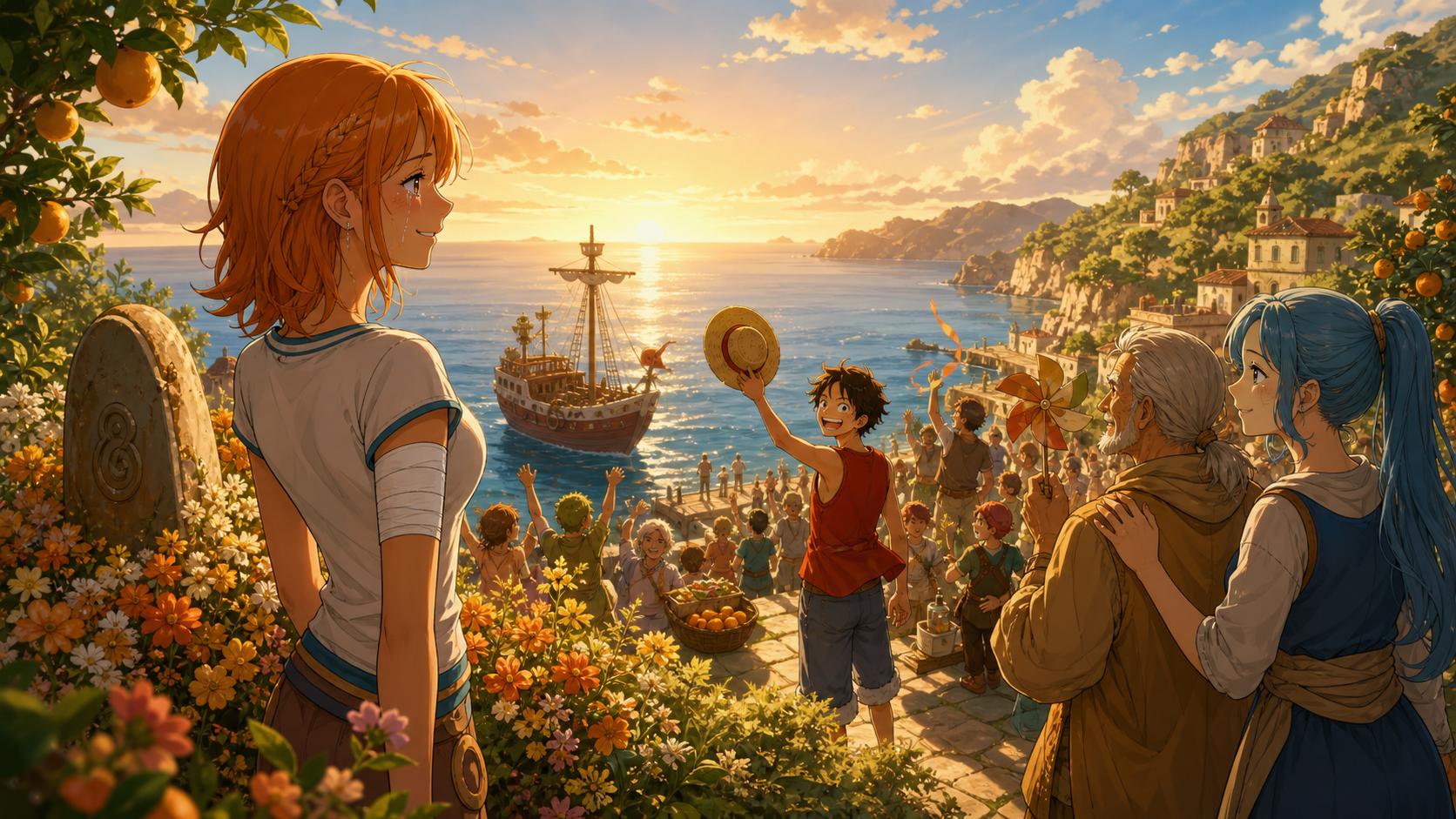
Farewell, Cocoyashi Village
Cocoyashi’s liberation gains an aftermath through medical care, Bell-mère’s memorial, Nami’s chosen tattoo, and a voluntary farewell
Episode information
Japanese title: Egao no Tabidachi! Saraba Kokyou Cocoyashi Mura
English title: Setting Out with a Smile! Farewell, Cocoyashi Village
Japanese broadcast: October 11, 2000
Saga: East Blue
Script: Michiru Shimada
Episode direction: Kounosuke Uda
Animation direction: Yuji Hakamada
Art: Yuri Sanami
Cocoyashi celebrates a real change in conditions
Episode 44 opens after Arlong Park has fallen and the immediate occupation has ended. The village celebration is not denial of what happened. The festival is a collective response to the first day in years when tribute, retaliation, and Arlong’s authority no longer structure every decision.
Joy becomes evidence that people can use public space without permission from the force that controlled the village. The festival belongs to residents before the celebration belongs to the visiting crew.
Celebration should not erase emergency work. Food, music, and laughter coexist with injuries, rubble, missing property, and unresolved Marine corruption. The village needs enough people assigned to medical care, security, documentation, and structural assessment that celebration does not create new preventable harm.
Recovery is strongest when joy and practical responsibility happen together.
Luffy keeps eating
After submersion, prolonged combat, and the final attack, Luffy’s appetite becomes both a familiar joke and an intuitive recovery signal. He is replacing energy after extreme exertion.
Eating alone does not prove medical stability. Someone should still monitor breathing, orientation, weakness, and delayed effects from the water emergency.
The feast is community care
Residents feed the crew from their own resources because they choose to express gratitude. The gesture is meaningful when participation remains voluntary and does not pressure households already harmed by years of tribute.
Organizers should distribute the cost, prioritize vulnerable residents, and avoid letting Luffy’s appetite empty supplies needed for rebuilding.
Zoro finally receives treatment
Dr. Nako attends the wound Mihawk left across Zoro’s torso. This is overdue medical care, not a decorative pause between battles. The severity Arlong exposed makes professional assessment essential.
Zoro’s ability to remain conscious does not reduce the risk of infection, reopened tissue, blood loss, or delayed collapse.
Endurance is not informed consent. Zoro routinely treats pain as a private obstacle. A clinician still needs to explain the condition, proposed care, limits, warning signs, and consequences of returning to combat too quickly.
The crew should support compliance with recovery rather than praising him for ignoring instructions.
Dr. Nako provides local continuity. A village doctor knows available supplies, residents’ histories, and which patients may need follow-up after the pirates leave. That continuity cannot be replaced by a single dramatic rescue.
Supporting the clinic with recovered resources and a clear list of injuries would strengthen the whole community.
The celebration reaches a third day. Three days of festivity create time for shock to loosen and relationships to reconnect. They also show that the Straw Hats do not disappear immediately after the final blow.
The duration gives Nami some space to visit Bell-mère, speak with Nojiko and Genzo, receive care, and decide what departure means.
Nami reports to Bell-mère
At the grave, Nami can name liberation without pretending Bell-mère is present to witness the change. The visit connects a new future to the person whose love and death shaped the eight-year plan.
Grief does not end because Arlong loses. The conditions surrounding grief change, allowing memory to exist without the same active threat.
The grave visit belongs to Nami
She may want privacy, company, conversation, silence, or ritual. The crew should not turn the moment into proof of their heroism.
Support means following her lead and recognizing that a memorial relationship cannot be rushed for a departure schedule.
Bell-mère’s influence survives without idealization. Nami can honor Bell-mère’s courage and love while still holding complicated feelings about sacrifice, poverty, fear, or choices made under impossible conditions. Memory does not need to become simple to remain precious.
The episode’s smile carries history rather than replacing that history.
Nami asks to remove Arlong’s mark
The tattoo identified her as part of Arlong’s crew and made coerced affiliation visible on her body. Choosing its removal is an exercise of bodily autonomy and control over public identity.
No one else gets to decide whether keeping, covering, altering, or removing such a mark is the more authentic response.
Removal is a medical procedure. The story compresses care, but real treatment requires explanation of options, pain management, infection prevention, healing time, and possible scarring. Consent must remain active throughout.
Nami should not be pressured to complete the process quickly so that departure imagery looks cleaner.
A new tattoo can represent chosen continuity
Nami requests a new design rather than leaving the area defined only by absence. The choice allows her to connect Bell-mère’s tangerines and Genzo’s pinwheel to a future she authors.
The symbol does not erase the old mark’s history. The new design changes who decides what the body communicates now.
The pinwheel carries Genzo’s care
Genzo used the pinwheel to make a frightened child smile. Its inclusion recognizes steady local care that continued through years when dramatic rescue was not available.
His importance does not depend on winning a duel. He helped preserve relationship, memory, and the possibility that Nami could return home.
The tangerine honors Bell-mère and Nojiko
The orchard represents family labor, survival, and a home built before Arlong seized control. The orchard also belongs to Nojiko’s continued work while Nami was trapped between navigation and the buyout plan.
The new mark can hold several relationships without reducing any of them to property claims.
Nojiko’s tattoo reveals solidarity
Nojiko chose her own tattoo so Nami would not carry visible difference alone. The gesture could not remove coercion, but the choice changed the social meaning of being marked within their relationship.
Solidarity does not require identical suffering. Solidarity means refusing to let imposed stigma isolate the person targeted.
Nojiko’s choice should remain hers. Her tattoo is not merely an accessory to Nami’s story. The design records Nojiko’s own decision, body, grief, and attempt to accompany her sister.
The sisters can value the connection without needing matching futures.
Nami’s departure is not abandonment
Leaving Cocoyashi with the Straw Hats does not mean rejecting Bell-mère, Nojiko, Genzo, or the village. The point of liberation is that distance can become chosen rather than enforced.
Home can remain part of Nami’s identity while she pursues navigation beyond the village.
The village should not demand permanent proximity. Residents may fear losing Nami immediately after regaining her. That feeling is understandable, but asking her to stay out of gratitude would create another obligation around other people’s safety and comfort.
A healthy farewell supports movement and keeps return possible.
The crew should not assume her answer. Luffy declared Nami his friend, not his property. That principle needs to survive the victory. She should receive a direct invitation, clear role expectations, and freedom to say yes, no, or not yet.
The ship’s urgency does not outweigh the need for voluntary participation.
Navigation becomes chosen work
Arlong forced Nami to map seas for his expansion. On the Going Merry, navigation can serve a route she helps select with people she chose.
The task may look similar from outside, but consent, ownership, credit, rest, and decision-making fundamentally change the labor relationship.
Chosen work still needs boundaries. Friendship does not eliminate schedules, workload, risk, or responsibility. The crew should agree on who maintains instruments, who follows safety directions, how rest is protected, and how Nami’s maps are stored or shared.
Informal groups can reproduce unfair burdens if they assume the most skilled person will always absorb them.
The village needs a reconstruction process
Arlong Park’s collapse leaves dangerous rubble and a politically important site. Residents should decide whether to clear, preserve, repurpose, or document parts of the site.
Outside help should provide labor or supplies without controlling the outcome.
Tribute records and property require review. Households may have lost money, tools, land access, and family members under Arlong’s system. A community-led inventory can support restitution and identify urgent needs.
Not every loss can be repaired, but refusing to count each loss would extend the erasure.
Nezumi remains outside the celebration. The corrupt Marine officer took Nami’s savings and may attempt to control the official account. The village needs copies of testimony and evidence in more than one secure place.
Trusted messengers should contact authorities beyond Nezumi’s immediate chain only when doing so does not expose residents to retaliation.
Prisoner custody needs transparency. If Arlong or his officers survived, their location, medical condition, and transfer should be witnessed. Disappearance, summary punishment, or an undocumented handoff could undermine later accountability.
Residents deserve safety and a process that cannot be quietly redirected by another corrupt official.
The crew’s departure should follow a safety handoff. Before sailing, confirm that injured people have care, structural hazards are marked, prisoners are secured, communications are active, and the village understands any remaining threat.
A farewell is responsible when local capacity, not visitor presence, holds the next phase.
Food, music, and laughter are political repair. Arlong’s rule made resources instruments of control and public gathering a potential risk. Sharing food freely and making noise without permission reverse those conditions in ordinary life.
The festival does not solve governance, but the gathering lets residents practice freedom together.
Smiling is not a recovery requirement. The title emphasizes a smiling departure, yet no survivor owes visible happiness to prove liberation worked. Nami’s smile is meaningful because the expression emerges from her own mix of relief, grief, anticipation, and affection.
Others may need quiet, anger, or distance. Their responses are equally legitimate.
The farewell needs room for unfinished feelings. Genzo can be proud and afraid. Nojiko can support Nami and feel the absence immediately. Nami can want the sea and ache at leaving the orchard.
A strong departure scene does not resolve those tensions. The scene lets the relationships carry them.
Michiru Shimada gives aftermath real narrative space. Shimada’s script does not jump from victory to the next enemy. Medical care, memorial ritual, tattoo choice, family history, and celebration show what the fight was meant to make possible.
The episode treats aftermath as story rather than administrative cleanup.
Kounosuke Uda balances community and intimacy. Uda’s direction moves between the crowded festival and Nami’s quieter personal decisions. The scale shift keeps Cocoyashi visible as a whole community while protecting moments that belong to one family.
Departure gains weight because viewers understand both the place being left and the future opening beyond Cocoyashi.
Yuji Hakamada changes the body’s meaning. The animation direction contrasts Zoro’s carefully treated injury with Nami’s chosen change and Luffy’s restored appetite. Bodies are no longer only weapons or targets. They need care, carry memory, and express agency.
Small gestures can therefore matter as much as the previous episode’s collapse.
Yuri Sanami restores warmth to Cocoyashi. The art brings color, food, orchards, graves, homes, and open sky back into focus after the gray destruction of Arlong Park. The village was always more than the fortress imposed upon Cocoyashi.
That visual recovery helps the farewell feel like departure from a living home, not escape from a blank ruin.
RaeRae’s real-time reaction
Nami visiting Bell-mère before leaving is the emotional center for me. She is not asking permission to have a future. She is bringing the person she loves into the moment when the future finally belongs to her.
The new tattoo works because the design does not pretend the old one never existed. Nami chooses what comes next, and the symbol keeps family care with her without turning that care into a leash.
The moment that lands
Nojiko’s reason for getting her tattoo reframes a detail we had already seen. She could not fight Arlong’s entire system alone, but she could refuse to let Nami appear marked and isolated within their bond.
That choice is not a complete solution. Sustained, imperfect care can help someone survive until conditions can change.
What Nami should take with her. She should control her maps, clothing, navigation tools, money, medical instructions, personal records, and any recovered objects connected to Bell-mère or the orchard. Copies should exist for documents that matter to both her and the village.
She should also leave contact plans, not promises of constant availability. A chosen journey needs practical ways to maintain relationships without recreating surveillance.
What the crew should change for a navigator. Give Nami authority over route safety and weather decisions. Maintain the ship when she identifies a risk. Share watch duties and routine labor so specialist work does not expand into every unclaimed task.
Discuss compensation, shared resources, map ownership, emergency authority, and rest even if the crew prefers informal friendship. Clear expectations protect relationships.
What Cocoyashi should retain. The village should keep its testimony, local governance, orchard access, medical capacity, and authority over the Arlong Park site. Nami’s departure must not remove the only person believed capable of organizing the future.
Freedom becomes durable when knowledge and responsibility are distributed.
Bottom line
Episode 44 understands that liberation needs aftermath. Cocoyashi celebrates, Zoro receives treatment, Nami speaks to Bell-mère, Nojiko’s solidarity becomes clear, and a coerced mark gives way to a design Nami chooses. The departure works because home remains alive behind her.
RaeRae rating: 9.8/10. Nami is not leaving because rescue created a debt. She is leaving because the village, family, memory, and crew can now exist inside a future she directs.