
RaeRae Reacts · One Piece Episode 43
Nami Is My Friend
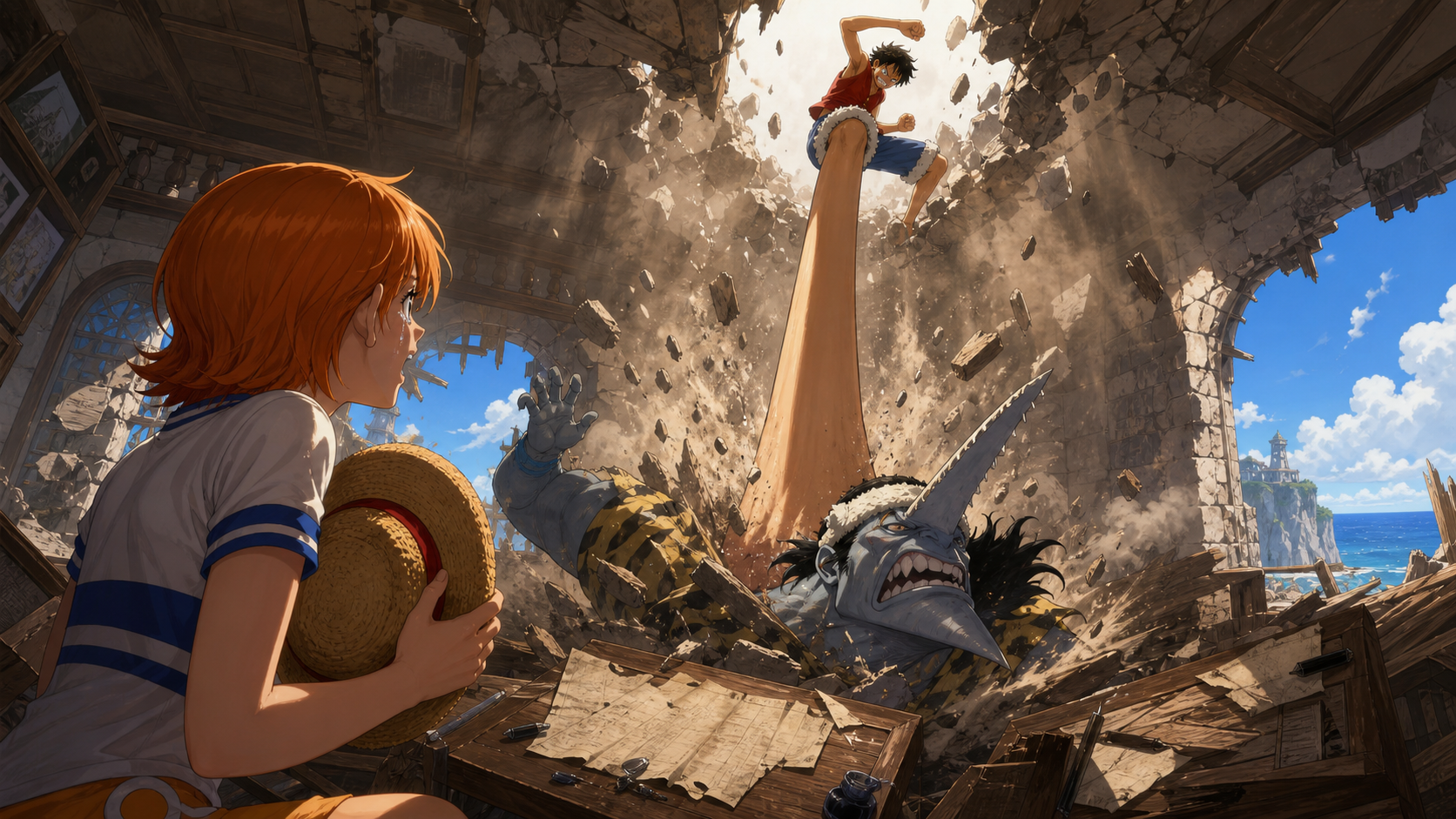
Arlong Park ends through destruction of the coerced map room and rejection of Arlong’s claim that Nami’s skill made her his property
Episode information
Japanese title: Gyojin Teikoku no Owari! Nami wa Ore no Nakama da! (1 Jikan SP Kouhen)
English title: The End of the Fish-Man Empire! Nami Is My Friend!
Japanese broadcast: September 27, 2000
Saga: East Blue
Script: Michiru Shimada
Episode direction: Junji Shimizu
Animation direction: Kazuya Hisada
Art: Miyuki Sato
The fight moves into Nami’s map room
Episode 43 changes the meaning of the battlefield by moving Luffy and Arlong into the room where Nami was forced to draw maps. What looked from outside like another chamber in a pirate fortress becomes the physical record of eight years of coerced work.
The room matters because violence in Cocoyashi was never limited to public attacks. Arlong controlled time, skill, authorship, movement, and hope. The drafting tables expose the daily machinery behind the tribute system.
Arlong describes Nami as a useful tool
His language strips her knowledge away from her personhood. He values the maps while treating the navigator who created them as replaceable property. That contradiction is not accidental. Exploitative systems often celebrate output while denying the worker’s right to decide how the work is used.
Luffy does not need a detailed history lesson to recognize the relationship. Arlong’s own pride reveals the exploitation.
The blood-stained pen makes the cost visible
A pen should represent planning, exploration, and Nami’s childhood dream. Blood on the tool shows how completely Arlong converted that dream into compelled production. The object joins intellectual labor to bodily harm.
The scene avoids treating maps as neutral artifacts. Every line carries circumstances of creation, and those circumstances affect ownership, meaning, and consent.
Luffy finally understands the room
He did not demand Nami’s whole story before agreeing to help. Now the room gives him information she never should have been required to narrate in the middle of crisis. His anger comes from recognizing what the space did to her, not from discovering that she needed to earn belief.
This distinction protects the earlier promise. Luffy trusted Nami before receiving documentary proof. The evidence deepens his understanding without retroactively making support conditional on proof.
Destruction becomes a targeted response
Luffy begins breaking the room itself. In another context, destroying maps and equipment would be careless. Here the action is directed at a workplace Nami never chose and a system Arlong expects to keep using.
The ethical question is whether Nami wants the space and its contents preserved. Her reaction matters more than an outsider’s abstract rule about protecting property.
Nami sees someone attack the structure, not her. For years, resistance risked bringing violence back onto the village. Luffy redirects force toward the machinery of coercion. He does not blame Nami for the maps, demand that she clean the room, or ask her to prove that she hates the room enough.
Her gratitude lands because the destruction answers a burden she had been carrying alone.
The room was never a home. Arlong may call the room Nami’s place, but assignment does not create belonging. A room where a child was confined to serve the person who murdered her mother cannot become home merely through repetition.
Luffy’s refusal is simple: a place she never wanted does not deserve protection as though the room represents stability.
“Nami is my friend” rejects ownership
Luffy’s declaration can sound possessive if isolated from the surrounding action. In context, he is not claiming the right to direct Nami. He is denying Arlong’s claim that usefulness entitles him to keep her.
Friendship here is a relationship she chose, built through reciprocal conduct, and can continue to shape. Friendship is the opposite of a contract enforced through hostages.
Chosen bonds need room for future choice. The crew’s support should not create a new debt. Nami can navigate with them because she wants to, renegotiate her role, take time to recover, or change direction later.
A rescue becomes liberating only when the person rescued gains more choices afterward.
Arlong treats skill as entitlement. He believes Nami’s ability belongs wherever the skill produces the most advantage for him. The argument erases her authorship and frames escape as theft from the exploiter.
The episode answers by putting the creator’s autonomy above the captor’s investment. Years of benefiting from forced labor do not produce a legitimate claim to more forced work.
The maps raise a difficult preservation question
Some of Nami’s work may be technically valuable, emotionally important, or useful as evidence. Other pages may feel inseparable from confinement. No outsider can determine the correct balance for her.
Ideally, she would have time to choose what to save. The active fight removes that control, which means the loss can be both freeing and painful.
Luffy cannot restore the stolen years. Destroying the room ends its future use but does not erase exhaustion, fear, injury, or grief. The scene should not be read as instant psychological repair.
What Luffy can do is stop the structure from making another demand. Recovery belongs to a longer timeline.
Arlong Park concentrates political power
The fortress is not only a residence. Arlong Park is a command center, detention site, storage facility, symbol of occupation, and gateway to the sea. Its architecture made Arlong’s rule visible across the region.
Bringing the fortress down has strategic and symbolic consequences, but people nearby need protection from the collapse.
Gum-Gum Battle Axe commits to an ending
Luffy stretches his leg upward and brings the leg down through Arlong and the structure. The vertical attack converts height into force and denies Arlong the sea lane he used for acceleration.
The climax is not a contest over replaceable teeth. Luffy targets the opponent’s whole position and the building that sustained his control.
The finishing attack uses Arlong’s commitment against him. Episode 42 showed Arlong repeatedly turning speed into straight-line attacks. In the map room, his confidence keeps him close enough to defend the system he values. Luffy changes the axis and attacks downward.
The shift demonstrates learning. Full power becomes useful when paired with a different problem definition.
Structural collapse creates secondary hazards
Falling stone, wood, dust, and equipment can injure fighters and residents who survive the central impact. No one should rush into unstable rubble solely because the duel appears finished.
The next phase requires a perimeter, head count, triage, fire watch, and careful search for trapped people.
Arlong’s defeat does not confirm immediate death. The attack buries him and ends his active resistance, but responders should avoid assuming the rubble provides permanent containment. Other officers may also remain alive.
Secure custody and medical assessment are compatible with accountability. The village needs freedom from renewed violence, not an uncertain body count.
Nami’s reaction validates the target
She understands exactly what the room represents and sees Luffy refuse the room’s continued existence. Her relief is not permission for every outside observer to decide that all survivor-linked objects should be destroyed.
Her response is evidence about this specific space, this moment, and the meaning of his act to her.
Relief can coexist with grief. Nami may welcome the room’s destruction and still mourn maps, time, skill, or parts of herself bound to the space. Conflicting reactions would not weaken her gratitude.
Support after the battle should allow complexity instead of demanding a clean celebration.
The villagers witness a change in power
Arlong Park’s collapse is visible proof that the institution enforcing tribute can fail. That matters after years in which resistance seemed guaranteed to produce punishment.
The sight can restore collective possibility, but governance cannot stop at cheering. Residents need to decide how safety, resources, and rebuilding will work.
Genzo and Nojiko carry local authority. They can coordinate head counts, communicate with families, identify missing residents, and explain which areas remain dangerous. The pirates should support that local process rather than assume victory grants them control.
The community knows its own vulnerabilities and priorities better than visiting fighters.
Zoro and Sanji require medical attention. Zoro’s wound remains severe, and Sanji has endured both underwater exertion and combat. The end of the duel removes the excuse for delaying assessment.
Celebration should not pressure either person to hide symptoms. Survival is the next mission.
Usopp deserves recognition without exaggeration. He faced Chew, managed fear, improvised, and contributed to the officers’ defeat. His actions matter without turning him into the sole hero of a story he completed with others.
Accurate recognition builds trust more reliably than another invented legend.
Nezumi remains an accountability threat. The corrupt Marine officer took Nami’s savings and protected Arlong’s system. The collapse of the fortress does not recover the money, preserve every record, or guarantee an honest report.
Witness statements, surviving ledgers, physical evidence, and clear custody of prisoners will matter if outside authorities arrive.
The village needs control of the narrative. Officials could describe the event as pirate violence while erasing the occupation that preceded the battle. Residents should document tribute demands, killings, coercion, and Marine collusion in their own words.
The Straw Hats can corroborate events, but local testimony must not become background to Luffy’s reputation.
Nami should control what happens to her work
Any maps recovered from the rubble remain connected to her authorship. They should not become crew property, saleable loot, or public evidence without her participation.
She may preserve, revise, destroy, license, or refuse access. Freedom includes information governance.
The village’s stolen money needs tracing. Nami’s savings represented years of sacrifice and an attempted purchase made under coercive terms. Nezumi’s seizure should be investigated separately from Arlong’s defeat.
Restitution cannot replace Bell-mère or the stolen years, but material recovery still matters for rebuilding.
The crew should not rush departure. Remaining long enough to stabilize injuries, secure prisoners, help with searches, and confirm that residents are safe would honor the purpose of the intervention.
Staying does not mean taking over reconstruction. A short delay means completing immediate responsibilities created by the battle.
Nami needs an unpressured next step. She has just moved from an eight-year plan into an uncertain future. Joining the ship may be what she wants, but the decision should not be treated as automatic payment for rescue.
Give her time with Nojiko, Genzo, the village, Bell-mère’s memory, and whatever remains of her belongings.
The crew’s promise becomes measurable
They said they would help. Now the result can be assessed: Arlong’s command is broken, the forced map room is gone, villagers survived, and Nami can choose without the same hostage structure.
The promise succeeds because the intervention changed conditions, not because the crew produced a dramatic speech.
Michiru Shimada centers the meaning of the room. Shimada’s script lets Arlong explain enough to expose himself. Luffy’s comprehension grows through objects and conduct rather than a long recap during the climax.
The writing connects a personal declaration to labor, property, and institutional violence.
Junji Shimizu turns vertical space into release. Shimizu’s direction moves upward through the room before the Battle Axe descends. The height builds anticipation and makes the final impact feel like the entire structure has been judged.
Reaction shots keep Nami’s experience central while the physical scale expands.
Kazuya Hisada gives the finishing move weight. The animation direction stretches time around Luffy’s leg, then accelerates the downward force through Arlong Park. Elasticity remains readable even as masonry fractures around the impact.
The attack feels powerful because preparation, direction, and consequence stay connected.
Miyuki Sato makes the workspace specific. Drafting surfaces, paper, ink, walls, and sea-facing architecture distinguish the map room from a generic villain chamber. The setting explains what was produced there and how isolated the labor became.
When the room collapses, viewers understand what physical system is ending.
RaeRae’s real-time reaction
The blood on the pen changes everything. Luffy does not need to know every date or every threat to understand that this room was built out of Nami’s pain and skill. Watching him attack the room instead of asking her for another explanation is the release I needed.
“Nami is my friend” works because he is not assigning her a job. He is refusing the idea that Arlong’s use of her talent created ownership.
The moment that lands
Nami watches the map room break and thanks Luffy. The emotional climax arrives before the dust settles because the target is larger than Arlong’s body.
The episode ends a place that kept demanding work from her. That change makes the finishing move meaningful.
What should happen immediately after the collapse. Establish a safety perimeter, count residents and crew, locate prisoners, control bleeding, and monitor unstable sections. Assign search teams only when entry is safe.
Secure records and recovered property without opening or distributing Nami’s maps. Photograph or document evidence before moving any object when urgent safety does not require otherwise.
Identify any surviving Arlong officers, separate them from weapons, provide necessary care, and maintain witnesses to custody. Send trusted residents to watch for Nezumi or other outside actors.
What liberation still requires. End tribute collection, restore community control of land and resources, investigate Marine collusion, recover stolen funds where possible, and create a process for residents to report harm without retaliation.
Support Nami and other survivors over time. A collapsed fortress changes the environment immediately; healing and accountable reconstruction take longer.
Bottom line
Episode 43 ends Arlong Park by revealing what the fortress demanded from Nami. The blood-stained pen, forced map room, and Arlong’s language turn the climax from a strength contest into the destruction of a coercive workplace. Luffy’s Battle Axe matters because the attack removes the structure that kept claiming her future.
RaeRae rating: 10/10. “Nami is my friend” rejects ownership without replacing Arlong’s claim with another claim. The victory opens choices for her and Cocoyashi, and the real measure of what follows will be whether those choices remain in their hands.