
RaeRae Reacts · One Piece Episode 40
Sanji and Usopp’s Fierce Battles
Rescue breathing, Sanji’s terrain change, and Usopp’s self-directed courage become distinct forms of adaptive responsibility
Episode information
Japanese title: Hokoritakaki Senshi! Gekitou Sanji to Usopp
English title: Proud Warriors! Fierce Battles of Sanji and Usopp
Japanese broadcast: September 6, 2000
Saga: East Blue
Script: Michiru Shimada
Episode direction: Yoko Ikeda
Animation direction: Naoyoshi Yamamuro
Art: Yuri Sanami
The rescue team changes the objective from extraction to breathing
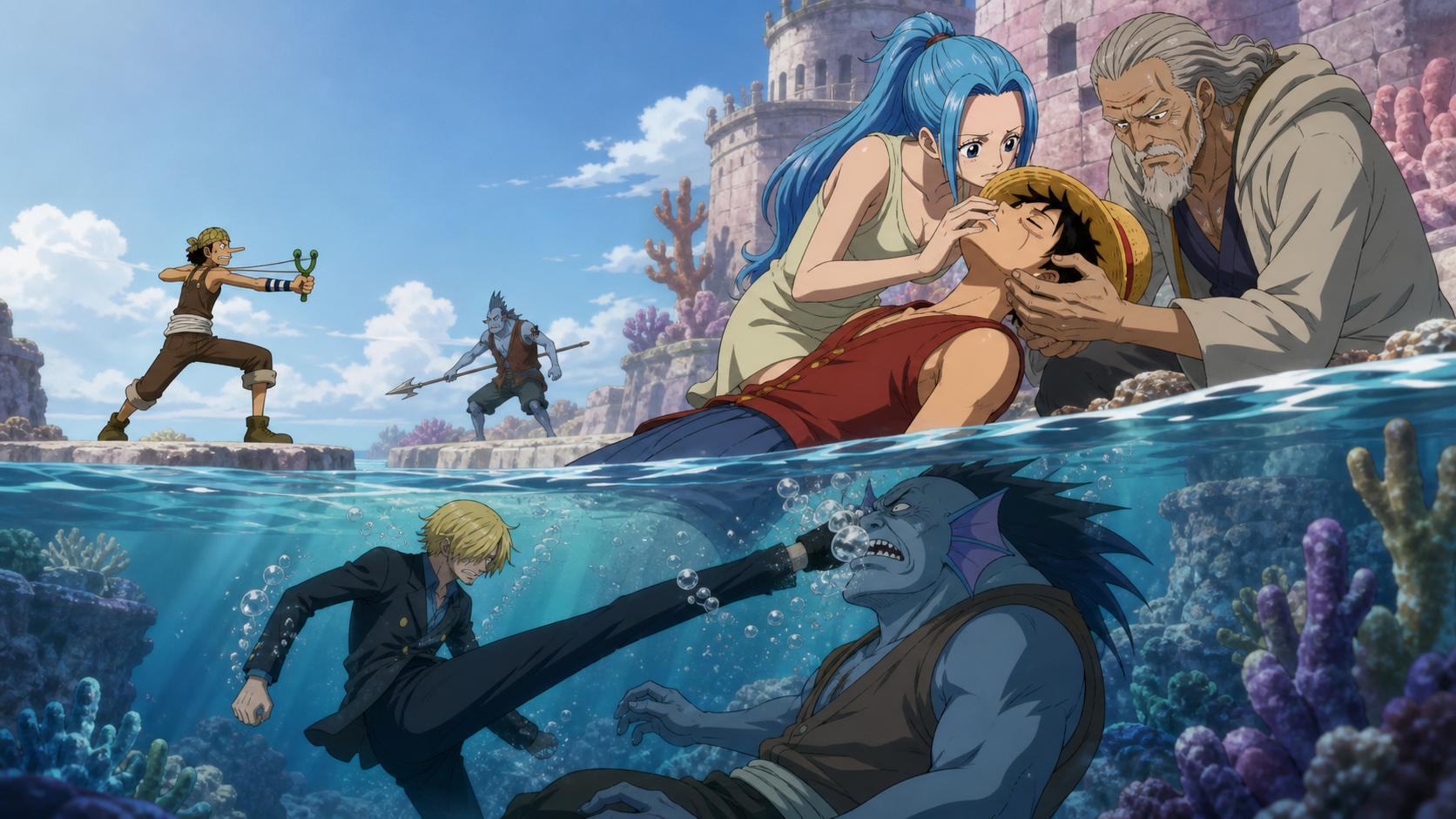
Episode 40 begins with Genzo and Nojiko accepting that underwater hammer strikes cannot free Luffy quickly enough. They adapt by stretching his neck until his head reaches air.
The plan does not solve entrapment. The airway bridge stabilizes the most urgent threat and creates time for a better extraction method.
That revision is a form of competence, not surrender. Rescue teams often need an intermediate goal when the ideal outcome cannot be reached safely in one move. Genzo and Nojiko separate breathing from extraction, assign hands to the task that can succeed now, and leave room for Sanji to change the obstacle later. Their approach protects Luffy from a false choice between immediate freedom and death. The sequence makes stabilization visible as active, skilled work rather than a pause before the important part.
Stabilization is a successful outcome. Action stories often frame rescue as complete only when the body is pulled free. In real emergencies, preserving breathing and preventing decline can be the decisive achievement.
Genzo and Nojiko stop measuring success by the original hammer plan and focus on what Luffy needs now.
The stretched neck becomes an airway bridge
Luffy’s unusual body permits a rescue option unavailable to most people. The team uses his specific physiology instead of forcing a generic method.
Adaptation requires understanding the person being rescued, not treating every body as identical equipment.
Artificial respiration keeps the rescue active
Nojiko and Genzo support breathing while Luffy remains weakened. This is sustained care work requiring observation, timing, and endurance.
The intervention may look less dramatic than combat, but every later action depends on successful breathing support.
Airway support needs continuous monitoring. A stretched neck at the waterline can be affected by waves, movement, debris, and attacks. Someone must maintain alignment and watch for changes rather than assume the position remains safe.
Rescue roles should rotate only through clear handoff so responsibility never disappears between people.
Sanji enters the water to help
He dives toward Luffy because the captain’s life cannot wait for his duel with Kuroobi to resolve conveniently. The choice shifts him from fighter to rescuer.
Specialists need permission to change roles when mission priorities change, even if an opponent calls the move retreat.
Relief arrives when he sees the airway plan working. Sanji discovers that Genzo and Nojiko have already preserved Luffy’s breathing. The local rescuers are not waiting for a pirate to provide the answer.
He can update his task instead of duplicating work, which is a mark of coordination rather than diminished heroism.
Kuroobi attacks underwater
The fish-man follows Sanji into an environment where his own physiology and martial art provide overwhelming advantages. The rescue route becomes part of the battlefield.
Protecting an emergency scene requires a perimeter because opponents may target the people or conditions keeping someone alive.
Water changes every part of Sanji’s technique. Resistance slows movement, breathing time is limited, footing disappears, and Kuroobi can generate force with familiarity Sanji lacks. A land-based kick style cannot be transferred without adjustment.
Terrain is not background. The environment determines which skills remain usable and which risks compound.
Kuroobi’s strike confirms the mismatch. Sanji absorbs another powerful attack before he can turn the rescue into offense. The hit demonstrates that determination cannot neutralize environmental disadvantage.
Accurate judgment requires leaving terrain selected by the opponent rather than proving pride inside that terrain.
Sanji identifies the gills as a route to space
He uses air against Kuroobi’s gills to disrupt the underwater control long enough to escape. The tactic targets function rather than attempting to overpower the entire body.
Observation creates a narrow exit where strength alone would fail.
The escape is not a claim about all fish-men. Kuroobi has specific anatomy and technique. Sanji’s tactic responds to the individual opponent in the immediate environment.
The tactic should not become a dehumanizing generalization about an entire people or a justification for harm beyond necessity.
Returning to land is the strategic victory
Sanji changes the conditions before trying to finish the fight. On solid ground, he can breathe, use footing, and restore the movement vocabulary his kicks require.
Withdrawal from disadvantage can be an offensive decision rather than cowardice.
Kuroobi insults Sanji’s chivalry. The provocation targets a personal code tied to Sanji’s identity. Anger gives him energy and threatens to narrow judgment.
An opponent who can control what a fighter feels may influence where and how that fighter acts. Values need reflection so they cannot be triggered like switches.
Chivalry should protect people, not pride. Sanji’s code can motivate respect and defense. If the code turns every insult into mandatory violence, Sanji becomes externally controllable.
The better measure is whether his action protects Luffy, Nami, residents, and the mission rather than whether a word went unanswered.
Sanji’s anger becomes concentrated technique
Once on land, he applies speed and precise kicks with a physical advantage Kuroobi no longer controls. The matchup changes because the environment changes.
The result validates analysis and repositioning more than emotional escalation alone.
Defeating Kuroobi protects the rescue perimeter. Removing the officer reduces the chance that Nojiko, Genzo, or Luffy will be attacked while airway support continues.
A duel serves the mission when its outcome creates safety for essential care work.
Usopp faces a different crisis of courage
His opponent and fear do not resemble Sanji’s underwater problem. Usopp can escape, hide, or create the appearance that he has already lost.
The temptation is powerful because survival is real and his teammates may never know the details.
Performance can become avoidance or strategy. Usopp has already used acting to survive Nami’s staged betrayal. Against Chew, pretending defeat could buy distance.
The ethical question is what he does with that distance. A deception that creates a better plan differs from one that abandons others indefinitely.
Usopp imagines the story he could tell
He is skilled at constructing a heroic account after the fact. The ability can protect self-esteem while separating public reputation from actual conduct.
His growth requires using story to support courageous action, not replace the action.
Shame is not the healthiest source of courage. Usopp compares himself with teammates and fears being the person who ran while others risked everything. That discomfort can move him back toward responsibility.
A crew should not need humiliation to make contribution possible. Roles matched to his actual skills would give courage a more sustainable foundation.
He chooses to stand on his own terms
Usopp’s pride as a warrior does not need to look like Zoro’s endurance or Sanji’s kicks. His courage can mean returning with a plan, using distance, and accepting fear without letting fear make every decision.
The choice matters because no captain orders the return.
A slingshot changes the geometry
Usopp can attack from range, use terrain, set traps, and force Chew to respond outside close combat. His modest-looking tool supports a specialized method.
Courage becomes operational when he trusts the skill he has rather than the one he thinks bravery should resemble.
Chew’s ranged water attacks complicate safety. The fish-man can project force across distance, preventing Usopp from assuming range belongs to him. Cover, timing, and movement matter.
Every specialist needs to know how an opponent can contest the domain in which that specialist feels secure.
Usopp’s battle affects more than his reputation. Containing Chew prevents the officer from reinforcing Arlong, attacking villagers, or disrupting Luffy’s rescue. His contribution is connected to collective survival.
The fight matters even if no one watches closely enough to praise Usopp.
The title calls both men proud warriors
Sanji and Usopp display pride through different choices. Sanji refuses to let an opponent define his code; Usopp refuses to let fear write the final version of his conduct.
Warrior identity is not reserved for one body type, technique, or relationship to fear.
Pride can support responsibility or conceal fragility. Sanji’s pride risks making him react to insults. Usopp’s pride risks making him lie about retreat. Each must decide whether identity serves honest action.
The episode values pride when the feeling reconnects a person to others rather than protecting an image at their expense.
Luffy’s continued dependence keeps the victories connected
Neither duel is isolated entertainment. Sanji and Usopp are buying time and safety while Genzo and Nojiko keep the captain breathing.
The battlefield remains a network of interdependent tasks.
Nami should see the support system forming. Her eight years under Arlong taught her to carry the plan alone because involving others seemed dangerous. The crew and villagers now share rescue, defense, testimony, and risk.
The point is not that she should have trusted sooner. A trustworthy network is finally being built in practice.
Production gives breath a visual rhythm. Yuri Sanami’s art direction uses the waterline to connect Luffy’s airway, Sanji’s underwater constraint, and the land where Usopp chooses to stand. Different pressures occupy one environment.
Yoko Ikeda’s direction alternates care and combat without making either a pause, while Naoyoshi Yamamuro’s animation direction gives water resistance, upward escape, kicks, and ranged movement distinct physical logic.
RaeRae’s real-time reaction
Genzo and Nojiko changing from “break the rock” to “keep him breathing” is the smartest decision in the episode. They stop trying to win the rescue in one dramatic motion and stabilize the person.
Sanji gets the flashy finish, but Usopp choosing not to let a lie become his actual role is just as important. He is afraid and still returns to responsibility.
The moment that lands
Luffy’s head reaches air while his body remains trapped. The rescue is incomplete, yet the image feels like a victory because time has been returned to the team.
Care changes what is possible before extraction changes where he is.
What the rescue team should maintain. Keep one person assigned to airway alignment and another to breathing support, with clear rotation before fatigue. Anchor everyone working at the waterline and shield them from combat debris.
Continue assessing the stone and prepare extraction tools while stabilization holds. Avoid pulling the neck or body in ways that transfer the block’s weight onto Luffy.
Track responsiveness and exposure time. If his condition changes, communicate immediately to the surface coordinator and fighters protecting the perimeter.
Prepare medical space, warmth, and observation for after extraction. Apparent recovery should not trigger an immediate return to combat without assessment.
The medical handoff must preserve what rescuers learned. When Luffy is finally freed, the people who maintained his airway should report how long he was submerged, when breathing support began, whether consciousness changed, and what movements occurred around the trapped stone. That timeline will guide later assessment better than a general claim that he is fine.
Someone should continue watching breathing, alertness, coordination, coughing, and fatigue after the dramatic rescue. Delayed problems can appear after water exposure, and Luffy has a strong incentive to minimize symptoms while Arlong remains active.
The crew also needs to examine Genzo and Nojiko. Repeated dives, strain, and rescue breathing consume energy even when no visible injury appears. Care workers should not disappear from the medical count because the patient survived.
A clean handoff names who is responsible next. Without that transfer, everyone may assume someone else is monitoring Luffy while attention returns to combat.
What the crew should learn from Sanji’s terrain change. Retreat from an opponent’s strongest environment should be normalized as strategy. Pride should not trap specialists in conditions where their skill cannot function.
Before future water operations, the crew needs assigned swimmers, lines, breathing contingencies, and an understanding of who can fight or rescue effectively below the surface.
Sanji’s gill tactic should remain a specific emergency response, not become a generalized way of speaking about fish-men. Tactical knowledge can be precise without becoming prejudice.
What the crew should learn from Usopp. Give him explicit ranged-security and reconnaissance roles before crisis so he does not interpret contribution through comparison with close-range fighters. Provide materials for ammunition, traps, signaling, and repair.
Create a debrief culture where fear can be reported honestly. If Usopp expects ridicule, he will be tempted to replace useful information with a heroic story.
Celebrate the decision to reengage and examine the risks without demanding that every future moment follow the same path.
Bottom line
Episode 40 defines courage as adaptation under pressure. Genzo and Nojiko stabilize Luffy instead of repeating a failed extraction, Sanji leaves Kuroobi’s strongest terrain, and Usopp refuses to let a survival performance become abandonment.
RaeRae rating: 9.4/10. The proud warriors are not proud because they never retreat or fear. They are proud because they revise, return, and connect individual technique to the people whose lives depend on the choice.