
RaeRae Reacts · One Piece Episode 39
Zoro vs. Hatchan
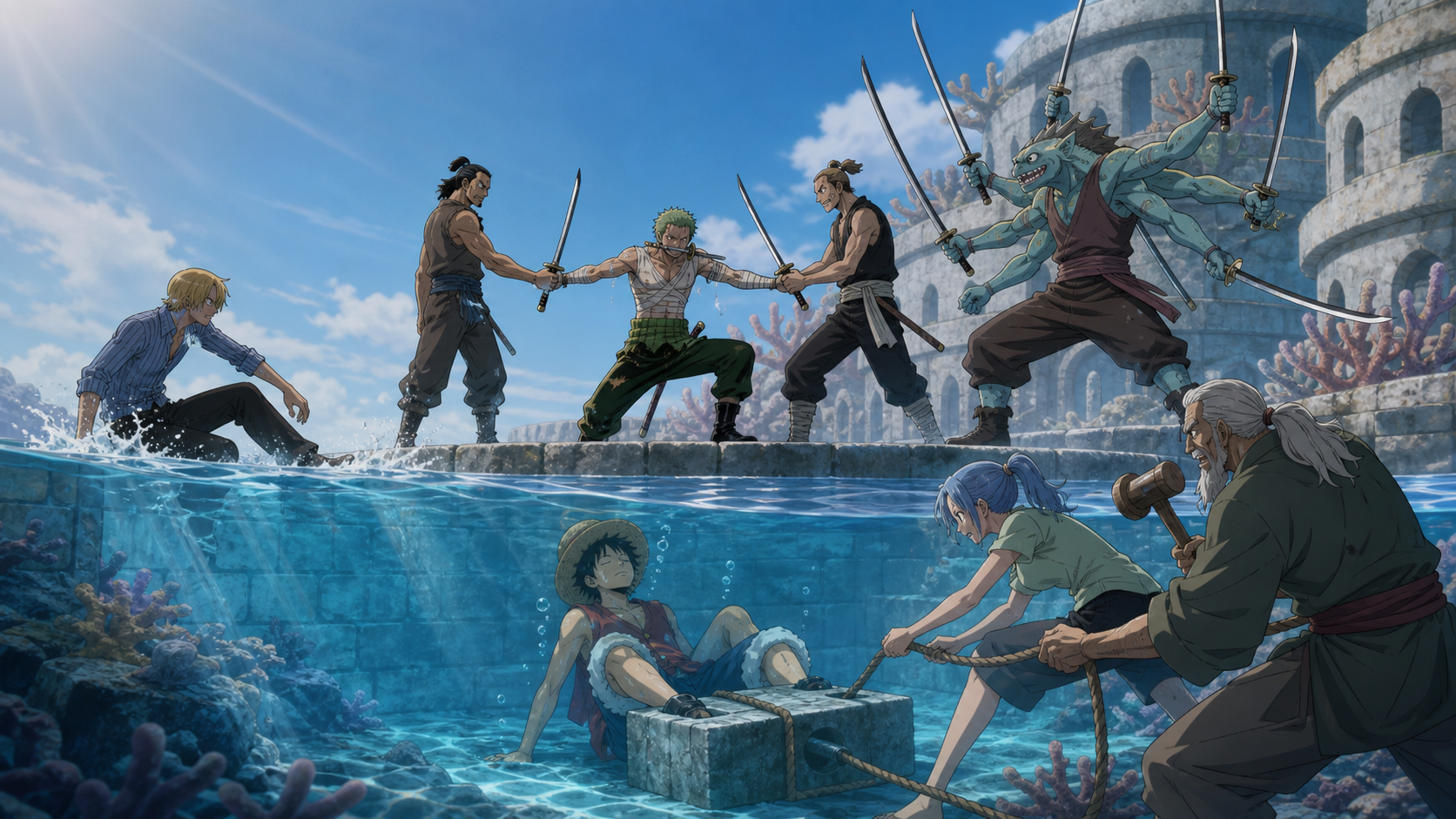
Zoro’s injured duel with Hatchan runs beside Genzo and Nojiko’s difficult underwater rescue of Luffy
Episode information
Japanese title: Luffy Suibotsu! Zoro VS Tako no Hatchan
English title: Luffy Submerged! Zoro vs. Hatchan the Octopus
Japanese broadcast: August 30, 2000
Saga: East Blue
Script: Michiru Shimada
Episode direction: Junji Shimizu
Animation direction: Kenji Yokoyama
Art: Miyuki Sato
Luffy remains underwater while the battle continues
Episode 39 refuses to pause every other conflict for the captain’s emergency. Luffy is trapped below the surface while Zoro, Sanji, Usopp, residents, and fish-man officers act in different zones.
The crew must preserve mission continuity and rescue simultaneously. Waiting for one hero to return is not a plan.
Genzo and Nojiko take responsibility for rescue
Two people from Cocoyashi move toward Luffy’s stone rather than remaining spectators to an outside battle. Their action connects the crew’s survival to local agency.
Nami asked Luffy for help, and her family and community now help him in return. Solidarity travels in more than one direction.
They use hammers against the stone
The first method is direct: break the material trapping Luffy’s feet. On land, repeated hammer strikes might create a fracture and release him.
Underwater conditions change how bodies, tools, impact, and leverage behave. A familiar method loses effectiveness in a different medium.
Buoyancy defeats the assumed mechanics
Genzo and Nojiko cannot generate the same grounded force while floating and resisting water. Their problem is not insufficient commitment.
Physics exposes a planning gap. Effort cannot replace anchoring, tool selection, position, or a method designed for the environment.
A failed first attempt is useful evidence. The hammer approach does not free Luffy, but the attempt reveals the constraints: rescuers need leverage, stability, a different cutting point, or a way to preserve his airway while extraction takes longer.
Failure becomes dangerous only when the team repeats the same method without learning because changing methods feels like admitting weakness.
Rescue time needs to be managed explicitly. Luffy’s Devil Fruit weakness makes submersion a rapidly changing medical emergency. The team must track breathing, responsiveness, stone movement, and rescuer fatigue.
A countdown should guide decisions more than the emotional rhythm of nearby duels.
Airway support may be the immediate priority. If breaking the stone will take too long, keeping Luffy able to breathe can extend the rescue window. That requires careful positioning and a person assigned to monitor him continuously.
Extraction and stabilization do not always happen in the same order.
Genzo and Nojiko need surface support. People above water can secure lines, pass tools, maintain an anchor, watch for attacks, and rotate exhausted rescuers. The work should not remain invisible or isolated below the surface.
A rescue becomes safer when every role knows who is underwater and when they must return.
Zoro’s Mihawk injury asserts itself
On the platform, Zoro can no longer hide the severity of the wound. His body struggles to remain upright before Hatchan’s six-sword style fully tests him.
The episode makes clear that determination did not heal him. Previous risk has accumulated into present constraint.
Standing is an act of will and a medical warning. Zoro forces himself upright through purpose. That moment can be inspiring without converting collapse signals into irrelevant obstacles.
Pain, weakness, and loss of balance are information the team should use, not enemies to defeat through shame.
Hatchan brings numerical complexity
Six arms and multiple blades create angles, timing, and coverage unlike an ordinary swordsman. Zoro cannot treat the matchup as a simple increase in weapon count.
He must read coordination across limbs and find the controlling rhythm behind apparent abundance.
More swords do not automatically mean more mastery. Hatchan’s anatomy permits a style unavailable to humans, but capability still depends on training, distance, and judgment. Zoro’s three-sword identity likewise does not guarantee superior decisions.
The duel should be assessed through technique rather than species hierarchy or spectacle alone.
Zoro is missing two blades
Mihawk broke two of his swords, leaving his established three-sword method materially incomplete. The damage travels forward from one duel into another.
Equipment continuity matters. A specialist needs backups, maintenance, and a process for replacing tools without pretending any substitute is identical.
Yosaku and Johnny lend their swords
The bounty hunters place their own equipment in Zoro’s hands, allowing him to reconstruct the form he knows. The act is trust expressed through material support.
Borrowed tools carry responsibility. Zoro should understand their condition, limits, and significance rather than treating them as disposable extensions of his will.
Three-sword style becomes collaborative
Zoro’s signature technique may look intensely individual, but the technique now depends on blades supplied by allies, care from others, and time created across the battlefield.
Expert identity is often supported by networks hidden behind the person performing the work.
Borrowing requires rapid adaptation. Weight, balance, grip, edge, and flexibility vary among swords. Zoro cannot assume the replacements respond exactly like the blades he lost.
Skill includes calibrating to unfamiliar equipment under pressure without blaming the tool for unmet expectations.
Sanji faces Kuroobi’s structured martial arts
Kuroobi’s fish-man karate is presented with formal rank and concentrated striking force. The discipline differs from Pearl’s armor and Gin’s tonfa.
Sanji must read a trained system rather than rely on the general advantage of speed against a slower opponent.
The forty-dan punch moves Sanji
Kuroobi’s straight strike sends him back, demonstrating that the officer can transfer enormous force with direct technique. Sanji’s earlier injuries and recent transition from Baratie may compound the impact.
Being knocked away is feedback about distance and guard, not proof that the matchup is decided.
Ranks are information, not destiny. A dan designation signals training within a system, but viewers and opponents still need evidence about what the rank means in practice. Titles can intimidate before technique is observed.
Sanji should respect the demonstrated force without surrendering analysis to the label.
Water will favor Kuroobi differently. Fish-man karate and aquatic physiology make a water-adjacent battle especially dangerous for a human fighter. Sanji’s movement options and breathing limits change below the surface.
The crew should avoid allowing every matchup to migrate into terrain selected by the opponent.
Usopp’s role remains structurally important
With Luffy submerged and two close-range specialists occupied, Usopp can provide ranged disruption, communication, tool delivery, and protection for rescuers.
Courage does not require abandoning those functions for a duel that looks more impressive.
Every fighter depends on someone buying time. Zoro needs time to adapt borrowed swords, Sanji needs time to read Kuroobi, rescuers need time to solve the stone, and Nami needs time to navigate the collapse of Arlong’s system.
Battle coordination is the distribution of time as much as force.
Arlong benefits from divided attention
The captain’s submersion forces the crew to allocate people away from offense. Officers can pressure those remaining and interrupt rescue.
This is why the original tactical mistake continues to shape the whole field even after Luffy disappears from view.
The crew should not hide Luffy’s condition from Nami. She may blame herself because the battle follows her request for help. Withholding information to protect her could reproduce the secrecy that isolated her.
Honest updates should make clear that Luffy’s anchoring decision created the emergency and that rescue is a shared responsibility.
Local participation should not become a new debt. Genzo and Nojiko help because they choose to protect someone acting for the village. The crew should not later claim their rescue proves Cocoyashi owes service or allegiance.
Mutual aid creates relationship without creating ownership.
Production gives rescue and combat one frame
Miyuki Sato’s art direction makes the waterline a boundary between visible duels and submerged labor. Stone, ropes, hammers, bandages, and borrowed blades all carry tactical information.
Junji Shimizu’s direction crosscuts without treating rescue as a pause, while Kenji Yokoyama’s animation direction emphasizes different constraints: buoyancy below, injury on the platform, and force in Kuroobi’s strike.
RaeRae’s real-time reaction
Genzo and Nojiko discovering they cannot swing hard enough underwater is exactly the kind of rescue detail action stories skip. They are brave, prepared with a tool, and still wrong about the mechanics.
Zoro borrowing swords while barely standing also makes the “solo” duel visibly communal. His style is being held up by people who trust him with their equipment.
The moment that lands
Yosaku and Johnny extend their swords toward Zoro. The gesture restores his familiar form without restoring his health or erasing the difference between borrowed tools and the ones Mihawk broke.
Support gives him options, not invulnerability.
How the rescue plan should change. Stop relying on unanchored hammer strikes as the primary extraction method. Secure rescuers with lines to a stable surface or bring a tool that can concentrate force with less body movement.
Assign one person to airway support and one to stone removal. Combining both tasks in the same exhausted rescuer risks losing track of Luffy’s condition.
Use Nami’s understanding of depth and currents to choose positions, and ask residents about submerged access or structural weak points. Rotate people before fatigue impairs judgment.
Protect the rescue perimeter. Usopp or another ranged defender can interrupt officers without drawing combat directly over the people underwater.
Prepare the surface team for immediate medical handoff. A freed body is not the same as a recovered patient.
Communicate milestones to Zoro and Sanji so they know whether to contain, finish, or disengage from their matchups.
How the crew should manage Zoro’s condition. Someone should know the wound status, signs requiring withdrawal, and what movement could cause irreversible harm. Zoro’s consent matters, but the crew also has a duty not to build strategy on concealed incapacity.
The borrowed blades should be inspected if time allows and returned or accounted for afterward. Equipment loans need closure, especially when damage is likely.
Once the immediate threat ends, Zoro requires medical evaluation and enforced recovery rather than another vow to stand through pain. Continued dependence on willpower shifts predictable care work onto others.
Underwater rescue needs incident command, not parallel guesses. Genzo and Nojiko begin with the same objective but limited ability to compare options while submerged. A surface coordinator should control timing, maintain visual contact, and decide when a failed method has consumed enough of the rescue window. That person needs authority to recall exhausted rescuers even when they insist on continuing.
The stone itself should be assessed before more impact. Rescuers need to know whether Luffy’s ankles are embedded, whether cracks will shift weight onto him, and whether breaking one side could trap him more tightly. A cutting or prying method may be safer than indiscriminate hammering.
Airway support changes the timeline but introduces its own risks. Extending Luffy’s neck or bringing his face toward the surface must not worsen entrapment. Anyone providing breaths needs stable positioning and protection from waves, debris, and attack.
Lines should connect every underwater responder to a known surface point, with distinct signals for more slack, retrieval, tool delivery, and emergency pull. One rope attached only to the stone could become a hazard if the block shifts.
The team should track exposure for rescuers as well as Luffy. Breath-hold time, cold, exertion, and repeated dives degrade judgment. Rotations keep commitment from becoming preventable collapse.
Medical preparation cannot wait until extraction. Clear deck space, blankets, airway supplies, and a person ready to assess breathing should be in place before the stone is freed. Rescue ends only when the patient is stable, not when the dramatic obstacle breaks.
Borrowed weapons create a temporary custody relationship. Yosaku and Johnny give Zoro tools tied to their own safety and professional identity. The loan implies informed trust, but the battle allows little time to discuss limits, replacement, or what should happen if a blade breaks.
Zoro should use them according to their actual construction rather than forcing every technique suited to his usual swords. Borrowed equipment deserves calibration, and improvisation should account for the owners’ future needs.
Afterward, returning surviving blades, naming damage honestly, and offering repair or replacement are part of respecting the relationship. A victorious technique does not erase material cost borne by allies.
The moment also teaches the crew to maintain shared equipment records and backups. Specialists will lose tools at sea. Prepared replacements reduce the chance that the next emergency depends on taking the only weapon another person has.
The crew is becoming capable of functioning without its captain. Luffy’s absence exposes weaknesses, but the absence also requires everyone else to make decisions from shared purpose. That capacity is necessary for any long voyage.
Distributed leadership does not diminish Luffy. Shared decision-making makes his crew more than an audience waiting for him to solve every problem.
Bottom line
Episode 39 makes survival a parallel discipline. Genzo and Nojiko learn that effort without underwater leverage cannot free Luffy, while Zoro reconstructs his style through borrowed swords and Sanji meets a trained opponent whose force changes the matchup.
RaeRae rating: 9.1/10. The episode’s strength is its insistence that support work, tool adaptation, injury management, and communication are part of battle. The crew will save its captain only by becoming a system rather than a collection of brave individuals.