
RaeRae Reacts · One Piece Episode 187
Noland Saves Mousse and Challenges Kalgara
One Piece Episode 187 follows the Golden Bell into Noland and Kalgara’s first conflict over Tree Fever, sacrifice, and proof.
Bottom line: One Piece Episode 187 interrupts the final battle at exactly the right moment. Enel destroys the evacuated Shandia village, and the story answers that loss by going back four hundred years to the first meeting between Mont Blanc Noland and Kalgara. The flashback is not a detour from Luffy’s climb. The flashback explains why the bell, the land, and the promise matter enough for generations to keep fighting.
“Guidance from the Sound of a Bell! The Great Warrior and Tales of an Explorer” begins as present-day catastrophe and becomes a collision between medicine, faith, grief, and foreign arrival. Noland saves lives with knowledge. Kalgara protects a people whose history has taught him that outsiders take. Both men enter the meeting with evidence behind their certainty, which makes the conflict painful instead of simple.
My reaction: I was ready to distrust Noland the moment armed outsiders walked into a community during a plague. The episode earns his place by making him do the work. He diagnoses, treats, argues, and risks his own people to stop an execution. He does not deserve automatic trust because he has medicine. Kalgara does not become stupid because sacred belief shaped his response.
Mousse makes the conflict hurt. She is not an abstract example in a debate between science and religion. She is Kalgara’s daughter, sick, frightened, and prepared to die because her community taught her that sacrifice protects everyone else. Noland saving her body does not instantly untangle what that belief meant to her family.
Enel destroys the village after the people escape
Enel notices the Shandia village below and targets the settlement with lightning. He jokes that people who came from the Blue Sea may enjoy returning there when Skypiea falls. The cruelty treats displacement as entertainment and erases the four-century struggle behind the village.
The Shandia watch from their evacuation boat. Leaving saved their bodies, but survival does not make the destruction small. Homes, tools, gathering places, memories, and the physical proof of community disappear under a ruler who never built any of them.
Wyper remembers a duty older than Enel
Wyper does not understand the battle only as revenge against the current god. He carries an oath connected to Kalgara and the fire of Shandora. Aisa urges him to move while the older story rises through his memory.
The Shandia chief once explained that Kalgara protected the homeland for another reason: a friend named Mont Blanc Noland. That name connects Wyper’s war to Cricket waiting below the clouds, even though neither descendant knows the full shape of the other’s inheritance.
Four hundred years ago, Kalgara was the demon at the shore
The flashback introduces Kalgara chasing intruders from Shandora. He hurls a massive anchor, boards the departing ship, and demands that the outsiders leave everything behind. The title “Demon of Shandora” belongs to the people fleeing him.
From Kalgara’s side, the violence guards a city, faith, and population against theft. The episode lets the same action look monstrous from the boat and protective from the island. Perspective changes the label before anybody changes the facts.
Noland feeds his crew with his own hands
Mont Blanc Noland appears on a ship that has run out of food. He jumps into the sea and returns with a giant fish rather than abandoning his crew. The sequence establishes competence through labor before the episode asks viewers to trust his scientific claims.
Noland is an admiral, explorer, botanist, and fighter, but rank does not keep him dry while others starve. He solves the immediate problem personally. That practical habit will shape every choice once the crew reaches Shandora.
The Golden Bell guides Noland through the storm
During rough weather, Noland hears a bell across the sea. His crew cannot confirm the sound at first, yet he records the experience and follows the signal. The bell acts as evidence that the storm cannot erase.
When the crew later hears the same beautiful tone near the island, doubt turns into shared knowledge. Noland concludes that people must live nearby. Sound becomes the first bridge between strangers who have not learned one another’s names.
Tree Fever has already killed a hundred people
Shandora is dying from a disease marked by green stains. The priests call the outbreak a curse, and the village has already lost roughly one hundred people. Crops and trees show infection alongside human bodies.
The spiritual explanation gives the community a cause, a ritual, and someone to blame when medicine is unavailable. That structure does not make the deaths imaginary. Tree Fever is real, contagious, and devastating. The error lies in the proposed cure.
Mousse agrees to become the next sacrifice
Mousse accepts selection for the altar because she believes her death may save the village. Her willingness is not evidence that the ritual is harmless or freely chosen. Everyone around her has been taught that refusal could condemn family and neighbors.
Her mother’s grief exposes the cost beneath the ceremony. A system can call sacrifice honorable while placing unbearable pressure on a young woman to treat her own body as public medicine.
Seto tries to scrape disease from his skin
Seto sits in the rain and uses a rock against the green marks on his arm. He wanted to become strong like Kalgara, and infection makes him believe he will die in shame. The physical action shows desperation more honestly than a polished speech could.
Kalgara can fight ships, invaders, and giant creatures, but he cannot stab a fever out of a child. The great warrior’s helplessness helps explain why ritual retains power. Strength without another framework has no answer.
Noland names the disease when nobody else can
Noland’s crew encounters Seto in the forest. Their doctor recognizes Tree Fever, and Noland orders conine distributed to the boy and the entire crew. Naming the disease changes fear into a problem with transmission and treatment.
The diagnosis does not make Noland morally superior by birth. Knowledge reached him through study, travel, plants, previous cases, and shared medical practice. Progress arrives through accumulated labor rather than a foreign man possessing magic intelligence.
The infected crops prove the crisis is ecological
At the village, Noland sees disease across people and cultivated plants. Treating one patient will not protect Shandora if the infected environment continues spreading fever. The cure must include both medicine and removal of the source.
That larger diagnosis will create conflict beyond the altar because sacred trees belong to identity as well as biology. Episode 187 establishes the medical stakes without pretending that cutting a cultural object carries no historical meaning.
Noland reaches the altar before Kashigami strikes
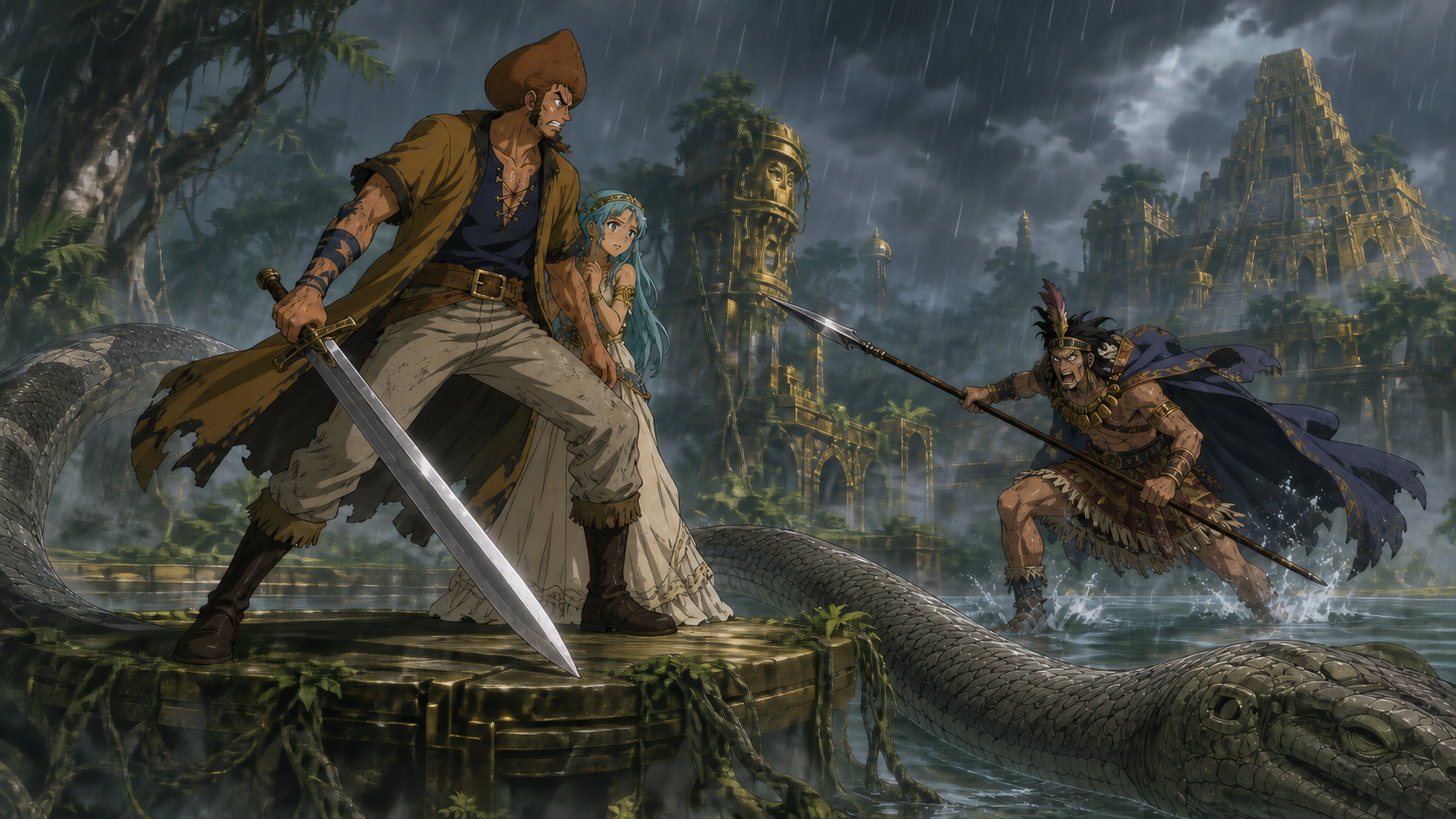
Mousse is tied to the altar while prayers ask the gods to spare the village. Kashigami rises to consume her. Noland enters the water, climbs the structure, and kills the giant snake before the sacrifice can be completed.
From Mousse’s position, he has saved her life. From the gathered Shandia position, he has murdered a god during the ritual meant to save everyone. The same sword creates rescue and sacrilege at once.
Kalgara sees an invader destroying the last protection
Kalgara charges Noland with his spear. He has watched outsiders approach Shandora, watched disease spread, and watched a stranger kill the being his people were begging for help. Anger follows a coherent history even though the conclusion is wrong.
Noland introduces himself as an explorer from the North Blue, but an introduction cannot overcome what Kalgara believes he witnessed. Information arrives after the wound. Trust has no foundation yet.
Mousse is still trapped inside the belief system
Kalgara throws a knife toward Mousse and urges her to complete the sacrifice herself. Noland stops her. The moment shows how communal belief can continue controlling a person after the physical monster is gone.
Saving Mousse requires more than removing Kashigami. Somebody must challenge the claim that her death would protect the people she loves. Noland tries to separate devotion to community from obedience to a lethal ritual.
Noland condemns sacrifice and offers evidence
Noland calls the ritual a disgrace and argues that gods who value the Shandia would not demand their deaths. More importantly, he offers a test: give him time to cure the disease, then judge him by the result.
His challenge places his own life and crew at risk. If treatment fails, the Shandia may punish them. If treatment works, the village must abandon human sacrifice. Noland asks belief to face an observable outcome.
The chief grants one day
The Shandia chief interrupts Kalgara and gives Noland until the following evening. He cannot hear the gods directly, but he recognizes wisdom in the explorer’s words. Waiting costs less than killing the only person offering a cure.
The decision is cautious rather than converted. Noland’s crew remains imprisoned, and the village council objects. The chief creates space for proof without demanding that everyone trust a stranger immediately.
Seto’s recovery changes the argument
Kalgara leaves the council and finds Seto already improved after receiving treatment. The boy asks what Noland means by progress. His body becomes evidence that the fever responds to medicine rather than sacrifice.
Kalgara cannot dismiss Seto as a distant theory. The sick child he expected to lose stands before him. New knowledge enters through someone he loves, which makes denial harder and change more personal.
Noland finds the plant he needs and the earth breaks
In the forest, Noland locates a Kona tree connected to the treatment work. Before he can return safely, the ground shakes and part of the forest sinks. The villagers interpret the earthquake as divine punishment.
Kalgara finds Noland trapped in a crevice and initially treats the injury as judgment from the gods. Noland insists that he must reach the village. The episode ends with cure, faith, pride, and survival suspended over the gap.
Episode 187 stops before friendship becomes possible
This React ends with Noland trapped and Kalgara watching. Episode 188 owns the full cure, removal of infected trees, the argument over sacred land, Kalgara’s changed understanding, and the emotional movement toward friendship.
The episode adapts parts of Chapters 286 through 288. The official Japanese archive lists March 28, 2004 as the broadcast date, with Hirohiko Kamisaka credited for script, Hiroyuki Kakudo for episode direction, Takeo Ide for animation direction, and Miyuki Sato with Kumiko Fukuzawa for art.
Final reaction to the warrior and explorer
Episode 187 works because neither medicine nor cultural respect is reduced to a slogan. Noland is correct that sacrifice cannot cure Tree Fever. Kalgara is correct that outsiders can carry theft and destruction behind friendly explanations. Their first meeting forces both truths into the same rain.
Mousse and Seto keep the argument grounded in bodies rather than abstract debate. Mousse is asked to die for a cure that cannot work. Seto receives medicine and improves. The contrast does not require mocking everyone who believed the ritual. Grief, repeated deaths, inherited teaching, and the absence of another treatment built the conditions in which sacrifice could appear necessary. Noland has to replace the false remedy with results, not merely insult frightened people.
The chief’s decision may be the quietest act of courage in the episode. He risks anger from priests, warriors, and families who believe waiting will invite divine punishment. He also refuses to hand the village’s future to Noland without a limit. One day creates a fair test under terrible pressure. Leadership appears through making room for evidence while remaining responsible for what happens next.
Kalgara’s hostility also protects the later friendship from feeling cheap. A man who guarded Shandora against raiders would not welcome a heavily armed foreign crew because their captain spoke confidently. Trust must grow from Noland treating the sick, accepting danger, explaining his methods, and respecting lives that the ritual had already surrendered. The story lets changed knowledge change a relationship.
The Golden Bell guided Noland toward people he did not know. Four hundred years later, descendants still need the bell to carry proof across the sea. History becomes a chain of people trying to answer someone beyond sight.
Enel’s destruction of the present-day village makes the flashback hurt more. Kalgara fought to preserve land for descendants and for a friend who might return. Wyper watches the settlement disappear while carrying a promise whose origin has survived longer than the buildings. Enel can destroy the current village, but he cannot erase why the Shandia remained.
The bell therefore carries history, location, friendship, and resistance in one sound. Ringing the bell will tell two separated peoples that memory survived conquest and distance.
RaeRae’s verdict: Noland saves Mousse by refusing to respect a death sentence. Kalgara protects Shandora by refusing to trust an intruder too quickly. The friendship has not arrived yet. Episode 187 earns that delay.