
RaeRae Reacts · One Piece Episode 186
Luffy Climbs Into Enel’s Mamaragan
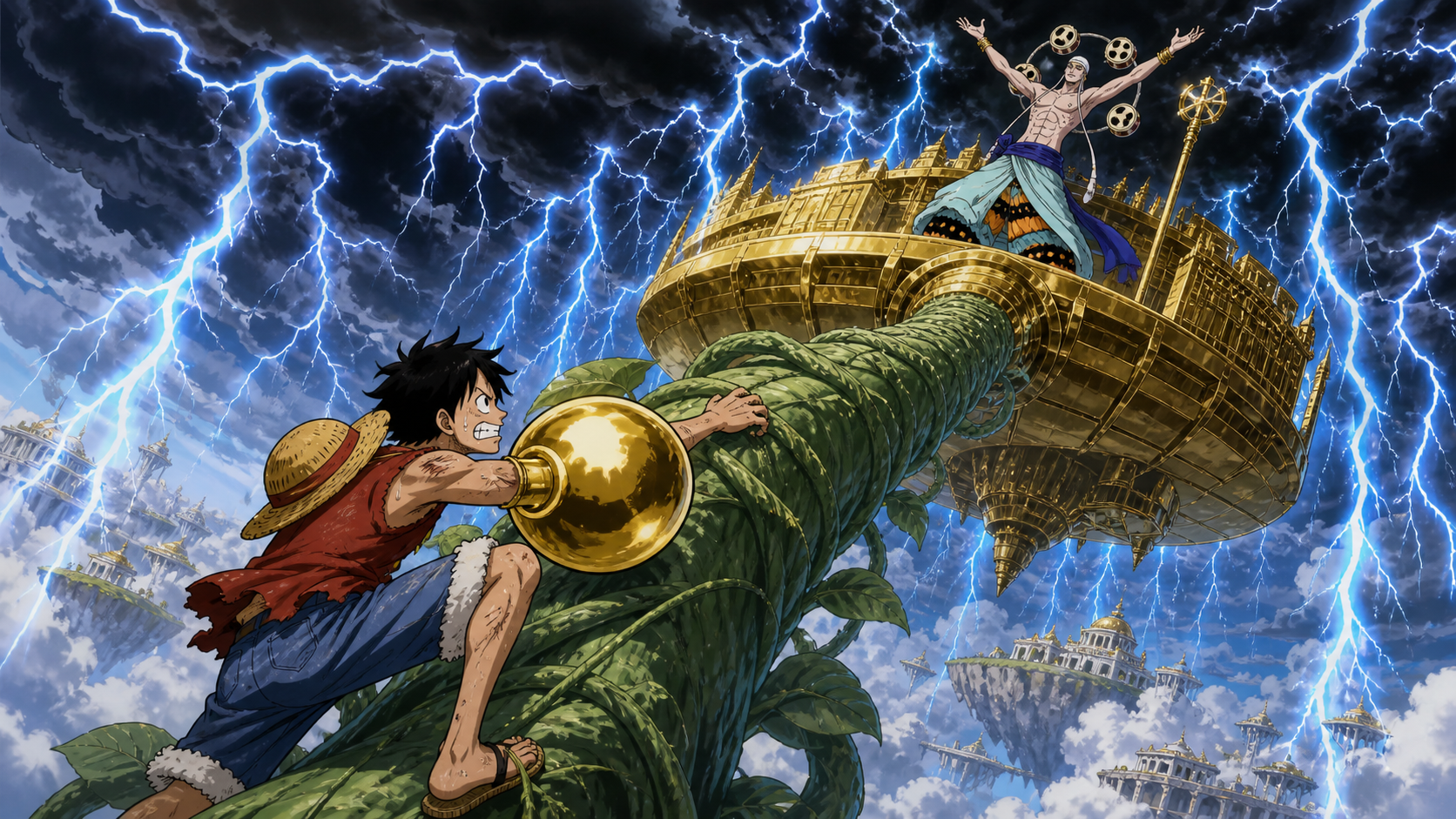
One Piece Episode 186 makes Skypiea’s evacuation a race against Enel’s repaired ark while Luffy climbs toward the Golden Bell.
Bottom line: One Piece Episode 186 turns Skypiea’s evacuation into a race between ordinary logistics and Enel’s unlimited appetite for control. Sanji damaged Ark Maxim, Usopp carried him away, and Nami escaped, but nobody gets a victory pause. Enel repairs the machine, fills the sky with Mamaragan, and forces Luffy to climb Giant Jack with stolen gold dragging from his arm.
“Capriccio for Despair! The Impending Doom of Sky Island!” widens the danger after Episode 185’s intimate rescue. The episode moves among Usopp, Sanji, Nami, Robin, Aisa, Luffy, McKinley, Conis, and the fleeing islanders. Every route depends on somebody doing a physical job while Enel tries to erase the entire map from above.
My reaction: this episode made me tired in the right way. Everybody below is evacuating children, carrying wounded people, finding boats, repairing damage, and trying to understand where safety still exists. Enel sits above that labor and produces a weather apocalypse. The imbalance is the point. Destruction is easy when one person controls the machine. Survival needs hundreds of people doing small jobs correctly.
Luffy climbing Giant Jack with that absurd gold sphere attached to his arm looks impossible because the task should look impossible. I was not waiting for a graceful solution. I was waiting for stubbornness to become a route. Nami sees the same possibility and starts turning a beanstalk into a launch ramp.
Sanji’s sabotage buys minutes, not safety
Ark Maxim stops producing black clouds after Sanji damages the machinery. Enel hears the failure and immediately understands that a gear has been displaced. The interruption confirms that Sanji’s warning carried a real consequence, even though the ark never fully falls.
Enel can rely on two hundred Jet Dials to keep Maxim airborne while he repairs the system. The backup reveals how much stolen labor supports his divine performance. Enel presents flight as personal power, yet engines, Dials, gold, and forced builders keep the throne in the sky.
Usopp goes back for the man who sent him away
Usopp does not remain safely beside Nami. He hooks onto Maxim again, climbs back to the deck, and finds Sanji blackened and unconscious. The return completes the rescue as a loop rather than a single heroic sacrifice.
Sanji pushed Usopp toward safety because somebody had to carry Nami away. Usopp returns because leaving Sanji on the ark would turn that opening into a death sentence. Both men accept danger at different moments, and neither contribution cancels the other.
Usopp Hopping is ridiculous and completely necessary
Carrying Sanji removes Usopp’s ability to climb down carefully. His spring shoes become the escape route. The leap looks absurd because Usopp’s inventions often keep their homemade personality even when a life depends on them.
Comedy does not weaken the action. Usopp has to calculate where the pair can land, avoid the jungle and ruins, and keep hold of an unconscious adult while jumping from a flying ship. The funny footwear solves a terrifying spatial problem.
Nami completes the rescue on the Waver
Nami has not abandoned Usopp or Sanji after clearing Maxim. She watches their fall and uses the Waver to recover them. The person originally marked for rescue becomes the driver who brings both rescuers back.
The reversal fits Episode 185’s shared structure. Nami’s navigation, Usopp’s retrieval, and Sanji’s sabotage form one chain. One Piece refuses to reduce the sequence to a man saving a woman while everybody else waits for the pose to finish.
Angel Island faces a transportation problem
Half the population remains on Angel Island while the sky darkens. McKinley understands that the available boats and Milky Road cannot move everyone quickly enough. His officers suggest reaching the wharf, but travel time has become more dangerous than limited capacity.
McKinley orders emergency Dials used to create another cloud river. The decision is practical leadership under pressure. No speech can widen the exit. Somebody must redirect tools, manage traffic, and stop families from carrying possessions that slow the boats.
Leaving belongings behind becomes a survival rule
McKinley orders residents to take no property. The command sounds harsh because a home contains work, memory, food, tools, and proof of a life. Enel’s timetable makes every object compete with a person for space and time.
The episode understands evacuation as loss before destruction arrives. Residents do not know whether any house, photograph, garment, or family possession will remain. Survival requires moving while grief still has no finished shape.
Amazon keeps charging at Heaven’s Gate
Amazon photographs fleeing boats and demands the enormous exit fee as if normal border procedure still governs the day. The joke lands because bureaucracy can continue after common sense has already left the building.
People warn Amazon to flee. The gatekeeper’s routine has become detached from the purpose of a gate, which should now help people escape. Enel’s regime trained officials to collect obedience even when obedience offers no protection.
Conis notices the wind has stopped
At the Going Merry, Conis reads the atmosphere before the catastrophe becomes fully visible. A stopped wind over the White Sea signals that Enel’s cloud system is changing the environment around them.
Conis has spent the arc learning to trust observation over official reassurance. She warned Angel Island when speaking could mean death. Now her attention remains fixed on the conditions that will decide whether the Merry and the evacuees can move.
Robin moves the injured toward one meeting point
Robin uses her Hana Hana powers to carry Zoro and help gather the fallen fighters near Giant Jack. Chopper, Gan Fall, Wyper, and the others remain injured, which turns reunion into triage rather than celebration.
Robin’s work is easy to overlook beside lightning and a flying ark. Moving bodies out of collapsing ruins creates the ground from which any later rescue can begin. Archaeological knowledge brought her to Shandora, but practical care determines what she does with the people lying there.
Luffy arrives carrying Enel’s stolen gold
Luffy reaches the group with the giant gold sphere still fixed around his right arm. The weight makes every movement harder, but the metal also gives him a physical connection to Shandora’s stolen treasure and Enel’s refusal to fight fairly.
The crew reunion lasts only long enough to exchange urgent information. Luffy does not stop to explain the entire duel. Enel is above them, the ark is moving, and the islanders have almost no time.
Aisa knows where the Golden Bell waits
Luffy asks Aisa to guide him toward the bell. Her Mantra and knowledge of Upper Yard make the child central to the route. Strength alone cannot identify the correct destination inside a broken city and a storm.
Aisa has already lost warriors whose voices disappeared from her awareness. Guiding Luffy means moving toward the source of that fear. The choice gives her knowledge an active purpose beyond sensing each new injury.
The Golden Bell connects the fight to a promise
Luffy wants to stop Enel, but the bell gives the climb another reason. Ringing Shandora’s bell can answer Mont Blanc Cricket below the clouds and prove that the city of gold never vanished from the world.
Enel sees gold as fuel, ornament, and restraint. Luffy sees the bell as communication. The same material can support domination or carry a promise across distance, depending on who controls the object and why.
Luffy climbs Giant Jack under impossible weight
The climb turns the gold sphere from a battle trick into an endurance problem. Luffy must grip the vine, pull his body upward, and manage a mass designed to drag him away from Maxim. Every meter rejects Enel’s assumption that weight ends pursuit.
Luffy’s progress is not elegant. He strains, slips, and keeps choosing the next hold. The physical awkwardness makes the determination readable without turning the climb into a polished heroic flight.
Enel repairs the system everybody hoped was dead
Enel restores the damaged machinery before the evacuation finishes. Sanji’s sabotage mattered because the delay allowed rescues and movement below, but Enel still possesses the technical access and electrical power to restart Maxim.
The repair prevents the previous episode from offering false closure. Damaging one gear cannot dismantle a system built with backups and concentrated authority. The people below must keep acting after a brave intervention proves temporary.
Mamaragan turns weather into occupation
Enel releases a field of thunderbolts from the black clouds. Lightning stops being a targeted punishment and becomes an environmental weapon spread across the Sky Islands. Every civilian route now exists inside his attack range.
The scale clarifies Enel’s politics. He does not want submission from a surviving community. He wants a blank sky that confirms only his destination mattered. Destruction becomes the final answer to people who refuse to accept his chosen future.
The fallen fighters begin to wake
Wyper, Zoro, and Gan Fall regain awareness while the catastrophe expands. Waking does not erase their injuries or return them to full strength. Consciousness gives them information, pain, and another decision.
The episode places those awakenings beside the civilian evacuation. Famous fighters and unnamed families face the same narrowing clock. Skypiea will not survive through one duel alone; movement, guidance, medical care, transport, and resistance all remain necessary.
Episode 186 stops before the history lesson
This React ends with Enel’s destruction underway and Luffy climbing toward the bell. Episode 187 owns the Noland and Kalgara history that explains why the bell matters across four hundred years. Keeping that flashback outside this page protects the emotional handoff.
The episode adapts the end of Chapter 284, Chapter 285, and the opening of Chapter 286. The official Japanese archive lists March 21, 2004 as the broadcast date, with Hirohiko Kamisaka credited for script, Hidehiko Kadota for episode direction, Masayuki Takagi for animation direction, and Miyuki Sato with Fumihiro Uchikawa for art.
Final reaction to the capriccio for despair
Episode 186 understands that catastrophe is measured through tasks. Usopp has to carry Sanji. Nami has to catch them. Robin has to move the injured. McKinley has to make an exit. Conis has to read the air. Aisa has to guide Luffy. Luffy has to climb.
The evacuation scenes deserve as much attention as the lightning because they show what Enel never learned about governing. McKinley has no perfect route, enough boats, or guarantee that his orders will work. He still has to compare bad options and choose the path that moves the most people. Leadership appears through responsibility for consequences, not through claiming a title nobody may question.
Amazon provides the ugly comic counterexample. Her camera and fee belong to a border system built around surveillance and punishment. Continuing the routine during an extinction threat exposes how rules can survive after their stated purpose has collapsed. The evacuees understand the danger better than the official recording their departure. They warn her because the community still recognizes her as a person worth saving, even while she treats them as transactions.
Robin’s movement through the ruins carries another quiet argument. Shandora is the historical discovery she crossed the Grand Line to find, yet injured people take priority over standing near the stones. Protecting knowledge never requires pretending human bodies are disposable. She can read the city later only if somebody survives the present.
Luffy’s climb gathers all those choices into one visible line. He cannot see every boat leaving Angel Island or every body Robin moved, but the route upward exists because Aisa can guide him and the others bought time. The captain’s determination matters most when the story shows the network supporting that determination.
Enel controls the largest machine and the loudest weather, but his power produces only one idea: remove everyone else. The people below answer with dozens of smaller decisions that preserve a community he cannot imagine wanting.
The gold sphere makes that contrast physical. Enel tried to convert Shandora’s wealth into dead weight on an enemy. Luffy converts the same burden into proof that he can still return. The metal remains heavy, unfair, and dangerous. Persistence does not make the burden secretly helpful. Persistence prevents Enel from deciding what the burden must mean.
The episode also refuses to pretend that knowing the correct destination makes the path simple. Aisa can point toward the bell, while Luffy must still climb with one usable hand. McKinley can identify the need for another cloud river, while officers must still build the route through panic. Knowledge creates a responsibility to act, not a shortcut around labor.
RaeRae’s verdict: Sanji’s broken gear did not save Skypiea by itself. The delay gave human beings room to keep saving one another. Enel fills the sky with lightning, and Luffy drags the weight of stolen gold straight back toward him.