
RaeRae Reacts · One Piece Episode 172
Chopper Grounds Gedatsu’s Swamp Ordeal
One Piece Episode 172 lets Chopper diagnose and dismantle Gedatsu’s Swamp Ordeal while Robin identifies ancient Shandora under Yama’s attack.
The battlefield keeps moving while Robin stops to read what survives
Episode 172 opens with Shandians and Divine Soldiers still fighting across Upper Yard. Robin moves through the ruins with a different priority: identify what the city can still say before another battle erases the evidence.
Her pace is not hesitation. Every inscription, wall alignment, construction layer, and displaced fragment can establish when people lived there and what happened after the city fell.
Robin should map the site in zones, mark every photographed surface, and keep notes tied to exact locations. A discovery without provenance can lose most of its historical value.
The crew needs a perimeter around her work. Archaeology cannot compete with cannon fire, collapsing stone, and roaming commanders through personal concentration alone.
A later monument gives Robin the name Shandora
Robin finds a monument erected after the city’s fall and identifies the ancient city as Shandora. The later construction preserves a name that occupation and time failed to remove.
The distinction between original ruin and later monument matters. Both layers are evidence, but they speak from different moments and may reflect different communities or political needs.
Robin should copy every mark before interpreting the whole inscription. Translation notes need visible uncertainty where damage, grammar, or missing context permits more than one reading.
Shandora now connects Upper Yard’s stones to Shandian identity. The city is not an ownerless treasure field waiting for pirates or Enel to claim.
The search for True History becomes possible above the sea
Robin considers whether Shandora may contain a clue to the True History she could not find below. Upper Yard’s impossible location may have protected evidence beyond the reach of ordinary destruction and censorship.
That hope should widen her search rather than narrow every object into proof of one theory. Architecture, language, trade goods, ritual spaces, and later repairs can challenge expectations as easily as they confirm them.
She needs duplicated notes stored away from the site, because a single notebook can disappear with one lightning strike, swamp cloud, or collapsing wall.
Any major inscription should be shared with Shandian custodians before removal or publication. Knowledge of a people’s history cannot be separated from the people still fighting for that ground.
Yama turns Robin’s archive into another impact zone
Yama reaches the ruins and launches Punch Mountain at Robin. His attack destroys more ancient stone while attempting to crush the researcher standing beside the evidence.
Robin calls him a fool because the loss cannot be repaired after combat. Yama treats mass destruction as proof of strength and never asks what his own ruler wanted from the city.
Robin should draw him toward open ground, use limbs to redirect balance, and avoid attacks that pull structural supports. Fighting inside the archive gives Yama two targets with every charge.
The destruction also exposes Enel’s hypocrisy. His forces search for the City of Gold while breaking the historical structure that could reveal where the city stood and why the site matters.
Luffy searches a cave without realizing the walls are alive
Luffy remains inside Nola and assumes the enclosed space is an underground ruin. Darkness, curved surfaces, fluid, movement, and swallowed debris all receive the wrong explanation.
A mistaken environment model creates mistaken safety decisions. He searches for an exit as though the location remains fixed beneath the ground while Nola carries him across Upper Yard.
Luffy should test airflow, listen for breathing and heartbeat rhythms, notice repeated muscular movement, and avoid open flame. Those observations would distinguish a creature from stone.
The rest of the crew cannot locate him by searching a cave entrance. Wyper’s last sighting of Nola now matters more than Luffy’s internal sense of direction.
Gedatsu’s lack of attention makes him unpredictable rather than harmless
Chopper identifies Gedatsu as a priest and prepares for the Swamp Ordeal. Gedatsu repeatedly forgets basic actions, misreads situations, and creates openings through his own confusion.
That behavior looks comic, but an inattentive operator with lethal Dials remains dangerous. Poor judgment can send an attack toward ruins, allies, or terrain nobody meant to target.
Chopper should not assume the same mistake will repeat on schedule. He needs distance, observation, and a plan that works even if Gedatsu suddenly performs correctly.
Gedatsu’s authority also deserves scrutiny. Enel placed a man with unreliable attention in charge of an ordeal where visitors could die without understanding the rules.
The Swamp Ordeal hides a fall inside solid-looking cloud
Gedatsu controls swamp clouds that appear supportive until a victim sinks. The surface replaces obvious warning with delayed entrapment.
Chopper must test every cloud patch before committing weight. A thrown stone, long pole, or marked route can reveal support without using his whole body as the probe.
Once somebody begins sinking, struggling downward wastes air and increases contact. Rescue needs a wide support surface, a line from stable ground, and force distributed away from the victim’s limbs.
The crew should mark every discovered swamp zone for later travelers. A defeated priest does not automatically remove the terrain hazard.
Numagumo Burger attacks from both sides of the escape route
Gedatsu launches swamp clouds in a closing formation, turning open space into a trap that can swallow Chopper between two moving masses.
The attack forces a decision before the cloud closes. Chopper cannot wait for full certainty because the available lane shrinks with every second.
He should move perpendicular to the closing direction, use the ruins for elevation, and avoid landing where another swamp patch hides beneath him.
Gedatsu should maintain sight of his own hazard boundaries. Filling the field with traps while forgetting their positions creates the same danger for the operator.
Jet Punch gives Gedatsu reach his attention cannot manage
A Jet Dial accelerates Gedatsu’s punch, extending force and speed beyond an ordinary strike. Chopper must read the shoulder and Dial activation before the fist becomes the useful warning.
Dodging the hand alone may leave him inside the follow-through or beside a swamp cloud. His escape path needs both impact clearance and safe ground.
Gedatsu’s weapon system joins body mechanics to stored propulsion. A misaligned wrist, obstructed arm, or unexpected miss can redirect recoil into the user.
Chopper should catalog the motion for later medical and tactical use. Understanding how the thrust travels may reveal where Gedatsu cannot correct direction after activation.
Chopper studies the feet because flight depends on two working controls
Chopper realizes Gedatsu’s mobility comes from Milky Dials fitted to his shoes. The priest’s aerial advantage depends on both feet producing controlled cloud thrust.
That observation changes the fight from overpowering a priest to disabling one component. Chopper does not need to match full speed if he can make the system asymmetric.
He climbs the ruins and targets Gedatsu’s foot, using elevation to reach the mechanism rather than jumping blindly into open air.
Equipment dependency creates a maintenance obligation Gedatsu ignores. Loose fittings, damaged controls, and unequal thrust can become more dangerous than an opponent’s direct strike.
Removing one shoe turns flight into a balance emergency
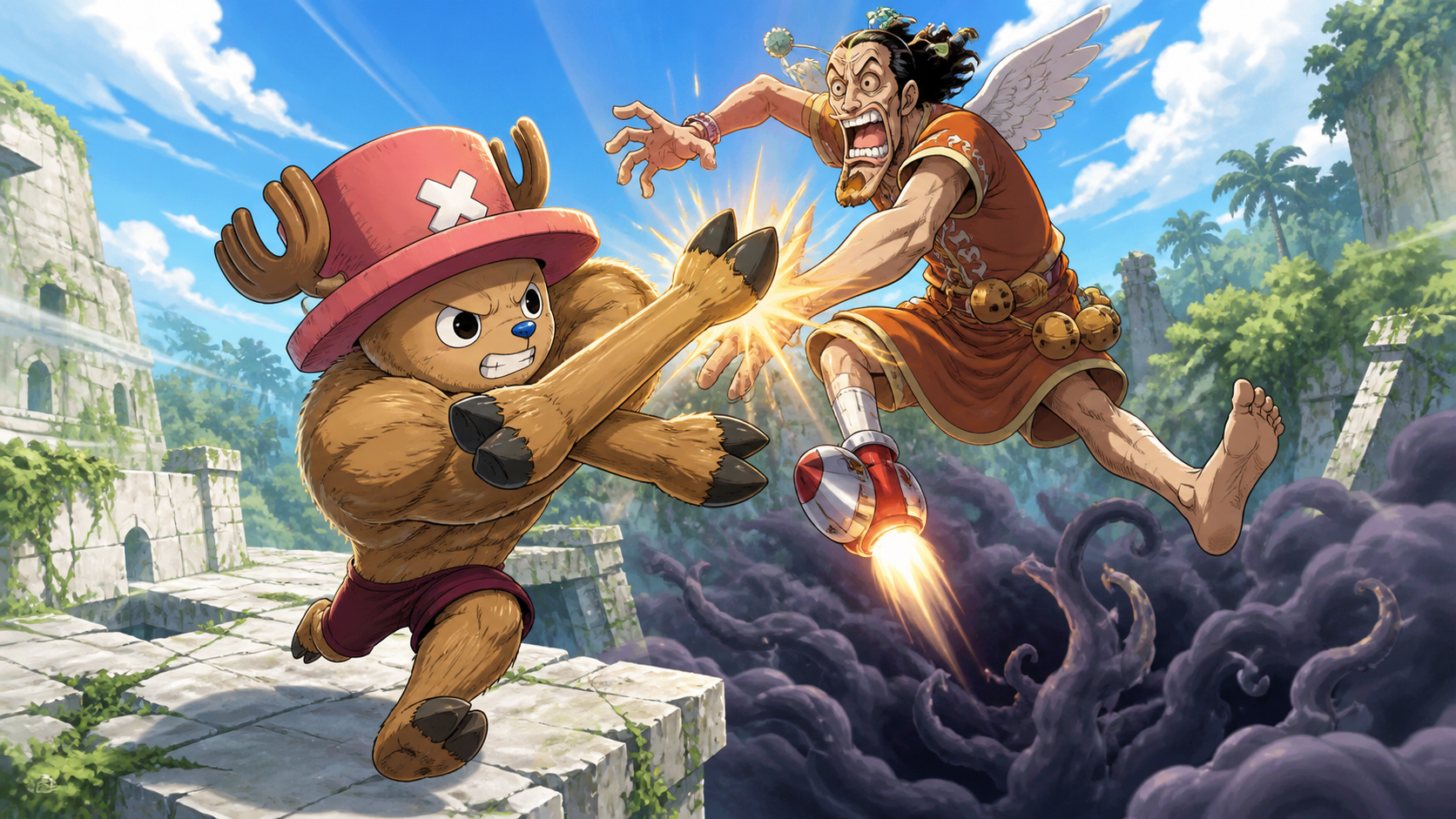
Chopper grabs Gedatsu’s foot and removes one Milky Dial shoe. Gedatsu kicks him away without noticing the missing control.
One functioning shoe can still produce thrust, but the force no longer passes evenly through the body. Rotation, drift, and uncontrolled descent become likely.
Chopper should move away from the remaining thrust line and keep the removed shoe from activating near him. Captured equipment remains active equipment until secured.
Gedatsu should stop, stabilize on solid ground, and inspect both feet. His failure to perform that basic check converts Chopper’s small intervention into the decisive system failure.
Chopper jumps into Gedatsu’s preferred sky and makes confidence do the chasing
Chopper leaps upward after dodging another swamp-cloud attack. Gedatsu declares the sky his domain and follows without confirming whether both shoes remain attached.
The bait works because confidence outruns inspection. Gedatsu believes elevation restores his advantage, while Chopper knows the priest now carries only half a flight system.
Chopper still accepts risk by entering open air. He needs a planned landing point, awareness of swamp clouds below, and enough transformation time to deliver the counter before falling.
A better priest would remain at range and test mobility first. Gedatsu’s title gives him confidence without the discipline required to protect his tools.
Arm Point converts Chopper’s diagnosis into one committed strike
Chopper shifts into Arm Point and uses Kokutei Cross against Gedatsu. The enlarged forelimbs concentrate his strength into a cross-shaped hoof impact.
The attack follows a complete sequence: observe the propulsion system, remove one control, lure the opponent upward, evade Jet Punch, then strike while balance is compromised.
Chopper’s medical knowledge supports the fight because he looks for function rather than spectacle. He defeats a system before trying to defeat the whole body.
After landing, he should check his own shoulders, forelimbs, and breathing. Transformation and aerial impact can create injury even when the finishing move succeeds.
Gedatsu falls into the same swamp he controlled
The strike sends Gedatsu into a swamp cloud. The priest who used hidden ground against visitors now depends on recognizing his own trap and escaping correctly.
Chopper celebrates too early when Gedatsu continues moving. A submerged opponent may still activate Dials, grab a rescuer, or disrupt the surface beneath nearby ruins.
Chopper should maintain distance, secure the removed shoe, and watch for an exit path rather than shouting instructions toward the hazard.
If rescue becomes possible without endangering others, capture provides more intelligence than an uncontrolled fall. Gedatsu knows Enel’s systems, routes, and priest operations despite his poor attention.
The remaining Milky Dial pushes Gedatsu deeper instead of free
Gedatsu activates the shoe still attached to his foot while buried in swamp cloud. The thrust drives him farther into the trap because his body orientation points the wrong way.
Propulsion has no judgment. A powerful device follows its alignment even when the operator’s intended destination lies in the opposite direction.
The result validates Chopper’s system diagnosis but creates an uncertain fall toward the Blue Sea. Nobody on Upper Yard can confirm survival from the edge.
Future Dial training should require orientation checks before activation, paired-control failure drills, emergency cutoff access, and restraints that keep critical footwear attached.
Chopper earns the victory without becoming careless about the aftermath
Chopper praises himself for defeating a priest alone. The pride is deserved after fear, separation, and an opponent with lethal terrain control.
Victory does not end his responsibilities. Gedatsu’s swamp clouds remain, Robin faces Yama, Merry holds injured crewmates, and Chopper still lacks a route back to the people who need a doctor.
He should recover the loose Dial shoe, mark the swamp, note Gedatsu’s last trajectory, and search for a signal from Robin without entering the damaged ruins blindly.
The crew should recognize the win as evidence that Chopper can analyze and execute under pressure, not as permission to leave him isolated in every future crisis.
Shandora needs defenders who value evidence as much as victory
Robin’s discovery and Yama’s destruction establish the episode’s larger conflict. Shandora can survive centuries and still lose irreplaceable evidence during one careless afternoon.
The Shandians fight for homeland, Robin searches for history, and Enel searches for gold. Those objectives overlap physically without carrying equal ethical claims.
Any alliance against Enel needs a preservation plan: protected zones, named custodians, mapped damage, no heavy weapons near unstable structures, and shared decisions about recovered objects.
Defeating commanders matters because their attacks kill people. Protecting the ruins matters because cultural destruction can outlast every person currently fighting.
RaeRae’s verdict gives Chopper the win and confiscates Gedatsu’s shoes
Keep this one. Chopper turns panic into diagnosis, identifies the two-shoe flight dependency, removes half the system, and lets Gedatsu’s confidence handle the remaining sabotage.
Robin supplies the heavier truth. A monument gives Shandora back its name while Yama proves that somebody can search for a golden city and still destroy the map under his own feet.
The action list stays crowded: secure the Milky Dial shoe, mark every swamp cloud, find Robin, treat Sanji and Usopp, document Yama’s ruin damage, and locate Luffy somewhere inside Nola.
RaeRae’s final note: if one rocket shoe is missing, do not leap over a bottomless swamp to demonstrate aerial superiority. That sentence should not require a doctor, yet Chopper apparently works in preventive care now.