
RaeRae Reacts · One Piece Episode 171
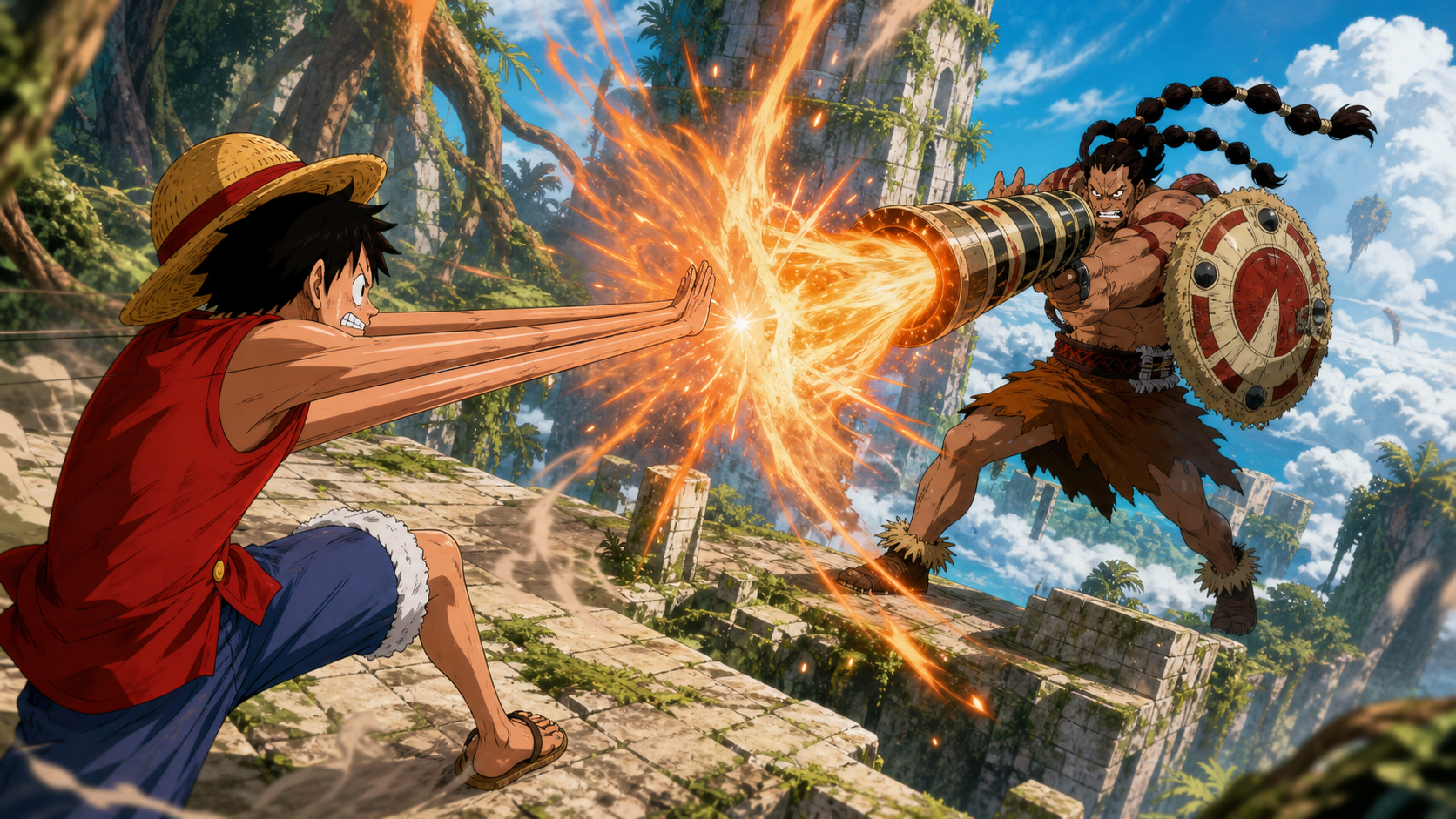
Wyper Answers Luffy with the Burn Bazooka
One Piece Episode 171 pits Luffy against Wyper’s Burn Bazooka while Enel reveals six years of forced labor and leaves Merry under attack.
Usopp checks the wrong side and turns first aid into a panic spiral
Episode 171 opens on Merry with Sanji down after Enel’s lightning strike. Usopp checks for a heartbeat on the wrong side of Sanji’s chest and announces the worst before Nami corrects him.
The mistake is funny only because Sanji remains alive. During an electrical emergency, a rushed declaration can waste seconds, spread panic, and push another crewmate into a reckless attack.
Usopp should check breathing, look for movement, feel for a central pulse if trained, and keep Sanji clear of further current. Nami should assign tasks instead of letting everyone crowd the patient.
Sanji needs monitoring for irregular heartbeat, burns, confusion, breathing changes, and delayed collapse. Consciousness alone would not prove that the electrical injury ended safely.
Finding Sanji’s heartbeat restores hope without restoring the battlefield
Usopp finds the heartbeat after moving his hand to the correct side. Relief matters, but Enel remains on deck within striking distance of every person and every escape system.
Nami and Gan Fall should move Sanji behind hard cover while Pierre stays clear of electrical arcs. Nobody should lift him by bare contact if current may still travel through wet wood or metal fittings.
The crew lacks Chopper, which makes observation and documentation more important. Time of strike, time unconscious, visible burns, pulse changes, and any new symptoms should reach the doctor later.
Merry also needs inspection after Enel leaves. Lightning can damage rigging, stored Dials, wood, fasteners, navigation equipment, and hidden structural points without an obvious hole.
Usopp’s eight-thousand-followers lie meets an opponent who already counts everyone
Usopp threatens Enel with the familiar claim that eight thousand followers stand behind him. Against ordinary intimidation, the lie can create hesitation long enough for an escape.
Enel has already counted eighty-one participants across Upper Yard through Mantra. A fabricated army cannot frighten somebody whose power depends on surveillance and numerical control.
Usopp should use lies that exploit uncertainty Enel actually has, such as hidden Dial arrangements or an evacuation already underway. Inflating a population Enel can sense invites immediate exposure.
The failed bluff still reveals Usopp’s protective instinct. He places himself between Enel and the others, but bravery needs an exit route when the opponent can answer speech with lightning.
Enel drops Usopp because humiliation is part of his command style
Enel strikes Usopp after the bluff. The attack adds another unconscious crewmate beside Sanji and leaves Nami and Gan Fall responsible for defense, treatment, and the ship at once.
Enel could simply depart, yet he punishes contradiction. His rule relies on making resistance appear foolish before making resistance physically costly.
Nami should not rush toward Usopp until Gan Fall knows Enel has stopped discharging power. One electrical casualty becoming three would serve Enel’s demonstration perfectly.
Once the deck is safe, Usopp needs the same cardiac and burn assessment as Sanji. Separate strike times and symptoms must remain separate in Chopper’s later evaluation.
The Divine Squad has spent six years building Enel’s hidden objective
Enel tells Gan Fall that captured members of the Divine Squad have labored without rest for six years. The missing workers were not merely imprisoned. Their skill and bodies were converted into infrastructure.
Gan Fall now has evidence of forced labor under Enel’s rule, but no location, health status, or extraction route. Rescue planning must begin with those unanswered questions.
Enel’s phrasing treats completion of their labor as completion of their usefulness. That change raises the immediate risk of abandonment or execution once the project no longer needs workers.
Gan Fall should record names, trades, family connections, and last known assignments. A rescued workforce cannot be restored as one anonymous group after six years of coercion.
Enel names the City of Gold and admits everyone has been searching the same ground
Enel explains that Upper Yard contains more than Vearth. Straw Hats, Shandians, Enel’s forces, and Enel himself are converging on the legendary City of Gold.
The revelation reframes his interest in the island. Religious authority provided obedience while forced labor pursued material and technological goals beneath the mythology.
Gan Fall should warn every resistance group that Enel knows the target and likely knows more about access than they do. Archaeological evidence, workers, and routes are now urgent protection priorities.
The City cannot become a prize awarded to whoever reaches the ruins with the strongest weapon. Shandian history and Robin’s evidence demand stewardship beyond possession.
Enel joins his own Survival Game after writing every rule
Enel calls himself a participant in the final game. The label pretends equality while he controls surveillance, soldiers, priests, timing, and the power to strike people across distance.
A ruler does not become a fair contestant by stepping onto the board he designed. Every rule still protects his advantages and hides his larger destination.
Opponents should reject the five-survivor target entirely. Their objective is evacuation, alliance, rescue of forced workers, preservation of the ruins, and removal of Enel’s command structure.
Gan Fall’s questions keep Enel talking, but the crew needs a signal for when conversation ends. Hotori and Kotori arrive before anyone aboard reorganizes.
Hotori and Kotori inherit Satori’s grievance without inheriting the facts
Satori’s brothers appear to avenge him after Enel leaves. They treat Merry’s remaining defenders as one guilty unit and ignore that Satori attacked the crew inside a lethal Ordeal.
Revenge gives them a simple target while Enel escapes responsibility for creating the entire system. The brothers defend a hierarchy that treats priests as expendable game pieces.
Gan Fall can identify their Dial methods and history, while Nami can keep distance through movement and deck obstacles. Fighting beside two unconscious crewmates requires containment rather than pursuit.
The defenders should protect the mast, helm, rigging, and patients first. A victory that destroys Merry would still strand the crew in Enel’s territory.
Luffy tells Wyper ordinary cannons cannot hurt rubber
Across Upper Yard, Luffy explains that bullets and conventional cannon force do not work normally against his rubber body. The statement answers Wyper’s current weapons but also gives Wyper a design requirement.
Sharing a resistance profile during combat can deter an opponent who lacks alternatives. Wyper carries adaptable sky technology and immediately treats the information as a problem to solve.
Luffy should use the opening to name Enel as the shared enemy rather than challenge Wyper to escalate. Wyper should recognize that a durable outsider could become useful against Enel.
Both choose proof over coordination. Their fight becomes a rapid weapons-development meeting where every demonstration lands on a human body.
A Flavor Dial converts Wyper’s bazooka from impact to combustion
Wyper adds a Flavor Dial and turns the weapon into a Burn Bazooka. Stored gas or combustible material changes the attack from blunt force into heat, flame, and pressure.
Rubber resilience against bullets does not guarantee protection from burns, oxygen loss, blast heat, or fire spreading across clothing and terrain. Wyper attacks the vulnerability Luffy just left unaddressed.
The modification also introduces hazards for the operator. Fuel storage, ignition timing, leaks, wind direction, and heat near the Dial all need control before firing.
Wyper uses the tool effectively, but battlefield success should not hide unsafe handling. A damaged or overheated Dial beside his shoulder could injure him before Enel enters range.
The Burn Bazooka cuts a burning lane through Upper Yard
Wyper fires a concentrated blast powerful enough to tear through the forest and threaten Luffy beyond ordinary projectile damage. The attack proves the adaptation worked.
The environmental cost is immediate. Fire across giant roots and dry vegetation can spread toward ruins, fighters, trapped soldiers, and people neither combatant can see.
Wyper should fire toward cleared ground or sky whenever possible and keep another warrior assigned to watch for secondary fire. Luffy should move across the firing line rather than retreat straight backward.
After exposure, Luffy needs checks for burns, smoke inhalation, damaged hearing, and hidden impact injury. Remaining conscious does not close the medical file.
Luffy’s rubber bazooka answers force with force and solves nothing political
Luffy stretches both arms behind him and launches Gum-Gum Bazooka as Wyper commits to his own weapon. The collision throws both fighters away from the center.
The exchange proves neither man can remove the other cheaply. That result should create negotiation, because continuing only spends strength Enel expects them to waste.
Luffy needs his crew, Wyper needs his homeland, and both need Enel defeated. Their objectives differ after that point, not before.
A ceasefire would preserve Wyper’s ammunition and injured body while keeping Luffy available for the opponent whose lightning may behave very differently against rubber.
Wyper finally saves his strength for Enel after spending too much on Luffy
Wyper decides that killing Luffy would waste energy needed for Enel. The conclusion is correct and late.
He has already fired ammunition, exposed the Burn Bazooka, absorbed Luffy’s counterattack, and stressed a body carrying injuries from Shura and the Reject Dial.
Future resistance planning needs engagement rules: avoid fighting outsiders unless they protect Enel, threaten Shandian civilians, or block an urgent objective after communication fails.
Luffy also needs enough context to stop treating every refusal as a challenge. Leadership includes recognizing when another person’s anger belongs to a history he has not heard.
Nola swallows Luffy before the ceasefire can become an alliance
The giant python appears and swallows Luffy, leaving Wyper unsure where his opponent went. Luffy enters a dark enclosed space he mistakes for an underground ruin.
Wyper should mark the snake’s direction and warn anyone nearby. A missing fighter inside a moving creature cannot be found by searching a fixed impact site.
Luffy should avoid uncontrolled attacks until he understands the enclosure. Fire, sharp debris, toxic fluid, collapsing tissue, or a narrow airway could make a blind strike worse.
The disappearance also removes a potential Enel counter from the battlefield. Every group needs a shared signal for Nola sightings and swallowed personnel.
Genbo clears Divine Soldiers until Yama turns mass into a weapon
Genbo overwhelms ordinary Divine Soldiers with iron cannonballs, showing that organized troops do not equal individual superiority. Yama enters after the squad fails.
Genbo’s weapon offers range and heavy impact, but Yama dodges and kicks a cannonball back. A projectile without a safe return path becomes ammunition for the opponent.
Genbo should change angle, avoid firing directly along Yama’s approach, and withdraw once the commander demonstrates control over the shot. Pride cannot justify repeating a compromised attack.
Nearby Shandians need to record Yama’s speed, size, and counter method. Intelligence survives a defeat only when someone carries the observation forward.
Axe Mountain defeats Genbo through terrain-scale force
Yama uses Ten-Fold Axe: Axe Mountain to crush Genbo’s resistance. The attack makes body mass, momentum, and the surrounding ground part of one impact system.
Genbo requires immediate assessment for spinal injury, internal bleeding, breathing problems, fractures, and loss of consciousness. Moving him without stabilization could compound the damage.
Other warriors should not approach Yama in a tight cluster. His area force can convert a rescue attempt into multiple casualties.
A safer response uses separation, ranged distraction, and terrain that cannot support his charge. Defeating Yama may require redirecting momentum rather than meeting mass directly.
Chopper finds Gedatsu while Merry faces two new priests
Chopper encounters Gedatsu at the ruins just as Nami and Gan Fall prepare for Hotori and Kotori aboard Merry. The separated crew now faces three priest-linked threats across two locations.
Chopper has no backup and no knowledge that Sanji and Usopp need medical care. Nami has patients but no doctor. Separation has placed the needed resource farthest from the urgent need.
Chopper should prioritize escape and communication unless Gedatsu blocks every route. Nami should protect Sanji and Usopp rather than chase Satori’s brothers away from the ship.
Every victory must shorten the separation problem. Combat that sends another person deeper into Upper Yard serves Enel’s countdown.
RaeRae’s verdict keeps the Burn Bazooka and rejects Enel’s rigged game
Keep this one. Wyper hears that bullets fail and upgrades the question, Luffy answers a flame cannon with both palms, and Enel explains six years of forced labor like a project update nobody requested.
The Burn Bazooka works because Wyper targets a different damage mechanism instead of increasing the same failed force. The operational cost remains fire, fuel risk, exposed technology, and energy spent on the wrong opponent.
The rescue list now includes Sanji, Usopp, the Divine Squad, Genbo, Luffy inside Nola, Chopper near Gedatsu, and Merry under attack from Hotori and Kotori.
RaeRae’s final note: when two enemies of the lightning dictator invent matching bazookas for each other, Enel does not need prophecy. He only needs everyone to keep refusing introductions.