
RaeRae Reacts · One Piece Episode 147
Dreams Need More Than Belief
One Piece Episode 147 contrasts Blackbeard’s dream speech with Luffy’s caution, Shoujou’s destructive sonar, and Bellamy’s pursuit of Cricket’s gold.
Bellamy keeps hitting after the argument has already ended
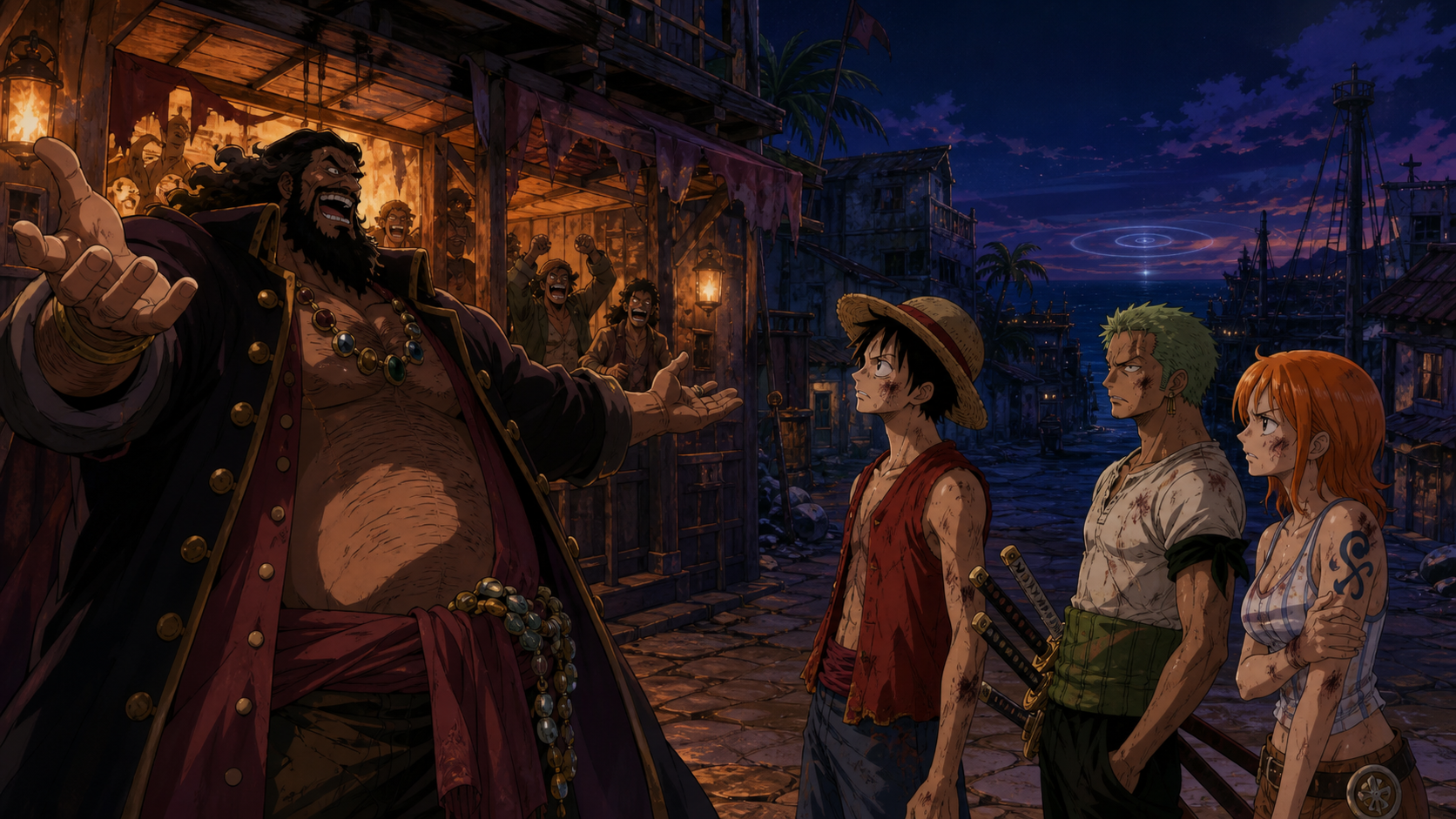
Episode 147 resumes with Luffy and Zoro refusing to retaliate while Bellamy’s crew continues the beating. The bar treats their restraint as permission for more violence.
Bellamy no longer tests strength or defends a claim. He punishes people for denying him the fight that would make his philosophy feel important.
Nami should move bystanders clear, identify an exit, and keep watching for head injury or loss of consciousness. The bartender should stop serving the aggressors and preserve witness accounts.
Refusal needs a stopping plan. Luffy and Zoro can choose not to strike while still leaving, shielding one another, and ending Bellamy’s physical access.
The crowd mistakes endurance for public property
Mock Town’s patrons laugh as bodies hit the floor. Group approval turns assault into entertainment and makes intervention socially expensive.
People who fear Bellamy may perform enthusiasm to avoid becoming targets. That pressure does not erase responsibility, but the safest intervention may involve opening an exit, calling allies, or documenting from distance.
The venue should have rules that apply regardless of bounty or affiliation. A customer cannot become available for unlimited violence because another customer calls him weak.
Workers and witnesses also need protection after the incident. Bellamy’s influence can reach anyone who contradicts his version of events.
An incident record should center the people harmed rather than Bellamy’s performance. Times, injuries, damaged property, attempted exits, and witness locations matter more than repeating every insult. Survivors should control whether names become public when disclosure could invite retaliation.
Bellamy orders the injured men removed like broken furniture
After tiring of the assault, Bellamy calls Luffy and Zoro eyesores and has them thrown out. He treats the damage he caused as contamination of his space.
Removal should become evacuation rather than another attack. Nami needs control of their heads, necks, and injured limbs while moving them.
The crew should not return to the Merry without medical assessment, water, and a record of symptoms. Walking away does not prove fitness for sailing.
Bellamy wants the final image to show discarded losers. Leaving together preserves a truth he cannot control: neither man accepted his terms.
Nami’s anger names the cost of a choice she cannot fully share
Nami understands why they rejected the fight and still hates watching friends bleed. Her reaction does not become less valid because Luffy’s restraint carries meaning.
The group needs a later conversation about bodily autonomy, command authority, and what each person may reasonably ask another crewmate to endure.
Luffy should explain why Bellamy was not an opponent without dismissing Nami’s fear. Zoro should confirm that he chose the same boundary rather than merely obeying.
Nami can respect their decision while insisting on medical care and a safer exit plan next time. Respect does not require emotional silence.
Blackbeard says the fight belonged to Luffy and Zoro
Outside the bar, the large stranger from the pie argument tells Nami that Luffy and Zoro won. He measures victory by whose convictions changed, not whose fists landed.
His statement validates their agency without repairing injuries or revealing his own motives. Agreement about one principle does not create trust.
Nami should remain cautious because the man observed the violence and chose commentary after the danger rather than intervention during the assault.
Luffy and Zoro also owe him no response. They can recognize the idea while refusing the relationship he appears to invite.
Dreams can never end and still become dangerous
Blackbeard declares that people’s dreams never end. The sentence answers Bellamy’s cynicism with a belief Luffy clearly understands.
A dream alone does not establish ethics. Ambition can build community, inspire research, excuse exploitation, or destroy anyone treated as an obstacle.
The crew should judge methods, consent, and consequences rather than assuming all dreamers belong on the same side.
Blackbeard’s intensity feels familiar because he refuses Mock Town’s smallness. The discomfort comes from sensing that the same language may support a very different form of freedom.
Trust requires patterns beyond one speech. The crew would need to observe how he treats subordinates, strangers, promises, resources, and people who obstruct his goal. Shared rhetoric can open a conversation; repeated conduct decides whether anyone should follow.
Luffy and Zoro identify a group without explaining the inference
When Nami asks about the stranger, Luffy and Zoro indicate that the danger extends beyond one man. The episode leaves their evidence incomplete.
They may have noticed other unusual people in town, coordinated behavior, or a shared presence. Uncertainty should remain uncertainty rather than becoming a confident theory.
The crew can compare descriptions of the distant marksman, the public fighter, the sick doctor, and the bearded speaker once everyone reunites.
Threat assessment improves when observations remain separate until patterns earn a conclusion. Mystery should not replace disciplined reporting.
Leaving Mock Town protects the real mission
The crew came for a route to Sky Island, not Bellamy’s approval. Remaining in town would expose them to more violence while the Log Pose reset window continues.
Nami should confirm supplies, crew count, injury status, and the Eternal Pose bearing before departure. A rushed exit can create a second emergency at sea.
They should also document what the bartender and crowd said about the Knock Up Stream. Ridicule may still contain route names, failure patterns, and local vocabulary.
Strategic withdrawal keeps time, evidence, and ship integrity focused on the destination Bellamy wanted them to abandon.
Robin’s search for Cricket leaves a trail Bellamy can follow
People in the bar discuss a strong woman asking about Mont Blanc Cricket. Her information gathering becomes public gossip.
Robin needs sources, but repeated questions can expose the target and the crew’s route to hostile listeners. Bellamy immediately pays attention when gold enters the story.
A safer approach would use separate sources, avoid naming treasure, and warn Cricket that others may follow.
Information work creates duties toward the person being investigated. Finding a guide should not make his home easier to raid.
Robin should also distinguish a contact point from a residence. Meeting Cricket at a neutral shoreline or sending a message through trusted salvagers would reduce the chance that every listener learns where he sleeps and stores recovered objects.
Cricket’s reported gold turns a person into a destination
Mock Town reduces Cricket to a recluse with valuable treasure. His history, work, and safety disappear behind the rumor.
Bellamy hears profit and asks for the location. The crowd’s casual disclosure may become direct assistance to a robbery.
Residents should not publish remote homes, medical vulnerabilities, or asset claims to armed visitors. A source can offer contact through an intermediary instead.
The Straw Hats need information from Cricket, not ownership over anything he recovered. Their approach should begin with consent and a clear explanation of the Sky Island evidence.
Shoujou claims a toll because his crew controls the water
At sea, Shoujou blocks passage and demands payment through territory associated with the Saruyama brothers. The claim resembles Masira’s ownership assertion over wrecks.
Control created by force does not automatically establish a legitimate toll. Travelers need notice, rates, safe passage standards, and a process for disputes.
The Straw Hats should state their route and seek a nonviolent crossing before challenging the claim. Injury and ship damage from Mock Town make another fight especially risky.
Shoujou’s crew may also depend on local salvage income. Understanding that economy can support negotiation without accepting unlimited authority.
Luffy insults Shoujou’s appearance without needing to
Luffy comments on Shoujou’s unusual appearance, and the crew reacts as though their captain has been demeaned. The remark adds conflict to an already tense encounter.
Curiosity should not become public evaluation of another person’s body. An apology can be brief, direct, and free from excuses.
Shoujou chooses not to center the insult at first, which creates an opening for practical discussion. The Straw Hats should use that opening instead of escalating.
Respectful language matters even among opponents. Dehumanizing comparisons make later violence easier to justify on both sides.
Shoujou boasts about becoming a Warlord without evidence
Shoujou claims Crocodile’s removal may create an invitation for him. The boast treats government recognition as proof of strength and status.
No invitation, criteria, or official contact supports the expectation. His crew should separate ambition from operational reality.
Joining a state-backed pirate system would create obligations, enemies, and scrutiny beyond local salvage waters. The decision cannot rest on vanity.
Luffy’s lack of interest frustrates Shoujou because the boast needs an audience. Refusing the status performance can be safer than debating worth.
Mentioning Masira changes the encounter into family retaliation
Luffy says they kicked Masira and assumes he survived. Shoujou hears harm against his brother rather than the complicated salvage dispute.
The crew should give a factual account: the wreck, turtle, divers, conflict, and last known condition. Casual phrasing makes unnecessary hostility sound deliberate.
Shoujou deserves confirmation of Masira’s safety. The Straw Hats can offer location data and a route back without surrendering to violence.
Family loyalty can motivate rescue, but retaliation before verification may harm the very people who can help find the missing person.
A responsible notification should include Masira’s last known coordinates, physical condition when last seen, names of witnesses, and the turtle’s direction. Vague reassurance or jokes about survival force Shoujou to fill missing facts with worst-case assumptions.
Havoc Sonar damages both ships
Shoujou unleashes a powerful voice attack that distorts and damages vessels across the water. His own ship suffers alongside the Merry.
A weapon that cannot distinguish target from operator creates unacceptable risk around crew, rigging, hull seams, and nearby marine life.
Nami should order distance at an angle that reduces exposure while Usopp and Sanji secure vibrating equipment. Chopper needs hearing protection and assessment for balance problems.
Shoujou’s people should have shutdown signals and authority to stop him. Loyalty does not require remaining aboard while the captain destroys their only transport.
Nearby wildlife and coastal workers also receive the blast without participating in the dispute. A weapon whose effects travel through water needs an exclusion radius, advance warning, and environmental monitoring before any claimed defensive use.
The Merry needs inspection after resonance damage
The Straw Hats escape the attack, but visible survival cannot prove the hull remains sound. Sound and vibration can loosen joints without obvious holes.
They should inspect mast fittings, rudder, seams, nails, stored glass, navigation instruments, and every repair already weakened by earlier events.
Chopper should check ears, headaches, nausea, confusion, and falls. Acoustic exposure can create injuries people minimize because no blood appears.
The route to Sky Island already demands unusual stress. Carrying hidden resonance damage into a vertical current would multiply danger.
Usopp should mark every newly loosened joint so later repairs remain traceable. Nami can compare compass behavior before and after the blast, since vibration may damage instruments even when the casing looks intact.
Bellamy chooses Cricket before understanding the story
Back in Mock Town, Bellamy hears about gold and decides to visit Cricket. He needs no evidence that the treasure is unclaimed or that Cricket will consent.
The planned encounter grows from the same philosophy used against Luffy: visible force grants access, and another person’s dream becomes a joke until profit appears.
Witnesses should warn Cricket and document Bellamy’s stated interest. Silence after disclosing the location would deepen their responsibility.
The Straw Hats are moving toward Cricket for knowledge, while Bellamy moves toward him for extraction. The difference will matter more than either group’s claim to strength.
Episode 147 makes shared belief an ethical warning
Blackbeard speaks the language Luffy lives by, yet Luffy does not embrace him. The episode understands that two people can defend dreams while disagreeing about every cost they may impose.
Shoujou offers a smaller version of the same problem. His ambition, family loyalty, and territorial pride are real, but sonar turns those motives into danger for his own crew.
RaeRae’s verdict: keep this one. Episode 147 refuses the easy comfort of finding another dreamer. Bellamy has no dream worth admitting, Blackbeard has one too large to trust blindly, and Cricket becomes a target before he enters the room. Belief matters. Method matters more. The road to Sky Island now runs through people whose ambitions can guide, exploit, protect, or sink everyone around them.