
RaeRae Reacts · One Piece Episode 146
Mock Town Laughs at Dreams
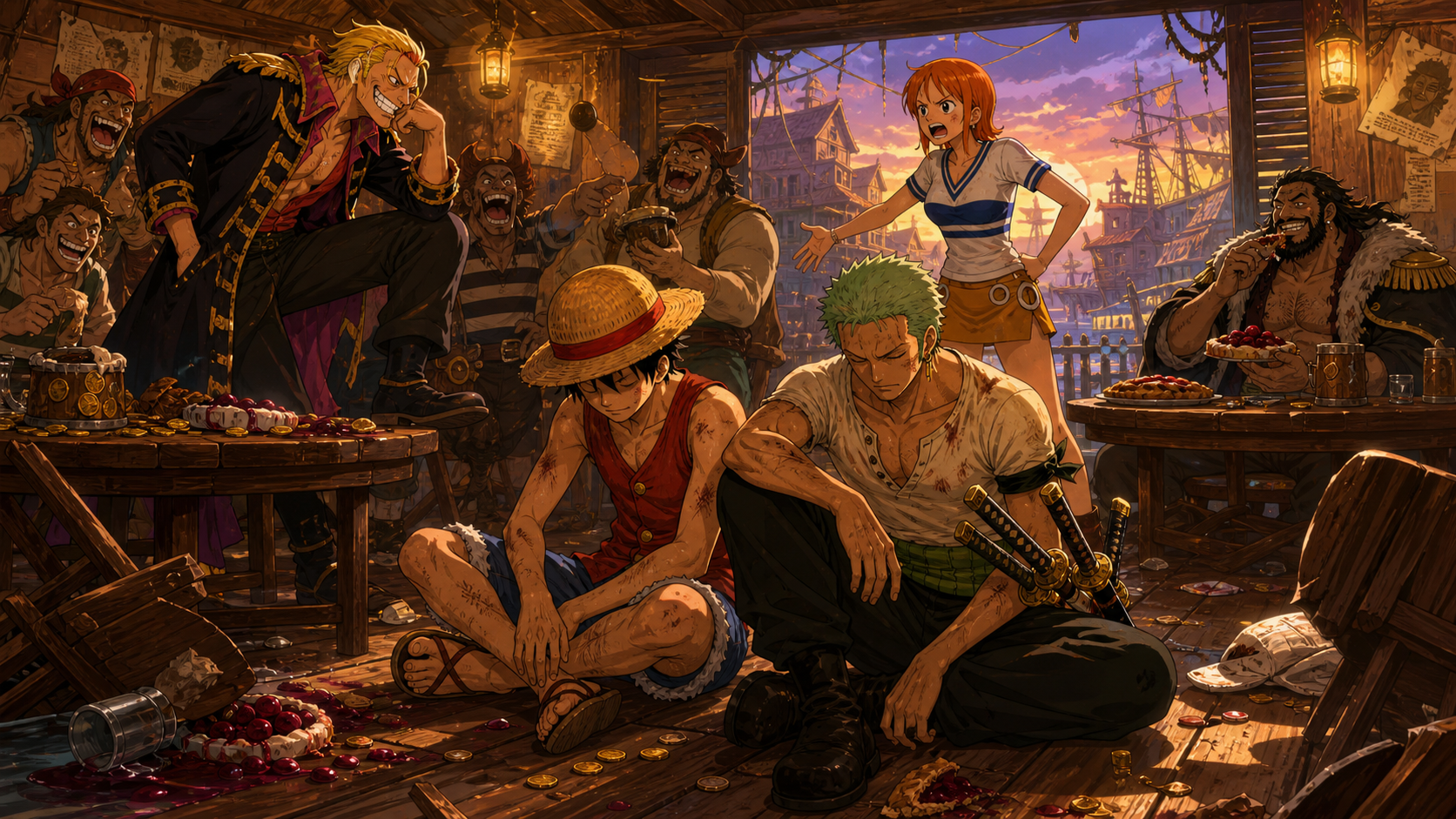
One Piece Episode 146 turns Mock Town into a pressure test where Bellamy weaponizes ridicule and Luffy and Zoro refuse to let him choose the fight.
Bellamy turns a card loss into permission to punish Roshio
Episode 146 opens with Roshio winning a gambling round and Bellamy refusing the result. Bellamy does not produce evidence of cheating. He decides that losing feels impossible and makes accusation replace proof.
Sarquiss supports the lie because power has already chosen the verdict. A witness who depends on the accuser cannot create a fair process.
The game should stop, money should remain untouched, and neutral people should review cards, stakes, and rules. Roshio needs a safe exit before anyone debates the result.
Bellamy’s violence reveals the real purpose. He wants public dominance, not game integrity. Mock Town rewards the spectacle because fear keeps everyone from challenging the manufactured story.
Any gambling venue taking a cut from the game also carries responsibility for dispute rules and security. A house that collects money while allowing the strongest player to rewrite outcomes becomes part of the coercion, even when staff never throw a punch.
Roshio’s crew learns that reputation cannot guarantee protection
Roshio carries a bounty and a dangerous name, yet Bellamy defeats him while the room watches. Status offers no due process when a stronger group controls the witnesses.
His people need an emergency plan for detention, injury, and recovery rather than assuming the captain will always win. Crew loyalty should include medical aid and testimony after public humiliation.
Witnesses should record who accused Roshio, who handled the cards, who took the money, and which injuries followed. Silence allows Bellamy to repeat the claim as accepted fact.
A bounty measures government interest, not character, consent, or safety. Mock Town confuses all forms of notoriety with social permission.
Van Augur shoots birds from a distance nobody can see
Seagulls fall around the approaching Merry, and Usopp recognizes that the shots require extraordinary range. The shooter remains invisible from the ship.
Random fire would still demand immediate cover, but precision means someone observed and selected living targets. The crew may also be within range.
Usopp should estimate direction from wounds and fall pattern while Nami changes course enough to make the ship harder to predict. People should move behind solid structure rather than gather at the rail.
Van Augur treats life as proof of technique. Skill without accountability creates danger long before anyone knows the shooter’s name.
Burgess turns public combat into advertising
Jesus Burgess challenges people in Mock Town and celebrates strength before a crowd. The fight builds reputation through visible domination.
Consent becomes unclear when refusing can invite ridicule, retaliation, or loss of standing. A real contest needs rules, medical support, stopping conditions, and a way to decline.
Onlookers connect one defeated man to Roshio’s crew, making every injury part of a wider status war. Individuals become symbols for captains who may not know the fight happened.
Burgess should own the damage he causes instead of treating bodies as posters for his strength. Spectacle does not cancel duty of care.
Nami sets a no-fighting rule because information comes first
Before entering town, Nami makes Luffy and Zoro promise not to start a fight. A brawl could close every bar, source, workshop, and route they need for the Skypiea search.
The instruction is operational, not moral surrender. They can defend immediate life while refusing insults, provocation, and reputation contests.
Nami should define the boundary clearly: leave after verbal abuse, block an attack when escape fails, and regroup at the Merry if separated.
Everyone needs a check-in time and a signal for urgent departure. Mock Town’s violence makes wandering without communication a preventable risk.
Doc Q asks strangers for help before offering lethal apples
Doc Q collapses in the road and asks Luffy and Zoro to help him onto Stronger. They respond to visible need without demanding credentials.
He then offers apples, some of which can explode. A gift becomes a concealed hazard with no informed choice.
The crew should not eat unknown food from a stranger in a lawless port, especially after a suspicious collapse. Chopper can inspect unfamiliar items away from people and flame.
Doc Q’s weak appearance also complicates threat assessment. Disability or illness never proves harmlessness, and danger never cancels a person’s right to respectful assistance.
Sarquiss uses money to stage class humiliation
Sarquiss sees Luffy, Zoro, and Nami and throws money toward them while mocking their clothing. He wants gratitude to confirm his higher status.
Luffy considers taking the cash because money can be useful. Nami recognizes the social trap and pulls him away.
Accepting money would not make the insult deserved, but leaving denies Sarquiss the performance he wanted. The safest response avoids escalation while preserving dignity.
Mock Town’s wealth comes from pirates spending stolen or dangerous earnings. Expensive clothing does not establish competence, legitimacy, or freedom from exploitation.
The bartender explains an economy built around violent visitors
The bartender describes a port where wealthy pirates unload money and fights occur constantly. Local businesses profit while workers absorb the risk.
Staff need exits, barriers, safe rooms, first aid, and a rule for refusing service to armed people. Revenue does not make assault an ordinary workplace condition.
Residents may avoid attacking customers because pirate money sustains the town, but economic dependence can still function as coercion.
Nami should treat local advice as survival intelligence. A person serving drinks sees alliances, habits, and danger patterns that official maps never record.
The bartender should also have a way to preserve incident notes without Bellamy’s crew seizing them. Names, dates, injuries, unpaid damage, and witness accounts can establish a pattern when one event alone feels too dangerous to report.
Luffy and Blackbeard nearly fight over pie and drinks
Luffy hates the cherry pie and likes the drink. The large stranger beside him loves the pie and hates the drink. Their opposite reactions escalate into shouting.
A disagreement about taste carries no meaningful harm. Both men can order separately and stop treating preference as a challenge to identity.
The bartender should keep glassware and other patrons clear before noise becomes violence. Nami can redirect Luffy toward the actual information mission.
The exchange matters because two men with huge ambitions first meet through petty contradiction. Shared intensity does not create shared values.
Blackbeard dismisses Luffy’s stated bounty without verification
When Luffy names a thirty-million bounty, the stranger refuses to believe him. He measures credibility against appearance and his own assumptions.
Luffy does not need to prove government valuation to a man he just met. A bounty poster could confirm the number, but validation from Mock Town has no operational value.
Blackbeard’s skepticism reveals active threat assessment. He wants to know whether the person beside him matches the reputation described.
The crew should avoid broadcasting bounties in a town full of hunters, rivals, and opportunists. Personal pride can turn a meal into target identification.
Bellamy buys a drink to manufacture trust before the attack
Bellamy enters, identifies Luffy, and offers him a drink. Luffy reads the gesture as friendly and accepts.
Bellamy then slams his head into the bar. The gift created proximity and lowered caution, making hospitality part of the assault.
The bartender should stop service, clear bystanders, and preserve witnesses. Nami and Zoro need to assess Luffy for head injury before responding.
Bellamy’s behavior is not a test of pirate quality. He uses surprise against someone who accepted a peaceful signal, then calls the result strength.
Nami asks about Sky Island in the loudest possible room
Nami asks the bartender for information while Bellamy’s crew occupies the bar. The question reveals their destination to people already searching for leverage.
A quieter approach would identify navigators, salvagers, weather observers, or old residents separately. Public disclosure invites ridicule and misinformation.
Still, laughter does not disprove the upward Log Pose, falling ship, Skypiea map, or giant shadows. Social confidence cannot outweigh physical evidence.
Nami should record specific claims about the Knock Up Stream and ask who witnessed failed attempts. Even mockery may contain details worth verifying.
Mock Town uses laughter to police what people may investigate
The room erupts when Nami names Sky Island. Collective laughter tells every listener that curiosity will cost social safety.
People may join the ridicule to avoid becoming targets themselves. Volume and unanimity can reflect fear rather than evidence.
Nami should leave before the crowd turns into a mob, then compare statements outside Bellamy’s influence. One private witness may speak differently.
A community that punishes questions becomes easy to control. Bellamy benefits when nobody investigates possibilities beyond the status system he understands.
Bellamy declares that dreams belong to an obsolete age
Bellamy argues that every mystery can be explained and that pirates who chase dreams deserve contempt. He presents cynicism as maturity.
Explanation and ambition are not opposites. The crew has evidence and seeks a method. Competent research strengthens the dream rather than replacing the dream.
Bellamy avoids his own uncertainty by punishing anyone willing to admit desire. Mockery lets him feel above the risk of failure.
His philosophy also protects existing power. People who expect nothing beyond visible status will not challenge the rules that keep Bellamy important.
Luffy and Zoro decide Bellamy is not the opponent
Luffy unclenches his fist after hearing Bellamy’s view of dreams and tells Zoro they will not fight. Bellamy can injure their bodies without gaining authority over the destination.
The refusal mirrors a lesson Luffy learned earlier: some insults do not require violence because the fight would validate the aggressor’s terms.
That choice remains theirs. Nami’s promise created restraint, but Luffy continues after she releases him because he now understands the conflict differently.
Zoro follows without treating obedience as weakness. Shared discipline prevents Bellamy from separating them through humiliation.
Consent to non-retaliation should remain active rather than assumed. Luffy needs to confirm that Zoro understands the reason and agrees, because one captain’s philosophical stand cannot automatically require another person to absorb injury without a voice.
Nami changes the instruction when restraint becomes abuse
Nami sees Luffy and Zoro beaten and tells them to fight back. Her priority shifts from information gathering to stopping ongoing harm.
Changing a plan when conditions change is responsible leadership. She does not owe consistency to a rule built for a safer situation.
Luffy refuses for a different reason, so the group now needs communication rather than command repetition. Nami should move herself and bystanders toward safety while respecting his choice.
Afterward, they must discuss the difference between tactical restraint and silently accepting injury. No captain should make that decision for injured crewmates without explaining the stakes.
Nami’s reversal also protects future teamwork. If a rule becomes dangerous, crewmates need confidence that she will change course instead of defending the original instruction to preserve authority. Flexibility makes later orders easier to trust.
Refusing retaliation does not remove the need for care
Luffy and Zoro absorb repeated blows, broken furniture, and public humiliation. Their philosophical choice does not make the injuries harmless.
Chopper should check for concussion, fractures, internal bleeding, cuts, and vision changes. Alcohol and adrenaline can hide symptoms.
The crew should document Bellamy’s people, weapons, statements, and location. Refusal now does not prevent later action if Bellamy threatens someone they must protect.
Nami also deserves space to process fear and anger. Watching friends refuse defense can feel like abandonment even when their choice carries meaning.
They should not return to sea until Chopper clears both men for balance, concentration, and physical work. A head injury discovered during rigging or a vertical launch could endanger the entire crew long after Bellamy leaves the room.
Episode 146 separates having a dream from performing strength
Mock Town treats violence as evidence and hope as embarrassment. Bellamy wins applause by manufacturing cheating, ambushing trust, and beating people who choose not to answer.
Luffy and Zoro understand that striking back would make Bellamy the judge of whether Sky Island deserves pursuit. Their refusal keeps the question with evidence, navigation, and their own commitment.
RaeRae’s verdict: keep this one. Episode 146 makes restraint hurt and refuses to call pain weakness. Nami’s anger is valid, Luffy’s boundary is valid, and Bellamy’s laughter proves nothing except that Mock Town built an economy around people afraid to look foolish. A dream does not need victory in every room. Sometimes dignity means leaving the room without letting the loudest bully choose the fight.