
RaeRae Reacts · One Piece Episode 138
Zenny Pirates Launch
One Piece Episode 138 closes Goat Island with Minchey’s hostage operation, Zenny’s dangerous launch, the goats’ defense, and a different meaning of treasure.
Minchey arrives under a false public purpose
Episode 138 begins with a Marine operation presented as an island inspection. Minchey already knows Zenny’s name and believes an elderly former moneylender has hidden treasure. The official explanation disguises a private search for profit.
Public officers must state lawful authority, operational purpose, and the scope of any search. Deception used to protect a tactical approach may be narrowly justified, but deception used to steal property corrupts the whole mission.
Nami notices that Minchey knows details nobody shared. Her attention to language exposes the gap between the inspection story and the officer’s real knowledge.
The crew should preserve that discrepancy as evidence rather than only confronting him in the moment. Names used, orders given, ship markings, officer ranks, arrival time, and witness locations can later show that the operation was planned before any alleged violation on the island.
Chopper smells the force hidden in the fog
Chopper detects more gunpowder than one visible ship could carry, confirming that additional Marines are concealed nearby. The hidden fleet turns a conversation into an ambush.
Surveillance and concealment require command authorization, reliable intelligence, medical planning, and rules that protect residents. Fog, cliffs, goats, and a fragile patient multiply the chance of uncontrolled injury.
The crew should communicate the warning quietly, identify cover, keep civilians away from the shoreline, and avoid pointing weapons before they know where Usopp and other separated members are located.
Usopp becomes leverage against the whole crew
Hidden Marines capture Usopp and force the Straw Hats to lower their weapons. His body becomes the enforcement mechanism for Minchey’s demands.
Hostage-taking is not a lawful arrest technique. Officers must give commands to the person being detained, explain authority when conditions permit, use proportionate force, and protect detainees from retaliation. Threatening one person to control unrelated targets abandons those duties.
The crew’s compliance prioritizes Usopp’s immediate survival. Lowering weapons under coercion does not mean consent to search, surrender property, or accept Minchey’s private authority.
Usopp needs medical and psychological care after release even if no visible wound appears. A weapon threat can produce shock, sleep disruption, shame, and delayed fear. Debriefing should gather evidence without forcing him to repeat the experience for entertainment or prove that he was brave enough.
Minchey isolates the operation from honest command
A subordinate suggests contacting Captain Moore, and Minchey threatens the man because formal oversight would expose the treasure hunt. He has also paid Marines to support his side operation.
Bribed personnel remain responsible for their choices. Following orders cannot excuse hostage-taking, theft, concealment, or violence against residents. Every officer has a duty to refuse unlawful commands and preserve evidence.
Protected reporting channels matter because a subordinate who fears immediate retaliation may need a safe way to contact command. Moore cannot correct misconduct he never learns about.
Command should also examine how Minchey controlled assignments, payroll, supplies, and communications. Corruption rarely depends on one decision. Weak oversight, cash payments, loyalty tests, and retaliation can turn an entire unit into protection for a superior’s private work.
Zenny recognizes corruption because he knows collection tactics
Zenny identifies Minchey’s bribery and mocks the officer’s claim to public service. A former private lender who once used bombs to collect debts understands how official language can hide personal leverage.
His insight does not erase his earlier coercion. The scene works because experience with wrongdoing can help someone identify another version without converting the witness into a moral innocent.
Zenny challenges Minchey to take the treasure himself. The challenge restores agency, though provoking an armed officer while medically fragile places both Zenny and the goats at greater risk.
The goats board as defenders rather than treasure
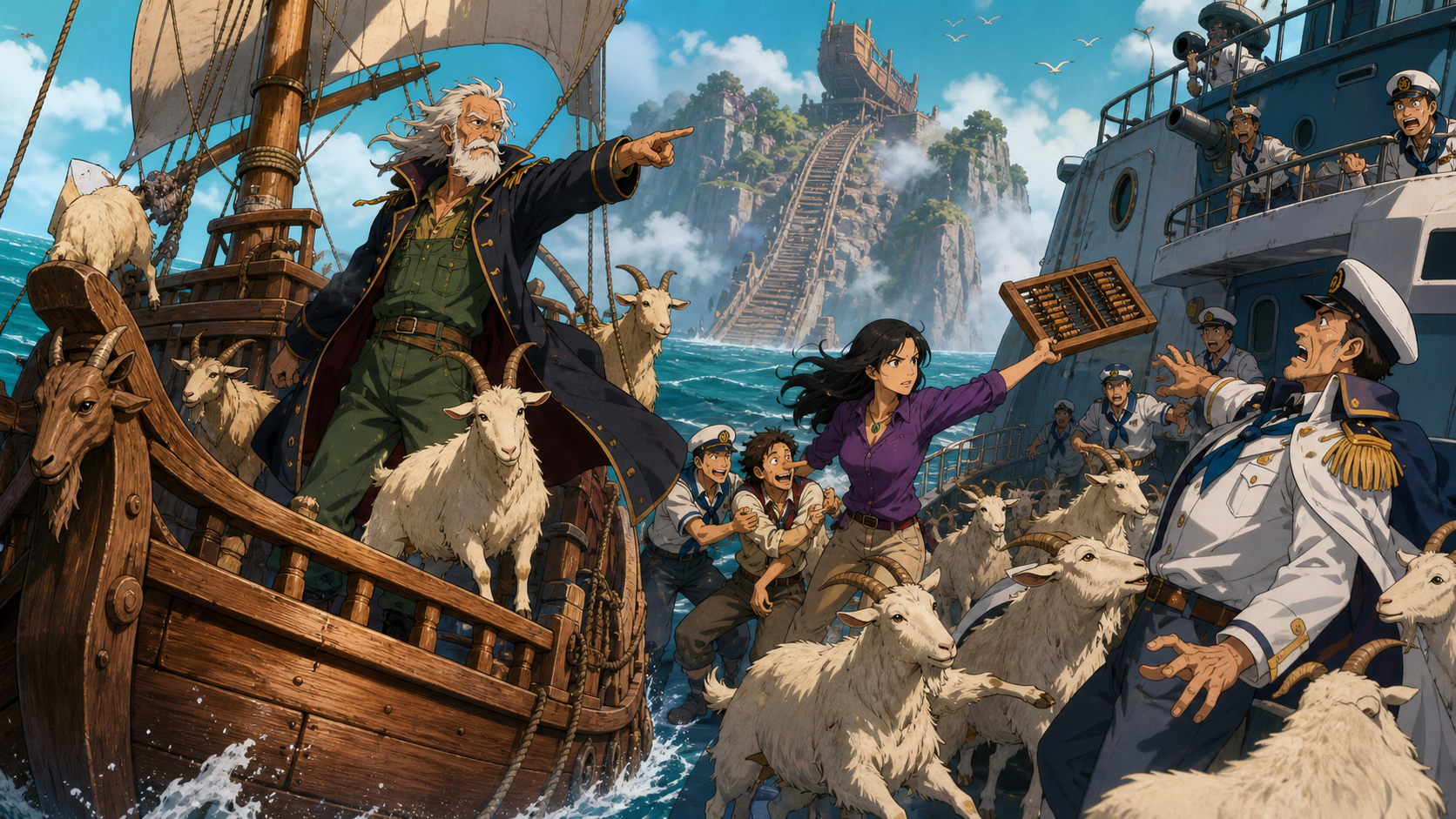
Zenny sends the herd onto the Marine vessel, where their numbers overwhelm the deck. Sailors hesitate because the animals are not conventional combatants and may be injured by ordinary weapons.
Animal deployment remains dangerous. Hooves can slip, rigging can trap legs, gunfire can trigger panic, and frightened goats can fall overboard. Zenny should direct them toward open routes and away from engines, weapons, and edges.
The Marines should de-escalate, lower weapons, create a clear exit, and use barriers rather than lethal force. Their obligation to protect life includes animals placed in danger by both sides.
Launching the mountain ship turns a dream into a public hazard
Zenny sends his handmade vessel down the mountain toward the sea. The moment delivers emotional release after twenty years of construction, but the launch path crosses terrain where people, goats, and structures may be struck.
A safe launch requires route inspection, engineered supports, braking systems, spotters, exclusion zones, tide timing, hull checks, and a contingency if the vessel veers. Nobody should stand downhill from an uncontrolled ship.
The Straw Hats helped repair the craft, so they share responsibility for whether the launch is safe. Encouragement cannot substitute for calculation.
The shoreline needs protection too. A heavy hull entering at the wrong angle can injure swimmers, damage the Merry, crush smaller boats, or disturb the seabed. A successful splash does not retroactively make an improvised launch responsible.
Zenny’s heart condition worsens during the fight
The exertion and chaos trigger chest pain. A medical warning everybody discussed now becomes visible while Zenny is isolated on a hostile deck.
Chopper needs immediate access, but the hostage situation and moving ships delay care. Emergency plans should identify how to reach the patient, where medicine is carried, and who can communicate symptoms if Chopper is blocked.
Zenny’s choice to fight deserves respect without romanticizing collapse. Agency includes accepting risk, yet informed choice depends on understanding alternatives and having rescue support.
Someone should record the time symptoms began, medications already taken, any blow to the chest, and whether Zenny lost consciousness. Those details help Chopper distinguish an expected episode from trauma, medication failure, or a worsening condition.
Minchey assaults a medically vulnerable elder
Minchey kicks Zenny and demands the treasure’s location while the elder is experiencing cardiac distress. The attack is punishment, interrogation, and exploitation of vulnerability at once.
Officers must obtain medical help for anyone in custody or under their control. Questioning should stop when a person’s condition threatens comprehension or survival. Pain cannot produce reliable consent or trustworthy information.
Other Marines have a duty to intervene. Rank does not transform an assault into policy.
Searching the whole island would multiply the abuse
When Zenny says he is broke, Minchey refuses to believe him and decides to tear through the island. Suspicion becomes an excuse for an unlimited search.
A lawful search needs probable cause tied to specific places or property, defined scope, documentation, and care for residents and animals. Treasure folklore cannot authorize destruction across an ecosystem.
Officers should inventory anything seized, photograph conditions, protect personal records, and repair avoidable damage. Minchey’s plan contains none of those safeguards because recovery was never his real purpose.
Robin’s abacus interrupts lethal force
Before Minchey can kill Zenny, Robin throws his abacus and disrupts the attack. The object represents Zenny’s history as a moneylender while becoming a tool that protects his remaining future.
Defensive force is justified by the immediate threat to life. Robin aims to stop the assault, not punish Minchey after control is restored.
The goats then trample and surround him. Once Minchey cannot continue the attack, the crew should restrain him, check injuries, and transfer him for accountable discipline rather than stage revenge.
Chopper reaches Zenny after the deck is secured
The Going Merry reaches the scene, and Chopper provides treatment. The rescue works because crewmates create access instead of expecting the doctor to fight through every obstacle alone.
Post-crisis care should include vital signs, medication, injury assessment, rest, and a review of what triggered symptoms. A fall, kick, stress response, or missed dose may each change treatment.
Chopper should also discuss what sailing will mean for future episodes. Stabilization does not make a weak heart disappear.
The missing treasure was converted to cash and eaten
Zenny finally explains that he converted his wealth to cash before pirates attacked and stranded him. When he woke, the goats had eaten the money, leaving no hidden fortune for Minchey or Nami to claim.
The story exposes the instability of wealth stored in one vulnerable form. Records, distributed reserves, secure containers, and trusted legal contacts could have reduced total loss.
Cash loss does not justify violence against the goats. Zenny survived because the herd became companionship, labor, warning system, and family after the money vanished.
Calling the goats treasure names relationship rather than price
Zenny’s answer changes the meaning of treasure across the arc. Minchey imagined property he could steal. Nami imagined a cache she could locate. Zenny names living bonds built over twenty years.
That language should never invite ownership transfer. The goats need a long-term care plan, veterinary resources, habitat protection, and a caregiver chosen before Zenny sails or becomes unable to manage daily work.
True value here comes from mutual dependence. The herd preserved his life after currency failed.
Moore removes rank instead of protecting the institution
The crew delivers Minchey to Captain Moore, who strips the officer of rank and calls him a disgrace. Visible discipline tells subordinates that bribery and private treasure raids are not accepted command practice.
Demotion alone is not a complete investigation. Moore should secure witnesses, financial records, communications, weapons, injury reports, and evidence about every participating officer. Usopp and Zenny deserve a process that does not depend on Marine self-protection.
Victims should receive medical costs, property repair, and notice of the outcome. Accountability needs more than one dramatic removal of epaulets.
Moore should separate implicated personnel before interviews and protect the subordinate who attempted to report the mission. Independent review would carry more credibility than asking Minchey’s closest colleagues to judge one another behind closed doors.
A debt of honor cannot replace equal enforcement
Moore says he still intends to capture the Straw Hats but owes them for exposing Minchey, so he allows Luffy to choose the battle location. The gesture separates gratitude from official duty, though the arrangement remains informal.
Public decisions should not depend on personal honor debts. Moore could document cooperation, decline immediate pursuit for safety reasons, or refer the matter to lawful review instead of inventing a private duel.
Luffy accepts because he values direct agreements, but the rest of the crew and every Marine vessel will bear the consequences of his chosen location.
The foggy reef turns Luffy’s guess into a mass casualty risk
Luffy points toward fog without understanding the reef, and the Marine fleet follows into rocks where ships run aground or sink. Comic luck replaces navigation.
Moore retains command responsibility. A captain should chart depth, post lookouts, reduce speed, use leads or soundings, and refuse an unsafe course regardless of an opponent’s gesture.
Afterward, rescue takes priority over arrest. Crews need flotation devices, head counts, medical triage, pollution containment, and assistance for anyone trapped below deck.
The reef may also suffer damage from broken hulls, fuel, ammunition, and cargo. Salvage crews should stabilize leaks, mark hazards for other vessels, and remove debris without destroying coral or blocking local fishing routes. Luffy’s accidental success creates a cleanup obligation that the comedy never erases.
Moore should report every lost or damaged vessel and account for all personnel before resuming pursuit. Hiding an embarrassing grounding would repeat the institutional secrecy that allowed Minchey’s operation. Honest incident review protects the next crew sailing through the same fog.
Episode 138 gives Zenny preparation instead of permission
Zenny returns to repair his ship and plans to sail once ready. The Straw Hats leave medicine and supplies, recognizing that support can continue without taking control of his decision.
He still needs a seaworthiness inspection, a realistic route, emergency signals, accessible medicine, clean water, weather information, and a care plan for every goat traveling or remaining behind. Courage cannot compensate for structural failure.
RaeRae’s verdict: keep this one. Episode 138 exposes a Marine who turns office into a private weapon, lets Robin and the goats stop lethal force without becoming executioners, and reveals why Zenny’s lost cash was never the arc’s real treasure. The ending works because nobody grants him a dream. They help remove barriers, leave supplies, and trust an elderly man to decide when his own ship is ready.