
RaeRae Reacts · One Piece Episode 137
Zenny’s Ten-Year Chess Debt
One Piece Episode 137 turns Zenny’s chess table into a fight over shared property, ten years of labor, medical uncertainty, and whether age can end a dream.
Repairing the mountain ship turns comfort into infrastructure
Episode 137 opens with the Straw Hats and goats moving timber toward Zenny’s unfinished pirate ship. The crew has shifted from performing household chores to repairing the object that holds his abandoned future.
Construction near a steep mountain needs a real safety plan. Workers require stable scaffolding, guarded edges, inspected ropes, clear lifting signals, rest breaks, and a route that keeps animals away from falling loads. Zenny’s urgency cannot replace engineering.
The repair only respects him when the ship serves a goal he chooses. Building a beautiful coffin for an elder who still wants to live would turn sentiment into surrender.
The goats make labor visible rather than magical
Chopped wood moves through a relay of goats toward the worksite. Their coordination makes the repair possible and confirms that Zenny’s two decades on the island created a community, not merely a lonely waiting room.
Animal work still requires limits. Loads should match size and health, harnesses should not cut skin, paths should be dry and unobstructed, and every goat needs water, food, shade, and recovery time.
The crew benefits from the herd’s labor, so the crew also shares responsibility for injuries and damaged equipment. Calling the goats family means treating welfare as part of the project budget.
Zenny supervises from a body everyone thinks is failing
Zenny criticizes slow work while the crew worries that exertion or excitement may stop his heart. Nami seats him, and Robin offers a shoulder massage to keep him calmer.
Rest can reduce risk, but adults should not restrain or distract a patient merely because observers feel anxious. Chopper should explain which activities are unsafe, which symptoms require stopping, and how Zenny can participate without climbing or lifting.
Supervision gives him a meaningful role. He knows the design, materials, terrain, and history. Medical protection should preserve that expertise rather than treating him as cargo.
A seated planning station could hold drawings, measurements, inventory, and a signal bell. That setup would let Zenny approve decisions and stop unsafe work without forcing him across unstable ground. The crew gains better instructions while he keeps authorship over the vessel.
Calling the ship a coffin alarms the wrong people first
When Sanji asks why a pirate ship sits on a mountain, Zenny calls the vessel his coffin. The crew immediately hears death, while Zenny may be using dark humor to describe a dream he expects to carry until his final day.
Any statement about death deserves calm follow-up. Chopper should ask whether Zenny wants to die, expects burial in the ship, fears his condition, or means that the project will outlive him. A dramatic phrase is not a complete risk assessment.
End-of-life planning belongs to Zenny, but environmental rules, animal safety, and legal ownership still matter. A mountain-sized wooden burial cannot proceed from a joke alone.
A nap becomes proof that panic is now controlling the room
Zenny dozes off during the massage, and the crew briefly believes he has died. Their shouting wakes him and may create exactly the cardiac stress they claim to fear.
Caregivers need a simple response protocol: approach quietly, check responsiveness and breathing, call Chopper, and clear space. Repeated false alarms can exhaust everyone and make a real emergency easier to miss.
Nami’s instruction to lower their voices restores proportion. Concern becomes useful only when concern supports assessment.
The Marines plan around bounties instead of residents
At a Marine base, officers learn that Luffy, Zoro, and Zenny are on the same island. Sergeant Minchey begins designing a victory around wanted names rather than asking who lives there or how a raid may affect a medically fragile elder and a herd.
Law enforcement should verify intelligence, identify civilians, plan medical support, and choose tactics that minimize crossfire. Fog, cliffs, animals, and an unstable ship make force especially dangerous.
A large bounty may justify caution, but a reward total cannot prove current conduct. Officers still need lawful authority and a clear surrender process.
Zenny’s paradise is built from temporary unpaid care
The crew cooks, massages, repairs, fishes, and serves food while Zenny celebrates his new paradise. The arrangement looks generous because everyone believes his time is short, yet the labor remains real.
Care should be divided according to skill and capacity. Sanji can manage nutrition, Chopper can manage medicine, and repair tasks can rotate so no one becomes exhausted. Rest matters even during an imagined final week.
Zenny should also know why they are suddenly so attentive. Kindness shaped by a hidden prognosis can feel like pity or manipulation once the truth surfaces.
Three days pass and prognosis becomes evidence to revisit
Zoro notices that Chopper’s predicted three days have passed while Zenny appears healthier. His observation does not prove that the diagnosis was false, but the changed evidence demands reassessment.
Chopper should repeat the examination, review medication response, ask about symptom history, and explain the limits of his earlier estimate. Survival beyond a deadline can coexist with serious chronic disease.
The crew should not swing from constant supervision to abandonment. A revised care plan needs the same honesty and patient consent as the first one.
Leaving after the repair needs a safe handoff
The Straw Hats consider departing once the vessel is repaired because Zenny seems stable. Their desire to continue the voyage is legitimate, and emergency help does not create permanent guardianship.
Departure should include medicine instructions, warning signs, clean water, accessible food, a plan for the goats, and a way to signal passing ships. Chopper should document what he observed and what future clinicians need to know.
Zenny should decide whether he wants them to stay longer. Ending support without conversation would repeat the loss of control created by the secret prognosis.
Nami gambles property that belongs to the whole crew
Nami keeps losing chess games and wagers increasingly valuable stakes while trying to learn where Zenny’s treasure is hidden. She eventually risks the Going Merry, even though the ship belongs to the crew and serves as their home.
No single crew member should transfer shared property without informed authorization. A valid wager requires capacity, clear terms, lawful ownership, known value, and freedom from deception or intoxication.
Curiosity about treasure cannot supply consent on behalf of six other people. Nami’s navigational authority does not include selling their shelter through a private game.
A ten-year labor debt cannot be created by one chess loss
After Nami loses, Zenny calculates that the crew owes ten more years of service to recover the ship. The result converts a recreational game into forced labor affecting people who never agreed to play.
Contracts cannot bind nonparticipants merely because their colleague made a reckless promise. Labor also requires ongoing consent, wages or valid consideration, safe conditions, rest, and the right to leave. A person cannot gamble another person’s freedom.
Zenny understands leverage well enough to know that possession and consent are different. The crew should reject the debt without threatening him.
Luffy treats a promise as sacred but misses the authority problem
Usopp suggests leaving, while Luffy refuses because a bet is a promise. His commitment to keeping agreements protects trust across the crew, but the principle is incomplete.
A promise cannot authorize harm that the promisor had no right to offer. Luffy may decide to honor his own share of a fair obligation, but he cannot surrender the others or the Merry without their consent.
Ethical loyalty includes challenging invalid commitments. Otherwise, integrity becomes a tool that rewards manipulation.
Leadership also requires repairing the internal breach. Luffy should ask Nami why she felt entitled to wager the ship, hear how the decision affected each crewmate, and establish a consent rule before another high-stakes game. Forgiveness without a changed practice leaves the shared home exposed.
Robin resolves the conflict through equal terms
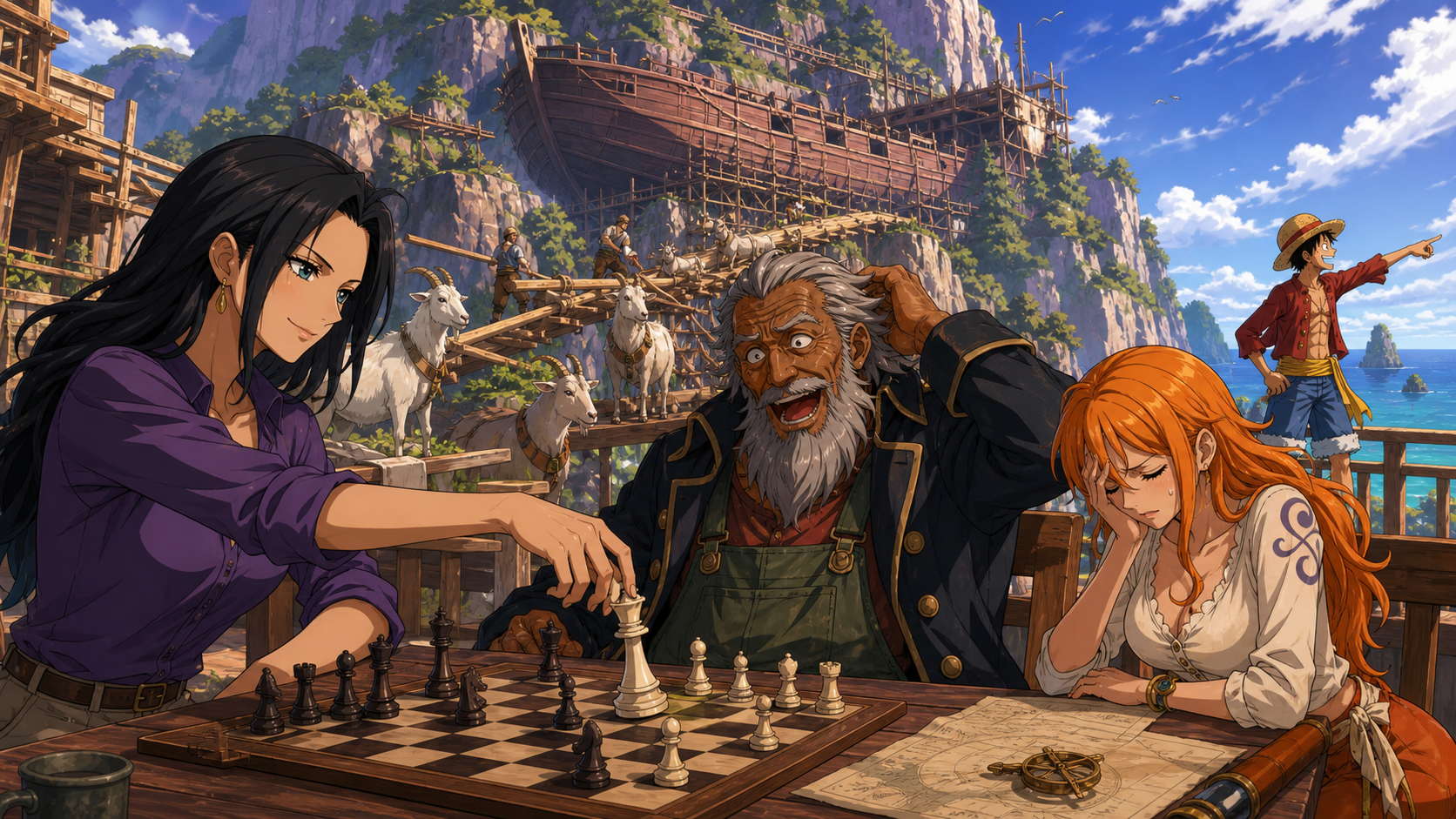
Robin sits at the board, defeats Zenny with checkmate, and wins the Going Merry back. She does not seize the ship, intimidate the elder, or pretend the disputed wager never happened.
Her solution uses the same game while correcting the power balance. Zenny accepts her skill and appears delighted by the challenge. The exchange gives both sides a face-saving exit.
Even so, the crew should establish a rule that shared property cannot enter future wagers. A clever rescue should not become the only safeguard against another unauthorized contract.
The party restores relationship after the debt dispute
Zenny celebrates because the pirates have brought noise, competition, food, and companionship into a life built around isolation. The party recognizes mutual affection without erasing the argument.
Food, drink, and medication need coordination because Zenny has a heart condition. Chopper should watch interactions, but Zenny still decides what to consume after receiving clear advice.
Celebration works best when nobody uses hospitality to extract secrets. Nami’s plan to make him reveal treasure information through alcohol crosses that line.
The goats are treasure without becoming property
When Nami asks about treasure, Zenny jokes that the goats are his real wealth. The answer frustrates her search for money but describes two decades of mutual survival.
Calling animals treasure can express love, not market value. The herd should not become collateral, inheritance without a care plan, or a resource strangers divide after Zenny dies.
Estate planning should name a capable caregiver, provide funds, preserve habitat, and prevent sale to harmful owners. Emotional value needs practical protection.
Zenny’s lending business relied on private coercion
Zenny reveals that he lent money to pirates and personally chased debtors who refused repayment. He planted bombs on ships and threatened destruction until they paid.
Pirate borrowers may be dangerous and dishonest, but default does not authorize an unregulated lender to threaten crews, passengers, ports, or the environment. Collection needs documented terms, notices, dispute resolution, proportionate remedies, and public enforcement.
High-risk lending also requires transparent interest and realistic repayment schedules. A lender who profits from desperation cannot call every consequence voluntary.
Bomb threats create risks beyond the debt. Fire can spread to cargo, fuel, neighboring ships, and waterfront homes. Crew members who never signed a loan may be injured. Zenny’s willingness to confront violent borrowers shows courage, but courage does not make private punishment lawful.
Twenty years of stranding changed ambition into construction
Pirates destroyed Zenny’s vessel and left him stranded. He began building a replacement on the mountain because he could not transport timber to the shore. By completion, age and illness had convinced him that the Grand Line was closed.
The project shows extraordinary adaptation, yet moving the ship downhill may be more dangerous than building one near water. Engineers need to assess slope, route, braking, structural stress, shoreline impact, and evacuation zones.
Zenny’s past as a coercive lender and his status as a victim can both be true. Suffering does not erase harm he caused, and past harm does not cancel his right to safety or future choice.
Twenty years also means the earliest timbers may have weathered before the newest sections were finished. Inspection should look for rot, insects, warped joints, corroded fasteners, water intrusion, and uneven loading. A symbolic vessel can tolerate flaws that a sea-going home cannot.
Episode 137 refuses to put an age limit on agency
Luffy tells Zenny that nobody is too old to pursue the title of Pirate King. The statement cuts through the crew’s assumption that a prognosis has already written the ending.
Encouragement still needs practical support. Chopper should explain medical risk, builders should make the ship seaworthy, and Zenny should choose a route compatible with his goals. Agency means informed choice, not pressure to perform youth.
RaeRae’s verdict: keep this one. Episode 137 lets Robin win the contractual argument that shouting could not solve, exposes the danger of gambling shared property, and gives Zenny back a future after everyone quietly assigned him a coffin. Dreams do not expire on a birthday. They do require consent, preparation, and people willing to ask whether the person at the center still wants the same destination.
The episode also earns the party only after the crew survives disagreement without violence. Robin’s checkmate, Zoro’s skepticism, Chopper’s uncertain medicine, and Luffy’s reckless encouragement each contribute something incomplete. Together, those perspectives return Zenny’s ship, health, debts, and future to open discussion.