
RaeRae Reacts · One Piece Episode 112
The Battle for Alubarna Begins
One Piece Episode 112 uses six Vivi decoys, infiltrated uniforms, and one timed shot to show how Crocodile turns two defensive armies into his civil war.
Quick reaction
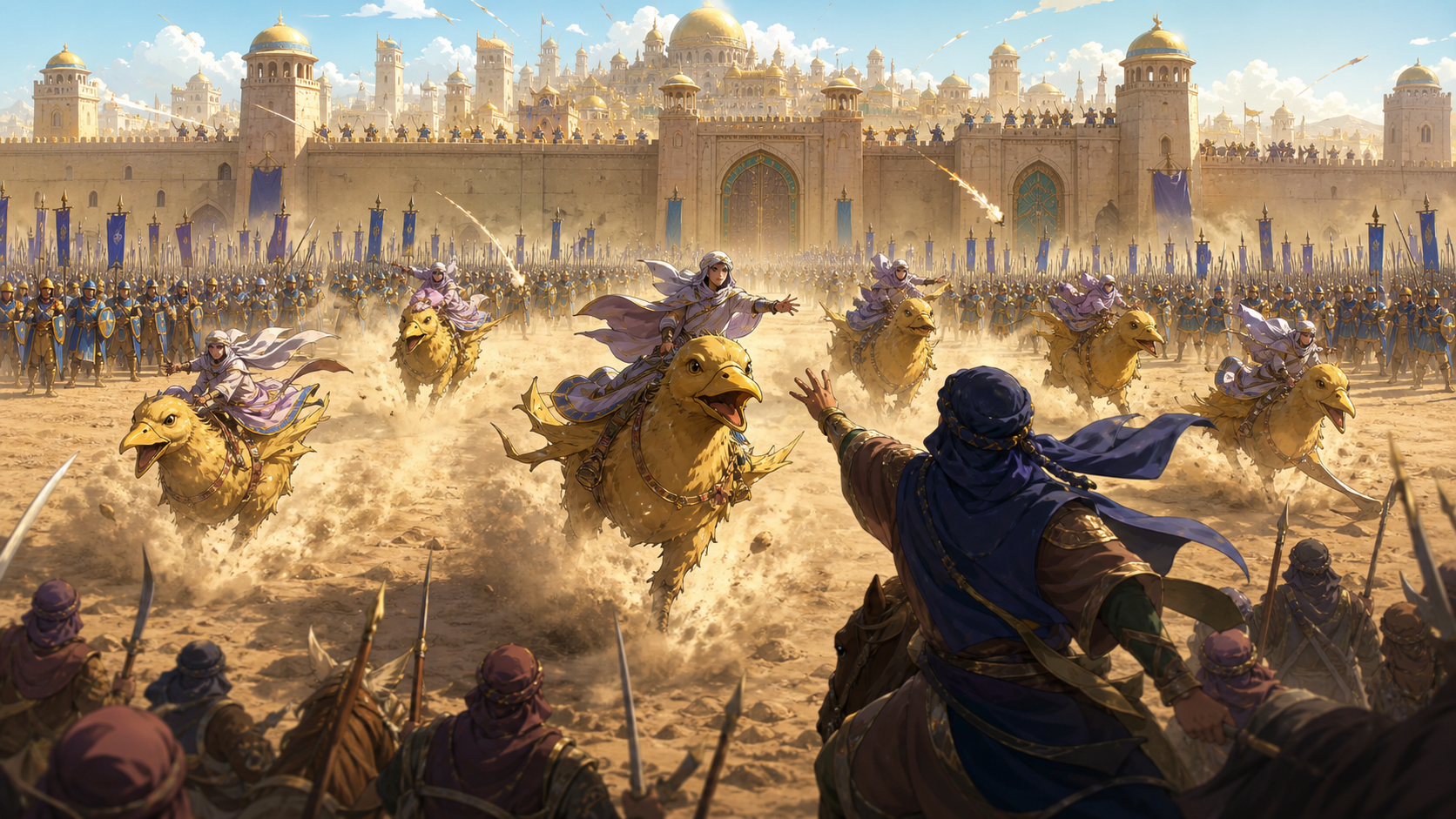
One Piece Episode 112 brings every piece of Operation Utopia onto the same battlefield. Koza’s rebel army approaches Alubarna. Chaka’s royal army prepares to defend the capital. Six apparent Vivis ride Super Spot-Billed Ducks toward different routes, forcing Baroque Works officer agents to split their attention.
The real Vivi and Karoo reach the rebel front, but infiltrators hidden inside the royal army fire before her warning reaches Koza. Both sides interpret the shots through years of manufactured distrust, and the collision begins.
RaeRae’s bottom line is simple: Crocodile does not need every soldier to believe his story. He needs one planted shot to make thousands of frightened people behave as if the story were true.
Alubarna becomes the collision point Crocodile designed
The rebel army and royal army arrive carrying different duties. Koza believes the crown confessed to stealing rain and attacked civilians. Chaka believes an armed force threatens the capital.
Neither formation needs to contain monsters for civil war to begin. Each side reads the other’s movement as confirmation of danger.
Crocodile chose Alubarna because political authority, civilian population, military defense, and symbolic power meet there. Damage to the capital can collapse trust across the country.
The battlefield is therefore engineered long before the first weapon rises. Operation Utopia controls why people arrive, what evidence they carry, and how little time remains for verification.
Koza reaches the capital carrying manufactured certainty
Koza leads people who endured drought, displacement, and visible inequality. Bon Clay’s false Cobra confession gave those injuries one apparent author.
The rebel army does not arrive because Crocodile invented every grievance. He attached a lie to real suffering and made armed action feel like the final available remedy.
Koza’s responsibility remains serious because his order places lives at risk. Fair judgment must also account for the evidence deliberately staged around him.
A leader manipulated through manufactured proof still needs accountability, but the architect who manufactured necessity carries the central blame.
Chaka prepares defense from the opposite information prison
Chaka sees an armed mass approaching Alubarna. His duty requires protection of civilians, palace personnel, and the capital’s infrastructure.
He does not share Koza’s view of the counterfeit king, staged shooting, and Nanohana disaster. Defensive preparation therefore looks responsible from inside his evidence set.
The same soldiers who could protect residents can become Crocodile’s weapon once infiltrators control the opening signal.
Institutional defense needs trusted communication with opposition leaders before formations meet. Alabasta has no channel strong enough to survive the conspiracy.
Six Vivis turn one target into a routing problem
Baroque Works officer agents intend to assassinate Vivi because her voice can expose the operation. Six similarly dressed riders appear on Super Spot-Billed Ducks, creating immediate uncertainty.
The decoy plan does not defeat the agents. The plan divides their time, personnel, and attention across multiple routes.
One protected person becomes harder to isolate when several allies voluntarily carry the visible risk. The crew converts identity into distributed defense.
Crocodile used Bon Clay’s copied identity to create false authority. Vivi’s side uses resemblance to protect truth long enough to reach its audience.
Decoy work carries real bodily risk
Each false Vivi invites pursuit from an officer agent capable of lethal violence. The disguise does not make the rider safe.
Calling the plan clever without counting that risk would romanticize sacrifice. Every Straw Hat accepts a route where the enemy may attack before confirming identity.
The strategy remains voluntary and mission-specific. Vivi does not order anonymous civilians to absorb danger while she hides.
Ethical decoy work requires informed choice, a rescue plan, and a reason proportionate to the danger. Preventing national civil war meets that threshold, but the cost still belongs in the record.
The riders also accept uncertainty about one another. Nobody can supervise all six routes once the squad separates. Each person must judge pursuit speed, protect the duck carrying them, recognize an ambush, and decide when to reveal the deception. That independence makes the plan resilient, but independence also means a wounded rider may disappear from the group’s view. Distributed risk needs a later accounting, not a victory montage that forgets whoever paid most.
The Super Spot-Billed Duck Squad provides distributed mobility
The duck squad makes six simultaneous routes possible. Speed, coordination, and familiarity with desert terrain turn the crew’s identity plan into physical movement.
A slower group would remain one visible cluster. The ducks create separation quickly enough to force Baroque Works decisions.
Distributed mobility also creates redundancy. One captured rider cannot end the entire intervention.
Karoo’s leadership therefore protects information. His squad carries bodies, but the deeper cargo is the chance that Vivi’s warning survives attempted assassination.
The real Vivi heads toward Koza instead of the palace
Vivi needs the person capable of stopping the rebel charge. Reaching the palace alone would not interrupt the army already moving outside the walls.
Her shared history with Koza matters because trust can cross a propaganda barrier faster than an unfamiliar official statement.
The choice also recognizes where authority exists in practice. Koza may hold no royal office, but his word shapes rebel action.
Conflict intervention must address actual decision makers rather than only formal titles. Vivi rides toward the relationship that can change behavior.
Karoo carries the narrowest communication window
Karoo must move Vivi close enough for Koza to see and hear her before both armies close distance.
Speed alone cannot guarantee success. Dust, shouting, massed riders, weapons, and fear interfere with recognition.
Karoo also protects Vivi as a moving target. One stumble or wound could silence the country’s best messenger at the decisive moment.
The sequence turns communication into embodied labor. A warning travels only because a tired animal keeps running through danger.
Baroque Works infiltrates the royal army’s legitimacy
Agents hidden inside the royal formation wear the appearance of lawful soldiers. Their position lets criminal violence inherit the authority of the uniform.
When they fire, rebels do not see a secret organization. They see the royal army attacking.
Institutional trust becomes a weapon because observers reasonably attribute an action to the group displaying the insignia and standing inside its ranks.
Security cannot depend only on clothing, location, or command claims. Verification, personnel records, unit accountability, and controlled weapon access matter most during mobilization.
Chaka’s command problem is especially cruel. A defensive leader can issue lawful orders and still lose control of what the formation appears to do when infiltrators act from inside. Immediate incident reporting, identifiable units, weapon logs, and independent observers would not prevent every shot, but those systems could separate an unauthorized attack from the army’s intent quickly enough to support de-escalation.
The first shot controls interpretation
The infiltrators fire before Vivi’s voice reaches Koza. Sequence matters more than volume.
Once a shot appears to come from the royal side, rebel soldiers interpret every defensive movement as planned aggression. Royal soldiers interpret the rebel response as proof of attack.
The first violent act supplies a frame for everything that follows. Later correction must compete with injury, fear, and self-defense.
Crocodile therefore invests in timing rather than persuasion. One shot at the correct second can overpower a truthful speech that arrives moments later.
That timing exposes another security failure. Neither army has a shared ceasefire response for an unexplained discharge. Without a rehearsed pause, medics, investigators, and commanders cannot separate accident, infiltration, or deliberate attack before mass retaliation begins.
Vivi’s voice fails because the environment is hostile to truth
Vivi knows the conspiracy, understands both sides, and reaches the correct person. Those advantages still fail when dust, distance, weapons, and panic block transmission.
Truth needs infrastructure. A voice requires amplification, recognizable signals, protected space, and listeners able to pause.
Placing the entire burden on Vivi would excuse every institution that lacked an emergency communication channel.
A country should not require one princess to outrun armies and shout through gunfire before officials verify an order to attack.
The armies become self-reinforcing evidence
Once both sides move, each formation sees the other advancing with weapons. The observation is accurate even though Crocodile manufactured the cause.
Action produces the evidence used to justify more action. Soldiers defend because opponents charge, while opponents charge because soldiers defend.
This loop makes de-escalation difficult. A person lowering a weapon may fear becoming the only unprotected target.
Stopping violence requires a credible shared signal, protected intermediaries, and leadership willing to accept temporary vulnerability. Crocodile works to remove all three.
The loop also changes memory. Survivors may remember the opponent’s charge more clearly than the hidden shot that started the exchange. Later political narratives can use those real memories while erasing the planted trigger. Preserving witness accounts, projectile evidence, unit positions, and command records matters because public history will shape whether reconciliation becomes possible after the battlefield clears.
Civilians carry the cost of the missed warning
Alubarna contains homes, workers, children, food stores, water systems, hospitals, and cultural sites. The battlefield is not empty terrain.
Every missed message increases injury, displacement, damaged infrastructure, and recovery labor for people who never joined either command.
Crocodile plans to inherit political power after others absorb those costs. His strategy externalizes destruction while reserving the reward.
Any final accounting must include rebuilding, treatment, lost livelihoods, trauma, and public records, not only which named fighter won.
The crew’s split creates the battles Crocodile wanted to avoid
Dividing into decoys exposes individual Straw Hats to officer agents. That danger also prevents Baroque Works from concentrating every assassin on Vivi.
Each pursuit becomes a containment battle. A crew member can occupy one agent while the real messenger continues.
The structure turns friendship into tactical depth. Every person trusts others to survive a separate route without constant supervision.
Crocodile compartmentalized his organization to protect himself. The Straw Hats distribute themselves to protect someone else.
Production choices make the collision tragic
Michiru Shimada’s script arranges the episode around converging clocks: armies close distance, decoys divide, Vivi approaches Koza, infiltrators prepare, and the first shot wins the sequence.
Munehisa Sakai’s direction keeps individual urgency legible inside mass movement. Vivi and Karoo must remain emotionally visible against thousands of soldiers.
Naoki Tate’s animation direction gives the duck squad speed while preserving the weight of armies beginning to collide.
Miyuki Sato’s art makes Alubarna worth protecting. Walls, gates, open approaches, and dense formations show how quickly a capital can become a trap for its residents.
What Episode 112 changes
Koza’s rebel army and Chaka’s royal army reach the edge of battle at Alubarna, completing the military setup for Operation Utopia.
Six apparent Vivis ride Super Spot-Billed Ducks toward different routes. The decoys split the officer agents assigned to kill her.
The real Vivi and Karoo reach the rebel front and try to contact Koza before the charge.
Baroque Works infiltrators inside the royal army fire first. Vivi’s warning fails to reach Koza, and both armies begin their collision.
Episode details
Japanese title: 反乱軍VS国王軍!決戦はアルバーナ!
English title: Rebel Army vs. Royal Army! Showdown at Alubarna!
Japanese broadcast: May 19, 2002
Saga: Alabasta
Material: Manga-canon adaptation
Script: Michiru Shimada
Episode direction: Munehisa Sakai
Animation direction: Naoki Tate
Art: Miyuki Sato
The official One Piece guide confirms Koza and Chaka leading the approaching armies, six apparent Vivis dividing the officer agents, the real Vivi and Karoo reaching the rebel front, Baroque Works infiltrators firing from inside the royal army, Vivi’s voice failing to reach Koza, and the armies beginning their collision. The communication, institutional, labor, decoy, propaganda, and accountability analysis is RaeRae’s reading of those events.
Final verdict
Episode 112 earns a 9.9 out of 10. The tragedy comes from proximity. Vivi reaches the battlefield, sees Koza, and carries the truth, yet one planted shot reaches the armies first.
The six-Vivi decoy is smart because the crew understands assassination as a routing problem. The larger system still fails because Alabasta has no trusted mechanism capable of pausing two armed formations.
Vivi’s failure to stop the opening charge does not make the intervention pointless. Her presence preserves a living bridge between both sides, while the divided Straw Hats prevent Baroque Works from completing every assassination assignment at once. The first signal belongs to Crocodile, but the battlefield still contains people capable of exposing who fired and why.
Crocodile wins the opening second by controlling sequence. The crew must now survive the officer agents, reach leadership, protect civilians, and build a signal louder than the violence already speaking for him.