
RaeRae Reacts · One Piece Episode 111
Alabasta Animal Relay
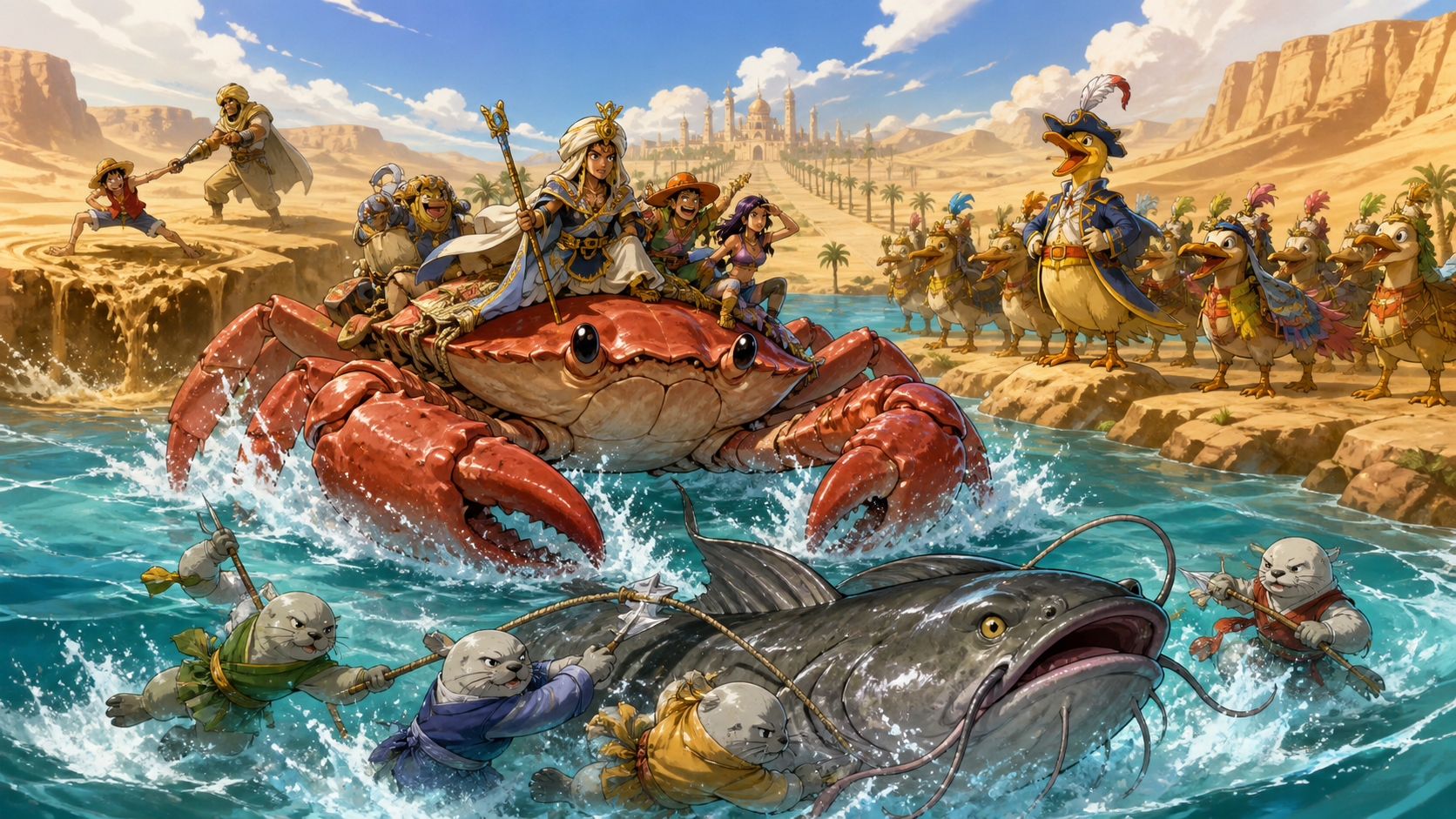
One Piece Episode 111 turns Toto’s water, the giant crab, Kung-Fu Dugongs, and Karoo’s duck squad into a mutual-aid relay racing toward Alubarna.
Quick reaction
One Piece Episode 111 turns Alabasta into a rescue relay where every earlier relationship suddenly matters. Toto’s water lets Luffy grab Crocodile’s wet left arm, proving the sand body can become tangible. Crocodile still overwhelms him and throws him into quicksand, but the discovery changes the fight from impossible to unfinished.
Meanwhile, Vivi and the crew race across the Sandora River on the giant crab. The Kung-Fu Dugongs defeat a massive river catfish, and Karoo arrives with the Super Spot-Billed Duck Squad to carry everyone toward Alubarna.
RaeRae’s bottom line is simple: Crocodile built power by isolating people. Vivi’s side moves because every person, animal, favor, and promise becomes part of one shared route.
Toto’s water becomes combat knowledge
Toto gave Luffy water in Yuba as an act of hospitality. Episode 111 turns that ordinary gift into the first evidence that Crocodile’s sand body has a physical countercondition.
Moisture prevents the left arm from dispersing, so Luffy can finally make contact. The discovery does not defeat Crocodile, but the word invincible loses credibility.
Care produces knowledge because the water stays available long enough to meet the right problem. Toto could not predict the exact duel, yet his generosity expands Luffy’s options.
Crocodile treats resources as tools for control. Toto shares a scarce resource without demanding authority. That difference shapes the battlefield.
Luffy learns through contact rather than explanation
Crocodile has already shown that dry punches pass through his body. The wet arm supplies a contrasting result.
Useful learning needs comparison. Dry contact fails. Moist contact holds. The change isolates a variable that Luffy can test again.
The insight arrives inside danger, so Luffy has little time for formal reasoning. His strength as an adaptive fighter comes from trusting physical evidence even when the opponent’s reputation says resistance is pointless.
RaeRae loves this kind of discovery because the answer belongs to the world. No random upgrade appears. Water changes sand, and the fight finally acknowledges that material fact.
A discovered weakness is not an instant victory
Grabbing Crocodile’s arm creates possibility, not control over the duel. Crocodile still has greater experience with the Sand-Sand Fruit, a hook, terrain advantage, and the willingness to attack civilians.
Luffy’s breakthrough may even make Crocodile more dangerous. The Warlord now knows this opponent can identify and exploit a real limitation.
Stories sometimes treat one clever observation as the end of a tactical problem. Episode 111 refuses that shortcut. Knowledge must become a repeatable method before the advantage matters.
Luffy needs moisture, timing, protection from dehydration, and a way to survive long enough to apply the lesson.
Crocodile answers discovery with quicksand
Crocodile throws Luffy into sinking sand rather than continuing a fair exchange around the wet arm.
The move restores environmental control. Luffy cannot use a discovered weakness while the ground consumes his movement and separates him from the opponent.
Quicksand also lets Crocodile leave without confirming a conventional knockout. The desert becomes an execution mechanism that requires no audience and little additional effort.
That choice reveals insecurity beneath the confidence. Crocodile dismisses Luffy as a rookie, yet he removes the person who just found a crack in his defense.
Luffy’s fall does not stop Vivi’s route
The crew continues toward Alubarna without knowing whether Luffy can escape. Their movement honors the delay he chose to create.
Turning back would bring Vivi into Crocodile’s reach and surrender the remaining time before the armies collide. Continuing feels emotionally brutal because the correct mission decision carries personal uncertainty.
Trust allows the group to separate without collapsing. They believe Luffy will fight for survival. He believes they will carry Vivi forward.
Crocodile depends on attachment becoming paralysis. The Straw Hats make attachment a reason to complete assigned work.
The giant crab converts terrain into a route
Alabasta’s desert punishes ordinary travel with distance, heat, unstable ground, and scarce water. The giant crab moves across conditions that would exhaust the crew on foot.
Chopper’s arrangement shows practical intelligence. The best rescue vehicle is not always manufactured machinery. Local animals already possess adaptations suited to the landscape.
Using the crab still requires consent, coordination, balance, and knowledge of the destination. Transport is a relationship rather than a neutral object.
The crab’s speed gives the episode comic energy while preserving urgent purpose. Every burst forward protects the chance to reach Koza before violence hardens.
Nami’s dance and the acceleration gag still serve the mission
The giant crab accelerates when Nami’s dancer outfit catches its attention. The gag belongs to One Piece’s shameless comic rhythm, but the speed has real operational value.
RaeRae can laugh and still side-eye the framing. Nami’s body repeatedly becomes a device for male attention, even when she remains the smartest navigator in the group.
The useful reading keeps both facts visible. The sequence creates movement and humor, while the broader pattern deserves criticism rather than automatic acceptance.
Nami continues doing mission work inside a joke that the camera assigns to her. Her competence should not disappear behind the reaction shot.
The distinction matters for editorial honesty. Enjoying the speed gag does not require pretending the visual framing exists without a gendered pattern. Nami has navigated impossible weather, challenged Vivi’s assumptions, protected the crew’s route, and kept the mission oriented toward Alubarna. The episode owes her that full context even while the crab supplies a ridiculous reaction.
The Sandora River changes the transport problem
The giant crab can race across sand, but the Sandora River introduces deep water, current, and aquatic threats.
A vehicle suited to one terrain may fail at the boundary between environments. Crossing plans therefore need transfer points and supporting teams.
The river matters politically as well as physically. Alabasta’s communities depend on water while the country experiences a manufactured drought. The crossing shows abundance concentrated in one channel beside widespread scarcity.
Crocodile’s conspiracy succeeds partly because access, not total absence, determines who receives water.
The giant catfish turns passage into another fight
A massive Sandora river catfish threatens the crossing. The crew cannot afford a long battle while carrying Vivi and racing a civil-war clock.
The animal is not part of Baroque Works, yet the danger still serves Crocodile by consuming time. Crisis systems do not require every obstacle to be centrally controlled.
That reality makes local support essential. A plan focused only on known villains remains vulnerable to weather, wildlife, injury, and terrain.
The response succeeds because help already exists within the route rather than arriving from a distant authority.
The Kung-Fu Dugongs repay respect with action
The Kung-Fu Dugongs met Luffy earlier, challenged him, learned from him, and recognized him as a master. Their return converts a comic desert encounter into meaningful solidarity.
They defeat the giant catfish and protect the crossing without needing a speech about destiny. Prior respect becomes immediate labor.
Mutual aid often looks exactly this practical. One group handles the obstacle that matches its skills so another group can continue the urgent mission.
The dugongs do not become lesser because their contribution supports somebody else’s objective. Alabasta survives through coordinated roles rather than one hero performing every rescue.
Earlier kindness becomes emergency infrastructure
Toto’s water helps Luffy touch Crocodile. The dugongs’ loyalty clears the river. Chopper’s relationship with the giant crab supplies transport. Karoo’s bond with Vivi organizes the next relay.
None of those connections appeared efficient when first formed. Friendship, hospitality, and respect can look secondary beside military power or criminal planning.
Episode 111 shows the opposite. Relationships store trust that can move faster than formal negotiation during emergency.
Crocodile built Baroque Works through secrecy and fear. Vivi’s network remains messier, but people and animals act because they care about the outcome.
That network also survives without one central command. Luffy does not direct Toto from the quicksand, Chopper does not micromanage the dugongs from the crab, and Vivi does not need to teach Karoo how to assemble his squad. Shared purpose allows local judgment. Crocodile’s organization waits for coded orders; Vivi’s allies recognize need and move.
Karoo arrives as a leader
Karoo does not merely reunite with Vivi. He arrives at the head of the Super Spot-Billed Duck Squad, bringing organized transport for the final approach to Alubarna.
The entrance changes his role from beloved companion to field coordinator. He understood the need, gathered a team, reached the transfer point, and prepared the next movement.
Leadership does not require human speech. Positioning, timing, trust, and visible direction communicate the plan.
Vivi’s relief carries more than affection. Karoo represents a route forward when the giant crab’s part of the journey reaches its limit.
The Super Spot-Billed Duck Squad solves distribution
One fast mount could carry Vivi. A squad can distribute the Straw Hats across multiple routes and protect the mission from one captured rider.
Distributed transport creates redundancy. If Baroque Works stops one duck, other riders may still reach the capital, draw agents away, or deliver information.
The formation also lets the crew match people to tasks. Fighters can intercept officer agents while Vivi seeks Koza.
Crocodile has spent years separating the country into isolated targets. The duck squad answers with coordinated mobility across the same desert.
The squad brings another advantage: witnesses can arrive from more than one direction. Baroque Works can impersonate a king and stage one city, but multiple independent travelers carrying matching accounts make total narrative control harder.
Animal labor deserves more than a cute montage
The crab, dugongs, catfish, Karoo, and duck squad make Episode 111 visually playful. Their bodies also perform dangerous labor under heat, current, combat, and time pressure.
Calling every contribution adorable can erase the work. The animals carry weight, defend passengers, navigate terrain, and accept direct physical risk.
Responsible partnership requires rest, water, treatment, and recognition after the emergency. A kingdom cannot celebrate animal allies only while demanding service.
RaeRae’s labor rule applies across species: if somebody carries the mission, the story should count the cost.
Production choices make the relay feel continuous
Junki Takegami’s script crosscuts Luffy’s discovery and danger with the crew’s expanding transport chain. The episode never treats the duel and journey as separate stories.
Junichi Fujise’s direction keeps momentum through changing terrain. Desert sprint, river obstacle, animal fight, and duck-squad arrival each pass urgency forward.
Natsuko Makiyo’s animation direction distinguishes Crocodile’s sand mechanics from the weight and splash of the river action. Every environment needs its own physical logic.
Miyuki Sato’s art makes Yuba, sinking sand, desert road, and the Sandora River parts of one stressed country. Geography becomes narrative structure.
What Episode 111 changes
Water from Toto lets Luffy seize Crocodile’s left arm, establishing that moisture can make the sand body tangible.
Crocodile throws Luffy into quicksand and leaves him sinking. The duel ends with Luffy in immediate danger but carrying essential knowledge about the Warlord’s power.
Vivi and the crew cross the Sandora River on the giant crab while the Kung-Fu Dugongs defeat a giant catfish threatening their passage.
Karoo arrives with the Super Spot-Billed Duck Squad, creating the distributed transport network needed for the final approach to Alubarna.
Episode details
Japanese title: 奇跡への疾走!アラバスタ動物ランド
English title: Dash for a Miracle! Alabasta Animal Land
Japanese broadcast: May 12, 2002
Saga: Alabasta
Material: Manga-canon adaptation
Script: Junki Takegami
Episode direction: Junichi Fujise
Animation direction: Natsuko Makiyo
Art: Miyuki Sato
The official One Piece guide confirms Toto’s water allowing Luffy to grab Crocodile’s wet left arm, Crocodile throwing Luffy into quicksand, the giant crab accelerating with Vivi’s group, the Kung-Fu Dugongs defeating the Sandora river catfish, the river crossing, and Karoo’s Super Spot-Billed Duck Squad receiving the travelers. The mutual-aid, transport, labor, environmental, and accountability analysis is RaeRae’s reading of those events.
Final verdict
Episode 111 earns a 9.5 out of 10. Luffy loses the immediate exchange but wins the most important piece of evidence: Crocodile can be touched.
The larger victory belongs to the relay. Toto’s water, Chopper’s planning, the giant crab, the Kung-Fu Dugongs, Karoo, and the duck squad each move the mission through a different barrier.
Crocodile wants every problem to end at his control point. Episode 111 answers with a network. Nobody needs to solve the whole country alone when everyone carries the part their body, skill, and relationship can reach.