
RaeRae Reacts · One Piece Episode 101
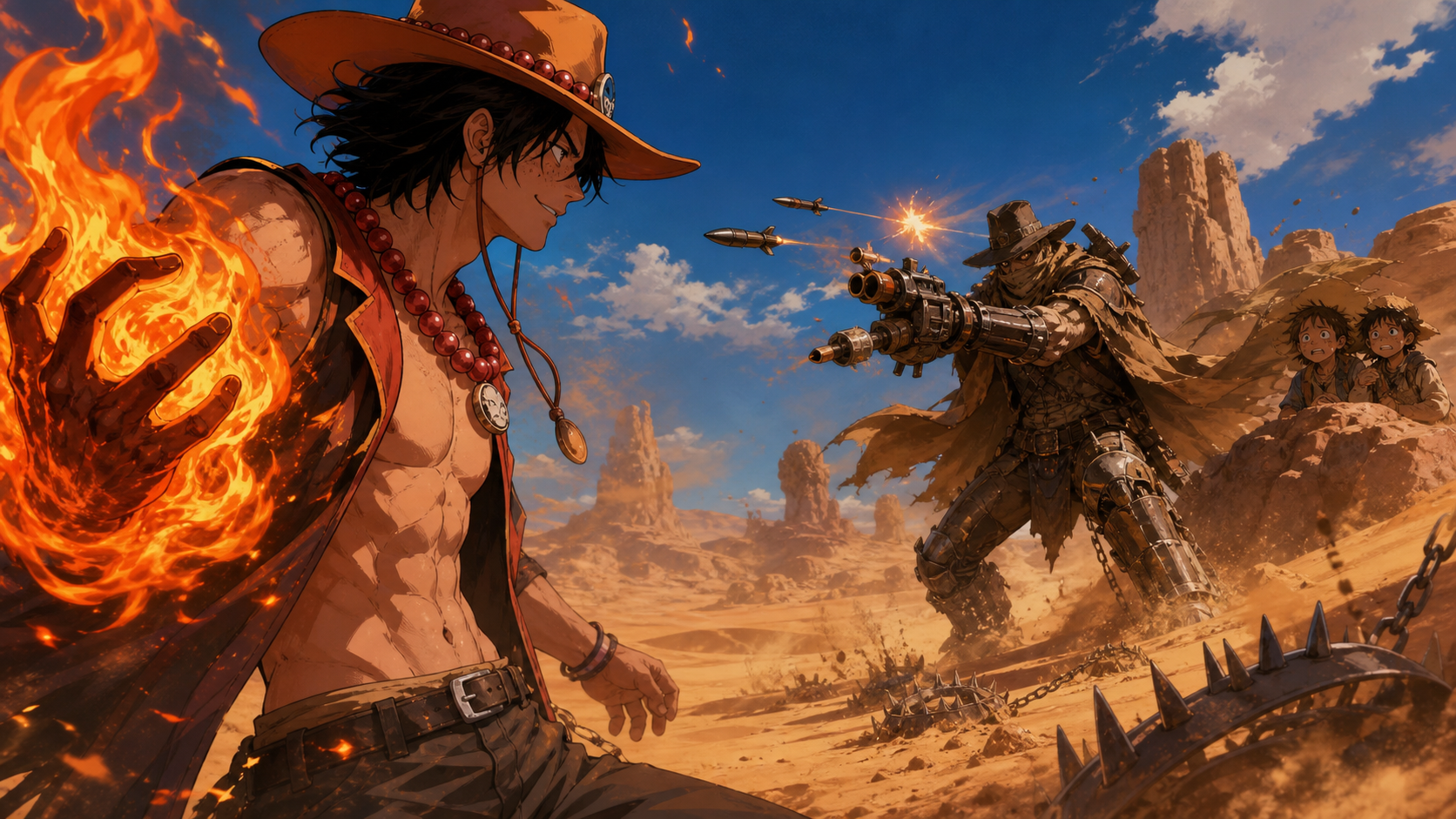
Ace vs. Scorpion
One Piece Episode 101 sends Ace into Scorpion’s false-Blackbeard duel, exposes the family cost of reckless pride, and gives Luffy a mysterious Vivre Card.
Quick reaction
One Piece Episode 101 gives Ace a desert farewell built from a ridiculous bounty hunter, two worried sons, and one lie about Blackbeard that cannot survive thirty seconds of scrutiny. Scorpion claims he defeated the man Ace has crossed the Grand Line to find. Ace wants information badly enough to hear him out, but Scorpion’s nerves and improvised weapons expose the performance almost immediately. The duel is never really about whether Ace can win. The real question asks what Scorpion is willing to risk so his children will believe he can still change their lives.
The episode’s anime-original material works because Scorpion is not secretly powerful or cruel. Drought ruined the family farm, poverty narrowed his choices, and shame made bounty hunting feel easier to announce than failure. Chip and Dip do not need a famous father. They need their father alive, honest, and home. Ace recognizes that need even while refusing to flatter a man who lied about Blackbeard and nearly killed his own children with a failed weapon.
RaeRae’s bottom line is simple: dreams matter, but children should not become collateral for an adult’s need to look heroic. Scorpion can keep ambition without staging a fatal performance. Ace demonstrates real strength by saving the entire family after the duel has already proved his superiority. Then he gives Luffy a small piece of paper that will matter far beyond this filler story, says their next meeting will happen at the summit of pirates, and leaves to continue the search.
Scorpion builds a reputation before he builds the skill
Scorpion waits in the Badland with Popo, food scattered around the lookout, and enough equipment to suggest preparation. Smoke in the distance reveals Ace traveling with the Straw Hats. The bounty hunter’s excitement quickly turns into visible panic because the target is no longer an idea on a wanted poster. Ace is standing within reach, and fire does not care about branding.
The false claim about defeating Blackbeard is calculated bait. Ace has repeatedly asked about Blackbeard, so Scorpion invents the one achievement guaranteed to secure attention. The lie borrows another man’s danger and turns that danger into personal advertising. Scorpion has no evidence, no credible account of the battle, and no physical confidence matching the boast.
His fraud still comes from a recognizable pressure. The farm failed during drought, and Scorpion wants enough bounty money to give Chip and Dip a better life. Economic desperation can explain why a person reaches for a dangerous shortcut. Desperation does not make every shortcut responsible. A parent cannot promise security by gambling the only caregiver his children have left.
The episode wisely avoids turning poverty into a moral defect. Scorpion’s family deserves water, food, stable work, and relief whether he impresses Ace or not. The failure belongs to the decision to disguise risk as certainty. If the community measures a father only by money or combat status, shame can become another trap layered over drought.
Chip and Dip follow because love has become emergency work
Chip and Dip search for Scorpion because they understand the duel can kill him. The children are not chasing adventure for fun. They are performing crisis response after an adult leaves home with a plan built from debt, fear, and fantasy. Every mile through the desert shifts responsibility downward.
The boys’ presence breaks Scorpion’s performance. A stranger might accept the image of a mysterious bounty hunter. His sons know the failed farm, the family conversations, and the distance between his claims and his actual experience. When they call him Dad in front of everyone, the audience finally sees the entire problem instead of one comic challenger.
Their request is not complicated. Stop fighting a man who can defeat you. Come home. They do not demand wealth, a famous name, or proof that their father can beat impossible odds. Scorpion has created those requirements inside his own shame. The boys’ fear exposes how little the heroic performance serves the people supposedly motivating the risk.
Children can admire ambition without becoming an audience an adult must constantly impress. A safer repair would let Scorpion admit the farm failed, apologize for leaving, explain the money problem honestly, and include the boys in age-appropriate decisions about what comes next. Pride hates that conversation because honesty feels smaller than a bounty poster. Family safety needs the smaller conversation.
Ace sees through the Blackbeard lie
Ace has a personal reason to pursue the claim. He is not wandering for a random opponent. Blackbeard’s actions created a duty Ace believes he must fulfill, and every rumor could shorten the search. Scorpion uses that urgency without understanding the weight behind the name.
The duel proves the fraud quickly. A net fails, Ace redirects the attack, and one clean response establishes the gap between them. Ace does not need a long showcase because Scorpion never possessed the information or skill advertised. The brevity protects Ace’s threat level while keeping the emotional focus on the family.
Ace also refuses to pretend Scorpion could have beaten Blackbeard. That blunt judgment may sting, but false encouragement would validate the same delusion endangering Chip and Dip. Compassion does not require lying about capacity. Responsible support can honor effort while naming a lethal mismatch.
The scene also protects the Blackbeard chase from becoming a joke. If every desert bounty hunter could credibly defeat the target, Ace’s mission would lose urgency. Scorpion’s lie shows how a famous pursuit attracts people who want proximity to the reputation even when they know nothing about the man.
The failed weapon turns pride into immediate danger
Scorpion continues after defeat because stopping in front of his sons feels worse than another attack. That calculation is exactly backward. The boys are begging for safety, while he hears a demand for proof. Shame translates care into criticism.
When the rocket drops and strikes rock, debris threatens Scorpion, Chip, and Dip together. The accident makes the family cost physical. Scorpion’s equipment no longer targets Ace alone. The weapon creates danger for the children whose future supposedly justified the duel.
Ace saves all three. His rescue carries more moral weight than the easy victory because he could have stepped aside after being attacked. Power becomes protection instead of punishment. Ace does not require Scorpion to earn survival through humility first.
The episode should still resist turning rescue into a clean reset. Scorpion needs to retire the unsafe gear, return home, repair trust, and find work that does not depend on defeating famous pirates. One dramatic save prevents death. Recovery requires ordinary follow-through after the heroes leave.
The episode separates courage from performance
Scorpion believes courage means continuing against impossible odds. One Piece often celebrates that behavior, especially when a character protects someone else or refuses oppression. Context changes the moral value. He is not holding a bridge so his children can escape. He is preserving an image after his children directly ask him to stop.
Ace displays a different courage. He listens to a possible lead, tests the claim, names the lie, controls his fire, and saves the liar’s family from the consequences. None of those choices require a speech about greatness. Competence allows restraint.
Chip and Dip also act bravely. They cross dangerous terrain, confront their father publicly, and risk his anger because silence could end with his death. Their courage aims at care rather than applause.
The episode becomes useful when viewers compare those forms instead of repeating “never give up” as a universal rule. Sometimes persistence protects a dream. Sometimes stopping protects a family. Wisdom means knowing which situation stands in front of you.
Ace’s farewell gives Luffy a future promise
After learning Blackbeard is not in Alabasta, Ace has no reason to keep traveling with the Straw Hats. His search continues elsewhere. The departure feels casual because the brothers trust separation more easily than most people would. Both expect the other to keep moving toward an enormous goal.
Ace gives Luffy a piece of paper and explains that the scrap will bring them together again. Episode 101 does not fully explain the object. Later story reveals the paper as a Vivre Card, sometimes called life paper, whose pieces pull toward the owner across distance.
The moment adapts a small but important manga event inside an episode dominated by anime-original material. That mixed construction matters for viewing guides. Scorpion, Popo, Chip, and Dip belong to anime-only continuity, while Ace’s paper connects directly to later canon events.
The promise about meeting at the summit of pirates sounds triumphant during Alabasta. Later knowledge changes the emotional temperature. A first-time review should not spoil every consequence, but returning viewers can hear how confidently both brothers assume time remains available.
Anime-original material adds texture without changing the mission
Episode 101 expands Ace’s time with the crew beyond the manga’s brief encounter. The added journey lets viewers see his patience, humor, power control, and protective instincts before departure. Scorpion’s family gives Ace a problem that cannot be solved through fire alone.
The filler also creates a continuity hazard if treated carelessly. The official guide connects the episode to manga Volume 18, but most of the duel does not come from those chapters. “Mixed adaptation” is the accurate label. The Vivre Card handoff carries canon significance, while the bounty-hunter plot is anime-original.
The addition does not alter why Ace leaves. Blackbeard remains the target, Alabasta offers no confirmed route, and Ace continues alone. Scorpion’s false claim delays the search for one episode without redirecting the larger story.
Good expansion reveals established character through a bounded conflict. Bad expansion invents knowledge or decisions that contradict later events. Episode 101 mostly stays on the useful side because Ace’s compassion and confidence fit what the series has already shown.
Production choices make heat haze part of the argument
Michiru Shimada’s script builds the episode around unreliable appearance. Heat makes distant shapes shimmer, Scorpion’s reputation distorts reality, and the boys carry the clear view their father avoids. The environment and the lie both make something look larger or less stable than reality.
Hidehiko Kadota’s direction keeps the duel readable rather than stretching a mismatch into false suspense. Ace’s calm body language tells viewers the power gap before the decisive exchange. Scorpion’s nervous movement tells a different story than his words.
Kenji Yokoyama’s animation direction gives the failed weapons enough mechanical weight to make the accident credible. The debris rescue needs clean staging because viewers must understand who created the danger and who protects the children.
Miyuki Sato’s desert art emphasizes exposure. Rock, open sand, harsh light, and limited shelter leave little space for Scorpion to hide from either Ace or his sons. The landscape also connects the failed farm to Alabasta’s wider drought without claiming Crocodile personally designed this family’s every hardship.
What Episode 101 changes
Ace leaves the Straw Hats with the Blackbeard search still unresolved. Luffy gains a mysterious paper link to his brother, even though neither man explains the future importance. The crew loses a powerful temporary companion before the central Alabasta conflict accelerates.
Scorpion returns to family life after confronting the distance between aspiration and capacity. Chip and Dip recover their father, which matters more than any bounty. The anime does not provide a detailed economic recovery plan, so viewers should not pretend one duel solved the failed farm.
The episode also prepares a tonal shift. Episodes 98 through 102 include expanded desert material, but Crocodile’s final operation is approaching. Ace’s departure removes an ally whose power could overwhelm many ordinary Baroque Works threats, leaving Luffy’s crew responsible for Vivi’s mission.
Most importantly, the paper changes a casual goodbye into a material connection. Ace and Luffy can travel separate routes while a fragment still points toward the person who gave the paper meaning.
Episode details
Japanese title: 陽炎の決闘!エースVS男スコーピオン
English title: Showdown in a Heat Haze! Ace vs. the Gallant Scorpion!
Japanese broadcast: February 17, 2002
Saga: Alabasta
Material: Mixed adaptation, with anime-original Scorpion material and a canon Ace farewell beat
Script: Michiru Shimada
Episode direction: Hidehiko Kadota
Animation direction: Kenji Yokoyama
Art: Miyuki Sato
The official One Piece guide identifies Scorpion as a bounty hunter targeting Ace, names Dip and Chip as his sons, confirms the false Blackbeard claim, and lists the production credits above. The family, labor, shame, and safeguarding analysis is RaeRae’s reading of the animated events.
Final verdict
Episode 101 earns an 8.4 out of 10. Scorpion is not a credible opponent for Ace, and the episode never needs him to become one. His value comes from showing how drought, poverty, and parental shame can turn a loving goal into reckless behavior. Chip and Dip cut through the performance because they want a father, not a legend.
Ace wins before the fight starts, but his best act comes after the failed rocket. He saves the man who lied to him and the children placed in danger by that lie. Strength does not need humiliation as a receipt.
The Vivre Card handoff gives the episode lasting story importance while Ace’s quiet departure closes his Alabasta detour. Let Scorpion go home. Let the boys stop chasing adult emergencies. Let Ace chase the man he actually came to find.