
RaeRae Reacts · One Piece Episode 100
Koza’s Promise
One Piece Episode 100 traces Vivi and Koza’s childhood leadership, Koza’s protective promise, and the shared dream beneath Alabasta’s rebellion.
Quick reaction
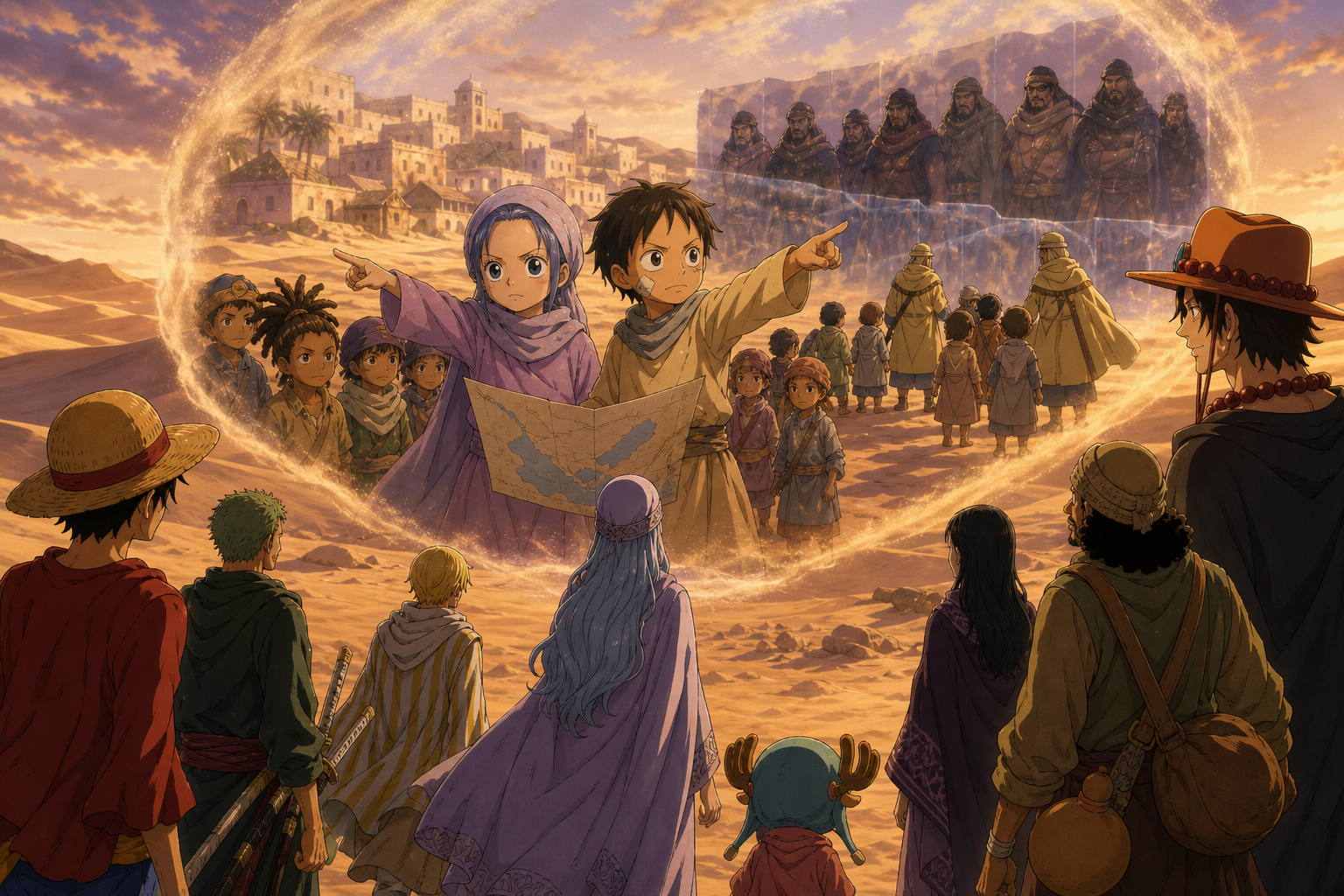
One Piece Episode 100 stops the desert march and finally lets Koza become more than the rebel leader Vivi needs to reach. The childhood memory explains why these two trusted each other, why Koza once believed in the royal family, and why the rebellion hurts Vivi on a personal level. Their bond grew through shared work, arguments, scraped knees, and a child-sized organization called the Sand-Sand Clan. That history makes the present conflict sadder without pretending friendship can solve a national crisis.
The strongest choice comes from treating Vivi as Koza’s deputy instead of a princess visiting ordinary children for a charming afternoon. She participates. She follows local rules. Koza leads because the children trust his judgment, and Vivi earns a place beside him through action. When Agotogi’s men try to abduct her, Koza protects his friend and receives the facial wound he still carries. The scar becomes a visible piece of their history, but the episode should never make a hurt child prove his worth through pain.
RaeRae’s bottom line is simple: Koza and Vivi already know how to build something together. Crocodile’s scheme succeeds by attacking the trust beneath that memory and by using real suffering as cover. Vivi can use their shared past to begin a conversation in Yuba. She still needs evidence, water relief, safe routes, and a plan that respects the people Koza now represents.
The Sand-Sand Clan gives Vivi and Koza a shared country
The Sand-Sand Clan sounds like children’s play until the episode shows what the group practices. Koza gathers local children, assigns responsibilities, makes decisions, and treats the desert as a place that demands cooperation. Vivi becomes his deputy. Her royal title does not automatically place her in charge, which gives the friendship a healthier foundation than automatic obedience. Koza knows the terrain and the children. Vivi brings courage, curiosity, and a willingness to work inside a structure she did not create.
That arrangement tells us more about both characters than another speech about loyalty could. Koza does not begin as a boy waiting to serve the crown. He already has leadership instincts and a community that recognizes them. Vivi does not enter the group to collect admiration. She accepts a role, learns how the group functions, and shares responsibility. Their bond begins with doing the job together.
The memory also gives Alabasta’s politics a human scale. A kingdom can look orderly from a palace and desperate from a dry village. Koza grows up close enough to ordinary families to see whether wells work, whether travel remains safe, and whether promises reach the people who need them. Vivi grows up with access to the state and a sincere belief that her father cares about the country. Both perspectives contain truth. Crocodile creates disaster by making those truths look mutually exclusive.
The Sand-Sand Clan becomes an early model of the country they both want. Leadership stays close to the people affected by each decision. Local knowledge matters. A title carries duties instead of guaranteed superiority. Nobody survives the desert alone. Adult Koza has not abandoned those values. He believes rebellion now protects the same people he once protected beside Vivi.
Agotogi turns a childhood adventure into a security failure
Agotogi’s attempted kidnapping changes the tone because armed adults enter a space run by children. Koza responds before anyone with greater power can protect Vivi. His courage is real, immediate, and frightening. He understands enough to recognize danger, but no child should have to place his body between a friend and armed kidnappers.
The facial wound follows Koza into adulthood, so the series gives the memory a permanent physical consequence. A scar can become shorthand for bravery, especially in a story full of bodies that record past battles. Koza does not become worthy of leadership because he was cut. He was already leading, organizing, and caring for people. The wound proves that adults failed to keep the children safe.
Vivi also needs protection from misplaced guilt. Koza chose to defend her, but Agotogi and his men caused the harm. A child who survives an abduction attempt should not grow up believing a friend’s injury created a debt she can never repay. Their friendship can hold gratitude and fear without turning Koza’s pain into ownership of Vivi’s future.
A responsible royal response would include medical care, witness support, an investigation into how the attackers reached the children, and safeguards that reduce another attempt. Praise for Koza may comfort him, but praise cannot replace prevention. The episode lands because the audience sees a brave boy. The harder question asks why bravery became the only barrier between Vivi and abduction.
Koza’s scar explains trust, not permanent obedience
The kidnapping memory explains why Vivi expects Koza to listen. He knew her before royal distance and rebel propaganda separated them. He saw her accept a deputy role, share danger, and care about ordinary children. Vivi remembers a boy who protected her without asking for a reward. Their adult conflict feels impossible because each person still believes the other once understood what Alabasta needed.
Shared history does not require Koza to obey her forever. Years of drought, displacement, and failed relief have changed the evidence available to him. Crocodile’s agents exploit that suffering and manufacture blame, but the manipulation works because people are already thirsty and angry. Koza would betray his own leadership if he ignored those conditions merely because his childhood friend asked him to trust the palace again.
Vivi faces the same problem from the other direction. She knows her father did not steal the country’s rain, and she knows a criminal organization has engineered the conflict. She cannot announce that truth and expect exhausted communities to discard everything they have witnessed. Koza needs a route from suspicion to verification. The people following him need the same opportunity.
Their childhood bond creates an opening, not a verdict. Vivi can ask Koza to remember how they made decisions when they were young: compare what each person knows, protect vulnerable people first, and keep leadership accountable to the group. Then she must bring receipts strong enough to survive beyond their private feelings.
The adult crisis needs more than a reunion
A meeting in Yuba should begin with immediate civilian needs. Water access, medical care, safe travel, and protection from both rebel and royal retaliation matter before anyone debates who deserves moral credit. Vivi should arrive with verifiable information about Dance Powder, Baroque Works, attacks carried out under false identities, and the routes Crocodile uses to turn scarcity into political rage.
Koza should not attend alone. Trusted advisers, local witnesses, and neutral observers can keep the meeting from becoming a private childhood appeal. A ceasefire needs clear boundaries, protected aid routes, a way to report violations, and a fixed time for the next negotiation. Nostalgia may lower the temperature long enough for everyone to sit down. Only transparent action can keep them at the table.
Luffy and Ace also need boundaries. Their power can protect Vivi during travel, but a dramatic entrance by famous pirates could make royal forces and rebels assume an ambush has begun. Chopper’s medical skills and Nami’s route planning may do more immediate good than another display of force. The Straw Hats help best when they support Vivi’s plan instead of replacing politics with a brawl.
Crocodile expects every side to act from anger, secrecy, and incomplete information. A public evidence process attacks his real advantage. The goal is not to make Koza feel foolish for being deceived. Humiliation would push him deeper into a position he can no longer leave without losing authority. The goal is to give him a truthful path toward protecting his people without continuing a war built by someone else.
Vivi’s childhood role sharpens her adult responsibility
Vivi becoming deputy matters because the position teaches her that leadership can be earned and shared. She has spent the journey asking the Straw Hats for help while still carrying responsibility for the destination. The Sand-Sand Clan memory shows that this pattern began long before she entered the Grand Line. Vivi listens, adapts, and works beside people who know conditions she does not.
The same memory exposes a weakness in her current strategy. Vivi often tries to carry every consequence alone because she believes a princess should absorb the danger meant for her country. Koza’s injury may have strengthened that habit. If someone was hurt protecting her once, she may feel obligated to prevent every future wound through personal sacrifice. That burden is impossible and can make her hide information from allies who need enough context to help safely.
Adult leadership requires distribution. Vivi can set the moral direction, confirm royal records, identify trusted officials, and speak honestly about what the palace missed. Koza can describe conditions beyond the capital and test whether proposed relief would work. Local communities can decide what protection and repair look like on the ground. The Straw Hats can handle bounded threats that require unusual strength.
The episode gives Vivi an emotional reason to keep moving, but the memory should also remind her that she never saved Alabasta alone. Even the children’s group had a leader, a deputy, and members with separate responsibilities. A national response needs a larger version of that shared structure.
The production team keeps the memory tied to the present
Junki Takegami’s script uses childhood history to answer a political question: how can two people who love the same country end up on opposite sides of a civil war? Neither person needs to become secretly heartless. Koza’s protective instinct remains consistent from childhood into rebellion. Vivi’s commitment also remains consistent. Crocodile weaponizes distance, drought, and missing information until their methods collide.
Yuji Endo’s episode direction has to balance warmth with approaching danger. The Sand-Sand Clan needs enough ordinary life for the friendship to feel lived rather than announced. Agotogi’s arrival then breaks that safety. The shift works best when viewers can feel how quickly children’s confidence becomes vulnerability once armed adults enter the frame.
Takeo Ide’s animation direction gives Koza’s decision physical weight. Fear should remain visible because courage without fear becomes a superpower instead of a choice. Koza moves anyway. Vivi’s reaction also matters. The scene belongs to both children, and the camera should not turn her into a silent prize while boys decide what happens around her.
Miyuki Sato’s art connects the childhood desert with the country now approaching war. Maps, village paths, shade, worn buildings, and open distance remind viewers that the children were already learning Alabasta through movement. The setting makes their game feel like preparation for responsibilities neither child should have carried so early.
What Episode 100 changes
Koza now has an emotional history equal to his political role. The rebellion no longer belongs to a distant leader waiting at the end of Vivi’s route. Koza is the boy who once placed Vivi beside him, protected her, and imagined a safer country with her. Every order he gives in the present carries that past, even when he no longer trusts the palace.
Vivi’s mission also changes. Reaching Koza will not mean introducing herself to an opponent. She will face someone who can challenge her memories with years of suffering she did not personally witness. The meeting may hurt more because both people can point to genuine care and still disagree about what care demands now.
The episode strengthens Crocodile as a villain without placing him in the childhood story. His plan does not merely move armies across a map. Crocodile corrupts relationships that once helped Alabasta survive. He turns Koza’s commitment to local people against Vivi’s commitment to the kingdom, then waits for both sides to destroy the country they want to protect.
That is why the flashback earns the pause in the journey. The audience needs to understand what could still be recovered and what cannot return unchanged. Vivi and Koza may remember the Sand-Sand Clan together. They are no longer children, and Alabasta needs institutions strong enough to survive after one emotional reunion ends.
Episode details
Japanese title: 反乱軍戦士コーザ!ビビに誓った夢!
English title: Rebel Warrior Koza! The Dream He Swore to Vivi
Japanese broadcast: February 10, 2002
Saga: Alabasta
Script: Junki Takegami
Episode direction: Yuji Endo
Animation direction: Takeo Ide
Art: Miyuki Sato
The official One Piece episode guide identifies Vivi and Koza as childhood friends, names the Sand-Sand Clan and Vivi’s deputy role, and records Agotogi’s attempted kidnapping and Koza’s facial injury. The political and safeguarding analysis above is RaeRae’s reading of those events and the surrounding Alabasta story.
Final verdict
Episode 100 gives the rebellion a face Vivi loves and a history the audience can understand. Koza’s promise was never blind service to a princess. He and Vivi learned to lead together, and he protected her when adult violence invaded their childhood. The same boy grew into a man who believes resistance now protects Alabasta. That continuity makes his rebellion painful instead of contradictory.
The scar should remain evidence of courage and failure at the same time: Koza acted bravely, and adults failed to keep children safe. Vivi can honor what he did without turning the wound into a permanent debt. She can also trust their history without using friendship to dismiss the people who followed him into rebellion.
RaeRae rating: 9.4/10. The flashback makes Koza matter before Vivi reaches Yuba, gives their conflict emotional roots, and shows how Crocodile turns shared love for a country into opposing action. Let the childhood promise open the door. Bring evidence, water, witnesses, and an accountable peace plan through that door.