
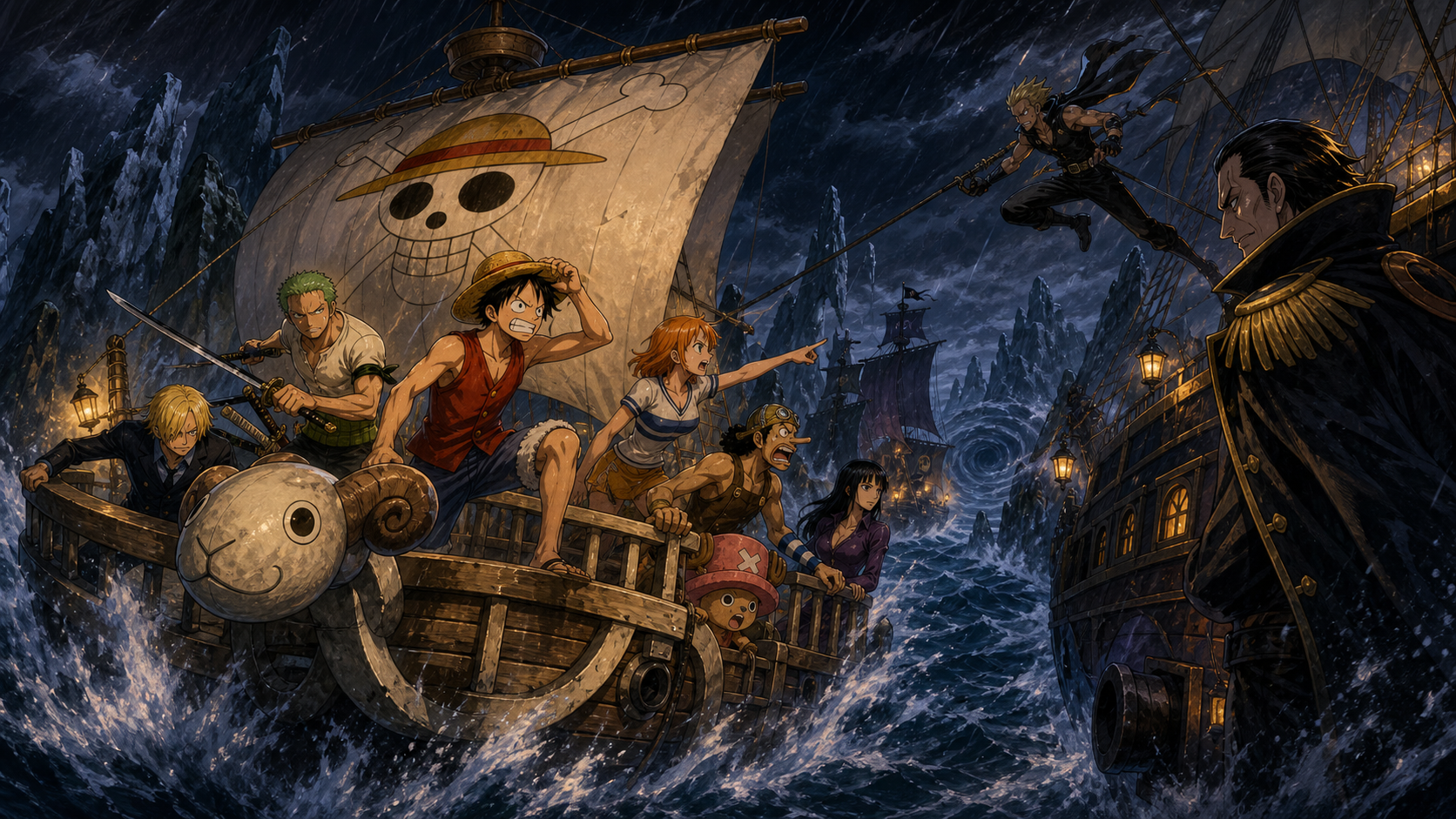
RaeRae Reviews: Dead End Adventure
Bottom line
Dead End Adventure is where the One Piece movies stop feeling like bonus cartoons and start behaving like films. The fourth theatrical release gives the Straw Hats ninety-five minutes, a pirate death race, a former Marine who has turned betrayal into a business model, and a bounty hunter whose revenge keeps trying to outrun grief.
Released in Japan on March 1, 2003, the movie finally has room for atmosphere, side characters, shipboard labor, and a villain who can survive more than one loud idea. The race is rigged, capitalism has put on a pirate hat, and Nami still signs up because the crew needs money. Honestly, that is a cleaner motive than half the captains at the starting line.
What happens
The Straw Hats enter a secret port and learn about Dead End, an illegal race offering a massive prize. Their finances need help, so Nami registers the Going Merry. The route immediately turns hostile, with rival crews, naval hazards, bad information, and an organizer whose concept of fair play begins and ends with collecting entry fees.
Former Marine Gasparde enters with a reputation built on betraying his unit. Shuraiya Bascùd infiltrates Gasparde’s crew while hunting the man who destroyed his family and town. A boiler worker named Biera and the child Anaguma become trapped inside the same scheme. The race slowly reveals itself as cover for Gasparde’s control and profiteering.
The race gives every crew skill a job
A ship race cannot be won by Luffy punching the horizon. Nami reads routes and deception. Sanji manages food and physical support. Usopp handles improvisation. Chopper treats injuries. Robin gathers information. Zoro protects the deck. Luffy makes the final moral decision, but the Going Merry moves because the crew operates as a system.
That structure is the movie’s first major improvement. The Straw Hats feel like pirates aboard a working vessel rather than seven popular characters transported to a guest villain’s island.
Nami enters for money, and money is not a joke
The crew needs funds. Repairs, food, medicine, supplies, and harbor costs do not accept friendship speeches as payment. Nami’s decision to enter Dead End comes from material responsibility as much as appetite for treasure.
The film lets her calculate risk without pretending she can calculate every hidden rule. Good navigation reduces uncertainty; good navigation does not make organizers honest. Nami’s expertise remains valuable even when Gasparde controls information.
Gasparde is institutional betrayal in one coat
Gasparde’s Marine history matters because he learned how uniforms manufacture trust, then converted that knowledge into private power. He does not reject institutions on moral grounds. He steals their authority and removes the accountability.
His candy-like Devil Fruit body makes him physically difficult to strike and visually wrong in a useful way. The soft, adhesive material hides violence beneath an almost edible surface. Gasparde sells opportunity with the same false sweetness.
Shuraiya has the revenge story the movie respects
Shuraiya is capable, charismatic, and consumed by the need to kill Gasparde. The movie gives him enough action to look like the protagonist of a neighboring film. That choice makes the world feel larger than Luffy’s camera position.
Revenge gives Shuraiya direction but narrows his ability to recognize what remains. He cannot restore a destroyed town by dying beside its destroyer. The film does not insult his anger. The film asks whether anger gets to spend every surviving relationship.
Anaguma is not a mascot
Anaguma presents as a boy while trying to earn money and survive dangerous labor. The child’s connection to Shuraiya changes the revenge plot from private pain into a current responsibility.
Adults repeatedly use children as labor, leverage, or emotional evidence. Anaguma refuses passive innocence. The performance, disguise, and stubbornness are survival tools, not proof that the danger was acceptable.
Biera represents the people keeping monsters operational
Biera works in Gasparde’s engine room, maintaining the ship that carries the villain’s power. His position raises an uncomfortable labor question: what does responsibility look like when survival depends on keeping a violent system running?
The movie gives him fear, care for Anaguma, and limits on available choices. Biera is not innocent because he feels bad, but guilt alone cannot create an exit. Collective disruption matters because one worker cannot safely dismantle the captain from below.
The Going Merry gets to be a racing ship
The Merry is smaller and less intimidating than many competitors. The design carries knowledge, history, and a crew willing to use weather instead of treating weather as background animation.
Hull strain, sails, steering, weight, and timing remain visible. The production makes the ship’s survival feel earned. A race film needs speed, but speed becomes meaningful only when viewers understand what may break.
Robin changes the crew’s information economy
Dead End Adventure is the first theatrical film to include Nico Robin. Her presence alters the crew’s balance. She observes without needing to announce every conclusion and can gather information in spaces other members cannot reach.
Yuriko Yamaguchi plays Robin with calm amusement that never becomes indifference. The crew has not yet reached Water 7, so her belonging carries a quiet uncertainty. She participates while still watching how this family handles betrayal.
Shuraiya versus Needles earns the choreography
The hand-to-hand material between Shuraiya and Needles has weight, spacing, and consequence. The fight does not rely on increasingly large energy effects. Bodies move through a dangerous ship, and every strike changes control of the space.
This is where the longer runtime pays. The movie can establish skill before demanding emotion. Shuraiya looks dangerous because the animation lets him solve physical problems, not because another character reads his résumé aloud.
Luffy versus Gasparde is a mechanics problem
Gasparde’s Candy-Candy Fruit makes ordinary blows stick, deform, or lose force. Luffy cannot win through enthusiasm alone. The solution uses flour to reduce the candy body’s adhesion and create a hittable surface.
The counter is simple, visible, and tied to available materials. One Piece combat works best when bizarre powers create rules and characters notice those rules. Bigger fists arrive later. First, somebody has to understand why the first punch failed.
The race is a market designed by the winner
Dead End advertises risk as equal opportunity while organizers control routes, information, enforcement, and payout. Participants consent to danger, but consent built on hidden rules protects the people hiding them.
The film’s illegal economy mirrors respectable exploitation without needing a lecture. Hopeful crews pay to enter, perform the spectacle, absorb the losses, and make the organizer richer. Gasparde calls that piracy because “vertically integrated fraud” does not fit on the flag.
Japanese performances
Mayumi Tanaka keeps Luffy’s disgust with Gasparde separate from Shuraiya’s revenge. Kazuya Nakai, Akemi Okamura, Kappei Yamaguchi, Hiroaki Hirata, Ikue Otani, and Yuriko Yamaguchi create the most complete theatrical crew ensemble so far.
Mitsuru Miyamoto gives Shuraiya confidence that cracks around family memory. Tarō Ishida makes Gasparde controlled and contemptuous rather than permanently shouting. The contrast lets the villain feel dangerous before his body transforms.
Direction, writing, and atmosphere
Kōnosuke Uda directs from a screenplay by Yoshiyuki Suga. The film uses rain, underground ports, engine rooms, jagged sea routes, and crowded ships to create a worn maritime world.
The darker palette does not force the page or franchise into a darker identity. Comedy, food, crew arguments, and elastic action remain active. Mood supports the story without pretending seriousness requires removing color.
Continuity placement
The film is an anime-original companion story outside manga continuity. Robin and Chopper are aboard while Franky and later members are absent. The crew status fits broadly after Alabasta and before Water 7.
Watch after Episode 130 if you want Robin’s presence to make sense. No numbered episode requires the race, and Gasparde’s events do not become manga history.
The Dead End Race rewards logistics
A race movie can collapse into vehicles moving past scenery. Dead End Adventure stays alive because Nami calculates risk and reward, Robin gathers information, Sanji manages food and people, Chopper handles injury, Usopp improvises, Zoro protects the route, and Luffy responds when competition becomes organized harm.
The Going Merry’s participation turns familiar ship labor into action. Navigation, repairs, weather, supplies, and knowledge of the course are not background services performed between fights. The race makes those jobs visible while Gasparde’s control of the market shows how a competition can be designed to reward the person already holding institutional power.
RaeRae’s verdict
Dead End Adventure is the first One Piece movie I would recommend without adding “for a short franchise side story” as protective packaging. The race gives the crew labor, the villain has structural meaning, and Shuraiya receives enough room to make revenge painful instead of decorative.
The child material still leans on familiar pressure points, and Gasparde’s final form is less interesting than the man running the scam. Eight out of ten. Bring flour, inspect the rules, and never trust a race organizer whose coat has its own weather system.
Official sources and routes
ONE PIECE.com: official Dead End Adventure page
Japanese Film Database: Dead End Adventure
Browse One Piece anime movies
Return to the One Piece anime hub