
RaeRae Reviews: Chopper’s Kingdom
Bottom line
Chopper’s Kingdom on the Island of Strange Animals gives Chopper a crown when the poor reindeer has barely learned how to accept a compliment. The setup should be perfect: an animal doctor lands among creatures who treat horns as sacred, while a hunter turns those same bodies into ingredients for power.
The third One Piece movie, released in Japan on March 2, 2002, is sweet, colorful, and maddeningly shallow. Chopper and Mobambi carry a real argument about courage. Count Butler keeps barging into that argument dressed like somebody ordered an evil safari guide from the clearance rack.
What happens
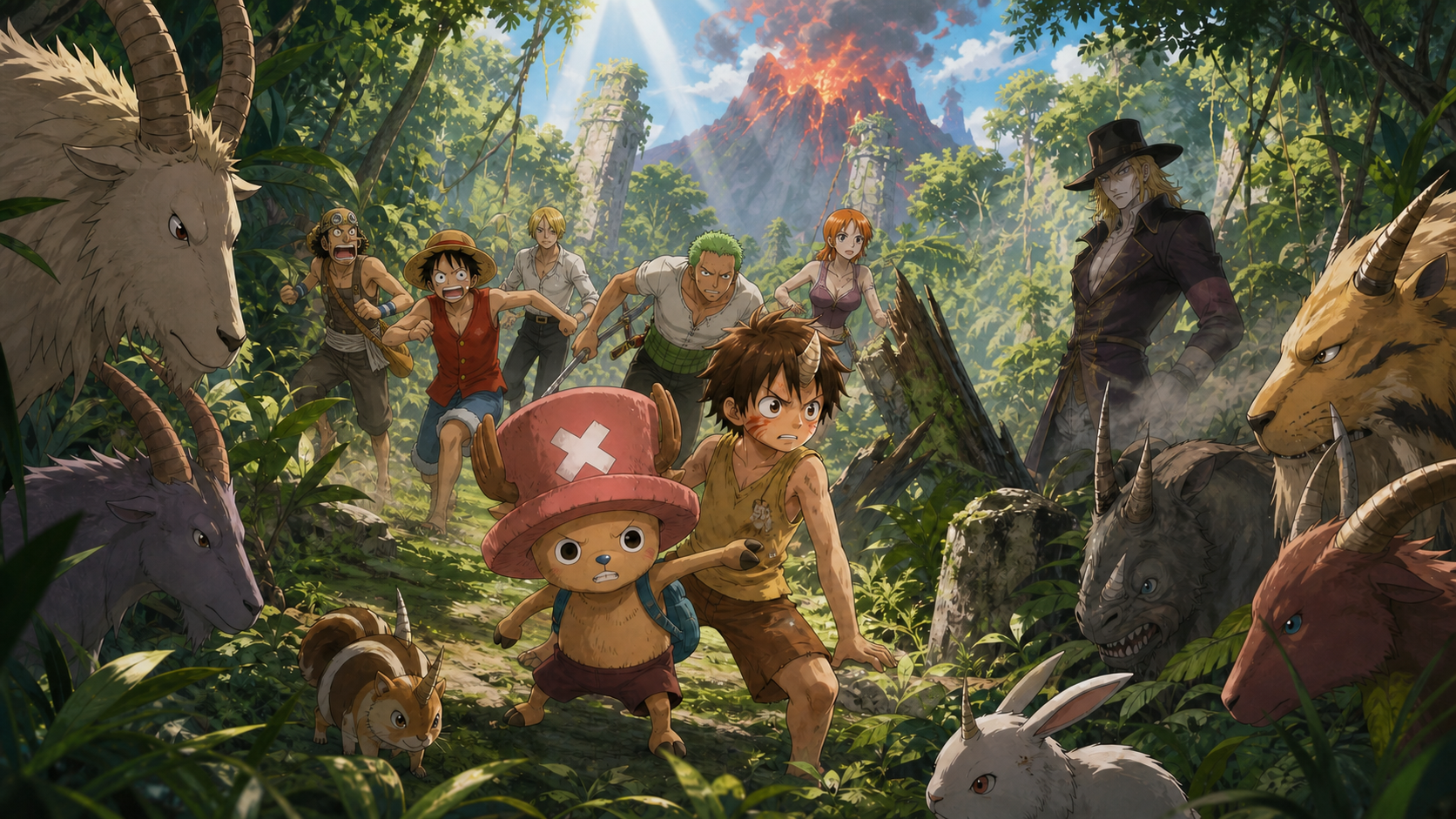
An underwater volcanic eruption launches Chopper away from the Going Merry and onto Crown Island. The island’s strange animals mistake him for the legendary Animal King. Mobambi, a human boy living among them, wants Chopper to accept the role and protect the community.
Count Butler and his henchmen hunt horned animals because Butler believes consuming the king’s horns will grant enormous power. The Straw Hats search for Chopper while the new “king” tries to decide whether courage means looking fearless or acting while every part of his body wants to run.
Chopper is the correct emotional center
Chopper has spent most of his life being classified before being heard. Reindeer reject him for his blue nose. Humans call him a monster. Crown Island commits a friendlier version of the same mistake by seeing horns, a prophecy, and a vacant throne before seeing the person standing there.
Being worshiped is not the opposite of being dehumanized when both reactions erase choice. Chopper needs belonging, not another community assigning a complete identity on sight.
Mobambi mistakes fear for failure
Mobambi wants a protector because his community faces organized hunting. He also carries shame about his own fear and projects the impossible solution onto Chopper. If the new king never trembles, Mobambi can keep believing courage belongs to somebody else.
Their friendship improves when both admit fear is present. Chopper does not become brave by losing anxiety. He becomes useful by applying medical knowledge, loyalty, and force while anxiety continues yelling.
The animals are a community, not scenery
Crown Island’s creatures have relationships, rituals, memory, and a shared need for safety. The best scenes let the animals disagree and react instead of functioning as one cute crowd waiting for a mascot king.
The film weakens that idea whenever species design replaces character. A horned rabbit is visually delightful, but visual novelty cannot carry political stakes alone. A hunted community needs more interior life than a parade of collectible silhouettes.
Count Butler turns extraction into appetite
Butler hunts bodies to convert horns into personal strength. The villain’s plan removes every polite layer from extractive power. He sees an ecosystem and asks which part can be swallowed.
The image is blunt but useful. Crown Island’s value does not exist because an outsider can monetize or consume a rare resource. Butler’s appetite threatens lives, memory, and the conditions that let those lives continue.
The horn myth has a responsibility problem
The belief in an Animal King organizes hope, but the crown also encourages everybody to wait for one exceptional body. Chopper’s arrival temporarily makes that shortcut feel proven.
A safer island cannot depend on finding a stranger with the correct head shape. The animals and Mobambi eventually have to choose collective defense. Leadership matters most when leadership expands participation instead of replacing everyone.
Luffy knows Chopper before the island does
Luffy does not need a speech about why Chopper belongs on the Merry. He chose the doctor before anyone offered a crown. That certainty protects Chopper from confusing public admiration with real relationship.
Mayumi Tanaka plays Luffy’s confidence as immediate rather than thoughtful. The captain may not understand the ritual, but he understands that a friend cannot be appointed away from his own dream.
The crew has too little to do
Zoro, Nami, Usopp, and Sanji contribute fights, search work, jokes, and support. The movie still struggles to give five established characters meaningful tasks inside a story shaped around Chopper and Mobambi.
Nami reads the island, Usopp understands performed courage, and Sanji reacts to the hunters’ cruelty. Those connections exist, but several scenes settle for familiar behavior instead of letting the crew’s skills reshape the crisis.
Chopper’s medicine should matter more
A doctor on an island where animals are hunted for body parts creates obvious material. Injury, species differences, ecological knowledge, and the ethics of treating beings outsiders call resources could have anchored the entire film.
The production leans harder on Chopper’s identity as a cute frightened fighter. Ikue Otani makes that emotional material work. The screenplay leaves medical labor sitting beside a much better movie.
Combat and Devil Fruit mechanics
Chopper’s Human-Human Fruit forms and Rumble Ball system allow him to change the body for speed, strength, defense, or analysis. The movie uses transformation as spectacle but keeps the central limit visible: Chopper still has to choose the correct form and act under pressure.
Butler’s power-up turns consumed horns into brute force. The mechanics are less interesting than the theft behind them. He treats other bodies as equipment, while Chopper treats his own changing body as a tool for care and protection.
Japanese performances
Ikue Otani carries the film through panic, embarrassment, anger, and the particular Chopper noise that means somebody has praised him and ruined his ability to stand normally. The performance keeps fear funny without making fear fake.
Ai Orikasa gives Mobambi enough force to challenge Chopper, while Masashi Ebara pushes Butler toward theatrical predation. The villain is loud by design. Chopper’s quieter moments provide the actual scale.
Continuity placement
The film is an anime-original companion story outside manga continuity. Chopper and Sanji are present, while Robin is absent. The status quo suggests a loose placement after Drum Island and before Robin settles into the crew.
Exact placement does not survive close inspection, so watch after Chopper joins and before the middle of Alabasta if you want character familiarity. Do not treat Crown Island as required canon.
Direction, color, and animal design
Junji Shimizu directs from a screenplay credited to Hiroshi Hashimoto. The 56-minute production favors bright jungle color, readable silhouettes, and creature variety over the mechanical architecture of the second movie.
The environment is pleasant and the central character animation gives Chopper expressive weight. The climax relies on size and noise more than visual invention. Crown Island deserved one more strange idea and three fewer generic punches.
The creature reaction shots also give scale to the threat. Butler is not attacking an abstract habitat. Every frightened face records a resident who must live with the damage after the pirates leave.
My read: I enjoy Chopper’s Kingdom most when Mobambi and Chopper are negotiating what leadership should protect. The animal-crown premise is silly enough to work, but the movie loses me whenever a crew conflict gets stretched mainly to delay the reunion. Chopper deserves stories where medical judgment and fear both matter, not stories where cuteness does all the emotional labor.
Chopper’s title deserves a medical conflict
The movie understands Chopper’s loneliness and desire to help, but the kingdom plot uses his symbolic role more often than his trained judgment. A stronger version would let medicine decide how he earns trust, interprets the horn myth, or protects a community under extraction pressure. Chopper should never become interchangeable with a cute animal chosen by prophecy.
His best moments come when compassion remains connected to knowledge. He can understand frightened animals without romanticizing every instinct. He can recognize Mobambi’s fear without agreeing that fear excuses abandonment. He can care for Luffy and still make a professional judgment the captain has to follow.
Count Butler makes consumption the villain’s language
Butler treats living creatures, horns, and transformation as resources waiting for the strongest consumer. The appetite fits a film about outsiders assigning value to an island’s animals. The problem is not hunger itself. The problem is a hierarchy where another body becomes material for private ambition.
The Straw Hats oppose that hierarchy most convincingly when each person contributes a crew skill. The film gives Chopper an emotional center but leaves Nami, Usopp, Sanji, and Zoro too close to supporting traffic. More distributed labor would make the kingdom feel rescued by a crew rather than visited by one hero and his famous friends.
Chopper needs choices after recognition
Being named a king does not answer what Chopper wants. His decision to return to the crew protects the difference between receiving community affection and accepting a role other people designed. Belonging gains meaning when departure remains available.
RaeRae’s verdict
Chopper’s Kingdom has a strong child, a stronger reindeer, and a villain whose philosophy is basically “eat the evidence.” The movie understands that courage can include fear, then repeats the lesson until the runtime starts checking its watch.
Chopper and Mobambi keep the film lovable. The underused medical premise and thin supporting crew keep the result ordinary. Six out of ten. Keep the horned rabbit, fire the safari department, and let the doctor do some doctoring.
Official sources and routes
ONE PIECE.com: official Chopper’s Kingdom page
ONE PIECE.com: official theatrical film archive
Browse One Piece anime movies
Return to the One Piece anime hub